Showing posts from March 2010 (48 posts). Show all posts

March 30, 2010

Google Buzz Now Explains Why Messages Hit Your In Box

Google Buzz Now Explains Why Messages Hit Your In Box

As promised in a note a little over two weeks ago on controlling Buzzed items entering your in box, the Google Buzz team is now explaining why posts are making their way into your Gmail. For people watching the new social service closely, this is a welcome, albeit small, help, especially as seeing the same items appear repeatedly - following new updates - could get tiresome.

While some are debating the perceived success (or lack thereof) of Buzz, and whether it is seeing engagement, it's no surprise that like most social networks, active people are rewarded with more activity. Engage, and others will engage with you - just like on Facebook, FriendFeed, Twitter or anywhere else. But the more I (and others) would participate, the more posts would be delivered to my in box from Buzz. Now, I can just peek at the latest, and see the most recent comment that bumped it to my attention, rather than scrolling all the way to the bottom to get caught up, as was the previous way.

One Buzz Item's Explanation (via a Linda Lawrey Comment)

In the same note, posted March 11th, the Google Buzz team promised settings to control what items hit your in box (which are live in GMail now), the aforementioned explanations, and a "mute" link to stop further comments from getting to your in box. The mute button's not there yet, so far as I can tell, but we can expect that is coming soon - given the appearance of the other promised features.

Buzz Inbox Control In Your Gmail Preferences

On another note, I have already seen people publicly comment on the perceived slowness of innovation from the Buzz team relative to expectations. Without making excuses for them, making change at the scale of Google is proving to be hard. As the team wrote in their March 11th post, they need to make sure these features work across all 50+ Gmail languages, and as I was told at SXSW, "Gmail code is sacrosanct" and nobody wants to increase latency or worse... downtime. With Buzz and GMail being intertwined for now, we can expect movement forward to be with caution.

You can, of course, find me on Buzz here: http://www.google.com/profiles/louisgray

March 29, 2010

Gray Family Set To Expand This Fall With One More

Gray Family Set To Expand This Fall With One More

It's a Boy! (The Latest Gray Family Member)

A little over two years ago, I shared with you the news that my wife and I were expecting twins, a boy and a girl, to add to our family. At the time, I referred to this as an expansion plan with 2 new hires. On June 20th of 2008, the twins, Matthew and Sarah, arrived and doubled our family overnight, from two to four. They turned a year old in June of last year, and are rapidly approaching their two-year mark. Now, while the family doesn't have yet another set of multiples to announce, I can let you in on the well-kept secret that we're adding one more to the brood this fall, and it's going to be a boy.

Should all go well, we anticipate adding the thus-far unnamed youngster to the family in the middle or latter half of September 2010, which sets us up with the unenviable position of two two-year-olds and a newborn causing havoc in our home by the end of the year. Pile that on top of all our other activities, and I think we're up for another round of exciting challenges.

When I first told people we were pregnant with Matthew and Sarah, a lot of folks thought you would see dramatic change here, that I couldn't keep pace on the blog and all other social media. But we made the twins part of the story, and have tried not to let our additional duties as parents get in the way of everything else. But the addition of a third child will most definitely bring change. The biggest change? Well, I don't see how we're all going to fit in our two bedroom, two bathroom condo. So that means the family will have to move up and out, and somehow get the opportunity to try and sell this place while finding a bigger home for our growing brood. Many have come before us and managed, so we have no doubt that we will also.


As Kristine, my wife, has successfully maneuvered her way through the first trimester, and all tests thus far have come back safe, it's time to share with you, and we look forward to more updates as the date draws closer. (This gives you six months to get on the schwag bandwagon...)

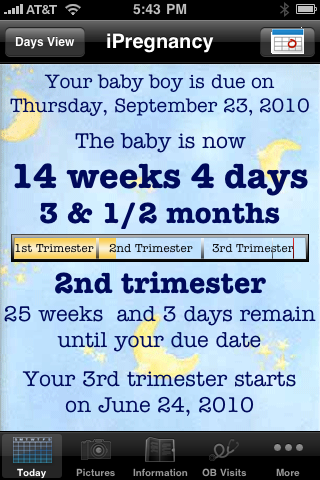
And yes, since we're geeks, we know "there's an app for that" too. We've been tracking this pregnancy with the iPregnancy app on the iPhone. It's been fun to see the days count up, and run through potential names. We have our favorites - and aren't closed to suggestions. So fire them up in the comments. What do you think? Twitter Gray? Does that work?

Twitter Hires On Lead Yahoo! Messenger Dev, Two More

Twitter Hires On Lead Yahoo! Messenger Dev, Two More

It's Monday, which must of course mean it's Twitter new employee day (TM). The company, which is continuing its expansion practically every week with new hires, onboarded three more today, including the lead Web developer for Yahoo! Messenger, focused on scalable Web technology, a senior database admin from Bebo (who also had history at Yahoo! and Apple), and a software developer who hails from the unlikely source of the Indianapolis Star, with background as an airplane pilot.

Twitter's growth brings the company's "Team" list to 176 total members, including contractors and other contributors to the company.

Twitter Product Manager Josh Elman Excited About Adrien Joining

Adrien Cahen, formerly a senior front-end engineer at Yahoo!, was the lead Web developer for Yahoo! messenger, until announcing his resignation after 3 1/2 years at the Sunnyvale company on March 15th. In the resignation announcement on his blog, Cahen said Yahoo! had a great company culture with cutting edge technologies under development, and said his efforts on highly used products was a "very humbling experience."

One of the products he most recently contributed to was the launch of Yahoo! Messenger 10, and its inclusion of insider pages, mini versions of the Yahoo! homepage built on YQL (Yahoo! Query Language). He can be found at @gaarf.

Adrien Waxing Happy On His First Day At Twitter

David Bravant, the DBA joining Twitter by way of Bebo and Yahoo! spent nearly six years at Apple from 1999 to 2005, and doesn't have a long history of using Twitter, having possibly just opened up his Twitter account today, with no activity yet. (See: @clarethammer)

Dana Contreras, the pilot hailing from Indiana, most recently of the Indianapolis Star, describers herself as a software developer with a wide array of platform experience, and lists her new job as software engineer on Twitter's platform. Dana is also the developer behind JLex.org, a Japanese language reference and learning tool, with integrated kanji search. She can be found at @danadanger.

Cliqset, Status.net Support Salmon for Comments Migration

Cliqset, Status.net Support Salmon for Comments Migration


As Marshall Kirkpatrick noted in a post on ReadWriteWeb this morning, the Salmon Protocol project we first introduced back in October of 2009 looks like it is progressing beyond the planning stages, as it has been integrated in two small, but influential, social networking sites, Status.net and Cliqset - both of whom are strong open standards advocates laboring away in the shadows of larger communities.

The Salmon Protocol, which aims to define a standard protocol for comments and gestures (such as likes) to swim upstream to the originating blog, hopes to unify conversations across diverse locations. It's planned for adoption by Google Buzz (See: Designing Buzz for a Google-Free World) and solves the problem that first blew up back in 2008 around fractured conversations.

While many people, including myself, have adapted to a new world whereby conversations take place in a wide array of communities, it would be nice for the content originator to have one centralized location to see all downstream activity.

Evan Prodromou of StatusNet mentions integration of Salmon's digital signatures in a blog post from Sunday, where he also notes support for Activity Streams encoded in RSS 2.0 and Atom. The move, paralleled by deployment at Cliqset, should be what I hope is the start of a lot more announcements, from small and big companies alike, to make Salmon a reality. The next big target, which I am biased in favor of, obviously, would be for Disqus to integrate with Salmon and pull comments upstream to this blog.

I managed to find time to talk with Darren Bounds of Cliqset at SXSW earlier this month. In our quick discussion, recorded on CinchCast, you can find his comments on their support of open standards, and that network's direction - which could hint at why they're an early adopter of Salmon.

LedeLog: Google Apps Hosted Media Workflow, Launches

LedeLog: Google Apps Hosted Media Workflow, Launches


In what Google's Brett Slatkin termed a "small foray into productivity software", the developer best known for his work on the PubSubHubbub protocol released a note-taking application for journalists and researchers, featuring rich text, tagging and built-in privacy controls that keep notes available only to the creator. The product, titled LedeLog, runs on Google's cloud infrastructure, and auto-saves progress every ten seconds, so vital notes don't get lost. As simple as it sounds, it is robust enough to serve not just for its intended audience, but it looks like the beginning of new word processing or blog authoring tools. In fact, just for testing purposes, I authored this post on LedeLog.

The product's name derives from journalist's use of the term "Lede", which refers to the lead paragraph in any story, and says it is built for the workflow of modern journalists - but could work for anyone who wants to take down notes and save drafts with tags that are searchable.

This Post, Being Authored In LedeLog

When I am interviewing somebody for a story, or dictating notes in a meeting or event, I tend to simply open Apple Mail and tap out my data there - a byproduct of my getting used to older blog platforms from yesteryear that lost my data if the Web browser froze (although Blogger autosaves now). This results in an undesirable list of untitled drafts in my draft messages folder, sorted only by date - certainly without any tags. Going back a full decade to my time at the Daily Californian at UC Berkeley when I was a reporter in college, I similar wrote out my notes in Nisus Writer, an archaic word processing system for the Mac. It's highly likely that many journalists today, provided they aren't using a pen and paper, are typing out their notes in Microsoft Word - so you can forget about tagging or searching those documents. LedeLog, though new and raw, could be an interesting alternative.

For any journalist who wants to keep their sources secure and their notes safe, LedeLog is a step above saving any of that content on a local disk. LedeLog "ledes" are saved in the Google cloud (I assume powered by AppEngine, where Brett spends most of his time), and are accessible only through one's Google Account or OpenID.

Searching LedeLog by Tag and Discovering This Post

Unlike many startup projects, which release in beta with no users, it sounds like LedeLog has already proven itself in the field. Its description in the Google Apps Marketplace says "LedeLog has been in constant use by professional journalists since January 2009." The Marketplace description also says the product is free for the next three months and may have further pricing information after that point. Including the product in the Google Apps Marketplace, in the document management category, enables companies who have set up Google Apps for their domain to deploy LedeLog for their users.

The media hasn't been given too many helping hands of late, and LedeLog isn't designed to make unprofitable businesses profitable again. But it is a very handy tool for note-taking, search and security. It's another peek into a world without Microsoft Office, where documents can be created in the cloud and shared outward. Every LedeLog can be e-mailed to an external address, such as an editor. Brett's initial notes on the product suggest in can handle the management of hundreds of Ledes easily. You can give it a shot at LedeLog.com.

EdgeTheory: Is Our Social Activity Sanitized, Inauthentic?

EdgeTheory: Is Our Social Activity Sanitized, Inauthentic?

In the social Web, we talk a lot about being transparent and open. But many of us are limiting what we say online to a specific topic. We’re sharing links and associating with people who share our viewpoints, and possibly avoiding hot-buttons like politics, in favor of talking about technology and tools. Is this the right thing to do, or have we gone too far in terms of being willing to share who we really are?

After a rare political post for him this week, titled "I am pro life", Chris Saad noticed a hesitancy for people to share his content. I said this was because the topic was out of line for what people expected from him, and each of us plays a specific role in each of the networks where we participate. This fell in line with my post Saturday on disaggregation and focusing content for each network. We would absolutely appreciate your thoughts and feedback.

This and all other EdgeTheory conversations can be found on the dedicated ET Conversations site.

Listen in below:

TheCadmus Hits Bay Area for Y Combinator, Twitter Boost

TheCadmus Hits Bay Area for Y Combinator, Twitter Boost

Since November, I've been talking to you about TheCadmus, a new tool that taps into your social streams to remove duplicates, find relevant topics and group discussions - one of many different services that is looking to improve the ability to find signal in today's noisy networks. TheCadmus is looking to make a name for itself in reducing clutter, and personalizing trending topics, including drill-down by lists. Now, the company is looking to take its personalization engine even further with a trip to Silicon Valley to talk with Y Combinator, the much-respected angel investment group, and a presentation later this week at Twitter headquarters to showcase what they have accomplished with the service's API.

The very acts of meeting with Y Combinator and Twitter are of course no direct correlation with success. TheCadmus is but one of 80 companies looking to impress the YC team with their story this week. A poor showing could send the two-person team back to Toronto empty-handed, with nothing but the experience to show for it.

I had the opportunity to meet with the company's two founders, Jay Air and Frank Wang, this evening, as we discussed the product's direction and its place in an online world where most of us are encountering too much noise. They told me the product's first direction, simply to group similar social updates and remove duplicates, led directly to more and more efforts around personalization. They told me that yes, it is a problem that many services are targeting now, but they believe they are approaching the problems in a new way.

Today, TheCadmus lets you consume updates from your social graph, but not communicate from them. For example, they're not a Twitter client. It's not outside the realms of thought that TheCadmus' API could be part of other Twitter clients looking to add new forms of personalization. I got the chance to take a few minutes with Jay Air to record a CinchCast explaining the company's plans for their short trip in Silicon Valley and what they would do with any potential funds gained from a Y Combinator investment. The discussion is embedded below:

March 27, 2010

A Big 2010 Trend: Disaggregation and Social Network Focus

A Big 2010 Trend: Disaggregation and Social Network Focus


For years, I've been sharing and distributing my content in such a way that if you followed me on just one network, you could essentially see all my updates in one place. While the most obvious example of that has been FriendFeed, for the last three years, I also mirrored my activity to other places, including Facebook - and Google Buzz has set up that opportunity to do so again. But what I am finding is that people in each network are more than likely following me in multiple places, and many are getting frustrated by non-native updates. The truth is that people don't always want to follow everything a person does online. They want to follow pieces of what they do in specialized places, and even where filters exist, I am seeing many people reduce inbound streams or focus them for the individual community. This specialization has even led to my running multiple Twitter accounts to give people that option, but not force it, and I know I am not the only one.

In the two plus years I have used Twitter, I have been quite careful not to overuse the product. I've kept my volume on my account to a comparatively low level, when contrasted with its more aggressive users. My main feed is primarily my blog posts, links to interesting stories around the Web, and real-time responses to people on tech. I don't use it so much for real-time status updates, but do so on occasion. At the same time, I have been more aggressive in my use of tools like Google Reader. To broadcast all the items I share in Google Reader to this main feed would be overkill. But for those people who want to consume this feed on Twitter, I created the separate @lgstream account. Separate, but equal.

Separate Content, Separate Twitter Streams

As one man's noise is another man's signal, I've also recently turned on a third parallel Twitter account (@lgloco), which is a mirror for my mundane Foursquare updates. Thus far, I've resisted Foursquare as I once resisted Twitter, but am at least experimenting with the app - all without muddying my main feed. Those who want to opt in to my comings and goings can do so there, as an opt-in process, rather than opt-out. (More on Foursquare's use for a married guy with kids who doesn't venture out much later...)

But this is just one service. Where the most visible issues with noise arise are when people like me try to use services as aggregators, when they're probably best suited not to be.

A New Approach to Facebook

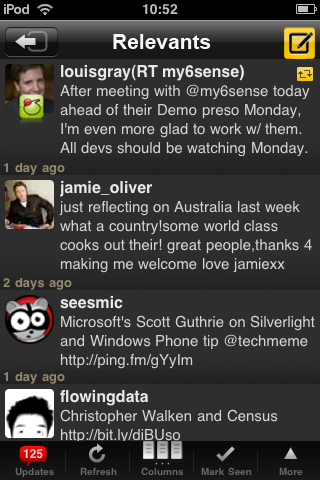
For example, take Facebook. Thus far, I've assumed Facebook to be full of the same tech-sipping geeks I've associated with in FriendFeed and other places - so I gave them the full firehose. But as I could shrug off people like my mom hiding my own feed as it was dominating their stream, I received additional feedback that my "Facebook experience" was less than optimal. The FriendFeed shares lacked imagery and became a series of undistinguishable headlines and links. So, I've turned that off, and will be working to make that experience better - through a small number of shares via my6sense on the iPhone, as well as using Facebook better where its strengths lie - with photos and engagement. This decision also comes as many people complain about Facebook's news feed being dominated by repurposed Twitter updates (most of which they have already seen).

Similarly, the world of Google Buzz presents again the opportunity to aggregate content all in one place. But I have seen a similar backlash against people who pass their Twitter updates through the service. This is partially due to a lag between Twitter and Buzz, which sends updates through in clumps well after they were posted, and also due to the same problem as from Facebook - disjointed conversations that began somewhere else and don't belong.

(See Also: Kurt Starnes' great post: Going Native In The Age Of Aggregation)

Buzz Works Best When You Don't Pull From Microblogging Sites

I chose not to pull in updates to Buzz from Twitter and FriendFeed when I started using the service, and anecdotally, I have seen the most activity in Buzz on items started there.

Just because a tool can aggregate doesn't mean that it should. In a world where practically all of us are using multiple social services, many of us are following the same people two, three, five or even ten times, across different networks. Seeing the same updates in every place is off-topic and tiring. I like the idea of participating wherever comments erupt, but also of giving people the option to find pieces of my updates in the right places.

I separated out my different streams on Twitter to give people who want the content the option to do so, at their choice. I'm thinning out my Facebook to optimize there, and, while I will continue to pull Reader and blog posts to Buzz, I do not think I'm going to cram every service I can find down Google's newest tool.

We live in a world with a very easy potential to be overcome with noise, and I don't want to be responsible for more than my share. So go ahead and follow my @louisgray account on Twitter. Or my @lgstream or @lgloco. You can connect with me on Facebook, FriendFeed or Buzz as well, just know that each place should be giving you a different experience - aimed for that audience.

Disclosure: my6sense is a client of Paladin Advisors Group, where I am Managing Editor of New Media.

Facebook Sharing Data Webwide Promising, Difficult

Facebook Sharing Data Webwide Promising, Difficult

Despite its walled-in history, many of Facebook's recent strides have trended toward making what was once private public, and that which was previously unavailable to search engines discoverable. The company, cognizant of the failures experienced by data hoarders of the past, appears to have the desire to change - and will need to do so progressively, as to not upset the apple cart, inviting the fire and brimstone from a mob wronged. This week's tea leaf readings spell out plans for Facebook to share data from your personal profile with third party Web sites you visit, letting them tailor your Web content (and ads) just for you. The result, a much more relevant Web experience, would likely have big benefits for consumers, advertisers, and of course, Facebook, but it sets off the same alarm bells that rang with Beacon and other companies who have changed the rules in the middle of the game. The question is, can Facebook make the leap in such a way that it can still be trusted?

I've talked a lot about my own desire for companies serving ads to leverage the social profiles I have created around the Web, so I don't have to constantly be bombarded with off-topic dreck. (See: I Wish Ad Companies Would Truly Leverage Social Profiles and I Just Marked All Facebook Ads as Offensive. So Should You., both from 2009) So the news from various outlets saying that Facebook is planning this very thing, to share data with third party Web sites, has me nodding in understanding, while at the same time cringing, thanks to a lack of transparency to the process, and the knowledge that many people won't be very excited about the move.

If I were to look at the situation from Facebook's perspective, I can see how the company is at a crossroads, tied to the old rules they've had since inception, but trying to be nimble enough to compete with companies that haven't had the same restrictions. Facebook is sitting on a gold mine of user information and attention data, and advertisers are as keen as ever to find the right targets and deliver relevant advertising or content. Facebook doesn't have the luxury of starting anew and trying to develop a new company that doesn't have the shackles of the past which it does, but has the opportunity of a network with 500 million users. The hardest part is seeing how they can get from Point A to Point B without leaving a bloody trail in the streets.

Shortly after the debate on Google Buzz and its own privacy issues, and my posting of an article where I said I thought the cries were dramatically overblown, I met up with Dare Obasanjo of Microsoft at the South by Southwest Interactive conference, and we talked about this balance of business versus privacy. In his opinion, social networks can never sacrifice their ideals on privacy, not matter the opportunity ahead of them. He told me, in a CinchCast (which blew up halfway through), that Microsoft had the opportunity to turn MSN Messenger and Hotmail into an open network like Buzz, but they chose not to because they determined it would be wrong. Buzz went through this process with Gmail, and they paid for it in the world of PR and trust, even if I thought the reaction was too strong. Facebook has had its struggles before with the same issue. For every public statement by the team's executives about the changing concept of privacy, and users like me who don't mind it at all, there are others who think their trajectory has them at odds with their user base.

I want to trust Facebook in the same way I have trusted Google and other networks with my data. I personally would not object to Facebook's sharing my information with third parties and advertisers, because I am not anti-ads, I am pro-relevancy, and I want to help solve these issues of quality. I think a world where third party sites know their targets better can only lead to more responsible business transactions and more commerce, period. I can see Facebook struggling to get 500 million people on its network to "opt in" to a system that shares their information, and them seeing pushing forward in a brutal way as the only option. It's a rough situation, where the end result would be great and the process in between would be a mess. I want the relevancy, but will everyone else find the cost worth it?

March 25, 2010

Twitter Highlighting "Clever Accounts" @cleveraccounts

Twitter Highlighting "Clever Accounts" @cleveraccounts

A common aspect of any Web-centric company looking to break out of an early adopter niche to more mainstream acceptance is the highlighting of customers who have been brave enough to take the plunge first. The best of those often make their way into being showcased on the site, hopefully to convince others on the fence that yes, the product delivers real value. Twitter, for much of the last month, has quietly been building out a showcase Posterous blog full of "Clever" examples aimed to make you say, "Now I get it!". Showcased on the site are businesses including North Face, Best Buy and even Dunkin Donuts.

While practically every little move Twitter makes gets dramatically magnified on the Web, response thus far to these new stories and an associated Twitter account (@cleveraccounts) has been remarkably muted. CleverAccounts, for example, only has 300 followers and is on 15 lists, contrasted with 82,000 following @twitterapi and more than 3 million following their main @twitter handle.

It's also telling that these "Clever Accounts" have been fairly quiet, as the Posterous page shows less than a handful of Twitter mentions for most, and no comments on any of the pieces. Authors of the short briefs are Twitter's new head of communications, Sean Garrett, and Jenna Sampson.

As Twitter has expanded, not just its core team, but into new geographies, the company has also spawned a second list, called More @Twitter Accounts, featuring these clever accounts, as well as official Twitter updates from Japan, India, and Italy.

Twitter's case studies on North Face, USGS, Best Buy and others are simple one-pagers, highlighting their use of the microblogging tool. The profiles are very similar to the highly visual case studies you might see on Apple.com, for example, in their Pro section, but they don't export to PDF for download, as many enterprise companies offer on their site.

You can see these "Clever Twitter Accounts" at http://cleveraccounts.posterous.com/ or by following @CleverAccounts.


March 23, 2010

Zite Launches Personal Web Filter, Recommends Content

Zite Launches Personal Web Filter, Recommends Content

Practically everywhere I turn these days, new products are cropping up to help you find content relevant to your interests. In addition to my6sense, who I covered yesterday, we've seen a fair share of Twitter applications, iPhone apps and Web sites looking to find signal in the noise, and each takes a unique approach. The latest to join the scene is a service called Zite, which bills itself as a personalized Web filter, leveraging your social profiles to guess your interests. You can improve the filter by grouping keywords you are interested in, and can dive down by domain to see what different sources are saying about your interests.

Setting Up My Zite

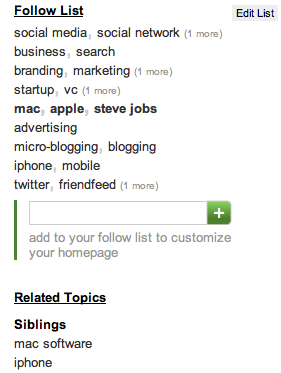
Upon entering Zite (and you can use one of 50 invites with this code: http://zite.com/?code=louisgrayorg), you are prompted to enter your user name for Twitter and Delicious. Zite analyzes the content you share on those sites, and delivers two things: recommended articles and keywords called your "Follow List".

Today's Recommendations from Zite

Older Recommendations from Zite

The recommended articles are split into two: first being today's recommendations, and the second being older items you might like, going from 1 day ago to as much as a month. If you like the articles you see, simple click the star to the left of each article, or you can read it. Zite intends to improved based on your feedback, so the more stars, the more you get to tailor it to your interests.

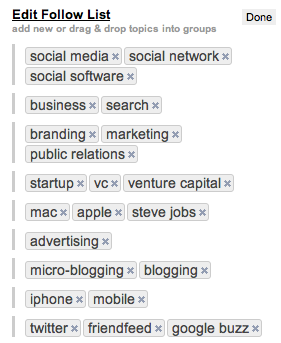
The "Follow List" at first is a quick stab at what Zite thinks you are most interested in. But the power of this list comes from your own edits. You can add new terms to follow, and interestingly, drag and drop topics into groups. This lets you have a set of results for "Startup, VC and Venture Capital", or another group for "Branding, Marketing and Public Relations", for example. You can also set up groupings for multiple domains, for example "louisgray.com and scobleizer.com", if you wanted to.


The Editable Follow List on Zite


Once the follow list is created, you can click on any of the groups and see recommended results on Zite from those terms. Zite tries to guide your exploration further with related topics, called "Parents" which are higher level topics, or "Siblings" which add more terms to those you're currently viewing.

Searching on one domain with a specific term on Zite

The ability to parse through RSS and other news sources by topic is something I like a lot, and you could see that from my feedback on Lazyfeed. Zite lacks the real-time updating element and cool UI that Lazyfeed brings, and doesn't clearly respond to implicit feedback, working on the explicit nature of your own activity. But if you want to see recommended articles from the Web on topics you like, you should check it out. You can get in to Zite's closed beta with one of 50 invites using this code: http://zite.com/?code=louisgrayorg.

Disclosure: My6sense is an assumed competitor to some aspects of Zite, and My6sense is a Paladin Advisors Group client, where I am managing director of new media.

FriendFeed Data Joins Its Coders At Facebook

FriendFeed Data Joins Its Coders At Facebook

Despite not achieving the lofty position in the social media stratosphere many of us had hoped it would as an independent company, FriendFeed played a significant piece for a mid-size community that has, for the most part, felt adrift and abandoned in the seven months since the once-perky startup was acquired and absorbed into Facebook. When parts of the site started to creak over the last few weeks, with features breaking or slowing, some thought it spelled yet more bad news. But after some considerable effort, the site and all its data has been migrated to the more robust Facebook data centers, which should hopefully keep the site going for those who have stuck around, even when others have said their last goodbye.

Moving all data on a live site as complex as FriendFeed's to another is no trivial feat, made even more challenging by differing hosting environments or code nuances.

On Thursday, after some of the site's more dedicated users complained the network's search engine was broken beyond repair, FriendFeed co-founder Jim Norris explained:
"We're working on moving the FriendFeed servers to the Facebook data center, which will have significantly more speed and capacity and (we hope) more reliable hardware. There are a bunch of difficulties we've run into though: FF has been running on Ubuntu Linux distributions whereas FB is based on various (old but stable) Fedora Core and Centos versions, so the package management is completely different."
Paul Buchheit, also a co-founder, best known for his work on creating GMail while at Google, and a successful angel investor besides, gained the unenviable task of compiling the code and building it on the new machines. As Jim added in a throw-away line, "I don't know the exact timeline but if when I see Paul I'll beat it out of him."

It turns out that timeline was for late Monday night and early Tuesday morning, as Bret Taylor, director of products at Facebook, announced the successful transfer of FriendFeed's data to the Facebook datacenter, adding, that it "fixed many of the ongoing performance problems we have had with the site and will provide us more room to grow."

Whether FriendFeed is growing, stagnant or decreasing depends on one's point of view. No longer a gem in Silicon Valley early adopter corners, the site did bounce off traffic lows last month (at least according to Compete.com) to rise more than 80 percent - even as new challengers including Google Buzz gained attention. FriendFeed has said the United States is no longer the most active country on the site, as that honor falls to Turkey. So somebody's using the site, and while figuring out the site's future and how it maps to Facebook requires either a divining rod or root access to Mark Zuckerberg's laptop, it doesn't look like the site is being allowed to gather dust and fade into the shadows.

As the move took place, users on the site are already thanking the team for improved speed, and lower errors. And as FriendFeed never quite let me export all my data I'd piled into the site since October of 2007, that's a good thing. If they had a way to export it all, that'd be a very interesting offer, but it's a battle for another day.

March 22, 2010

My6sense Intros Attention API for Hyper-Relevant Web

My6sense Intros Attention API for Hyper-Relevant Web

Content is coming at us from every direction in the form of streams, from blogs to tweets to social networks. These streams are combining to become information waterfalls of noise from practically every direction - noise because they are all shouting for our attention and demanding we choose them over updates from somewhere else. For some, this crashing sound has become information overload, as the demands from our data exceed the time we have available to give everything its appropriate attention. For the last nine months, I have been talking to you about my6sense's application for the iPhone, which watches my activity and senses what is most relevant to me, from my RSS feeds and my social streams. At the end of the last year, they became a Paladin client, and I have been working with them closely as they improve their digital intuition. Today, at the DEMO conference, they announce their new Attention API, which lets developers and service providers capture personalized relevance - and this, the ability to see my6sense-like sorting and impact throughout the Web, is what I have been waiting for. It is this Attention API that will help quiet the noise and start delivering clear signal from new places.

my6sense Promises Personalized Streams Across the Web

As you know from my prior coverage of my6sense, and likely your own experience with the application, my6sense's intention is to surface the highest quality, most relevant information, not from the crowd, but for you. It watches what you read, and what you don't read. It watches what you share, and what you don't. It watches how long you read, what articles you open, and what you skip. And over time, effortlessly, you will find the content getting better and better. Now, one of my first stops on my iPhone after time away from the desktop is to my6sense, so I can just scan a handful of headlines and know I didn't miss anything. The introduction of the Attention API from my6sense promises to take that personalization to the Web at large, should software engineers and content publishers be interested in delivering personalized streams to their users, no matter the type of content, without requiring them to fill out detailed surveys, or explicitly indicate what they like, and what they don't.


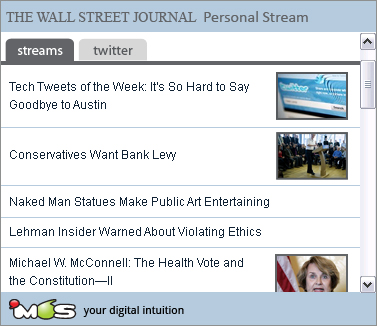
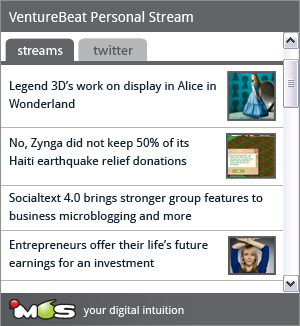
Examples of Prioritized Streams on VentureBeat and the WSJ

In the past few months, you have seen increased focus on relevance. Google Reader has made significant steps forward with their addition of "Magic", both on their desktop client and most recently on the mobile phone. Google's search engine has started to personalize results for you, including links from your social circle. Cascaad also talked about personalization of their social media application for the iPhone, and Twitter client Twazzup is trying to find "highlights" for you based on who you interact with the most, and other factors. But my6sense doesn't see attention and relevance as simply features - but instead as the core mission of their product. That other services are also trying to solve this issue speaks well to the need for publishers to provide better user experience to their customers and make their products even more appealing.

As I introduce my6sense to people, the most common requested product features are for its running in other environments than the iPhone. The company has promised new platforms are in the works, but the addition of the Attention API does more than bring my6sense benefits to new handsets, but to new environments altogether. While the company already made a big step to start filtering Twitter and Facebook streams by relevance in the application, you can imagine how content publishers, from vertical sites to industry news, new social networking clients and blogs could offer personalized streams, based on relevance, without having users jump through complicated hoops - or simple annoyances, with "more like this" buttons, thumbs up and down, likes and dislikes.


Examples of Apps That Could be Impacted by an Attention API

As my6sense promises today with their announcement, partners looking to offer tailored, personalized streams would connect my6sense's digital intuition engine to the streams they wish to personalize, and then let my6sense know how users are expected to interact with the streams. My6sense would then return personalized streams for each user, regardless of feed type. If partners sign up, the silos of unfocused, unprioritized data that we live in today should change - into a more focused Web that delivers content ranked for every visitor. With more people tapping into social services, and trying to follow more people in more places, the opportunity to cut through the noise and find the important information, taking it to the top, could be a critical competitive advantage. With today's launch, I look forward to seeing which applications and sites will step up first.

Disclosure: my6sense is a client of Paladin Advisors Group, where I am Managing Editor of New Media. My comments on the company's product are always independent, and do not pass their way in advance.

March 21, 2010

Branded Site Aggregator Nombray to Shut Down April 5th

Branded Site Aggregator Nombray to Shut Down April 5th

Nombray, the project which looked to showcase all your individual or brand's destinations at a single URL, navigable by tabs, looks like it is going to find itself extinct as soon as April 5th, after the CEO was unable to complete the site's sale to a potential buyer at the end of 2009. Despite coverage from CNET, Lifehacker, Killer Startups and others upon its launch, the product apparently never gained the traction necessary to keep it going, although emphasis was on paid accounts with monthly subscriptions.

CEO Chris Lunt sent an e-mail today to users notifying them of the impending closure, saying the site was to shut down on Monday, April 5th, adding he wished "there was a different ending".

Nombray Will Be Gone for All Soon...

As I mentioned in my April 2009 coverage of Nombray, the site was very flexible, importing content from my various social media outposts along the Web and presenting them in one place - a site, which at least for the next two weeks, can be found here: http://www.nombray.com/users/305.

Lunt's note to customers spoke quickly of a potential buy that simply didn't pan out:
"I had arranged a buyer for Nombray in November, but after a long delay, they were unable to complete the deal. They could not marshal the necessary resources to run the business, and I find myself in the same position."
In the wake of Nombray's closing, Lunt pointed to alternatives, including Chi.mp and GizaPage.com. (Of note, I wasn't that big a fan of Chi.mp upon first glance at the end of 2008)

Sites come and go. Nombray no doubt had a hard time selling people on the benefits of a single site managed by their engine. The site is still up here: http://www.nombray.com/

Google Buzz Stats Now Available Via App Engine Project

Google Buzz Stats Now Available Via App Engine Project

With Google Buzz still being considered very new, just a little over a month after its introduction, it has been interesting to see users adapt to the new aggregation engine - seeing some use it to pull in their content and others using it as a self-contained blogging platform. Some people see lots of activity on their feeds, while others get significantly less. Now, as we have seen with products like TweetStats for Twitter and a multitude of packages for blog statistics, we now have the first entry (of many, no doubt) aimed at showing your activity on Buzz, and how much traction your feed is getting, along with details on who is commenting, and how much they are saying.

The new project, hosted on Google App Engine, authored by Siegfried Hirsch, analyzes your last 100 entries to Buzz, from any source, shows their origin, counts up the words, characters and replies, and displays the people interacting with your feed.

My Top Level Statistics for the Last 100 Buzz Entries

As Buzz does not yet have an official API, there is a lot of information hiding from the initial cut, such as the total number of "likes" for your feed, who is liking your content, and any data beyond the first 100 posts. It also does not analyze your own personal activity - trying to find just where you are commenting and liking through your own network (although Google's Dashboard can give you some top-level stats).

Who Is Engaging On My Buzz (and how often)

As I ran the numbers for a number of people on Buzz, from the highly prominent Googler DeWitt Clinton (whose script was the inspiration for this project) to Twitter's John Kalucki, Jesse Stay and myself, it seemed that those who posted natively to Buzz gained the most engagement, while those who piped in activity from third party services - such as Twitter - got less.

DeWitt's Unique Set of Data from Buzz

DeWitt, who has 76 native Buzz entries, saw responses from more than 430 unique authors, with 12 different people (him and myself included) making more than 25 comments on those entries. In contrast, 156 different authors made comments in my last 100 entries, the overwhelming majority of which have been shares from Google Reader.

DeWitt's Engaged Buzz Followers

Not unsurprisingly, DeWitt's native entries into Buzz are much longer than my shares, which are often excerpted. While my 100 posts totaled 4,228 words, the 76 posts he provided were a whopping 18,380 words, or more than 240 apiece. The attention to length resulted in nearly 2,200 comments on his items, with an average of 61 words per reply. The nearly 400 comments I received had a similar 57 words pre reply over the last 100 entries.

The Buzz-Statistics engine is billed as version 0.1, and has some work to do. I found it often lagged with larger accounts (my own included), but it's an intriguing first step into getting analytics data out of the new platform. You can check out your data by going to http://buzz-stats.appspot.com/ and entering your Google user ID.

March 20, 2010

Qwotebook Tracks Quotes by Friends, Famous Quotables

Qwotebook Tracks Quotes by Friends, Famous Quotables


How many times have you logged on to Twitter and seen somebody note in a tweet: "OH", standing for "Overheard"? Some of these "Overheard"s are a doozy. But with Twitter's ephemeral nature, they fade as time moves on. Now, there's a site that aims to capture all the top quotes, both from the world of history, but also the world of the present, online in one place - called Qwotebook. The new site lets you "Qwote" your friends, attribute "Qwotes" to them and even provide context. The result is a fun site that acts as a quote book for the Web.

Drew Olanoff, an oft-quoted friend of mine, and brains behind the site, says, "I'm passionate about quotes." And one can see why from looking at the earliest aspects of the site. Coupled with top excerpts from friends in the social landscape, you can see quotes from famous people including Albert Einstein, John F. Kennedy, Steve Jobs, Barack Obama and others. The result is an insightful mix of funny sayings and overheards intermingled with advice, friendly comments and observations.

With a goal of "Making Quotes More Social", Qwotebook is all about quotes submitted by its users. Submitted Qwotes are displayed with the most recent chronologically on top, as with many social sites, and each quote displays the user who submitted the entry and the user who said it. If the user doesn't yet exist, Qwotebook will make a page for that person. (As I did when I added a quote from Ronald Reagan last night)

My Profile, Showing Qwotes I Have Added

If a quote has context, only mutual friends who are connected can see the context of the qwote, allowing for some privacy.

A Quote from Adam Ostrow I Found

Words of Kurt Cobain, Posted by Drew

Over time, as your qwotes build up, your profile displays not just the qwotes you have entered for others, but also those that are attributed to you. You can "Favorite" some quotes by clicking the star to the left of the quote, and these will be displayed on your profile under your favorites tab.

One of Drew's More Qwotable Moments

Drew is not rolling this out as a one-man project. A duo of developers from the site I Heart Movies are the coders behind the scenes making everything work, and they recognize there are a number of features they want to add to the site over time. I have already seen opportunities where I would want to make a comment to a quote and explain what it means to me, or even provide some feedback. I can see situations where somebody qwoted could reject a qwote outright and say they never said such a thing, or maybe, like other sites, you would want to hide all updates from a specific user (like Einstein, for instance). But for a gen-one site, Qwotebook makes sense and could be a lot of fun. So go sign up and get to qwoting.

There are a number of invites with the code of "louisgray". Go to http://www.qwotebook.com and get started.

March 19, 2010

Hey @You! We are Talking About @You Over Here!

Hey @You! We are Talking About @You Over Here!

Over the last few years, I have enjoyed watching new sites spring up built around conversations and social engagement. These new social networks, be they about friends (Facebook), business colleagues (LinkedIn or Brazen Careerist), shared interests (MyLikes), shared items (Google Buzz and FriendFeed) or even shared purchases (Blippy), are primarily architected around posted items, and various groupings of gestures (likes) and comments. Practically all of the best sites are now following this model to varying degrees. But some are doing a better job than others of alerting you to your being mentioned or pulling new voices into the conversation. I believe that we are on the cusp of even better improvements to connect people across the Web, no matter where they are.

Take, for example, a basic share on Facebook. Today, when a shared item is added to Facebook, you can add a person's name to the item through their own twist on the familiar Twitter address of an "@reply". You can also tag photos or notes with people's IDs and they will be alerted, either by e-mail, or in their message box.

Facebook Lets You Tag People As You Post Updates

That's a great addition. But if I am making a comment on this entry, I can't refer to anybody in the same way (an @reply), and nor can anybody else. This is the same issue on FriendFeed, where I can copy a connected friend on a native entry, but can't do any kind of @reply to add them after the fact, nor can anybody else.

Facebook and FriendFeed Don't Let You Tag in Conversations

Two sites that do this very well are Google Buzz and Blippy.

Google Buzz has it set up so you can notify somebody they are being talked about by adding the @ symbol ahead of their e-mail address. For example, you can tag me by writing @[email protected] in the middle of any thread, and it will resolve to something that looks like @Louis Gray. The catch here is that you need to know the individual's e-mail address, have previously messaged them before through GMail, or you have to open up the person's Google Profile and use their username ahead of Gmail.com to get it right. It absolutely works, but is clunky, with too many steps.

Google Leverages WebFinger in Buzz for Mentions

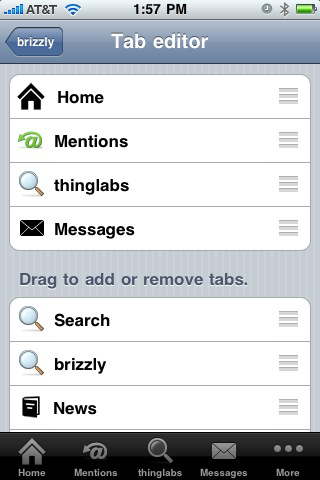
Blippy's is the very best I've seen so far. Forget about e-mail addresses. If you want to reference another Blippy user, just enter @ and their ID, and a link is added to their profile. For me, as usual, that's just an @louisgray away. I will get notified you mention me, and no doubt, jump into the conversation, or at least see what you were saying. I used that just today to pull Jason Shellen of Thing Labs into a conversation on Brizzly, and in minutes, he was there.

Blippy Lets You @ Users In the Thread

By using this kind of @reply functionality, it takes out some of the guesswork and overdone ego-searching and vanity-searching from network to network. Just as Twitter has integrated mentions as part of their service, this mention functionality is becoming part of how we communicate - and I think we're about to see this taken up a notch thanks to two movements - one being WebFinger and the second being Twitter's @anywhere platform, even if it's not the goal right away for the latter service.

WebFinger is essentially supposed to leverage your e-mail address to aid in providing one true identity that is yours, across the Web. Google Buzz leverages WebFinger to tie back your mentions to your GMail account. If more services were to leverage WebFinger, I could tag your "true identity" in a comment, a blog post, a tweet, a photo, or practically anything else, and there would be no ambiguity in terms of whether I meant you or another person with your name (just like the easy confusion between Louis Gray, tech geek blogger and Louis Gray, Osage Indian senator). The open standard, being promoted by Google engineers, and some others, leverages public profile data to be made complete.

Meanwhile, Twitter's @Anywhere platform is looking to put a thin skin of Twitter on top of some major partner sites, at least at first, letting you follow people from 3rd party sites or let you perform Twitter-related actions outside of Twitter.com. I can see a future where this functionality could in theory be embedded as part of major Web browsers, or via plugins, or on enough sites whereby my mentioning of @ and then your Twitter ID would tie back to your Twitter account. Once that gets turned on, you can forget about just counting @replies and @mentions on Twitter.com, and you would instead get, for example, 2 @mentions from ESPN.com, 3 @mentions from The Huffington Post and 1 @mention on TechCrunch. At this point, Twitter's @anywhere could become the @mention and @reply engine for entire Web.

Any good social media maven knows the best ways to search for their own mentions and see if people are talking about them or linking to their content across the Web. I get real-time notifications if I get mentioned on BackType, and I use IceRocket to see links from around the Web or mentions on Twitter. Google News and Blog alerts still work, even if they seem stale. And yes, Technorati is still alive. But if more sites leveraged the kind of @mention and @reply functionality in a great way, as Blippy and Buzz are starting, and Twitter and WebFinger are promising, we could have an even better, more connected, more participatory Web without demanding constant searching. I'm ready.

Are you ready to see this work, @chrismessina @dewitt @ev @biz @scobleizer @parislemon @kevinrose @paultoo @btaylor @finkd @elatable @daveman692 and @pud?

Apple Sets March 27th Deadline for Apps in iPad App Store

Apple Sets March 27th Deadline for Apps in iPad App Store

If the runaway success of the iTunes App store has been any indication, Apple is getting ready for an onslaught of new and refined applications from its growing hoard of developers as they jockey for position on what's possibly another big hit - the iPad. Today, Apple sent a note to developers saying they could be included as part of the "iPad App Store", as it is being called, on its grand opening, so long as they submit their app by March 27th, or this upcoming Saturday. The initial apps will be reviewed by Cupertino's App Review Team, who will judge their readiness for the day of unveiling.

Preliminary estimates have said Apple has already sold hundreds of thousands of iPads to eagerly awaiting customers, the vast majority of whom have never seen, let alone touched an iPad, but recognize its significant potential for casual computing and content consumption. Developers, keen not to miss out on what could be Steve Jobs' latest hit, following the iPhone, iPod, iTunes, iMac, and many others in his ten-plus years in his second go at leading the company, are likely salivating at the expanded real estate available on an iPad, when compared to the iPhone, and wouldn't mind becoming one of the many coders who have found financial success through the iTunes store.


Apple's note, sent to iPhone Developer Program members, advises developers to build and test their iPad app using the latest iPhone SDK: 3.2, beta 5, and says only those that use the latest version will be accepted. The app then needs to be submitted through iTunes Connect by 5 p.m. Pacific time on Saturday, March 27th, following which the App Review Team, no doubt under some amount of stress, will e-mail details about your app readiness, and provide feedback on what is needed for final review before the iPad ships.

If developers miss this March 27th date, they will not be considered for the grand opening of the iPad App Store, Apple warns. So if you know an iPhone developer who is looking to hit the iPad on day one, leave them alone for the next week. They've got some work to do.

March 17, 2010

Twitter Tightens Security With Encryption Expert Hire

Twitter Tightens Security With Encryption Expert Hire

On Tuesday, Twitter added computer security veteran Bob Lord to the company's expanding employee roster as the manager of network and infrastructure security, bringing with him 20 years of experience focused on electronic security systems at large companies, most recently including Red Hat, AOL and Netscape. Highlights in Lord's background include his building security and encryption features into the Netscape browser, iPlanet servers (an alliance with Sun and Netscape) and the AOL Communicator product, which also included Mail, Address Book, Instant Messenger and Calendar. Since leaving AOL, Bob has worked with a team of cryptography experts to add security features to many projects including FireFox, Mozilla Thunderbird and Red Hat Linux.

Bob's LinkedIn profile shows praise from colleagues who gave him credit for ensuring successful releases of complex application suites at AOL, as well as his being recognized as a "visionary" with energy and intensity, while at RedHat. Bob is also a patent-holder for his development of temporary digital certificate proxies that can be used for a specific amount of time.

The Obligatory "First Tweet" from the Mothership.

As Twitter's Web site and activity become more critical in the way the planet is communicating, so to will its need increase for security to protect that which is private to remain private, and enable accounts to be secured. It's also not unexpected that the company's core offerings will get increasingly complex - maybe not to the level of AOL Communicator, but expanding nonetheless.

We should be seeing what Bob will be bringing to the Twitter team over the next few years, or just keep tabs on his updates at @boblord.

March 15, 2010

The SXSW Keynote With Ev Williams You Had Hoped to See

The SXSW Keynote With Ev Williams You Had Hoped to See

This afternoon, as most of you know, Ev Williams, CEO of Twitter sat down for a much-anticipated and heavily-attended keynote interview at the South By Southwest conference in Austin. After thousands of Twittering geeks and quasi-geeks alike had settled in to the packed exhibition hall and overflow rooms to hear the latest updates delivered straight from Twitter's leader, their excitement soon turned to boredom and finally, severe annoyance, as the interview's pace, tone and content fell well below expectations. After an hour's time, the halls in Austin were more than half empty, and an opportunity to showcase one of technology's biggest successes in the last few decades was for the most part lost.

For a huge number of attendees at SXSW, Twitter epitomizes a new form of communication. Their friends are on it. It's where they chronicle their lives and connect with like-minded people and businesses. That the keynote was the draw of the week would be a dramatic understatement. As I sat upstairs in the Austin Convention Center, letting my laptop get some electricity in anticipation of live-blogging the keynote, the escalators jammed with hopeful starry-eyed nerds awaiting a visit from their blue-tinged oracle.

I have met Ev twice myself, including quickly Sunday night at the Google Reader/Blogger party, exchanging a few pleasantries and shaking hands, but by no means consider us close. That said, I expect I will see him again, while for many of those attending today's event, this could be their first and maybe only time to hear Ev's words directly. He doesn't do major speaking opportunities often, and SXSW is one of the biggest geek meccas of the year. Even if it was not an opportunity to announce something amazing, both Ev and the interviewer would have a huge platform to talk to the audience and be interesting. And they failed. Ev may not be the charismatic leader in the image of Steve Jobs, but he really had no chance, being served a syrupy mosaic of cotton-ball soft questions that dealt with feeling, culture and "awesomeness."

As I summarized the keynote in a running transcript on Google Buzz, I hoped my own fatigue wasn't seeping through the text, but the pedantic non-inquisitive approach had me fidgety, featuring insightful questions such as:
"It was you or Biz that said if it was awesome people would use it, and when you talk about creating something, it is about awesomeness? What is awesomeness for you guys?"
At other points, I wrote... (Questioner keeps agreeing with Ev and saying that's "cool" rather than asking questions) and (Questioner recaps his own previous blog posts).... When I looked up at the conclusion of the keynote, the once-packed overflow room I was in was tired, quiet, and very empty. The row I was sitting in, once packed elbow to elbow, sported five empty chairs to my left, and a pair of folks to my right with a few empty chairs in between. The talk had clearly missed the objective, and people were sorely disappointed, compared to what they had obviously hoped would be something special.

Here's what should have happened.

For me, the keynote speech fell far short, not because the questioner was friendly, but because there was very little substance. One can question a speaker in an interesting way without being contentious. What failed to happen was any detailed questioning into competitive markets, technology, challenges or relations with developers. Instead, we got questions about management principles, overly long descriptions of Wal-Mart, ambition, whether partnerships should be "win-win", or if Twitter could be a force for good.

I respect Ev and think he had hoped for a lot more. I would have challenged him and asked:
  1. Has Twitter finally escaped the scalability problems that plagued the service in 2008? If not, what's left to solve, and what kind of technical challenges remain?

  2. There was talk that Facebook once was interested in purchasing Twitter, and you chose to remain independent. How do you see Twitter's role in a world alongside Facebook? Where do you compete and where could you potentially partner? How did their acquisition of FriendFeed change things?

  3. When you saw the launch of Google Buzz, did you feel like the old company you once worked for was looking to stab you in the back?

  4. You talked about being an open company hoping to foster strong developer relations. How can developers on the Twitter platform be sure advances in your own services won't compete with them and put them out of business?

  5. While you have opened up the firehose to select partners for revenue, can anybody who wants to pay gain access to the firehose feed? If not, how do you set the criteria for doing business?

  6. There are many different Twitter clients out there. What are aspects of third-party clients which you like the most? What attributes of these clients can we expect to see in Twitter.com?

  7. The Twitter search engine still is extremely broken and only returns a few days worth of tweets. Will this ever be solved, and how big of a priority is it for your team? What is left to do and how soon can we see the true search engine come online?

  8. The company has recently reversed its approach to a Suggested User List, but as you know, many people on Twitter have followings in six or seven figures that benefited from the old model, and have incredible reach or influence because of that approach. How can the playing field be leveled?

  9. It is assumed that your relationship with Betaworks has also led to your use of Bit.ly as the primary URL shortener on the service. How soon until you purchase Bit.ly outright? Should we also assume closer relationships with other Betaworks companies, such as TweetDeck?

  10. So far, it appears you are avoiding revenue models that include advertising in the stream, similar to Google AdSense, but we have also been promised advertising we will love. Can you explain how this advertising will work, and if I can block it?
To sit down with the CEO of one of the most interesting companies in all of technology and not talk about technology or competition or specific tools in any meaningful way was a dramatic letdown. That the interviewer did not recognize the fatigue of the audience as they scurried out of the cavernous halls was shocking, and now, Ev, who seems to be more on the shy side than the screaming and yelling type, like Steve Ballmer, may think twice about another opportunity, which is unfortunate. I recognize a public interview on such a stage can be a real challenge. We all learned about Sarah Lacy's struggles in that space back in 2007. But those of us who use Twitter and really care about these products deserved more. The SXSW community deserved more. They voted with their feet and they voted with their retweets. While one can remain civil and not throw barbs at the speakers, there was no question this could have gone a lot better than it did, and Twitter will have to promote its new @ Anywhere platform in a better way, for today, it was seriously overshadowed by a train wreck we found ourselves stuck watching.

March 14, 2010

Gmail Failures, Crazy Ideas and Wave's Leapfrog

Gmail Failures, Crazy Ideas and Wave's Leapfrog

On the Web, there is a lot of confusion over where Google Wave fits alongside the recently-introduced Google Buzz, or even if Wave is supposed to be a companion or competitor to Gmail - which could potentially cannibalize the company's extremely visible (and profitable) e-mail business. Today at the SXSW conference, the team leading Gmail said the company has to take risks, learn from mistakes, and yes, even sometimes build products that are in conflict and may replace one another - in the name of keeping competition from doing it themselves.

As it was described this afternoon, Google Wave, which debuted in early beta last year, is a "leapfrog project", which goes beyond today's environment, but is set to impact a future Web. The team working on Wave, as discussed with the product launched, is looking to do more than just build a collaborative service, but to possibly even replace e-mail itself, something the GMail team recognized might seem at conflict to their core mission.

"When people ask if we are cannibalizing our own services, we would rather cannibalize our own services than have other people do it," said Todd Jackson, product manager for Gmail and Google Buzz.

Putting significant resources into disparate product lines that may come to future conflict might seem crazy, or even a bit paranoid, but it sounds like that is par for the course for the team, which said it likes to take big risks, which might not ever see the time of day, or die when they do. In fact, we learned today that Google Buzz's original incarnation began several years ago.

"Most of the things we try fail," said Jonathan Perlow, software engineer on the Gmail front end, responsible for GMail Chat and Mail Goggles. "We have lots of things that are false starts. We recently launched Google Buzz, and it had some false starts before it launched. We started something like Buzz around when we launched chat four years ago. Good ideas live on, and you figure it out."

Figuring things out for the Gmail team can be very quick. The team boasted of a close-knit engineering environment where ideas can be discussed and coded quickly, and where meetings are the exception rather than regular practice.

But while most failures for Gmail have occurred in testing and not made it outside of the walls of Mountain View, the initial failures for Buzz happened thanks to the team making some core mistakes and not having a testbed of real-world users, relying too heavily on their open corporate mentality.

"Gmail thought that e-mail and chat networks were also the social networks, and we missed the boat there," said Jackson. "(Autofollow) worked really well within Google in a trusted environment. Googlers rarely used block."

While Gmail's focus has changed over the last six years with the additions of Chat, Buzz, user interface updates and other features, the product initially aimed with three main goals: enable users to never delete e-mail, have a spam filter that really works, and build a Web interface with the level of quality of a desktop application - concepts that nobody knew how to do, but wanted to accomplish anyway.

"One of the lessons I learned is that when we start with ideas that are crazy at the time, but we thought we could do, they would be pretty great for users, said Perlow. "They had no idea how to build these things, but had to figure it out."

GMail's Invite Marketing Coup Was a Myth

GMail's Invite Marketing Coup Was a Myth

For the last six years, marketing teams and Web services have pointed to GMail's invite-only approach as on of the most successful examples of driving user demand in a time of scarcity. At one point, GMail invites were so sought after that account-holders were selling off their spare invites on eBay. In fact, that's where I bought mine, as well as a never again used account ID for Orkut, way back in 2004. Today, at SXSW, we learned the move to make GMail an invites-only platform was not a marketing strategy, but instead one driven by fear from engineering, who thought they might not be able to scale under tremendous potential demand.

As is well-known, Gmail's debut on April 1, 2004 was not a massive April Fool's joke that promised a gigabyte of Web-based e-mail at a time when competitors like Yahoo! offered a comparatively measly 50 megabytes. Combined with a new Web-based interface that echoed the quality of desktop apps, and integrated anti-spam, the team thought potential customer demand for the new platform could outstrip available resources - and the engineers pushed for the invite only system.

"People were selling their souls on the Internet for invites," said Arielle Reinsten, Product Marketing Manager for GMail, at SXSW Interactive today. "But it wasn't a marketing idea at all (to offer invites). We were worried about capacity. It was an engineering decision that was seen as marketing."

With GMail now having passed the initial time of scarcity, open to all, the company now focuses on how they can leverage word of mouth from happy customers, and push for activities like viral videos and fan-building activities. Reinstein did say GMail was advertised widely in 2007, in part of a wide push to highlight it's built-in spam protection, but "it was a drop in the bucket compared to the organic growth and the viral growth GMail is known for," she said.

On Monday, the Users Will Strike Back Against Products

On Monday, the Users Will Strike Back Against Products

Although I covered a pair of panels from the South by Southwest conference in Austin yesterday, I didn't go deep and explain why I chose to return to the event, which I first participated in and attended last year. Thanks to work at home and with Paladin, I almost opted out of SXSW in 2010, but after being offered the opportunity to speak on behalf of users everywhere and talk about how we may be losing the battle against products that are poorly designed or don't have our input, I had to accept - and therefore, I am spending the weekend in Austin. Tomorrow, in a core conversation, where I will participate in tandem with Chris Wetherell of Thing Labs (makers of Brizzly), and formerly of Google Reader we will sound the alarm for users to once again get the upper hand.

As users, we for too long have not had much of a voice in the products we are expected to use. We have been dragged through iteration after iteration of beta software, expected to accept poor user interfaces, lost data, incompatibilities and decisions that have been made that benefit the company rather than ourselves. We have seen violations of privacy, we have seen sites that we like abandoned when founders get bored, or when the acquiring company has no interest in supporting the existing community.

In an allegedly social world, we have seen companies think all they have to do is start a Twitter account or beg you to join their Facebook pages, but instead of having real connections, the are sending out their interns to spout coupon codes and collect follower counts. We have seen discussion boards and feedback forums created, and then ignored.

Users are not to be feared. Users are to be embraced - and very often, we may have some fantastic ideas in terms of how to drive your product strategy that will help your company gain in differentiation, gain market share, and outperform the competition.

This is not a game of power users demanding power and access. This is a cry for help, to give us the option to trust you again. Just like every airline reminds us at the end of every flight, yes we have choices, and we are looking for solutions that give us real value. We want to help you.

If you are at SXSW in Austin tomorrow, please take up a torch on behalf of users everywhere, and join us at 11 o'clock to talk about how we can prevent products we like from becoming products we hate - and ask developers to take us seriously. We are in Hilton J, and the session is titled: "Products vs. Users: Who's Winning?"

Join us: http://my.sxsw.com/events/event/770

March 13, 2010

Users vs. Companies: Conflicts over the Real-Time Web?

Users vs. Companies: Conflicts over the Real-Time Web?

If 2009 was the year of real-time Web, with practically every major service finding ways to bring content to its users instantly, 2010 is about optimizing the new real-time world, expanding interoperability between sites, finding more ways for users' content to be discovered, and taking the potential of real-time out of the status world and into the real world. Today, at the South by Southwest Interactive event in Austin, Texas, one panel asked if we were making serious progress in this vision, and if companies, feeling increased competitive pressures, are short-changing users in the process.

Marshall Kirkpatrick of ReadWriteWeb, who moderated the panel, featuring representatives from Collecta, Google, Gowalla and Microsoft, said "the real-time Web is a big, complex and multi-headed beast," adding, "almost as many people you talk to on the subject will give a different perspective."

For most, the real-time Web represents reducing latency from the time updates are published and when they are experienced practically to zero. This can be anything from updates from blogs to downstream aggregators and RSS feed readers, status updates from social networks to other points in the ecosystem, or instant alerts from the Web at large that a saved search you requested has found a positive match.

But one of the existing problems with the real-time Web that has occurred is that despite the focus by many services to solve the same problem, many have done so without delivering true data interoperability - and other services are trying to solve for real-time without having full access to users' public data.

"Back in the day, you couldn't send e-mail from AOL to Compuserve, and today, you can't send data from Google Buzz to Facebook," said Brett Slatkin of Google's App Engine team, and co-author of Pubsubhubbub. "Part of what we are trying to work on is breaking down these barriers that connect to different sites. If I am on Buzz and Marshall is on Identica and Jack is on Twitter, we should all be able to communicate."

Standards have evolved in the real-time Web space, from OAuth to PubSububbub, WebFinger and Salmon (as documented here), but that's not to say there aren't still heated debates over these standards, or even which version of standards should be supported. (See this article for a discussion of OAuth 2.0)

"I try to be a practical person, and when I hear about a family of specifications, it sounds like a family of work," said Dare Obasanjo of Microsoft. "There is clearly a place where we have a common pain that we can work on. There is a bunch of shared pain, and the way you have to get real-time service is to work on APIs, and that is a clear starting point for standards. Pubsubhubbub can help solve that problem, but I get concerned when you have to implement certain specs to solve that problem."

"These specifications we agree on should be useful on their own," answered Slatkin. "When you implement a specification like HTML, you are not buying into an ideology."

As the real-time Web's protocols are debated and deployed, so too does the application of these services. Google Buzz and Facebook have received scrutiny for their aggressiveness in converting assumed private data to public, and Netflix recently canceled an algorithm development contest thanks to concerns of assumed privacy violations.

"When talking about privacy, right now, unfortunately, the social networking market is failing, and they have little incentive to encourage user privacy," said Obasanjo. "I am waiting to see when people find what they thought were private updates as part of trending topics on Google and Bing. Users and companies are in conflict."

Obasanjo gave the example of Twitter needing its users to be public in order to drive value into the system. After all, if users were all private, there would be no trending topics, and thus it is Twitter's best interests for updates to be public. "There is a factor that if a user wants to be private, it subtracts value from the system," he said.

Beyond these concerns, known benefits of the real-time Web are scratching the surface of what could be done with more expanded to real-time data from other sources, it was argued. Slatkin forecast a time where you could query supply chains for inventory and purchase locally instead of from Amazon.com, turning economies of scale on their head. Scott Raymond of Gowalla talked about intersecting real-time Web technologies with geodata to show trending locations and the hot parties of the moment, by decaying the relevance of checkins over time. Jack Moffitt, CTO of Collecta, said a development environment for new tools and applications that leveraged zero latency was becoming "very interesting".

"All these guys are working on realizing the potential right now, working on real-time data," Kirkpatrick said. "Brett Slatkin said it was important people focus on the unforseen future that systems we worked on to support undiscovered use cases - things are going to get real crazy real soon."

Web-wide adoption of RSS and Atom standards has eliminated the problem of publishers providing their data, and tools like Pubsubhubbub are working to get data from one site to another faster. "Polling doesn't scale and you need a push notification to deliver it. It's possible we will have multiple winners, and we have to consider privacy considerations that people won't want their data available to everyone," said Moffitt.

The element of real-time is being layered across the Web, and it seems to be happening even if developers aren't completely in agreement over the tools needed to optimize the experience or if the debates on privacy versus public data are solved. And there's a lot of room for real-time to grow outside of the statusphere and to more traditional markets. The question is can developers provide solutions that don't have users running to the FCC?

Activity Streams Aim to Be DNA of the Future Web

Activity Streams Aim to Be DNA of the Future Web


When the well-respected open source advocate Chris Messina announced he was joining Google in January, many folks were concerned that his being absorbed in to the big company Borg would mean a cessation or redirection of some of his projects targeting the next generation Web, possibly in exchange of proprietary efforts to promote the company's products. Today, at the South by Southwest Interactive event in Austin, Texas, he spoke on how he and others in the community, both at Google and outside of it, are working to bring more meaning to our social networks, activity, and feeds, through extending today's data portability standards to include more information and more relevance. Messina walked through a history of the Web's publishing, from static portals of a decade ago, to today's RSS and Atom-powered sites, and suggested a future with even more information, based on streams, that tells a story.

Messina, after expressing his excitement about working with a team he believed was leading the industry in things he cares about, including the Data Liberation Front, letting data move from one site to another, said he was focused on what he called "generative structures" that were the underpinnings and DNA of how information is shared, updated and transmitted.

As he recounted, in 1999, portals ruled the Web, and people, myself included, would put their data in sites like My Netscape and My Excite, customizing these sites with headlines from third party services, primarily tapping RSS, which offered the headline of a story, a link and its description. In an era when publishers wanted to not give away their data, it was "the best we could do", he said. By 2005, a new extension of RSS was promoted, called Atom, which was still the essential concept of syndicating data from one Web site to another, but also adding an author and an identifier for the atomic bit of information.

Now in 2010, little has changed. Most news feeds of today, be they on Facebook, on customized portals, or the headline and link model that dominates Twitter, are fairly simple, and they don't indicate intent. As Messina said, "It's not all that different from the last 10 years, and that gets kind of depressing".

But what has changed is the increase of sharing rich media in these places, on platforms designed for "dead tree media". He said we should be able to show what we did, who with and why we were doing it, and that needs to happen through new richer formats for the social Web.

Activity Streams, an extension to the Atom Feed format, is looking to accomplish this by extending Atom and RSS with new aspects, including a verb and an object type. The world of FriendFeed, which supported a unified feed of 58 different services, where people could have one single stream that represented their identity online helped guide much of ActivityStreams' framework. As entries flowed to FriendFeed, they largely represented actions of posts, shares, bookmarks, reviews, from different sites. But ActivityStreams is aiming to do more than just syndicate data from one home page to another, as RSS and Atom have done for a decade, but also display intent and meaning.

"If your goal is to help people produce meaning, knowledge and culture, you have the basics for a pretty compelling social application and can motivate people to act," Messina said.

But with more streaming of information from many different sites, it can exacerbate the assumed problem of information overload - and tools need to be further developed to help us consume the data.

"We snack on information. It may feel like overload, but the tools haven't caught up," Messina said. "The solution to data overload is more metadata and we are at that point where can start generating that. We take the basic construct from 1999 and weave in some additional information - data about data."

As I outlined in my summary of DeWitt Clinton's talk on Google Buzz at the beginning of the month, Activity Streams are playing a big role in this new network, and these streams are intended to be open, not just for a company like Google, but other social networks that are tracking individual's activity and intent. The goal is to make discovery of intent data ubiquitous and transitive between sites, in the same way that RSS and Atom focused on publishing of data from one site to another.

Messina called the work on Activity Streams as iterative "baby steps", but ones that focus on getting today's rich media activity a home with a rich experience, and to make this process easy for service providers.

"If you have a Web site that has people doing things on it, and they have a feed they are taking with them, it is fairly trivial to add ActivityStreams information," he said. "Essentially we have the verbs and object types represented."

You can find out more on the continued development of ActivityStreams at http://activitystrea.ms.

March 12, 2010

Cadmus Adds Twitter Lists Support, Including Trends

Cadmus Adds Twitter Lists Support, Including Trends


Cadmus, the Twitter filter and conversation collector we have covered a few times on the site, has just introduced support for Twitter lists, providing personalized trending topics by list and conversations from that list, giving you an instant update as to what your friends or a specific group of friends are talking about on Twitter. Also, in parallel with the start of the SXSW Interactive 2010 event in Austin, Cadmus has created a dedicated page for speakers at SXSWi.

We've recently seen Twitter introduce trending topics by geography, a good move beyond the worldwide trending topics the company has featured since their acquisition of Summize in 2008. But the trending topics are not yet personalized for you, all those you follow, or by specific list. Cadmus takes these trends a step further with what they call "Personal Trending Topics" and yes, trends by each list you follow.

For me, the personal trending topics I see in Cadmus today are: "#sxsw, Twitter, sxsw, Austin, iPad, news, #media, iPhone, #ff and #followfriday".

If I change my view to the "TopTechBloggers" list, the trending topics for that list show me: "sxsw, #sxsw, iPad, Twitter, austin, #triout, iPhone, new post, #sbs2010 and #NCchevySXSW". Meanwhile, the "awesomesocial" list from Josh Elman is talking about: "#sxsw, austin, sxsw, #gdc, San Francisco, sf, new blog post, iPhone, #startupvisa and api".

So yes, clearly most of those people I follow and list are talking about SXSW.

Top Conversations In my TopTechBloggers List

Within each list, you can still see the grouped conversation that Cadmus is known for. I can see that Mathew Ingram of ReadWriteWeb got 11 responses to a recent query on Twitter, and see that Mashable continues to get 100+ retweets to most of their posts. But instead of seeing all 100, Cadmus groups them under the originating tweet to reduce the noise - as is their hallmark.

While you're checking out Cadmus' updates, also be sure to see their dedicated page for SXSW speakers here: http://thecadmus.com/topics/sxsw-speakers.

Com2Us' 9 Innings Got Me Through Baseball's Offseason

Com2Us' 9 Innings Got Me Through Baseball's Offseason

Oakland Is Up 12-3 Over San Francisco In This 9 Innings Battle

Behind only technology, sports, specifically baseball, is my true obsession. I've dedicated a good amount of my idle time and brain power over the last 20 years absorbing statistics and remembering the sport's lore, and for several years, before we had our twins, my wife and I had season tickets to the Oakland A's. In the months when baseball isn't played, it can get very frustrating to not have the regularity of the sport, the speculation on players and trades, and the daily contests. This offseason, I cheated a bit, thanks to Com2Us' game 9 Innings, on the iPhone. Though the game doesn't deliver highest-quality graphics or have the official blessing of Major League Baseball and the Players Association, it features practically every wrinkle of the game and is challenging enough to play again and again.

Home Run! 9 Innings Gives 121 Points for This 2-Run Shot.

Like its sister game, Home Run Battle 3D, 9 Innings puts the bat in your hands and expects you to deliver results. But it's not just about hitting balls out of the yard in this game. Whether you choose an exhibition contest or start off a full 126-game season, you are expected to pitch, bat, steal bases, take a walk, and all those things that make the game of baseball a real pleasure.

You Win! Congratulations, Says The Manager.

Any sports games nut knows there are fine lines in the degree of difficulty for a game. You can make it too easy, practically guaranteeing a win every time out and rapidly becoming boring. Or, conversely, you can wrap a game in difficulty and odd combinations that eliminate the fun, as you rack up your losses. Whether on "Easy" mode or "Hard" mode, I have managed to be just good enough to feel competitive, and still growl in frustration as I popped up with the bases loaded, or saw my closer give up a 9th inning bomb to lose the game. And for every game I won by a margin of 5 or more, I have seen the 3-2 losses as well, that slipped away thanks to a misplaced pitch or mistimed swing.

A Peek At the 9 Innings Schedule With Results

Gameplay on the iPhone is relatively simple and intuitive. Instead of using a gamepad, like the Wii or Playstation, for example, 9 innings leverages a baseball diamond diagram for the up, down, left or right. You can move up or down to select pitches, and toggle left to right to determine pitch location. Hit OK to confirm and again to release the pitch. The better your timing, the better the location and chance for success. Similarly, when batting, you want to swing at pitches that get good wood on the ball and can pass by fielders.

Team Statistics Are Available for the Full Season

Just like in the real game, there are good hitters and bad, fast and slow, those prone to strike out or ground into double plays. Some pitchers have more stamina than others, and a sometimes annoying manager will urge you to put in a relief pitcher or tell you it's okay to give up one or two runs if you've gotten the bases loaded and nobody out. There are errors and stolen bases, wild pitches and hit batsmen. And practically every activity is being recorded for statistics, by player, team and league-wide. Meanwhile, the game is also tracking your team's record and standings, and there is a short postseason.

The Current Standings for Season 2 of 9 Innings

In addition to the gameplay, you gain points for specific activity. The more difficult the activity, such as a three run homer, instead of a double play or three consecutive strikes, the more points you get. You can exchange these points to improve your coaches' ability, and theoretically, your winning percentage. This can lead to intentional hit batsmen to strand the bases full and garner points, or pulling a double steal with runners on the corners to rack up a theft of home.

One 9 Innings Game's Achievements

Unlike a real baseball game, a 9 innings contest doesn't take 3 hours. It can take about 20 minutes for a full game, and as you can expect, it can take several weeks or a few months to wrap up a full 126 games, with dedicated playing. What it may lack in perfect management of defense, or cutting-edge graphics, it makes up for in sheer entertainment and bringing the most realistic flavor of the national pastime to the iPhone which I've seen. While I haven't turned my back on the real world of baseball in these cold winter months, it hasn't been that dramatic, thanks to having a methadone equivalent for my fix.

9 Innings costs $4.99 from Apple's iTunes Store. You can find it here, and it's worth the five bucks.

March 11, 2010

Google Reader Mobile Adds "Magic", Faster UI

Google Reader Mobile Adds "Magic", Faster UI

The Google Reader team hasn't been completely at "Play" of late. They have put in some work too. The latest updates to the popular RSS reader, which I am buried in multiple times a day in an attempt to consume and share the best news on the Web, are focused on the mobile version. While considered small, in comparison to the launch of Play, and continued efforts to make Reader play well with Buzz, the updates have made it both more fun to consume feeds while on the go, but also a lot easier.


Google Reader Mobile (Sorted by Magic)

The two easily-recognizable updates to mobile Google Reader are the introduction of "Sort by Magic", which prioritizes content based on your own interests, and a new, extremely helpful, feature that puts a "Next Item" link at the top right corner of every single feed item, letting you quickly click from one update to the next. This is much how I use the "J" feature on the Web version of Reader to "Jump" to the next item (a few hundred times a day), but built with today's smartphones in mind, including the iPhone, which, as you know, lacks a physical keyboard.

The "Sort by Magic" functionality, missing in the prior Mobile updates, helps to bring the feed items to the top that Google assumes are most interesting or relevant to you, thanks to their watching your reading, consumption and sharing activity over time. While I do manage to read every feed item in my Reader, and never mark all as read, the benefit of getting the "best" updates" quickly on the iPhone is more important than on the Web, especially when you consider a smaller screen, potentially lower bandwidth, or less time. (And yes, these are some of the same reasons why my6sense, a company I advise as part of Paladin, is interesting - although my6sense also sorts social updates, beyond RSS)

Stuck at the San Jose airport this afternoon, on my way to Denver for a connecting flight to Austin for SXSW, I pulled up the new Mobile Reader and found the "Next Item" addition to be a huge help as I navigated my feeds, and shared several out to the link blog. To date, I've primarily relied on my6sense to get my RSS feeds while mobile, and haven't found the Google Reader mobile equivalent particularly compelling. These two updates make the offering a lot more usable for me.

In parallel, I also got a note from Mihai Parparita and Brian Shih on the Google Reader team, saying the company implemented a fix for the desktop version of Reader that should speed boot-up times for accounts with lots of followers (which Robert Scoble and myself fall under). I haven't been grousing about any slowed start times, but will soon check it out and hopefully appreciate its benefits.

You can find the new Google Reader mobile on your handset here: http://www.google.com/reader/i/.

Disclosure: My6sense is an assumed competitor to some aspects of Google Reader, and My6sense is a Paladin Advisors Group client, where I am managing director of new media.

Blogger Intros Highly Customizable Template Designer

Blogger Intros Highly Customizable Template Designer

In what the company called Blogger's biggest announcement in several years, Google introduced a versatile template designer this morning that opens up a wide array of creative high-quality designs to the millions of users on the platform. The launch comes in the wake of Blogger's 10th anniversary, and raises the bar in terms of both appearance and ease of customization, guiding Blogger users to leverage new professionally designed themes with thousands of background images, and customization on layout and color themes. The combined package could mean the end of flat-looking Blogger templates, and gives potential WordPress users or switchers a serious alternative.

The new Blogger Template Designer, which launched on Blogger In Draft, features 15 new professional templates at introduction, with more to come, including anticipated user submissions, customized layouts with up to three columns, hundreds of background images via a partnership with iStockphoto, and the ability to change colors and fonts across the site. The package, which I will definitely be messing around with shortly, is an effort to give everyone their own personal look and feel that doesn't appear to be "cookie cutter".

Blogger's New Template Designer In Action

"How people look on the Web is really important, especially if it comes to publishing or blogging," said Siobhan Quinn, a product manager of Blogger at Google yesterday. "We wanted to empower people to create their own unique design, with tools that are extremely simple and powerful at the same time. We believe the blog is your blog, and you should be able to do anything you want with it."

Prior to this morning's launch, the vast majority of existing Blogger templates were created by or impacted by Google's then visual design lead Doug Bowman in 2005. With Doug now at Twitter for a year, and the templates looking somewhat stale, not to mention difficult to parse in HTML (trust me), it is high time for new designs.

Blogger Template Designer's Image Picker

Blogger Template Designer's Layout Tab


The introduction of a few dozen templates for Blogger wouldn't be that much of a big deal, except for the fact the company has leveraged the engineering talent at Google, and applied that to its new design options. As was explained yesterday, every template can be applied to every available site layout, and if users opt to tilt their blog toward one specific color theme or another, care is taken to make sure the text and images are not only readable, but look good.

Blogger Template Designer's Advanced Tab Options

This customization leverages a new concept of a "main color theme" which as Quinn explained, "lets you shift from one complementary set to another, with an infinite number of palettes in the color spectrum."

Blogger users who tap into these new designs will get the option to modify the existing templates through a Layout tab that lets them apply any template to any layout, including 8 body layouts and 3 footer layouts. You can even adjust the width of any column to get customization down to the pixel. As the sidebars are edited, they present different "drop regions" for Gadgets you may have installed. And if you want to get into the code, there is always the option to muck with the HTML to make it yours. Should you want to add a customized CSS file, you can add that as well, and even remove it later without seeing your blog fall apart, as Blogger uses your code to override their own, not deleting it outright.

With tens of millions of Blogger blogs out there, even if Google offered hundreds of pre-made templates, they would still be recognizable as Blogger hosted. Now, if Blogger users do revamp their blogs with the new Blogger Template Designer, they can take on the author's personality in a new way. Watch this space, as I may be leveraging them myself shortly.

Brazen Careerist Adds Future-Focused Social Resumes

Brazen Careerist Adds Future-Focused Social Resumes


For most of us, resumes are updated with great irregularity - usually just before leaving one job, and just after arriving at another. These resumes also are much more focused on our pasts than our future - highlighting previous jobs and degrees, durations of each stop, and what we think were the most notable accomplishments. In parallel, online resumes that encourage connections, such as LinkedIn and Plaxo, are dominated by connections to previous colleagues and partners found at each position. This leaves the often most-difficult portion of the resume, the objective, as the only major segment that looks to the future - and all the focus on previous accomplishments makes the entire process more challenging for new entrants into the workforce, with little or no experience that matches their goals or potential.

Brazen Careerist, a social network aimed at generation Y professionals, took a look at this gap and has made moves to turn the resume around, focused as much on one's ideas and forward-looking goals as it is on their work history. The site encourages users, who are posting upwards of 100,000 updates a month to the network, to add "Top Ideas" to their resume, where they are given high precedence which can hopefully overcome one's assumed lacking years of experience. These top ideas, like other engagements on the site, are open to comments and discussion from other members, making the resumes not just about these top ideas, but social as well.

Ryan Paugh's "Top Ideas" On His Brazen Resume.

The network lies in between the more established social networks of LinkedIn and Facebook. LinkedIn can be rigid and stodgy for an older generation, with Facebook presumably being very casual. Thus, so too is the social, ideas-based resume, a less formal, but still professional way to communicate one's business goals and inspiration.

You can add up to five "Top Ideas", up to 500 characters apiece, and rank them any way you wish, on top of your more traditional resume on the site. (see mine here) If you change your mind as to your top thoughts any time later, you can delete old ones and replace them with newer priorities.

Brazen's Top Ideas Are Both Integrated And In a Dedicated Tab

Brazen Careerist is tapping into generation Y's proclivity to be active in social networks, while also presenting them the opportunity to organize their thoughts. The site suggests: "Conversations happen pretty fast on the web, and before you know it, they're forgotten. Effortlessly organize the most important things you have to say so employers, colleagues and friends don't forget just how smart you really are."

I have been working with Brazen Careerist since the beginning of the year, and they are a client of Paladin Advisors Group. The launch of social ideas-based resumes also follows the network's recent overhaul which makes the site much more like Facebook or FriendFeed, letting you post to a "Fan Feed", recommend entries and add comments. The result is a much more friendly and social experience than a LinkedIn, but focused on career mobility, not entertainment.

Will the addition of "Top Ideas" to one's resume help potential recruiters and employers get to know candidates better before reaching out? It certainly can't hurt. Brazen Careerist's moves are welcome in a world of resumes that haven't updated much in a long time.

Also see: Ere.net: For Gen-Yers, the Conversation’s the Resume and TheNextWeb: Brazen Careerist Looks To The Future With Social Resumes.

Disclosure: Brazen Careerist is a client of Paladin Advisors Group, where I am managing director of new media.

March 10, 2010

Coverflow for Feeds? Google Reader Goes to "Play".

Coverflow for Feeds? Google Reader Goes to "Play".

Anybody who watches my online activity knows that I try to consume a ridiculous amount of information and filter out the best to you. My most efficient tool for that is Google Reader, which captures all the feeds I am interested in, as well as recommendations from friends I follow. The best of these items get shared. But not everybody wants to read a ton of items as fast as possible, in the order they were received, with no sorting on relevance. With that in mind, Reader is experimenting with a new tool called "Google Reader Play", available today in Google Labs. The presentation of Play is a lot like Apple's Coverflow, showing one item at a time, in full screen. And the more you use Play, it adapts to what you like. (See their blog post)

Some of Play's promise sounds reminiscent of my6sense, the digital intuition iPhone app I help to advise as part of Paladin. Brian Shih, product manager at Google Reader, explained that Play watches your behavior, and tailors itself to your own personal interests.

One Item (A Video) Displayed In Google Reader Play

"As you browse, let us know which stuff you enjoy by clicking the "like" button, and we'll use that info to show you more stuff that you'll like," he said in an e-mail. "If you want, you can also choose categories and we'll personalize your stream to only show you stuff from those categories."

The technology behind Play has been publicly available in Reader for some time, including the same code behind "Recommended" items and sources, as well as the sorting function they call "Magic". While you don't need a Google account to use Play, if you do sign in, it will be personalized with items that you already like, including items that people you follow in Reader have shared, as well as other items similar to those things you have taken action on before.

One Item Displayed In Google Reader Play

The learning process for Reader's Play is based on both implicit and explicit behavior. Without your needing to fill out forms online indicating what you like or don't like, Google will figure out your preferences based on your own behavior - just as my6sense does on the mobile app for RSS and social streams.

Shih says by no means is Play intended to replace Google Reader outright. He says "both Google Reader and Reader Play are about finding and reading interesting stuff online". Play is supposed to be, yes, more fun, while Reader is all about organization, tracking your history and making sure all your items are read. From within Reader, you can view any feed in "Play" by opening the feed settings and opting to "View in Reader Play". (See image on left)

Disclosure: My6sense is an assumed competitor to some aspects of Google Reader, and My6sense is a Paladin Advisors Group client, where I am managing director of new media.

Brizzly Acquires Birdfeed, WikiRank, Adds iPhone App

Brizzly Acquires Birdfeed, WikiRank, Adds iPhone App

Thing Labs, the parent company of Brizzly, one of the more innovative Twitter Web clients out there, unveiled a slew of announcements this morning, with the acquisition of popular iPhone application Birdfeed and WikiRank, a visualization Web app based on Wikipedia data. The acquisitions will help fuel the launch of Brizzly's first branded iPhone application, and a new Brizzly Guide, which extends the trend explanations core to Brizzly since the product debuted with permanent definitions, accessible even after a topic stops trending.

The Brizzly Guide, as you can assume, looks much like Wikipedia, integrating a trending topics definition with related links, and a Twitter search. For example, Chuck Norris is trending because he turns 70 years old today, and SXSW is trending because of its debut on March 12th. This furthers the company's focus on the Let's Be Trends API launched last fall.

Why Is Chuck Norris Trending? Because Chuck Norris Trends When He Wants.

"I would love to see the Guide fill the gap in 'why are people talking about this' and 'what is it' that I don't see on Wikipedia or other search/news sources. Wikipedia is definitely of great value and we use it for context on some Guide pages," said Thing Labs CEO Jason Shellen. "We are turning on new ways to contribute and can't wait to see how our users continue to help explain the world around them."

Brizzly's new iPhone application, released today, has been much awaited, and a clear hole in their lineup. But the company took a different approach. Rather than building their own app from scratch, they acquired Birdfeed, and worked with the developer, Buzz Andersen (@buzz), who recently joined Jack Dorsey's Square, to add new features and release it as a branded app.


Brizzly's New iPhone App With Custom Tabs and Photos

The new iPhone app features many Brizzly-only features, including Brizzly Guide support, uploading of photos to Brizzly Pics, and muting from Brizzly.com. It also features multiple account support, lists, saved searches, classic retweets, custom tabs and infinite scrolling, according to a microsite on the new product, found at http://brizzly.com/iphone/.

March 9, 2010

Google Buzz Integrating With Apps Still Pending

Google Buzz Integrating With Apps Still Pending

Editor's Note: This version replaces a prior one that suggested rollout had already started.

When Google Buzz debuted a month ago, integrating a new social network into your GMail, it did not roll out to business accounts running GMail on Google Apps. At the time, the company promised Apps customers would see Buzz added "within a few months." A premature promotion of the mobile version of Buzz to both consumer GMail users and Apps users made some see Buzz erroneously, before its time.

On Tuesday, as Susan Beebe's showed, many Apps users saw Buzz appear as "New" in their GMail settings, with a description of the new service. But that excitement proved to be short-lived, as explained by Todd Jackson, GMail Project Manager at Google, late Tuesday night.
"Nope, we haven't released Buzz to Apps customers yet. We had a small issue this afternoon where we mistakenly promoted the mobile version of Buzz to both consumer Gmail users and Apps users, but this is now fixed," he said.
When Buzz actually does go live for Apps, the social sharing service, which took some initial criticism for aggressive connecting and transparency, taking a step into the corporate world, will need to do so tentatively, as discovery of partnerships, let alone recruiters or other relationships, is more dicey than familial or casual friend connections that dominate most GMail activity.

Buzz Rolling Out to Google Apps?

Susan showed screenshots of Buzz appearing in the mobile version of Susan's GMail account, where Buzz is marked as "New", and features a short description of the service, as letting you "see what's going on nearby and post messages for your friends tagged with your location."

Susan Shows Google Buzz In Her Apps-Enabled GMail.

Whether you use Apps or not, you can find me on Buzz here. TheNextWeb also reported similar early deployment, which has since been explained.

March 8, 2010

Step 1. Rip Off Doodle Jump. Step 2. ??? Step 3. Profit?

Step 1. Rip Off Doodle Jump. Step 2. ??? Step 3. Profit?

A year ago, I introduced you to a simple, but challenging, iPhone game called Doodle Jump. Produced by Lima Sky, the fun game, which took advantage of the iPhone's accelerometer and had you jumping from platform to platform in search of new high scores, has seen phenomenal success, passing one million downloads before the end of 2009. Thus, it's no surprise that its success has drawn what I perceived to be the highest form form of flattery - complete copying, possibly with the intention of making you think there is a new companion game to the app, called "Doodle Run".

This evening, I got a press release on the new Doodle Run, being told I could "Run, fly, and shoot your way through danger with Doodle Run for iPhone". The game's graphics even were reminiscent of the trendsetting Doodle Jump, leveraging graph paper in the background of what looked to be a hand-drawn figure and hand-drawn scenery.

From the Doodle Run Press Release...

I immediately thought Doodle Run was the companion game to Doodle Jump, and clicked through to the Web site for Doodle Run, only to find out it wasn't Lima Sky behind the application, but instead, a developer called eBattalion, whose other work includes games such as Nanoids, Love Link and FLIP, also on the iTunes store - all of which were updated on March 8th, for whatever reason. It seemed to me that the addition of the word "Doodle" to their new Run game was to seize on the popularity of Doodle Jump and trick casual visitors like me into downloading their latest 99 cents offer without thinking.

I e-mailed Igor Pusenjak, co-founder of Lima Sky, to ask if the game was theirs or if there was any affiliation. It is not, and my e-mail was the first they had heard of it. Igor responded:
"Your assumptions are correct. This is not our game nor do we have any agreement with the developers. Thanks for bringing this to my attention."
I sent an e-mail to the eBatallion team as well, and they said that "no copyrights or trademarks were violated in the development of Doodle Run and the title is very descriptive of the actual content in the product." Sam, the developer, also pointed me to other applications, such as Doodle Army and Doodle Bomb, that used the same language, going so far as to suggest Doodle Jump was "very similar" to another product, called Papi Jump.
"The word “Doodle” is intended to describe the graphic style of the game, not any association with any of the other numerous doodle-style games on the App Store."
On first blush, this seemed like bad intentions of the highest order, which could and does cause confusion in the marketplace. Even if this game is amazing, I am avoiding it on name alone. But eBatallion may have a point that Lima Sky doesn't have a monopoly on the word "Doodle".

SocialToo Expands Twitter Phishing Protection to All Users

SocialToo Expands Twitter Phishing Protection to All Users

Increased use of Twitter has made the users sharing and clicking on links more attractive to both legitimate businesses and ill intended people looking to steal passwords or guide you to unsavory sites. Seemingly each week there are new stories about phishing attempts that prey on direct messages (DMs) from trusted people, and if compromised, these accounts could lead to more spam, just spreading the mess further. SocialToo, a company led by Jesse Stay, and one where I am an advisor, has opted to take a proactive approach to enable phishing protection for all users, not just those with a premium setup, or those who had manually enabled filters themselves. The result is a much-improved, and safer, Twitter environment.

The move, as outlined in Jesse's post from this morning, means that anybody who has ever created a SocialToo account, even a free one, is protected from receiving direct messages that contain known phishing attempts.

Prior to today's move, SocialToo had already blocked nearly 20,000 malicious messages, just on the 2,000 users who had enabled the feature, an average of about 10 per user. With phishing protection now enabled for 60,000+ accounts, the volume should similarly scale thirty-fold.

Over the time Jesse has been working on SocialToo, there have been multiple instances where his application has publicly noted phishing attempts faster than any official word from Twitter, or the press covering Twitter. Rather than leverage this opportunity to extract money from users, we agreed it made more sense to do the right thing and get these protections out to the much wider audience.

"As has always been a priority, we feel keeping your stream clean and the web in general a cleaner place is important," he writes. "Hopefully this makes a significant change in how clean the streams of Twitter users are."

As an advisor, and as a SocialToo user, I have had phishing protection enabled on my account for quite some time, and the coverage of such attacks almost catches me amused, as I never see the ill-intended direct messages targeting my mail box. In fact, SocialToo tells me more than 140 direct messages to me have already been filtered, automatically.

I believe that using Twitter without having SocialToo enabled would be as silly as running a Windows computer without having antivirus enabled. Even if you won't convert to the premium plans offered by SocialToo, you should set up an account to get your Twitter messages protected.

DISCLOSURE: I am an unpaid advisor to SocialToo. I hold a small equity stake in the company.

Four More Join Twitter via Yahoo!, Google, LinkedIn, Retail

Four More Join Twitter via Yahoo!, Google, LinkedIn, Retail

Twitter's growing ranks continue to swell practically every Monday this year, and today is no exception, as the blue birded microblogging service added four more to its arsenal today with an interesting mix of well-known tech faces and a curveball, also taking on an executive from a franchise furniture store in San Francisco. The latest hires take the company's full-time roster closer to 150, and swell the number being followed on their official list to more than 170.

Last night, you could see three of the four new hires getting what they called "first day of school anticipation" jitters, as Bryan Haggerty, who championed LinkedIn's mobile development, saw his excitement echoed first by Isaac Hepworth, most recently at Google, and finally by Kristen Cordle, who left Yahoo! earlier this month, getting a goodbye hug from co-founder Jerry Yang.


The three new hires from LinkedIn, Google and Yahoo! are also joined by Caroline Quick, who along with her husband, Josh, built out a furniture business, called EQ3, which launched in 2003 and started to take off the following year. Caroline's LinkedIn profile describes how she oversaw the build-out of two multi-million dollar retail locations in San Francisco and Emeryville, which are the company's top performing stores in North America.


Haggerty's role at LinkedIn, and subsequent move to Twitter, was highlighted by TechCrunch at the end of February, describing his move to Twitter's mobile team.


Isaac Hepworth, who left Google at the end of January after 3 1/2 years there, didn't spend much time on a planned break, announcing his joining Twitter in mid-February. He starts today as a product manager for Twitter after his role at Google as a group program manager focused on partner solutions. Products he impacted while at Google included AdSense, Android and YouTube.

Kristen joins Twitter as an executive assistant to Evan Williams, according to her LinkedIn profile. She was previously executive assistant to Carol Bartz, Yahoo! CEO, and prior to Bartz, she held the same role working with the since-departed Sue Decker.

Despite Isaac's addition and the fact that both Biz and Ev hailed from Blogger, part of Google, Twitter hasn't become completely dominated by former Googlers, as we have seen hires join the company from practically every major tech company since the beginning of the year, including Facebook, Microsoft, Ning, IBM, Six Apart and others as well. The wide array of backgrounds should make for interesting discussions as the company makes strategic decisions going forward.

Editor's Note: A previous version did not denote Kristen Cordle's role and background, which has now been included.

BackType Launches Labs, BackType Me, for Social News

BackType Launches Labs, BackType Me, for Social News

BackType, the best comments search engine on the Web, which launched in 2008 and has since morphed to act as a "real-time, conversational" search engine, today announced the introduction of BackType Labs, an "in progress" look at some of their newer projects. The first to debut is a service called BackType Me, which aims to find out what content is being shared by people you follow on Twitter.

Funded by Y! Combinator, BackType has grown from its two cofounders to a team of three, and is actively looking to hire two more engineers, focused on software and search. In the last few months, the threesome has evolved the site to display news by category, such as "Technology", "Politics" or "Entertainment", and has grown closer to Twitter, displaying topics that are "Hot Right Now", much like Twitter's trending topics.


Shares from Within My Social Circle on BackType Me

Now, searching BackType displays shared items from friends as well, which feeds the BackType Me product. Search BackType for a specific term (for example, the Oscars) and if logged in, you can see which of your connections shared a specific article on Twitter. The core BackType Me service displays all content shared in your social circle, and highlights the individuals who have shared it.

BackType Me could be a quick way to scan important items shared on social sites from friends in your network, and I assume we can expect more to come from BackType Labs. The team is already hinting at something called "BT.IO", which could be yet another URL shortener or something else entirely. We'll be watching them at work in the Labs when it debuts.

March 6, 2010

For Many Families, Facebook Is The Real World Web

For Many Families, Facebook Is The Real World Web

Facebook is huge in practically every way measurable. The site sports more than 400 million active users, and just passed Yahoo! for the 2nd most trafficked site on the Web, made even more impressive by the number of hours each active user on the site spends using the platform each month. The company's Facebook Connect product is setting itself up as a challenger to represent your identity online, and many anticipate the company taking on PayPal or other products for online transactions. But even more than the raw numbers, the impact Facebook has, from sharing, to members' gestures, to the act of friending and unfriending, cannot be overstated. For while many of us digerati get all atwitter about newer, shinier objects, the mainstream Web has made Facebook their central gathering place to talk with casual friends, family members, and even talk business. Now, activities online affect those offline, and offline events directly impact a response on Facebook.

Offline Impacts Online. Online Impacts Offline.

About a year ago, I said Facebook's success made it the social media prism and translator, by which all newer tools could be described. But as the site adds functionality and sheer mass, it's possible that could render many of its potential challengers irrelevant.

Even as I try service after service, or single-use products, those in my family who have made the Web less of a central point in their lives have taken to Facebook in a way unseen with any other product. While my family has generally been among the faster to adopt other platforms, like e-mail, or even blogging, Facebook has become the central point where messages are sent, photos are shared, updates are given, and offline relationships are mirrored. Now, rather than making phone calls to see how everyone is doing, it can be a lot easier to check one's Facebook status, read their Wall, and see what other friends of theirs are saying. And when we do meet face to face, we can reference what we've seen on Facebook, instead of starting with an empty slate.

Facebook Connect for All Platforms

As with most families, ours occasionally has bumps. Marriages show cracks, and siblings fight, just like any other unit. When one couple was rumored to be talking of splitting, it became even more official when the in-law unfriended all of the other's siblings and relatives, making a clean break. When friend requests came from the crazy aunt who had ridiculous political leanings, it was declined. And people internally squabble about why one sibling's photos get a ton of comments, but another's don't.

I have seen and heard many similar conversations in families everywhere. What seems to be happening, as Facebook becomes THE default social network, where people are expected to be connected, and always listening, is that other sites become utilities for specific functions. Google is used as a search utility. Yahoo! becomes a news site or finance hub. ESPN is for sports. But Facebook has become that go-to site that absorbs what many other sites used to. It has become the platform for sharing photos, the platform for messaging, the platform for casual games, and personal connections. Its continued growth and visibility reinforces this position, as over time, the Facebook hold outs join up and get connected.

I may prefer Google Buzz and FriendFeed and Twitter and SmugMug and all these other best-of-breed sites for their specific use cases, but thus far, I haven't been able to convert the family to converge with me there. Facebook is rapidly becoming the Web platform with external services feeding in, and it feeding out. It becomes the conduit, but also the destination.

March 5, 2010

EdgeTheory: Twitter’s Firehose, Emerging Business Model

EdgeTheory: Twitter’s Firehose, Emerging Business Model

As mentioned on Monday, Twitter introduced firehose access to their API for seven new partners. This evening, Chris Saad, Mashable's Ben Parr and I discussed the announcement of Twitter’s new API partnerships and implications for the company's revenue, developer and user communities.

Is this approach competitive or cooperative with the community, and how is their model likely to change over time?

Original Post Here: ET Conversations

Listen in below:

How Interesting Are You? Your Twitter Stream Might Know.

How Interesting Are You? Your Twitter Stream Might Know.


Do you drink too much? Do you have what it takes to be a movie critic? Are you the Foursquare mayor of your own office? A new service, in its infancy, has emerged to find out the answers to those questions and others, by analyzing your Twitter stream, providing you with a score, per category, and pitting your results against those of other Twitter users from across the Web. In its undiscovered phase, the app doesn't have too many results, but if you run the service against your account (and so do your friends), you just might find out you're the biggest social media guru in the world (or the biggest drunk).

How Big a Nerd Are You? Find Out.

Start out by heading to http://howinterestingareyou.com/. You'll find the site has preloaded a number of questions, including whether you like to cook, whether you are a nerd (I only got 1 point and demand a recount!), or if you are a "real gamer".

One Query's Score Lets Me See the Ranks or Add a Comment

Click "Find out", and after the service taps into your Twitter account, using OAuth, you gain a score, and can view the rank against your peers, in a leaderboard. If so inclined, you can add a comment to that score, which is placed on your result (and your profile). If you don't add a comment the first time, but want to later, just run the query again, and add or edit a comment later.

How Interesting Is It That I'm Not Very Diversified?

Your personal profile (and those of all who use the service) shows the total score you have received, your top 9 scores overall, and even shows the results in a pie chart. With 114 points as a "social media guru" (Boo! Hiss!) and only 38 elsewhere, that result dominates my chart. But if you are less one-sided than I am, you can probably fare better.

Give it a run at http://howinterestingareyou.com. You can find my profile at: http://howinterestingareyou.com/p/louisgray.

March 4, 2010

Designing Buzz for a Google-Free World

Designing Buzz for a Google-Free World

If you haven't seen a lot of applications built in the last few weeks that leverage the Google Buzz API, it's because there aren't any. In fact, Google hasn't yet rolled out any API for Buzz. According to the company, this isn't due to any backroom dealings where they plan to introduce proprietary code and hooks that tie activity to their platform, but instead, because they wanted to be sure they could first build a product that in fullness leveraged open Web standards, and start with that foundation to deliver an interoperable system that could continue to function even if Google were to "disappear off the face of the earth".

In a presentation to the Silicon Valley Google Technology Users Group last night, held at the Google campus, DeWitt Clinton, a software engineer for the company, talked to developers and other tech enthusiasts about the company's API strategy and approach to Buzz, and explained that Buzz is designed not to increase lock-in to Google, but instead, to leverage open technologies that will let data flow to and from sites without central ownership. While a Buzz API will eventually be released, it will leverage the same open standards that power it today.

"The first principle of Buzz is that we can build this on protocols that are open and free, but not centralized," DeWitt said. "Can Google disappear off the face of the earth and Buzz still works? We need to make this data federated and distributed."

On the day Buzz launched, I referenced much of the foundation for Buzz in a quick article about the open tools and APIs that "make Buzz hum". But last night, DeWitt expanded that story to include 9 major open APIs, briefly outlined below.

1. Atom

DeWitt called Atom "the lingua franca of the programmable Web today", explaining that Atom contains entries that are "well structured", and include source entry, GUIDs that enable deduplication, and specification of the content type. He said, "You are able to pass rich data in that Atom feed in a way that is more specific than other feed types."

2. AtomPub

DeWitt said AtomPub "has become the most popular paradigm for restful APIs on the Web." AtomPub expanded the original Atom format to include the ability to both create and update feeds, not just passively read.

3. ActivityStreams

ActivityStreams essentially watch users' activity and can specify rich verbs and actions within those feeds. This enables feeds for all comments posted on Buzz, all likes, or even alerts that one person following you on Buzz also follows you on another network. DeWitt's examples hint at future developments for the platform, as these specific feeds are not yet clearly visible.

4. Pubsubhubbub

Much discussed here on the blog, Pubsubhubbub reduces the need for sites to poll for updates, and powers real-time updates between services. DeWitt reiterated "the hub is decided on by the publisher" and "there is nothing Google-specific about that.", saying that the infrastructure and plumbing for Buzz has been laid for the last few years. Pubsubhubbub has been pioneered by Brad Fitzpatrick and Brett Slatkin, both Google employees.

5. MediaRSS

Developed by Flickr, MediaRSS syndicates rich media through both RSS and atom feeds, creating a structured namespace inside RSS for content and a thumbnail. Buzz leverages MediaRSS, letting you pull rich content, like Flickr photos, into the platform. Of course, PicasaWeb, a Google property, also supports MediaRSS.

6. OAuth

The product of engineers from all corners, including Twitter, OAuth was engineered "to solve a vexing problem in the industry," Dewitt said, explaining OAuth prevents the need to ask users for their name and passwords on third party sites, acting as a delegated authorization protocol that gives permission to the application. Google Buzz, like Twitter, leverages OAuth to provide authenticated access to your data.

7. WebFinger

A new-age version of the old command-line prompted, text responding Finger protocol, WebFinger aims to be a way to get public information tied to an individual, through their identity, assigned to an e-mail address. "We want people to identify themselves, and we want people to discover people," DeWitt said.

WebFinger is similar to the strategy of OpenID, but OpenID hasn't had massive adoption by end-users who have found it unwieldy. WebFinger, aiming to be less arcane, enables the independent nature of Buzz, helping to federate the data and distribute it by domain, owned by the end user. DeWitt said, "The profile lookup and notification mechanism can be in the hands of the user being addressed."

8. Salmon

Still in earliest stages of development, Salmon is an extension or replacement for the old PingBack model that had blogs informing the other about references or links. This "flawed" model only provided minimal data, and could not be verified, letting me send PingBacks anywhere I wish if I chose. Salmon's goal is to leverage what's being called "Magic Signatures", signed with a public key to prove and verify linkage.

The first approach for Salmon will be to migrate comments from aggregators to originating posts, as covered a few times on this blog. But DeWitt said that "Likes" are similar activities that could flow back with Salmon, or be used to notify users of "following" or other activity. DeWitt forecast that sites like Blogger and StatusNet would rapidly adopt and federate Salmon to transmit data updates.

9. Portable Contacts

Simply described, Portable Contacts show your information and that of the friends who you follow, providing users a secure way to get access to address books and friends lists without having to request credentials or scrape the data.

DeWitt also noted XFN, the XHTML Friend Network, and FOAF (Friend Of a Friend) as being key contributors to the Buzz technology stack today, adding that he was "glad smart people were working on this ten years ago because we are all benefiting from it now."

DeWitt, on his Buzz feed, has been talking a lot about open standards and their importance to the Google team at large. See @Jesse Stay A few points of clarification to your most recent post [1], because I believe getting the details right matters. and "The thing I find most attractive about Google Buzz is its stated commitment to open standards.", as well as his first post from February 21st, which thanked the standard developers: Standing on the shoulders of giants—a look at the people behind the protocols behind Google Buzz:

Given Google's size, there is a good amount of distrust on the Web from people who think they own too much of your data, know too much about you, or have goals that run contrary to your own ideals on privacy, communication and sharing. Not even DeWitt's detailed presentations and explanations and promises of openness and data portability will convince everyone that they are on the right path. But I personally believe the frankness and detail that is being shown here is not just promising a strong future for this individual product (Buzz), but also in extending the groundwork done for the entire Web, for products and services we haven't even seen yet.

DeWitt adds: "All of these protocols are open. They are literally also all free. They are intended to be used by everybody, with or without Google being involved. You don't have to ask us if you can use Salmon or Pubsubhububb. We have a liberal and permissive patent license."

Is Google going away? Not today, and not this year. Is Buzz perfect? No. Of course not. Can it do all the things I can do on other sites, like FriendFeed? No. Not yet. But it seems that the Buzz team has opted to make tradeoffs that favor fast shipping and openness over completeness and individual features. And if you don't trust Google, it sounds like you can do something about it.

"We are pretty adamant about not building this on proprietary technology," DeWitt said last night. "If any of you feel that it is not going in the right direction, you have the power to change its direction and Google will not stop you."

You can find me on Buzz here and can follow DeWitt Clinton on Buzz here.

March 3, 2010

Open Identity Exchange Proposes Identity Trust Framework

Open Identity Exchange Proposes Identity Trust Framework


Today, at the RSA conference, the Open Identity Exchange (OIX), aimed to increase trust in online identities, and backed by the OpenID and Information Card Foundations, announced its inception. In parallel, the U.S. Government is recognizing multiple technology companies as meeting federal standards for identity assurance, including Google, PayPal and Equifax, essentially securing users' ability to register and log in at federal Web sites with credentials from each of those services.

Goals of the Open Identity Exchange include building online users' trust and confidence in the exchange of identity credentials, standardizing these interactions and reducing hassle with online logins, registrations and purchases. As practically any Web user knows, frustrations with remembering scads of online user names and passwords, each corresponding with different sites with varying trust levels, can be a complete pain - no matter how much effort is taken to standardize, and the alternative, keeping one password for multiple services, which many do, has many more problems of its own.

OIX and its members are looking to reduce the problems with today's Web and move toward further highlighting open standards. Founding members of OIX, a non-profit corporation, include Booz Allen Hamilton, CA, Equifax, Google, PayPal, Verisign and Verizon.

The Often Complicated Process of Assessing Trusted Identity Online

Google's participation in the exchange follows the company's hirings of some of the more vocal advocates of OpenID and the open movement in general, including Chris Messina and Joseph Smarr. Earlier this week, a Google spokesperson wrote by e-mail that the inclusion of the company as part of OIX's launch should not come as much of a surprise.

"As you probably know, Google has long supported and contributed to the development of identity standards such as OpenID and OAuth, largely in order to increase online security by reducing the reliance on password use across websites." they wrote.

A white paper on the new OIX Web site, entitled "An Open Market Solution for Online Identity Assurance", explains how open identity technologies, including OpenID and Information Cards, serve to take closed user name and password systems deployed by most Web sites and expand them to accept identities issued by other parties, such as Google, PayPal and Equifax. Much of the paper, and OIX's mission, centers around the issues surrounding identity, including social, business, legal and emotional, such as trust.

This model of trust is explained in a second piece which defines a new "Open Identity Trust Framework (OITF)". The OITF paper shows holes in today's trust frameworks, and questions how people passing along personally identifiable information can be sure their data is protected with acceptable technical, operational and legal safeguards, while proposing a structured role for policymakers, providers, assessors, auditors, and dispute resolvers, to be sure that all participants are acting in a trusted manner. It may seem overly bureaucratic, but considering the Federal government needs to accept its findings, process is a good thing.

Lest you think this just yet another association or bureaucracy with talking heads looking to grease the skids of online growth, see the conclusion of the OITF model paper, where the authors explain a data utopia: "
Imagine 
that 
the 
OITF 
model
 takes
 off
 and
 identity 
aspects
 of 
all 
digital 
communications 
become
 reliant 
on 
this 
new
 layer 
of 
the
 Internet. 
Society 
could 
become
 dependent 
on 
this 
type 
of 
infrastructure 
for
collective 
action. 
The 
authors
 want
 to
 make
 it 
clear
 that 
trust 
frameworks
 for 
identity 
information 
portend 
to 
be
 so
 important 
for 
the
 future 
information 
society 
that
 they
 warrant 
extensive 
scrutiny, 
participation, 
and
feedback
 from
 a
 wide
 representation 
of 
stakeholders.
"

You can find out more on this new exchange at http://openidentityexchange.org. In addition, Google posted on the announcement on the company's online security blog: Federal Support for Federated Login

March 2, 2010

TiVo Launches Premiere DVRs, Keyboard Remote, Web Ties

TiVo Launches Premiere DVRs, Keyboard Remote, Web Ties

After changing the way many people watch television, by pioneering time shifting, season passes and the ability to pause live TV, TiVo has become synonymous with scheduled television recording, even under intense competitive pressures from cable provider clones. In recent years, TiVo's standard-bearer hardware boxes have evolved to include ever-larger hard disks, integration with wireless networking, avoiding pokey phone line schedule updates, and more additions to the machines' playlist - adding on music, photos and on demand videos from partners. Today, the company introduced a new top of the line product family with its Premiere and Premiere XL boxes, aiming to make the DVR the central entertainment box for your living room - including not just cable TV, but movies, Web content and music as well. Alongside the announcement, the company also introduced a new take on their trademark remote - with an integrated keyboard, as well as new partnerships with Pandora and FrameChannel.

TiVo's aggressive marketing materials call the new Premiere and Premiere XL DVRs "the one box to rule them all". The reason for the new messaging? A focus on integrating all these entertainment sources into one package, with improved discovery. As important to TiVo as the new boxes' 320 gigabytes of space for Premiere or a full terabyte for the XL model is a revamped search functionality that lets viewers find content from many sources at once - be they on cable, the Web or from partners.

The New TiVo Premiere DVR

For the last few months, TiVo has been running a search beta for its customers, and it looks like they have been watching the activity, as the new search shows the highly graphical interface, previously only accessible through their beta trial, including poster-like images for related programs, and hooks to BlockBuster, Amazon and Netflix. Searching the new Premiere line becomes even faster when one has access to the new remote control, which, when turned sideways, slides out to reveal a QWERTY keyboard, greatly easing the ability to type onto the screen.

TiVo's New Remote With a Slide-Out QWERTY Keyboard

Beyond basic search, TiVo is talking up its directory of programming and artists - saying you can now view actors' entertainment resumes and show's cast lists, much like an on-demand IMDB. TiVo also promised you wouldn't need to be constantly changing screens from menu to menu, moving to a more simplified UI, with double and even triple columns, built for today's larger HD sets.

The New TiVo Browsing Experience

TiVo Central With Built-in Search With Partners

Also announced today was a tie-in with Pandora, the popular music streaming service, letting you listen to your personalized radio stations through your TV set. This news not only is available to the Premiere line, but also to existing Series 3 and HD line customers, which means our home could tap into our music on the HD and XL boxes we have. While announced today, Pandora doesn't go live for a few months.

Interestingly, also debuting today is a relationship with FrameChannel, which promises to "bring the best of the Web directly to the TV, offering users access to nearly 1,000 content widgets of personal and commercial content, ranging from Tweets, photos and status updates to news, weather, sports scores and stock quotes." The FrameChannel tie-in is highlighted as your own personalized channel, much like a browser start page or PointCast from the late 1990s, but on your TV.

The new Premiere line carries on the TiVo tradition of getting ever thinner and more sleek from generation to generation, despite increased hard drive capacities. Also new to Premiere is an on-screen disk space meter to show how many more shows you can record, and a built-in 30 second scan, which no doubt makes it even easier to skip commercials.

The new TiVo lineup is available in a month's time - debuting in early April. The standard Premiere model is $299 and the XL is $499.

Beware Apple Fanboys Interpreting Apple Lawsuits

Beware Apple Fanboys Interpreting Apple Lawsuits

The news this morning of Apple filing suit against HTC for allegedly infringing on 20 patents related to the iPhone is making its rounds through the Web, as Cupertino fights back against what it perceives to be unfair copying of its intellectual property. The suit, related to specific functionality of the phone, as well as user interface issues, is largely seen as Apple trying to slow the growth of Google's Android mobile OS, without suing Mountain View directly. And while precious few of us carry law degrees, and can offer deep analysis of why this suit has more merit than any other, the gut feeling is one I recognize from my decades as an Apple fanboy - Steve must be right and Go Apple!

John Paczkowski of All Things Digital explains the suit's array of patents, and which HTC phones, namely the HTC Hero, the Droid Eris, T-Mobile G1 and Google's vaunted Nexus One, are impacted by the suit.

Regardless of which mobile handset camp you sit in, the question that the iPhone dramatically changed the marketplace cannot be debated. From Apple's position, the many smartphones that have followed have increasingly approached the iPhone's previously unique capabilities, and no doubt, one must respect Apple's innovation in the space, which had previously one of compromise and mediocrity - with the possible exception of BlackBerry's product line. That Apple is allowed to protect their intellectual property is serious business, and if they truly find their work was infringed upon, then serious business says lawsuits can be required.

But that exact same voice that tells us Apple fanboys to root on Cupertino is the same one that laughed in the face of Nokia's lawsuits, which similarly claimed the iPhone infringed on ten patents of their own last fall. In that case, one can smirk and look at Nokia as a has-been handset maker who fell behind the times to a more nimble Silicon Valley legend.

Could it possibly be that Nokia's lawsuit is every bit as valid as Apple's against HTC? Ask any Mac fanboy, and the answer should be no - regardless of the visible data. In an Apple fanboy's mind, there are two eras of phone: Before the iPhone and After the iPhone. All phones prior to the iPhone are irrelevant, and all smartphones after it are mere copies.

In Silicon Valley, and many parts of the world, there is a saying: "Small companies innovate and large companies litigate." So what to make of a large company like Apple who somehow manages to innovate but plays the courtroom as well as Perry Mason? And how would the Web react if Steve Jobs and team had gone all in and filed suit against Google? Relationships and families would be torn asunder as people scrambled to choose sides. So while this morning's news makes us all raise our eyebrows, and think again about the world of innovation, patents, and business, don't expect those of us who have been drinking the holy water of Cupertino to see things on a level playing field - because when Apple is involved, they're on another field altogether.

Intuit's Mint and TurboTax Have Your Finances Summed Up

Intuit's Mint and TurboTax Have Your Finances Summed Up

It may only be the beginning of March, but our home's taxes are already done. It's a yearly tradition of sorts to head online, capture all relevant data, and trick Uncle Sam into giving us a refund in time to blow it all on the Final Four (not really). That's due to my leveraging TurboTax online, which gets easier every year, considering how it comes pre-linked to the prior year's data. Now, with Intuit also owning the personal finance site (and awesome iPhone app) Mint.com, the same company keeps my data organized all year round - and with tax time being a good opportunity to look backwards, I thought I would highlight some of Mint's more interesting options.

While much of Mint.com's focus has been on trying to find ways for you to save money, for example, by switching from one credit card to another, or finding a new brokerage firm, I have been watching my Mint activity to help see whether we have been breaking even this month, if our family is within budget, or through getting alerts on high expenditures and deposits. Mint has become one of my most frequently-used iPhone applications and Web sites, especially as I've managed starting the new consultancy in the middle of last year, transitioning from my full-time role with a more stable income.

Mint.com Shows Half My Spend Was from 10 Merchants in 2009

As you know, doing one's taxes helps to bring clarity into the last twelve months. It gives you a sum total of what you earned, what you took home, what you were able to deduct, and how much you gave to the government. But it doesn't show you details on your spending. Mint does.

If you are a Mint user, you can walk through your spending history, and if organized well, you can see where your money is going - to your house, to your groceries, utilities, car, or entertainment, to name a few categories. After logging into Mint, click Trends, and choose Spending By Merchant.

Clicking Mint's "Other" Category Shows Me Merchants 11-20

I selected the 2009 period, and found, unsurprisingly, that 5% of our home's expenditures went to Safeway. What was a surprise is that we had more than 100 transactions at Safeway, which meant either my wife or I was going to the grocery store every 3 or 4 days (some days had multiple charges). The most we ever spent at Safeway was $208.32, and the least was a mere $5.49. In contrast, expenditures at Apple just exceeded 1% of all spending last year, less than 2 percent overall. Meanwhile, no doubt the result of having twin toddlers, and their being invited to other baby showers and friends' birthdays, there were more than 20 expenditures at Toys R Us, good enough to have gotten me a brand new MacBook Pro with all the fixings.

Just like you no doubt do when you look backward at your previous year's investments, there are purchases on my Mint.com history that make me cringe - as I look at air travel to events that proved less than useful, or wonder about whether I should have given so much money to Adobe, or raise my eyebrows at the more than $1,100 spent at Chevron in 32 separate transactions. But the more I look at the data, the smarter a consumer I become, as I use the information to change my behavior, and constantly look at Mint to see if I am on track.

Everything I have heard from my occasional talks with people at Intuit is that Mint.com's being set to replace Quicken Online is that Quicken was seen as a tool for the last generation - the one who balanced their checkbooks to the penny. Mint.com isn't yet integrated with TurboTax, but I would assume having the two properties under the same roof offers plenty of potential. The question is, can you take advantage?

March 1, 2010

The Followers Game Is So 2008. Time for New Metrics.

The Followers Game Is So 2008. Time for New Metrics.

Any time one's statistics can be counted and ranked against peers online, the inevitable next steps include leaderboards and gaming. Humans have this innate sense of need to be ahead of all others, to measure themselves, and deliver some level of self-assigned worth thanks to what are questionably valuable statistics. While it is said by some that there is real value to having an open, random, network, we have all seen bot-driven impersonal behavior on many networks as people try to game the system for maximum follower counts. It would be harmless were it not for many third parties using these inflated follower counts as one element of assigning value to an individual.

For the many of us who roll our eyes at Twitter accounts with followers well beyond 20,000 or 50,000, who seemingly spout nonsense interspersed with advertisements, or those of us who recognize million-plus accounts were the product of the recently semi-retired suggested user list, there are the frequent media swoons over people's following numbers, used to verify one's credibility.

I Stopped Growing My Followers. Am I Less Relevant?

It's this seeming need to count and extend one's network further and further in a never-ending for self-validation that might have Facebook deciding to never open up beyond 5,000 connections, avoiding the faux arms race, and why you now see complete unknowns gaming Google Buzz by following tens of thousands of accounts in hopes that a fraction of the number follow back, pushing them up the rudimentary leaderboards that exist today.

Ask any active social media user or blogger their follower statistics or RSS subscribers, or even their usual page views per day or month, and they will know within 3-5%. Anybody who says they don't know or don't check is probably lying. They might modestly tell you that one number is "too high" because of one service or another, or they aren't chasing numbers, but they know because it's one way to measure success.

Of These "Top" Buzzers, Which Belongs? All of Them?

Breaking through 1,000 subscribers on this blog was a big deal for me. So was rapidly getting to 2,000 and eventually 5,000. Now, I glance and note any wide variance in the number as being due to one service or another missing each other on the back end. On Twitter, my numbers don't go up or down much, especially after I stopped using autofollow, slowing growth dramatically. So watching the newest network, Buzz, has been interesting - the first real valuable network to come along in a while.

Even though the Google team considered not displaying followers and following counts in Buzz, they eventually opted to display. Now, sites like Buzz Top not only show the same top tech enthusiasts you have seen on other networks, but scores of unknowns who could be following as many as 10,000 to more than 36,000 different accounts, hoping their message can reach more people.

I promise you that even the 250 I follow in Buzz is enough, just like I've decided following about 1,400 in Twitter is enough for how I want to use the service today. There is no question that anybody following more than a few thousand in Buzz is missing out on most of the updates, yet the allure still exists.

We have got to achieve more accurate ratings of influence that determine value. There is no question that value of an individual varies widely from one person's point of view to another, but I've just about had it with follower numbers. How would social networks be improved if we just hid them away entirely, and stopped looking at growth or relative sizes? My value is still the same, in terms of quality, whether I have an audience of 2,000 or 20,000, especially if I have the right people. Buzz had a chance to take a high road with putting the numbers game aside, but we're seeing the games begin already. I wonder what new network will be the first to start focusing on quality and less on quantity.

Twitter Unleashes the Firehose to Seven New Partners

Twitter Unleashes the Firehose to Seven New Partners

As Twitter promised back in December at LeWeb, the company has now extended access to the firehose, the full feed of public tweets, to a full array of partners - going beyond the initial deals with search leaders Yahoo!, Google and Microsoft. The partners announced today include personal favorites Twazzup, Collecta and Kosmix, taking Twitter more into the realm of platform rather than destination.

Twitter, through its continued rise in traffic, use and the public consciousness, has seen the data flowing through its system grow increasingly valuable, as the company aims to live up to its lofty goal as the pulse of the planet. This rich data set, now open for partners to tap into, can potentially rival traditional search engines in terms of value, especially where real-time reaction and sentiment analysis comes into play.

Kosmix, behind the personalized newspaper service, Meehive, and extended topic pages on its own search tool, wrote to say, "Having full access to the entire tweet streams will give us the chance to surface all relevant and interesting information on what is buzzing on the Web for any given topic."

Financial deals were not disclosed by Twitter, or by its partners, but the company looks to have found a way to recognize revenue and gain income off of the public stream. In this age of real-time data, the faster and more relevant, the better. That Twitter is letting more of its secret sauce spread across the Web will make it harder for other sites, namely Facebook, to look as nimble.

Disclosure: Kosmix has previously done business with Paladin Advisors Group, where I am managing director of new media.