Showing posts with label Law (24 posts). Show all posts

April 21, 2016

Real Valley Stories: The SVP of HR and a Bunch of Lawyers Will See You Now

Real Valley Stories: The SVP of HR and a Bunch of Lawyers Will See You Now

Editor’s Note: Part 11 in an irregular series of stories from my many years in Silicon Valley. Part 10 talked about the time I left my job for a competitor and rescinded the offer. This time, a story involving industrial espionage, the SVP of HR and way too many lawyers.

If I could show the leads from the lawyers’ lists were gone from our system,
we’d be on a path to redemption.

The day had started innocently enough. I was hosting our company’s public relations firm at the office, as we worked with our product marketing and management teams on interacting with press. At a break, I stepped outside of the conference room and found the longtime senior vice president of HR waiting for me — usually not a good sign.

“Louis, please come into my office,”
he said, with a tone that made it obvious this wasn’t really a choice. So I followed.

We entered his office, only to find another man in a suit was waiting. The HR SVP shut the door behind us, and then turned back to me. “Louis, on the date of (whatever it was), did you upload a list of contacts to Salesforce.com from (an account manager)?”

“I Don’t Recall”

I paused. In my marketing role over the last few years, I had used Salesforce.com practically every day. It was our customer contact tool that hit all aspects of our business, from prospecting, to forecasting and demand generation. So it sounded like something I’d do. But I couldn’t tell him yes or no without looking.

I heard the words escape my mouth as bluntly as Oliver North in the Iran Contra hearings: “I don’t recall.”
But I promised to check — not knowing exactly what they were expecting to find. Somewhat shaken, but mostly mystified, I opened up Salesforce.com, logged in, did a query, and found I had uploaded a list of contacts into the system on that date. But it didn’t have any significance for me than any other list or date. It was just one of the regular requests I’d gotten from our director of Sales Operations, who often asked me to do the imports or set up reports in the system that she was responsible for, but didn’t completely understand.

So I went back to the SVP of HR, a little more nervous now, and said that yes, I had uploaded the list on that day. So what was going on?

Unwittingly Aiding Corporate Espionage

It turned out that, unbeknownst to me, an account manager acquired a customer list from his previous employer, complete with contacts and titles, and shared it with his inside sales representative — whose job it was to email and call these prospects to sell them our products. The ISR then sent the list to the Director of Sales Ops, who forwarded the request on to me. So while I had been fulfilling a standard request, I was, in effect, aiding what amounted to corporate theft.

The SVP of HR was clearly not too excited with me about my role in the upload. But he was more annoyed by the director’s not investigating the source of the list, and her not being in tune enough with Salesforce.com to do the upload herself — not to mention his being beyond furious with the account manager and ISR who had put us in this mess. Unsurprisingly, the suited man in the HR SVP’s office was on the company’s legal team, and our competitor wanted us raked over the coals for the impropriety.

Immediately, on the spot, the account manager responsible for obtaining the list was fired. The ISR, whom I considered a friend, was also fired, knowing what the contacts contained and calling against the list. He packed his personal items into a box, took a very lonely stroll trough the parking lot — and I never saw him again.

Running Queries to Solve the Whole Mess

Now I was back in the HR office. Having somewhat absolved myself, our efforts turned to limiting the damage. The press training boondoggle I’d been working on with the PR team was practically a memory at this point. I told them they could leave whenever they were done as I was busy, but didn’t tell them just why I was now occupied.

The HR SVP, and our attorney, wanted to know if I could find all the records that had been uploaded from that list, if I could find out what action had taken place — and if possible, could I remove those records from our company database. Of course, the answer was yes, so long as I knew what questions to ask Salesforce.com.

I started to run the queries, with both him and our attorney looking on. I ran a query showing what Leads had been added to Salesforce.com by my account on that day — and came up with a few hundred. A few clicks on each lead would show if they had been called, or emailed, if any meetings had taken place, and if we had any resulting sales pipeline in our forecast from the illicit list.

I produced reports that showed how many records were in the system, with both he and the attorney taking note of what I found. I was told to take no action on those records, and to be ready to come back into the office at the crack of dawn the next morning to begin the purge.

With Great Data Comes Great Responsibility

After a night to repeatedly think over the previous day’s events, I got up early, dressed much better than normal, grabbed my work laptop and headed back into the office to join the SVP, that same attorney, and surprisingly, about a half dozen more lawyers, who represented the competition, and had been sent to confirm we were in compliance. We entered the boardroom, centered with a long table seemingly carved from a massive cedar tree, and I had the projector all to myself.

Whether I could perform the next tasks correctly were central to showing if we were acting in good faith.

My task was clear — explain to everyone in the room what had been uploaded, show how it could be extracted from our main database, and then destroyed forever in a way that was unrecoverable.

After an opening introduction from the HR SVP, I fired up Salesforce.com, ran the same queries as the day before, highlighted the records, and started the purge. As I’d delete 100 records at a time, the attorneys for all sides would mark it. I’d pause for agreement to continue and move to the next set of 100. Soon, the records were out of the main DB, and into the Trash.

Then, with everyone around the table nodding in agreement, I emptied the system’s Trash, so the records were truly gone. Then, the attorneys flipped through hard copy printouts of the offending names and cherrypicked customer data to see if could be found. “Jane Smith of Acme,” they might say. I’d search. No records found. “Evan Jackson of Key Labs?” No records found.

The Salesforce.com database was clean. I was pretty much off the hook — having shown I had the capability to both get us into the mess and get us out of it. But it didn’t mean our company was found without fault. Those prospect companies on the lists were added to a “Do Not Contact” registry that fell across our entire sales organization for at least a year forward, and had us saying no to many different potential sales opportunities as a result.

In the next few years, the SVP of HR left our company and later became the Executive Vice President at a pre-IPO firm that eventually went public and made him undoubted millions. The director of sales operations didn’t last long, finding her role replaced by her predecessor, who was returning to the company — later telling me how stunned he was that personal keepsakes he’d left in his desk drawers remained untouched while he was away. I stayed another five years or so, exceptionally more skeptical now about importing any leads to Salesforce.com from any source that Marketing didn’t explicitly gain ourselves. And that ISR, according to LinkedIn, seems to have recovered and since enjoyed a solid career in sales management.

The experience was not one I had expected to have when taking such an active role with our customer relationship management system, but with great data comes great responsibility. When it came to proving ourselves in a room full of lawyers, we had survived.

March 30, 2012

Writing for Social, Defending for Court

Writing for Social, Defending for Court


Earlier this month, I had an interesting experience, being asked to participate in a deposition, taking questions from a legal team as part of an ongoing case. While I’ll skip the details out of deference for confidentiality, there were aspects of the morning that serve as a reminder for those of us who participate online that often, content we post is permanent, and it can be discovered and used for means far beyond those we originally intended.

For those unfamiliar with the process of a deposition, it’s essentially when an individual is called as part of a fact-finding mission, to bring information deemed relevant to a lawsuit or other legal matter, outside of court. The individual being deposed, in this case, me, fields questions from an attorney, and those answers are recorded as on the record, as they would be in court. The questions can draw from one’s memory and experience, or can come in response to exhibits entered into evidence.

In my example, beyond questions about my knowledge and experience, I was presented with four exhibits entered into evidence. As is procedure, I was first asked if I recognized the exhibits, and after acknowledging I was familiar, I fielded questions about their content. The source of these exhibits was intriguing, consisting of:

1. The main documents related to the case, as one would expect.
2. My own LinkedIn resume.
3. A Google+ post I made in 2011.
4. Multiple Quora posts I made in 2010 on a single topic.

Seeing my own words come back to me, in a new and unexpected setting, was initially unnerving. No doubt when I set up my LinkedIn resume and ongoing work history, I didn’t anticipate it forming the background for how I would be qualified in the legal process. When I posted to Google+ last year, I didn’t anticipate mining a few of the paragraphs to confirm what I had stated was accurate. I certainly didn’t expect posts I made on Quora two years ago would later be entered into the legal record.

As I revisited my own words, I was comforted to see they were not only accurate, but mirrored my testimony and helped answer the questions. I was intrigued to see the mix of content coming from LinkedIn, Google+ and Quora as forming the exhibit summary for the case, and glad that my honest and direct approach to social networking meant I didn’t have to explain away any hyperbole, sarcasm or misdirection.

The morning’s events wrapped and I was left thinking about the mountain of content I’ve brought to various social networking sites in the last several years - from the blog to Twitter, Facebook, Google+, LinkedIn, Quora and so many other places, as well as the activity many of my peers are consistently producing. We’ve all heard stories about how posting pictures from a party or slandering your boss online can have real world impact. But as social networking content becomes the grounds for evidence in law, it brings up new considerations for seriousness on the web.

As one friend of mine, who has also gone through the deposition process before, noted when I replayed the events, “People who work for a large company, yet insist on saying crazy things, probably haven't been through a deposition already.” I would have to agree. That doesn’t mean lose your sense of humor and personality, but it does mean that if you do participate online, consider where the words could eventually fall. You might be surprised.

August 3, 2011

Microsoft and Apple Together... We've Seen This

Microsoft and Apple Together... We've Seen This

This afternoon, Google's SVP and Chief Legal Officer David Drummond highlighted some of the many ways industry participants are ganging up on Android in reaction to its strong growth. In his post, he said "when (Microsoft and Apple) get into bed together you have to start wondering what's going on."

If you can reach all the way back to 1997, you can remember another time when Apple and Microsoft got in bed together... which led to Microsoft putting $150 million into Apple, and squashing an active lawsuit from Apple against Redmond. As a CNET article from the time argued:
"the real benefit for Microsoft is that it gains an ally against Sun Microsystems' Java programming language. "Apple has not been the bogeyman to Microsoft in a long time. They are more than happy to have a legitimate threat to their business, and it's called Java."
Of course, there is some irony to how Java now powers Android and that is central to Oracle's suit against Google as well (as they own Sun now)... but two big companies with divergent views will turn to each other to fight a more nimble competitor. Apple and Microsoft teaming up to buy patents is not exactly done with the end user in mind. We've seen this before...

BTW - Thank goodness CNET keeps its archives. I wish every media pub did this.


July 24, 2011

Patents: True Innovation or Trolling?

Patents: True Innovation or Trolling?

When I first started working in the Silicon Valley, I held patents in the highest of esteem. I was in awe when I would see inventors' walls speckled with plaques, and believed they reflected true innovation. Later, the companies I worked for went through the somewhat arcane system to have their own discoveries recognized. But in 2003, NetApp acquired a set of patents from Auspex and sued BlueArc (where I worked). Though our products were obviously very different and we were not infringing, the battle took lots of our employees' time, the case was used against us with customers, and millions were spent in legal fees, before it was dismissed in 2007.

Now, the words I think of after patent are either "suit" or "troll". I see how Apple, a company I once held in the very highest esteem, is attacking companies like Samsung, HTC and others with patents made well before the devices in question were created. I see others defining basic elements of Web services and cringe at suits to come. The system is broken. +Chris Sacca talks about one firm, Intellectual Ventures, who will probably be at the center of some of these future fights, in a detailed article on NPR.

(See: When Patents Attack)

Interested to your own thoughts around patents, invention, legalities and innovation, or what experiences you've had.

/via My Google+ Profile.

June 2, 2011

Record Labels Yank Videos from Youtify Over Syndication

Record Labels Yank Videos from Youtify Over Syndication

Saturday night, I introduced the service Youtify, a neat service which helps find top music videos and playlists from YouTube, and organizes them in a browser app that looks much like iTunes. Though I published late on a weekend, the story was quickly distributed, especially on Twitter, with nearly 150 shares of the story. But the fast rise to visibility has hit a wall for the service, thanks to problems that started late Tuesday night, when almost all the top videos from YouTube simply stopped playing.

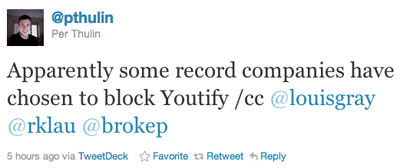
It turns out the rights owners for the music videos themselves, primarily record labels, put a stop to their content being played on the site, with Youtify specifically being blocked.

Per Thulin, one of the cofounders of the project, along with Karl Tannergard, initially thought he had somehow run afoul of YouTube's API rules, as users found the video player was rendered almost completely useless. But after reaching YouTube, they confirmed it was the record labels, and not they, who had stopped access.
Youtify Ground to a Halt Thanks to Record Labels' Intervention

That the record labels aren't immediately excited about yet another cool and innovative way to showcase their artists' content is no surprise. They've been late to the game and backward in practically every opportunity over the last 20 years. As Thulin wrote me in an email, the action caught them by surprise, especially as nobody made any attempt to contact Youtify directly.

Youtify's Playlists Show Holes Thanks to Rights Management

"Our new plan is to embrace and reward the artists and labels still allowing us to play their videos," he wrote. "We will let those artists and labels put ads in our application for free, and also let our community help spread these videos, generate good ratings, viewcounts, shout-outs on Twitter, etc. We hope that our growing community will generate enough noise for them to reconsider!"

Other Songs Not Impacted Play As They Always Have

Unless the record labels change their mind, the most likely culprit being VEVO, who owns a large portion of the videos that aren't working, Youtify, for the time being, is somewhat hobbled. A small fraction of the Top 100 songs play, while amateur content from "Best of YouTube" still runs as will many searched for playlists that don't intersect by the resistant labels.

The concept for Youtify is great. Even the user interface got a revamp in the last few days following the initial post. But the content is what it's all about, and if they are starved for content, users will probably not be made loyal. The question is will the labels let this one go, or will they remain obtuse?

April 22, 2011

Flickchart Plans Suit Against Movieweb for Infringement

Flickchart Plans Suit Against Movieweb for Infringement

Flickchart, the movie comparison site that has film buffs ranking their all-time favorites, for any decade, genre and many other ways to debate cinema, is inches away from taking Movieweb to court for "a rather obvious duplication of the concept, functionality, user interface, and formatting" of their site. An 11-page legal brief from Flickchart's lawyers to Movieweb, submitted Thursday, alleges theft, infringement and "a complete lack of any attempt by Movieweb to conceal its wrongdoing".

The legal brawl was sparked following the introduction of a feature on Movieweb's site called "Face-Off" last Saturday, April 16th, which they called "the coolest movie ranking app yet". Similar to Flickchart, the Face-Off feature let users rank movies in terms of which they thought was best, have head to head "face-offs" between favorites, and the ability to compare tastes with other users. All of these are features highlighted by Flickchart since the site debuted in 2009.

One Thumbnail Example of Alleged Copying by Movieweb

(Side Note: The initial post on Flickchart was on this blog in May of 2009)

Flickchart's founders, Nathan Chase and Jeremy Thompson, are not taking kindly to the new competition. The next day, April 17th, Chase posted a link to Movieweb's new offering on Twitter, saying, "Well, I guess they say imitation is the sincerest form of flattery, right?" By Monday April 18th, Chase posted a series of thumbnails comparing Flickchart to MovieWeb's Face-off on FriendFeed, the social service aggregator owned by Facebook, and said "we've already contacted our lawyer."

The series of thumbnails in that post, and the blog post issued Friday, April 22, draw up a clear parallel in terms of features and display from Flickchart and the new Face-off, including feature set, wording, placement, graphics, social site integration, and more. While it's entirely possible to create a similar site either in parallel or inspired by competition, the direction seems like a clear duplication of the Flickchart service.

The legal missive spares little in its wording saying "Movieweb has stolen the fruit of years of work... in such a blatant manner that, quite frankly, shocks the conscience." The filing reports the copying is fed in no small manner by the direct copying by one of Movieweb's employees, as it states "a managing editor of Movieweb registered an account with Flickchart in December 2009, and has logged in as recently as April 6, 2011." This would have been 10 days prior to the launch of Face-off, making any argument that Movieweb was unaware of Flickchart's similar functionality appear dead on arrival.

The brief says Face-Off! "would not exist" had it not been for the reproduction, duplication and copying of Flickchart, which violates the site's terms of service. If Face-Off! is not immediately removed from the site, Flickchart anticipates filing suit "to seek statuatory damages, actual damages, punitive damages, disgorgement of Movieweb's profits, injunctive relief and an award of attorney's fees and costs." Deadline was given for Face-Off's removal by 5 PM Pacific time on Friday April 22nd, and that deadline has since passed, with Face-Off! remaining up and running.

The full brief, hosted by Google Docs, is below:

April 18, 2011

Sosumi: Apple vs. World for Phones, Tablets & the Future

Sosumi: Apple vs. World for Phones, Tablets & the Future

Apple is not taking the war on iOS lying down. Bleeding from the wounds of a thousand cuts courtesy of the knives from the wide-ranging Android ecosystem, the company is taking on Samsung in the courtroom, targeting the Galaxy series of phones and tablets, just over a year from their initial suit against HTC, months after they sued Amazon for their App Store naming and six months after they sued Motorola for their use of multitouch. It's getting a little busy in Cupertino's legal counsel these days, and without suing their current nemesis, Google, outright, Apple seems to be throwing their significant market weight around. Despite being outnumbered, there's no question they believe they have both might and right on their side.

An early flashpoint in the return of Steve Jobs to Apple was the agreed upon cessation of legal wrangling with Microsoft over the famous "look and feel" lawsuit that claimed Windows had borrowed heavily from the Macintosh. Of course it had. But it was legal, thanks to shoddy early contracts. In the announcement of the stopped legalities, Jobs famously said, "We have to let go of the notion that for Apple to win, Microsoft needs to lose.'"

The ensuing (no joke) 13-plus years have put Apple in the driver's seat versus Microsoft in may places - in market capitalization, and leadership on music players, mobile phones, tablets and sheer brand desire. Microsoft didn't lose, per se, but they didn't have to get the verdict handed down from the courts. The verdict has been handed down in the world of public opinion and choice of quality products that saw the Zune dismissed as a joke and Windows Media become an also-ran, with CEO Steve Ballmer being a lightning rod of futility.

But this time around, Apple is the front-runner. They have market muscle, they have clear differentiation and leadership in hardware and software. They have an amazing app store with high quality software - a combination that is practically unmatched, even as Android has passed Cupertino by in numbers, and quality improves rapidly. This time around, they are not being loose with their contract work, patenting everything under the sun - from the implemented to the theoretical, and they are backing up those patent claims by taking on their competition directly. They refuse to go down without a fight.


It took Apple to change the way the world interpreted smartphones. It took Apple to introduce a successful tablet. It took Apple to turn the tide against peer to peer free file sharing and to a legitimate music and video store. In the years following their leadership, iTunes has in some ways been lapped by Spotify and other offerings. Android's flexibility means there are many choices in handsets which look remarkably like the iPhone. The Galaxy Tab, my tablet of choice, comes in sizes the iPad doesn't. But the volley of lawsuits smacks of preemptive desperation, not from a company in trouble by any means, but by one that wants to make sure it won't ever be.

In March of 2010, former Sun CEO Jonathan Schwartz wrote a post, titled, in a nod to Jobs, "Good Artists Copy, Great Artists Steal". In the post, he claimed that Apple going after the competition raised their visibility and relevancy to the market.
"Having watched this movie play out many times, suing a competitor typically makes them more relevant, not less. Developers I know aren’t getting less interested in Google’s Android platform, they’re getting more interested – Apple’s actions are enhancing that interest."
I can't say that more users and developers are flocking to Android directly because of Apple's moves, but it is wearing down on the good will that Apple has fostered with the general tech community. In a world where Apple has forged its own path, going practically partner free, owning their own pace and great margins, the rest of the world has been expected to choose a side opposed to their own - be it Android, be it Samsung's BADA OS, be it Blackberry or Microsoft Windows Phone 7 (see Nokia). By choosing to compete with Apple and to develop solutions that mirror the iPhones of the past, it's left them open for such courtroom drama.


At this point, I probably have nearly as many Samsung devices in my home as Apple devices. From the Galaxy Tab to my Galaxy S powered Epic 4G phone on Sprint and our TVs, I'm looking at Samsung logos many hours a day. So this particular lawsuit doesn't exactly give me the fuzzy feeling that Apple is going to enable a great electronics manufacturer to provide solutions users want.

At my last startup company, the market incumbent sued us immediately following the acquisition of patents they had gained through buying a dying market pioneer. The intent of the suit, which was baseless, was to prevent us from raising a $47 million D round, and to thwart our momentum. The lawsuit was a major distraction for years, and damaged our ability to sell to customers, until it was dismissed years later. I've seen the big market leaders come after the challengers to try and protect their turf, and it has me wary. I can't defend copying and a lack of innovation, but I hope customers don't suffer as the Valley goes to court.

October 27, 2010

Following Injunction, LimeWire Says Illegal Acts Are Illegal

Following Injunction, LimeWire Says Illegal Acts Are Illegal

I am of the belief that most people will take legal approaches to purchase goods or services if they are provided at acceptable market rates and are readily available. Only when market conditions are so out of whack with public perception, combined with free or near-free alternatives, do you see a dramatic uprising of illegal activity - as the public essentially revolts against the inflexible market makers.

But while most people are law abiding honest folks, there are of course exceptions who will flaunt the law because they can and feel the sheer capability they have to do so means they must. In the world of Peer To Peer (P2P), this has no doubt been the case. For every cash-poor college student trying to get the latest Green Day album off Napster, you may have others bootlegging new releases filmed in the theater on a handicam. And for the most part, both the college student and the video voyeur know what they are doing is "wrong", and there's also no doubt the networks they used were fully aware and supportive of said bad activity.

Napster kicked off the P2P digital music revolution, followed by many others in its wake, from Kazaa to Gnutella, BearShare, eDonkey, LimeWire and others. While the RIAA and its ilk moved to respond like drunken Neanderthals to shut down the users and its networks, many of them have eventually fallen. The latest to give up the ghost is LimeWire, who fell under a court-ordered injunction and was forced to stop supporting its file sharing software.

This is not news to those of you who are RSS addicts, like myself. But as someone who had previously downloaded the software, used as a backup if the TiVo failed, I got a note from them via e-mail today reporting the shutdown and ominously stating:
"DOWNLOADING OR SHARING COPYRIGHTED CONTENT WITHOUT AUTHORIZATION IS ILLEGAL."
Well, duh.

It's not as if the company didn't know exactly what it was getting into when it launched and supported its service. It wasn't as if it was naive enough to think its users were sharing PG-rated photos and freeware software. P2P networks like LimeWire are rife with dark content. So I have to smirk at the stark reminder that essentially states the obvious. Illegal things are illegal. They always have been. Just because software and technology makes it possible doesn't change the rules.

April 4, 2010

Google Buzz to Users: Do You Know What You're Doing?

Google Buzz to Users: Do You Know What You're Doing?

In the company's continued efforts to reduce the impact rising from the initial confusion around Google Buzz controls and transparency following the social network's initial launch in early February, which saw many claiming privacy breaches or unsavory connections related to the initial autofollow feature, Google will ask all Buzz users to reconfirm their settings tomorrow when they enter Buzz. This move, albeit a minor one, is likely another requirement to get the network's house in order after taking numerous body blows in the press - which have helped to sully Buzz's reputation and cloud its success to date.

The settings, which are already available in the Buzz section of Gmail settings, as highlighted in mid-February, ask you to confirm:
  1. Who you are following
  2. Those who are following you
  3. If the connections can be displayed
  4. How many sites you have connected to Buzz
The changes come amid the resurfacing of stories around undesired visibility of connections, labeled as "privacy flaws", and the news that congressional representatives are asking the FTC to investigate Buzz for allegedly exposing private information from Gmail to outsiders.

All the bad news, which hasn't seemed to ebb in the two months since the service debuted, has often unfortunately overshadowed the very capabilities of that network and its activity - and has made it hard for Google, a company with assumed tremendous resources, to compete more directly with Facebook and other social sites. In a note from Google's PR team tonight, they promise the setting confirmation screens will roll out gradually to users throughout the day, and a post summarizing the move will likely appear Monday afternoon. They also promise more updates in the future through a number of Google channels including their own Buzz (of course), and on their YouTube account.

In my opinion, many of the problems have arisen from standard Gmail users who had Buzz enabled, but either ignored the network or were unfamiliar with it. The promise is to show this screen upon entering Buzz, but I believe it would be even more transparent and effective to show this announcement to all Gmail users - regardless of their Buzz history. That's a big step indeed, but one that could go beyond the series of small steps the Buzz team has had to make to step away from the brink. I have sent an e-mail to their PR team to ask if that is planned.

I know who I am connected to and what I am sharing. You can find me on Buzz here: http://www.google.com/profiles/louisgray.

March 8, 2010

Step 1. Rip Off Doodle Jump. Step 2. ??? Step 3. Profit?

Step 1. Rip Off Doodle Jump. Step 2. ??? Step 3. Profit?

A year ago, I introduced you to a simple, but challenging, iPhone game called Doodle Jump. Produced by Lima Sky, the fun game, which took advantage of the iPhone's accelerometer and had you jumping from platform to platform in search of new high scores, has seen phenomenal success, passing one million downloads before the end of 2009. Thus, it's no surprise that its success has drawn what I perceived to be the highest form form of flattery - complete copying, possibly with the intention of making you think there is a new companion game to the app, called "Doodle Run".

This evening, I got a press release on the new Doodle Run, being told I could "Run, fly, and shoot your way through danger with Doodle Run for iPhone". The game's graphics even were reminiscent of the trendsetting Doodle Jump, leveraging graph paper in the background of what looked to be a hand-drawn figure and hand-drawn scenery.

From the Doodle Run Press Release...

I immediately thought Doodle Run was the companion game to Doodle Jump, and clicked through to the Web site for Doodle Run, only to find out it wasn't Lima Sky behind the application, but instead, a developer called eBattalion, whose other work includes games such as Nanoids, Love Link and FLIP, also on the iTunes store - all of which were updated on March 8th, for whatever reason. It seemed to me that the addition of the word "Doodle" to their new Run game was to seize on the popularity of Doodle Jump and trick casual visitors like me into downloading their latest 99 cents offer without thinking.

I e-mailed Igor Pusenjak, co-founder of Lima Sky, to ask if the game was theirs or if there was any affiliation. It is not, and my e-mail was the first they had heard of it. Igor responded:
"Your assumptions are correct. This is not our game nor do we have any agreement with the developers. Thanks for bringing this to my attention."
I sent an e-mail to the eBatallion team as well, and they said that "no copyrights or trademarks were violated in the development of Doodle Run and the title is very descriptive of the actual content in the product." Sam, the developer, also pointed me to other applications, such as Doodle Army and Doodle Bomb, that used the same language, going so far as to suggest Doodle Jump was "very similar" to another product, called Papi Jump.
"The word “Doodle” is intended to describe the graphic style of the game, not any association with any of the other numerous doodle-style games on the App Store."
On first blush, this seemed like bad intentions of the highest order, which could and does cause confusion in the marketplace. Even if this game is amazing, I am avoiding it on name alone. But eBatallion may have a point that Lima Sky doesn't have a monopoly on the word "Doodle".

March 2, 2010

Beware Apple Fanboys Interpreting Apple Lawsuits

Beware Apple Fanboys Interpreting Apple Lawsuits

The news this morning of Apple filing suit against HTC for allegedly infringing on 20 patents related to the iPhone is making its rounds through the Web, as Cupertino fights back against what it perceives to be unfair copying of its intellectual property. The suit, related to specific functionality of the phone, as well as user interface issues, is largely seen as Apple trying to slow the growth of Google's Android mobile OS, without suing Mountain View directly. And while precious few of us carry law degrees, and can offer deep analysis of why this suit has more merit than any other, the gut feeling is one I recognize from my decades as an Apple fanboy - Steve must be right and Go Apple!

John Paczkowski of All Things Digital explains the suit's array of patents, and which HTC phones, namely the HTC Hero, the Droid Eris, T-Mobile G1 and Google's vaunted Nexus One, are impacted by the suit.

Regardless of which mobile handset camp you sit in, the question that the iPhone dramatically changed the marketplace cannot be debated. From Apple's position, the many smartphones that have followed have increasingly approached the iPhone's previously unique capabilities, and no doubt, one must respect Apple's innovation in the space, which had previously one of compromise and mediocrity - with the possible exception of BlackBerry's product line. That Apple is allowed to protect their intellectual property is serious business, and if they truly find their work was infringed upon, then serious business says lawsuits can be required.

But that exact same voice that tells us Apple fanboys to root on Cupertino is the same one that laughed in the face of Nokia's lawsuits, which similarly claimed the iPhone infringed on ten patents of their own last fall. In that case, one can smirk and look at Nokia as a has-been handset maker who fell behind the times to a more nimble Silicon Valley legend.

Could it possibly be that Nokia's lawsuit is every bit as valid as Apple's against HTC? Ask any Mac fanboy, and the answer should be no - regardless of the visible data. In an Apple fanboy's mind, there are two eras of phone: Before the iPhone and After the iPhone. All phones prior to the iPhone are irrelevant, and all smartphones after it are mere copies.

In Silicon Valley, and many parts of the world, there is a saying: "Small companies innovate and large companies litigate." So what to make of a large company like Apple who somehow manages to innovate but plays the courtroom as well as Perry Mason? And how would the Web react if Steve Jobs and team had gone all in and filed suit against Google? Relationships and families would be torn asunder as people scrambled to choose sides. So while this morning's news makes us all raise our eyebrows, and think again about the world of innovation, patents, and business, don't expect those of us who have been drinking the holy water of Cupertino to see things on a level playing field - because when Apple is involved, they're on another field altogether.

November 30, 2009

Disclose This: I Can't Disclose Everything Everywhere!

Disclose This: I Can't Disclose Everything Everywhere!

Though hubbub around the FTC's plans to require bloggers to disclose relationships with companies, services and products has lessened over the last few weeks, the December 1st date for enactment is rapidly approaching. As promised before, and many other times, I will make any relationships I have that are beyond "typical" clear to you as best as I am able. But, as you can expect, as communication vehicles evolve, even today's best-attempt laws aren't ready for how I am operating. With so much of my downstream activity being automated due to activity elsewhere around the Web, the potential for disclosure sometimes doesn't even come up.

Long-time site visitors know that for the first 3 years of my writing on the blog, I was extremely careful not to talk about my company, its employees, partners, customers or even talk about the industry. In 2008 and this year, I started to have some unpaid advisory roles that included a minor equity share, and told you about that, disclosing where it made sense. And now, with my new role at Paladin Advisors Group (@paladinag), I am growing the client roster, attracting some enterprise companies, and startups who want to work with me more closely.

So that's a good thing, right? I agree. I am excited about the new possibilities as I sign up new clients and advisory roles, because my entanglement in the Web is changing - from an interested observer and consumer to one that can play more of an activist role, shaping the tools we are using now or will use soon. Yet, as I add such entanglements, I am thinking about where I can possibly disclose - not so I am covered by the FTC, but so I am covered with you, because your trust is more important than whatever the FTC dreams up.

(And to be honest, I've given it a lot of thought, and it's probably true that in many cases, advisors to a company, or its VCs, should be trusted a great deal more than a typical consumer, as they actually know the product and company better than just about anyone)

Here's where I perceive gaps from the FTC to my workflow:

1) Archived Posts and Discussions of Current Clients

Very often, my new clients are ones I have written about before. My previously writing on them was no doubt due to my interest, and they came to know me either prior to the story, or because of it. Now that I have a working relationship with a client, for example, with my6sense, should I retroactively go tag all previous posts that mentioned them with a new Disclosure text?

Also - should it be perceived that maybe I covered them in a positive light before, because I was angling for an advisory role? Even if there was no professional role before, should one assume that was the case, or is this coincidence?

2) Liking of 3rd Party Content On Current Clients

I won't even waste my time reading every word of the FTC's script, but other folks, including SiliconAngle's Mark Hopkins have done the dirty work. The obvious places to disclose are, of course, in blog posts, and in Tweets. But what about other people's content, where I can add visibility to their own comments, even if I was not the original author?

For example, should I not "Like" comments by the client or other shares of the client's work that others have made on Facebook and FriendFeed? Is it assumed that I would only "like" a post about a feature release because of the relationship? What about adding their items to Delicious or other networks?

3) Automation Can Prevent Disclosure

If I see a blog post by a client and share it in Google Reader, do I also have to add a note when I share that they are a client? What if I retweet their official Twitter account? Notwithstanding that Twitter won't let you make any additional comments on their new retweet functionality, one almost runs out of characters.

If you also remember that I have a fairly robust social media workflow, much of the way I get data around the Web is by letting other networks do the heavy lifting. Bookmarks I make on Delicious and items I share on Google Reader automatically get tweeted - and I never get a chance to disclose - if there is any relationship. This is essentially what could be construed as a crime of omission, one that is not egregious, but could still be looked at sideways, if one feels that I did not make best efforts to make a relationship clear.

In October, I said the disclosure rules would have little effect, largely because I believe people who skirt the rules today will continue to do so, and while there will be some showcase examples of enforcement, they will be a small percentage of infractions indeed. I still don't think this will be dramatic. But it always seems like the people who try to change the rules are changing them for the way the Web was, not the way the Web is. And if I can easily find loopholes or places to work around the rules, the people who are the real bad guys will walk all over this thing.