Showing posts with label Foursquare (38 posts). Show all posts

August 16, 2014

When Priced for Perfection, Startups Not Given Room for Error

When Priced for Perfection, Startups Not Given Room for Error

While I maintain the meme of a "billion dollar startup" is a myth, there's a clear reality that some early stage and often pre-revenue, companies are quite publicly obtaining historically high valuations. These big bets by angels and venture capitalists are made with the expectation their investments will pay off, and masterfully well.

Sometimes they do, but often, they don't, and the gap between initial expectations and reality can put incredible pressure on the funded company - not just from those who put money in, but from a closely watching press, and users who want to be part of something exciting.

When a private company sees incredible media visibility, and scores a fast-ramping, highly active customer base, it's usually assumed similarly climbing revenue isn't far behind. For game changers like Facebook and Twitter, who commanded sky high valuations privately before earning them publicly, this made sense. But for companies who are seen to have missed expectations, the descent in public perception and media love can be fast and steep - forcing pivots and other odd behavior  that can be somewhat puzzling to the outside world.

Hey, Didn't You Use to Be Cool?


This awkward stage is where you see one time shoo-ins for the next big thing, including names like Foursquare, Path, Fab.com and even Square - who now have many people scratching their heads. Instead of talk of near-term IPOs and exceptional user adoption, you see things like Foursquare taking on debt financing and spinning up new apps that bear little resemblance to the much loved 1.0,  Path taking money from an Indonesian VC most people in the Valley have never heard of, Fab.com enduring many rounds of layoffs and Square also taking on debt financing after a rocky year. None of those moves are what I'd bet their founders were hoping for just two or so years ago - when they were rumored to be turning down acquisition offers and debating preferred ticker symbols.

These mega-hyped startups aren't "too big to fail", but they just might be "too big to pivot", and expectations are so stratospheric, that anything less than perfection is perceived as failure.

My Own Experience With a Priced to Perfection Startup

If you allow for a little self-indulgence, I experienced this very thing at BlueArc early in my career, at the end of the first dot com bubble, when next generation storage companies seemed poised to take advantage of unprecedented data growth, and quite possibly unseat market behemoths like Sun Microsystems, EMC and NetApp. In May of 2001, we raised a stunning $72 million round, for 20% of the company, valuing us at about $360 million. Adjusting for inflation and the sky-high valuations of today, that's probably comparable to being valued above a billion now.


Our $360 million valuation was based largely on promise. We had exceptional technology, smart leadership and a good customer pipeline - or so we thought. But we didn't even have revenue yet. And over the next few years, as things didn't go perfectly, we saw the CEO replaced more than once, and later funding rounds forced employees to accept reverse stock splits - first at a whopping 550 to 1 exchange, and later, at a 40 to one exchange. This made my 15,000 options I'd gained when joining the company essentially worthless, and there wasn't a week that went by when we weren't confronted with press inquiries or rumors on the street that we were about to go out of business. (See: How My Stock Got Reverse Split 22,000 to One)

While the company was eventually sold (and not for pennies) to Hitachi Data Systems in 2011, the decade-long road, executive turnover and significant rounds of layoffs weren't anything like those first investors had hoped. The people behind funding our Series A, B and C rounds were largely absent in later raises, as was practically the entire management team. Our customer base also was radically different, as were the market players, with peers like 3Par and Isilon seeing significant success (and larger exits). While we didn't crash and burn as naysayers thought we might, we were victims of our own predicted fast route to success.

So What's the Solution?

There are multiple views to raising and using venture funds. Some would argue to raise only what you need to get you to the next stage, to reduce dilution, maintain control, and lessen demands from outside influencers. Others would say to get as much funding as you can, to provide a long runway, allowing for tinkering and learning what works best. Others still say to raise about 18 months worth.

By taking the big money at big valuations, you're essentially asking for the spotlight, and if things take longer than expected, or aren't as dramatic a success as expected, people's patience grows thin, and the gap between reality and expectations can take a toll. It seems the biggest complaints about these awkward companies who were once youthful darlings isn't that they don't provide a good service now, but that they're not what we expected. After all, you can still get great tips on Foursquare, buy interesting products on Fab.com, take payments on Square and share your moments with friends on Path. But doing so in 2014 feels a little different than it did in 2011, when you were the start of something new.

In some cases, the startups (if that's what they are) are victims of their own rapid rise to success and visibility. If they had instead raised less money, at lower valuations, and not milked the hype machine for what it was worth, they'd be given the benefit of a longer road to success. What I'm seeing now is that we expect them to grow up fast - and if they don't hit it big, we're on to the next thing. But industry interrupters like Google, Amazon, Twitter, Facebook and their equivalents don't come around all too often, and they have become household names in large part because they are the unicorns - the exception to the rule, and not the rule itself.

Just like individual investors can get caught up in fast-rising markets, and find themselves buying at the peak of the market, their funds trapped as value of their owned stock decreases, so too can company executives and employees, with underwater options, or VC partners holding underperforming funds. After a while, you just want to make something out of that investment, just to see some kind of return. And when that pressure finally reaches a tipping point, it gets really uncomfortable. If priced at perfection, there's really no pleasant alternative to just getting it all right.

Disclosures: I work at Google, which partners with and competes with many of the companies mentioned here. No bias intended. I spent 8 1/2 years at BlueArc, and we also occasionally competed with or partnered with the many storage companies mentioned. I did get a check as a common stock holder of BlueArc shares when HDS finally bought them in 2011, but I certainly wish it had been bigger.

June 29, 2014

50 Top Startups from 2010: Acquired, Pivoted or Still Going?

50 Top Startups from 2010: Acquired, Pivoted or Still Going?

Editor's Note:

This is one of the longest posts I've made - in length and duration. It's said that one year in the life of a startup is the equivalent of dog years when compared to more established companies. So looking back to a post I made just over four years ago is the equivalent of a generation of startups, and a quick glance at each shows what you'd expect from a generation of change - with some names graduating to the big time, others running in place, and yet a good chunk who've disappeared altogether.
My goal with this June 2010 post was not to highlight the top private companies, as I withheld inclusion of many of the bigger companies, like Facebook and Twitter and Tesla. Instead, it was to show 50 I was following that had promise, leveraging a tool from Symbaloo. I highlighted 50 top startups on the Web. I was reminded of this effort when, at the conclusion of my kids' kindergarten year, many teachers featured computers with Symbaloo organizing their Web.

So let's go back to the list of fifty, and see what's happened. How many are on the verge of hitting the big time, how many are out of business, and how many got acquired?
Walking Down Fifty Top Startups of 2010

#1: Foursquare Status: Independent
At the time of the post, there was no buzzier company than Foursquare. It was the undisputed leader of the checkin. It beat back competition from Facebook Places, and its places database became the backend of even more third party apps. But its Swarm app has seemed to fall flat among users, and nobody's quite sure where the company's headed.

#2: Spotify Status: Independent
At the time of my post, Spotify hadn't even made it to the US. Now it has 1,000+ employees and is the clear market leader in streaming music, with Apple's Beats and others chasing. The company is looking to finish the music business revolution started by Napster more than a decade ago, and remains one of my favorites.

#3: Automattic Status: Independent
Automattic, the company behind WordPress, isn't going anywhere. They've got about 250 employees, and have been acquiring small services like Intense Debate, instead of getting gobbled themselves. They haven't had a big exit like Tumblr, or become a small part of a big company, like Blogger at Google, but they're a lead option for publishing, from blogs to full-featured sites.

#4: Posterous Status: Acquired by Twitter
Posterous was acquired by Twitter in 2012, and while they initially promised their Spaces service for private blogging would remain live, it was quickly killed, becoming yet another acquihire. They'd raised $10 million overall.

#5: Blippy Status: Pivoted beyond recognition
The Blippy I liked didn't turn out how I had hoped. Its initial privacy bump with credit cards being revealed online came at an inconvenient time, right as they raised funding and were poised to come out of the gate strong. That, combined, with an audience skeptical of their focus on oversharing, meant they had to do the dreaded pivot. Phil Kaplan, cofounder of Blippy, left with momentum flagging. Now they're an app for animated GIFs.

#6: SlideShare Status: Acquired by LinkedIn
In 2012, Slideshare was acquired by LinkedIn for a rumored $119 million. That'd probably be around $300 million in today's inflated market.

#7: Tumblr Status: Acquired by Yahoo.
Following incredible traffic growth, Tumblr became the biggest acquisition made by Yahoo CEO Marissa Meyer, who has a tough task to transform a Web pioneer. The $1.1 billion deal in May of 2013 was huge in many ways.

#8 TweetDeck Status: Acquired by Twitter.
The social networking client (which debuted here in 2008) was won by Twitter in a bid above $40 million, after a rumored buy from Ubermedia. TweetDeck founder Iain Dodsworth has since left Twitter, and is working in stealth on Gathers.

#9: Square Status: Independent
The company, headed by Jack Dorsey, cofounder of Twitter, made a stake for itself in an incredibly challenging market, and you can see their payment readers in small businesses or cabs. You could argue they got too big too fast, or margins are tight, but they've neither crashed nor graduated since the first report.

#10: Quora Status: Independent
Quora is an odd duck. They were a Web darling at the end of 2010, founded by early Facebookers, and attracting engagement from a who's who of Silicon Valley. With one founder jetissoned, and the company now being a fifth wheel at Y Combinator, it's not sure whether they're the next Wikipedia or Yahoo! Answers. Nobody really questions the quality of the discussions, but everything else is questioned.

#11: CinchCast Status: Pivoted beyond recognition
The audio Web publishing service I really liked, and used regularly, is vaporized, as was my published content. The shadows of that plan show a site focused on cloud-based conference calls and Web seminars. Meh.

#12: Sports Blog Nation Status: Independent
If you don't remember the name Sports Blog Nation, I'll bet you've seen their content. This one time sports publishing empire expanded to what's now Vox Media, taking on smart writing for tech and much more. I've been lucky enough to see this happen in front of us over the last decade, and consider the founder of SB Nation, Tyler Bleszinski, a fellow A's fan, a good friend. If there are any questions about Vox Media, it's whether the content business can be valued in a world where it's so easy to make it for free.

#13: Bit.ly Status: Independent.
Once Twitter switched to its own t.co URL shortener, bit.ly's perceived value for short link and analytics dropped dramatically. The company refocused on performance tracking and engagement, and is still plugging away, even if you don't hear about them daily, as you used to.

#14: my6sense Status: Independent.
Months after my initial post, I expanded my time helping my6sense from consulting to something closer to full time as VP of Marketing. We launched a lot of cool tools, but there wasn't a big enough market (or funding) to make that dream a reality. So I left to Google, and the team refocused on mobile advertising. Founder Barak Hachamov is now working on Samba.me, a reactive video messaging play.

#15: Thing Labs Status: Acquired by AOL.
Thing Labs, and the Brizzly team, were acquired by AOL after getting an offer in July of 2010, which I had incorrectly hypothesized was from Foursquare. Soon after, Brizzly was shut down, and the team splintered inside of AOL, to take up roost at Avocado, Dropbox and other places.

#16: Plancast Status: Pivoted beyond recognition
Plancast was given a funeral and the post-mortem was written in early 2012. The social events sharing company just didn't take off. The site still exists, focused on planning and event management.

#17: Seesmic Status: Acquired by Hootsuite.
After a bazillion pivots, and clear buddying up with Salesforce and Microsoft, the remnants of Seesmic were sold to Hootsuite in 2012. Founder Loic LeMeur seems to have retrenched into his annual conference, LeWeb.

#18: Lunch.com Status: Independent.
Lunch.com, a community around relevant news and opinion, has been very quiet - but seems to have its diehard users, as many of these sites get. I'd bet it doesn't cost much to run, so there's no urgency to shut it down, but it's hard to predict a rebound.

#19: Gowalla Status: Acquired by Facebook.
After years of chasing Foursquare's fumes, Gowalla's team waved the white flag, and was acquired by Facebook in December 2011.

#20: DropBox Status: Independent.
DropBox is a consumer cloud giant, and has managed a significant position, even when faced with industry competition from practically all the big names: Google, Microsoft, Apple, Salesforce to name a few. The world awaits what will happen once DropBox goes public.

#21: Lazyfeed Status: Dead
The lead developer made many intesting apps, including a Twitter and RSS mashup LazyScope, and Joint.im, but users haven't always followed. So Lazyfeed is gone.

#22: Hunch Status: Acquired by eBay.
The consumer-focused personalization company pivoted to providing services for businesses, and looks like a good fit for the online auction giant.

#23: Ecademy Status: Acquired by Sunzu
Ecademy was acquired by Sunzu in July of 2012, and the open business networking community's content was later vaporized. Most the original Ecademy team is now working on social media tactics with Scredible.

#24: Xobni Status: Acquired by Yahoo!
Initially rumored to join Microsoft in 2008, the address book apps and plugins group was acquired by Yahoo! as part of Marissa Mayer's buying binge in the summer of 2013.

#25: Tweetmeme Status: Dead.
Nik Halstead's smart consumer facing link site that pulled content from Twitter was sunset in 2012 in favor of analytics and more professional work, a move that made sense when Twitter reduced opportunities for consumer-facing developers.

#26: Feedly Status: Independent.
Even if Google Reader is dead (a moment of silence, please), RSS isn't. Feedly was among the most obvious to benefit from the feed reader giant's closure. Nobody really asks how Feedly makes money or what its future plans are… just that it keep working and doing well. It does. As they debuted here, I'm always happy to hear good news from team Feedly.

#27: Klout Status: Acquired by Lithium Technologies
I despise the idea of Klout. Independent arbiters giving you a score is distasteful. But that didn't stop the company from being famous (or infamous) and at least one other company deciding that their stockpile of data and faux reputation was worth paying for. So that happened. Congrats to the team.

#28: Justin.tv Status: Independent
Justin.TV is still around, while most of the team(including Justin himself) now is working on Twitch.tv, a games streaming platform. Justin.TV recently told customers that videos will no longer be archived, since nobody was watching anyway. I have to assume most people at this point are watching YouTube.

#29: Amplify Status: Dead
The Amplify we once knew, which encouraged you to build and share something between a tweet and a blog post, is gone - shutting down in February of 2012. Ironically, they pointed users to web clipping service Clipboard, which itself was shut down after being acquired by Salesforce.com a year or so later.

#30: OneRiot Status: Acquired by Walmart Labs
After pivoting from the unfriendly world of real time search to the world of ad networks, OneRiot was picked up by the active, if not lofty, palace of Walmart Labs in September 2011.

#31: Lijit Status: Acquired by Federated Media
Lijit has had its share of bumps over the last four years. The company was picked up by Federated Media in October 2011, and in early 2014, spun out when Federated Media sold off its content business in the beginning of this year. Now, Lijit claims they're back, under a new name. Lost? Me too.

#32: Echo Status: Independent
Echo may first have been known as a comments competitor to Disqus and others, and was among the first to capture reactions from the real-time stream. They successfully moved to aid enterprise companies with adding social platforms and engagement with their platform. They're quietly executing - even if an endgame isn't obvious.

#33: MyLikes Status: Independent
MyLikes bills itself as the largest content and advertising platform in the world and has a top-notch board. The social advertising platform raised just under $6 million in 2010, and isn't noisy about trumpeting its success. Side note: Robert Scoble and I were introduced as advisors in early 2010 when they raised seed funding, but things are quiet on that front.

#34: Outbrain Status: Independent
Outbrain, like it or hate it, is most well know for its “more like this” or “you might also like this” type of content ads spread across the web. Their goal is more engagement on content, and they do a great job at it. They've raised nearly $100 million, with the last round being in 2013.

#35: DailyBooth Status: Acquired by AirBnB
In a “you didn't see that coming” deal, the photo sharing site team behind DailyBooth ended up as an acquihire for dodgy rental service AirBnB in the summer of 2012. Meanwhile, DailyBooth is dead.

#36: Gist Status: Acquired by Blackberry (RIM)
Gist, the one-time contacts manager, was acquired by Blackberry in early 2011. A little more than a year later, news came that Blackberry would shut down the original site. Oh well.

#37: Soluto Status: Acquired by Asurion
The cloud service for remotely managing devices was acquired for more than $100 million by insurer Asurion in late 2013. Maybe not an exciting ending, but the checks still clear the bank - a good turn for $18 million funding by VCs.

#38: Tungle.me Status: Acquired by Blackberry (RIM)
As with Gist, social calendaring app Tungle was acquired in early 2011 by Blackberry to improve their software suite.

#39: Qwotebook Status: Dead
A fun idea for a quote repository and database, started by my good friend Drew Olanoff (and listing me as an advisor) didn't really get off the ground. Next time.

#40: Regator Status: Independent
Blog and content directory Regator is still tracking blog trends and aggregating news from the Web. But I haven't heard a word from them in some time, and they're not talking.

#41: Untitled Startup Status: Independent (with a new name)
Damon Cortesi's untitled startup ended up being Simply Measured. The social media analytics company now sports 159 employees and says it's used by more than ⅓ of the top 100 global brands. Hats off to you, Damon. I knew this was one to watch.

#42: Twazzup Status: Independent (but mostly dead)
Twitter's battles with developers over web clients and search made some promising ventures less so over time. Founder Cyril Moutran lists his time at Twazzup as ending in 2011 on his LinkedIn profile, spending more time on his role with Feedly.

#43: The Cadmus Status: Dead
The Cadmus is no longer being maintained, but the team behind the Twitter analysis tool is working on a host of new products under the name Anomaly Innovations in San Francisco.

#44: Branchr Status: Dead
The one time text and image-based pay per click advertising company, who once claimed hundreds of millions of ads on tens of thousands of sites, seemingly vaporized. Web site? Gone. Twitter account? Dead. Huh.

#45: Graphic.ly Status: Acquired by Blurb
Graphic.ly, the comic book enthusiasts platform, was integrated into Blurb earlier this year, having raised about $10 million in funding.

#46: BlockChalk Status: Acquired by Klout
BlockChalk, a Twitter-centric community bulletin board, renamed itself BlockBoard, and was later turned into an acquihire by Klout (see above) in February 2012.

#47: FitBit Status: Independent
FitBit, in my view, lit the fire of the wearable gadget revolution. They're the default fitness tracker, competing with Nike, Jawbone and others, and I've been a devout user for the better part of two years - even if I wasn't at time of this post in 2010. So far, they've managed to keep independent. I'd see them being picked up by a big company before seeing them go public, but if they did, I'd invest.

#48: RockMelt Status: Acquired by Yahoo!
Yahoo acquired Rockmelt in 2013 and the products were shut down shortly afterward, despite rock star visibility at launch, and the support of Marc Andreesen.

#49: Live Intent Status: Independent
LiveIntent is focused on email advertising and engagement. They've been at it since 2009. And they're hiring. But if I had to do this list again, they're probably not top of mind.

#50: Fabulis Status: Pivoted beyond recognition
I loved Jason Goldberg's Socialmedian, and launched it here. Fabulis was his next attempt, a social network for gay men. I liked the idea, but wasn't the target market. When Fabulis pivoted into Fab.com, and had a meteoric rise for flash sales and other online commerce, I was again cheering on Jason from the sidelines, and root him on through the subsequent downturn. We'll see what happens with Fab, but Fabulis is most certainly dead.


Summary

I never claimed I was ranking these fifty startups as the most likely to succeed, or ranking them in order, although it's easy to see the first ten named were stronger than the last ten in my list. But when the list was posted and people questioned the longevity of these companies, I knew it would take time to bear it out. With four-plus year hindsight, we have those results.

Of the fifty companies named, 21 are independent, 19 were acquired, four pivoted, and six are dead. I expected more to be dead, outright, but it shows me many companies in search of an out found a willing corporate partner - be it another startup, or a large company, be it Blackberry, LinkedIn, Yahoo! or eBay. Tumblr sold for more than a billion, and Spotify is valued at much more. Others, no doubt, went for nothing except a handshake. Interestingly, none of these 50 were acquired by Google.

If I were to do this again, with hindsight, there'd be less focus on Twitter tools, but in 2010, one thought Twitter's platform was not just an interesting testbed, but potentially a big business. And I didn't even mention Uber.

Meanwhile, Symbaloo, who hosted my original list of fifty… they're still around - and found a niche.

December 10, 2013

How the Moves App Can Track Your Steps, Places and Commute

How the Moves App Can Track Your Steps, Places and Commute

Ever since jumping feet first into the Fitbit fanclub last year, I've been quantifying just about every step, finding excuses to take a walk, parking further away, and generally being more active. I lost 30 pounds from my peak weight, and have found many people doing the same, as we battle on the weekly leaderboard for the most steps. If I don't have my Fitbit tracker on, my activities simply don't count. But on top of my daily Fitbit habit, for the last few months I've been tracking my comings and goings with the Moves app for Android, and have found it a strong companion that tells me information about where I've been, even if it lacks the social component that has Fitbit play such a big role in my need to be competitive.

Unlike Fitbit, which requires a dedicated device, be it a tracker or armband, to glean data from your walking, running or cycling, Moves leverages the built-in accelerometer and GPS data from your phone to pick up on your step count. So if you're someone who doesn't want to carry yet another device, and you just want to keep tabs on your own activity, Moves does exactly that.

     
A Big Day On Moves Shows A Long Walk on the Steven's Creek Trail

Moves initially didn't get a lot of interest from me for three reasons, after colleague +Scott Knaster introduced me to the app. The first is that when using Fitbit and Moves in tandem, Moves almost always counts 10 to 20 percent fewer steps than does Fitbit, for the same ground covered. Having been a staunch believer in Fitbit's data, and always wanting the higher numbers, Moves lost. Second, Moves always requires you to have your phone on you, so if you run low on battery, your steps don't count. Fitbit's battery goes for days and that's never been an issue. Third, Moves is done in complete solitude. There's not yet any ability to follow people or share with them your activity - which is a keystone of Fitbit's intrigue.

You Know It's Bad When It Takes an Hour from Mountain View to Milpitas

With all that out of the way, Moves gets more interesting for what it does do. As I move from place to place, Moves makes a best effort to find destinations along my path. If I go to the office, Moves taps into Foursquare's map data to find the office building. If I am on a scenic trail, again, Moves taps into Foursquare. And Moves is smart enough to know, based on my speed, whether I am walking, running, cycling or driving - which is labeled as transport.

The latter bit, transport, now makes it easier to show my wife just when I left the office, or how long I was in the car, or can be shown to demonstrate just how ridiculous traffic is getting in South Bay with the tech economy doing so well.

Two weeks ago, Moves made its first move (see what I did there?) into making their data get out of your phone and possibly onto the Web (like Fitbit) and into new applications with their launch of accounts and connected apps. One can easily see a future with your historical data on the Web or sharing with friends by email or other connected services, including Moves Export, which promises to take the activities you're already doing and take them to RunKeeper or compare with Facebook friends, further bringing the two apps closer.

You can find Moves free on Google Play. If you're an iOS user, don't fret, Moves is on the App Store for 99 cents too. It may be double counting for me to track all my steps twice, but as you can see, there's a good reason. Even if you already use Fitbit, check out Moves. And if you don't, there's really little reason you shouldn't give it a shot.

Disclosure: It could be assumed Foursquare Maps compete with Google Maps, and yes, I work for Google. But then, I don't see how that makes this post biased more or less. I just like writing disclosures.

June 15, 2012

Pictures, Or It Didn't Happen on Mobile

Pictures, Or It Didn't Happen on Mobile

Foursquare made waves two weeks ago with the launch of their newest application, which more broadly emphasized recommendations, discovery and tips from friends than the original use of the app - a simple checkin, alongside the race for badges and mayorship as you traveled from place to place. Some sites called it the death of the checkin altogether, not wanting to miss an opportunity to be sensational.

But the application's refresh did more than take the focus of all my minor comings and goings. It made photos an even greater part of the experience, putting pressure on me, more than ever before, to include something visibly pleasing as part of the checkin. With the upgrade, Foursquare joins many other leading social apps that have rallied around photos as a major part of their approach to mobile.

Images from my Path and those from a friend.

Instagram's recent sale to Facebook for a gaudy $1 billion thrust them into the spotlight, as the photo sharing app had users preferring its emotion-grabbing images and filters to the standard fare seen on the largest social networks. Given Instagram's iOS-only approach during its early period, I'd never gravitated toward using it, but many embraced its simplicity - the presentation of photos, and encouragement of light social signals for friends to react.

In some ways, this is similar to the Path app, which initially made waves for going mobile only, and focusing on a 50-friend limit, when other networks let you friend freely into the thousands and tens of thousands. Their push for an intimate network, making every share a selective one, where you can see who has liked a moment, or even just seen it, puts more focus on the user to share something meaningful and personal, instead of the mundane.

Now that Path's on Android, and with people I respect, like Shak Khan (formerly of Spotify) and Dylan Casey (formerly a colleague at Google) on board, I've been using the app a lot more, even if it's just as a simple way to send high quality photos to Foursquare. It's been fun to tap into the casual photos and moments from those friends on Path and see things from their view, in color.

Now I Feel Guilty If I Check In Without a Photo, Even At Home

Of course, like Path, selective sharing has been a hallmark of Google+ since the network's launch a year ago. The idea of getting the opportunity to share the right content to the right people at the right time, parallel to that of how you share offline, has struck a chord for privacy-seeking individuals, families and groups. But it's also been a good showcase for photographers who want to bring the images to the world. Prominent camera slingers like Thomas Hawk and Trey Ratcliff had gained followings in the millions, and there was even a  conference in San Francisco for the Google+ Photographers community at the end of May.

On mobile, as many noted, the refresh of the Google+ app, first on iOS and quickly following on Android, made photos take center stage. Like Instagram, Path and Foursquare, the mobile app displays photos to the full width of one's screen, letting the images do the talking. While Google+ also is home for lengthy comment threads, and longer text-centric posts, if there is an image available to display in the post, it gets the headline, and everything else is below the fold.

Google+'s Mobile App Delivers Full Bleed Photos and Full Color

The move toward photo-centric experiences in social mobile apps is one that reflects a few things - that smartphones are increasingly capable of taking high quality images, but also having improved displays to bring pictures to life, that wireless download speeds can handle the increased demands of a photo-centric experience, unlike the days of WAP and text-only mobile sites, and that users love it when updates from friends come to life.

Facebook Also Pushes Large Images In Its Mobile App

Google's Chrome browser was famously named as a reverse expression of its qualities. Chrome referred to all the borders and features that surrounded the app's content. Chrome took them away, for the most part, going to the edges and trying to put the emphasis on the pixels inside the browser window. These apps, including Facebook, on the news feed and individual timelines, are doing the same - putting photos in the center of the experience, and encouraging lightweight social actions.

As many people are turning to social interactions with micro-updates and away from lengthy text-centric blogs, something beyond incredible prose has to catch one's attention, and it's becoming photos - from memes to LOLCats, Instagram, Path, Foursquare or others, you can see how the photos on mobile really have become as powerful as a thousand words.

Disclosures: I am a Google employee, and have worked closely with the team focused on Google+ Mobile. One can assume that in some way Facebook, Path, Foursquare, Instagram and others could compete with various aspects of Google's different products.

May 31, 2012

Fifteen Signs You're a Fitbit Fanatic

Fifteen Signs You're a Fitbit Fanatic

Two years ago (to the day, surprisingly), I highlighted four squared (16) ways to tell if you've become a Foursquare addict. In the ensuing two years, I've continued to enjoy my regular checkins from place to place, but I've got another obsession that also tracks my comings and goings - not in where I go, but what I do, with the Fitbit. Fitbit, as I described in March, has the potential to take your every day activity and match you up against friends, rewarding you with virtual badges and making you exercise more than you might otherwise.

I'm having a blast telling everyone I know who doesn't already have a Fitbit tracker to go get one, and those who do, I'm recommending we connect so we can trade stats and urge each other on. I even picked up a Fitbit Aria scale to wirelessly track my daily weigh-ins and see if that number is trending the wrong way. With that in mind, I thought it was time to trot out fifteen ways you can check if you're a Fitbit fanatic.

1. You take the long way everywhere - and find yourself scheduling meetings or lunches at a place far more convenient for those you're meeting than yourself. You walk, of course.

I'll take the stairs, thank you.

2. You look incredulously at people who take the elevator, even if you're going to the top floor.

3. You've figured out what optimizes you for the most steps across a distance - walking, biking, skipping or jogging.

Time to fall asleep: 5 minutes! I can beat that!

4. You'd pretend to be asleep when your partner wants attention at night because you don't want to mess up your "Time to sleep" statistics, and you think you can set a new record.

Yes, that would be me, pounding out 20,000+ steps on the last day I'd get credit.

5. You read that Foursquare was about to discontinue their 20k step Fitbit badge on June 1st, so you spent much of May 31st walking around in circles, just so you could get it.

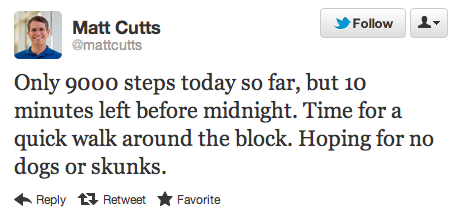
6. If people ask to friend you on Fitbit, you ask them their daily average of steps, and only accept their friendship if you think you will beat them. (I'm looking at you, Matt Cutts)

7. You don't talk about how far things are in the number of miles or kilometers, but instead in steps.

8. You consider getting one of those fancy walking treadmill desks.

9. You find yourself wanting to look at how many flights of stairs you've climbed in the middle of the flight, and you have to restrain yourself until you get to the top, just so you make sure it counts.

Good luck Matt! Hope you reach 10,000 by midnight!

10. You find yourself just a few steps away from your usual goal, consider if you can hit that number before the clock hits midnight, and then go do some laps in the kitchen.

11. While on a walk with a friend who also has the Fitbit, you look at each other's starting step count, and ending step count, compare it to yours and wonder aloud as to whether Fitbit is accurate, if your units are calibrated correctly, or if it's something to do with the other person's height and stride. (My mom and I actually did this on Monday)

12. You memorize your daily weigh-ins and body fat percentages from each morning's weigh-in, and can correctly anticipate both the next day to the tenth of a pound or percentage point.

13. You actively contemplate whether it makes sense to adjust your Fitbit goals to match your real world activity, or adjust your real world activity to match your Fitbit goals.

14. When you type F into your browser's URL bar, it autocompletes Fitbit instead of Facebook.

15. Every time you take a step while not wearing the Fitbit, you're annoyed.

Are you as silly about Fitbit as I am? I am loading up on people to connect with on that service. Find me at [email protected] and we'll compare steps.

March 9, 2012

Fitbit: Virtual Badges Influence Real Behavior

Fitbit: Virtual Badges Influence Real Behavior

I am not going on a diet - and I have no interest in going to the gym, even if Google makes it incredibly easy to eat healthy on campus, and gym membership is free with equipment abundant. It's just not me. But despite this clear disinterest in my making any kind of physical life change, I have been wearing a Fitbit the last week, obsessively counting my steps, climbing the stairs and tracking how many miles I make on foot. I've even been wearing the lightweight tracker at night to see how long and how well I sleep - working to optimize that as well.

So why would I resort to such silliness? It's the stinkin' badges - helped along by casual competition with friends, and now, despite my best attempts to not make any actual alterations to how I behave, I am sure I am doing things that are actually better for me, in the same way that Foursquare recommendations have pushed me to new venues and trying new things, based on badges and recommendations from friends.

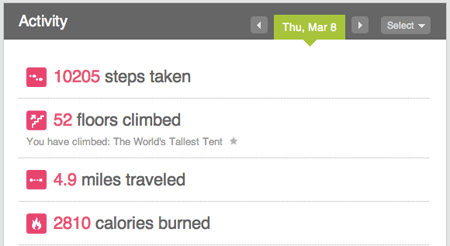
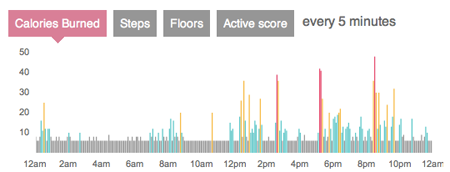
Yesterday's Fitbit activity shows average walking, and lots of climbing.

The Fitbit itself is not entirely new - having debuted in late 2008, and so far, I've been uninterested. I recognize that my mostly sedentary activity of holding down a desk, and chasing after my kids being my main form of exercise would not be particularly interesting. Even now, while I managed 10,000+ steps and 50 flights of stairs yesterday, I still managed to scarf down a great bacon and cheddar sandwich for lunch, so weight loss is not the target.

After scads of occasional tweets and other status updates from acquaintances updating me on the minutiae of their daily fitness activity, it took a simple email of a friend's weekly dashboard last week to recognize this was a device I needed. In minutes, I'd not only purchased the $99 Fitbit Ultra tracker, but also pre-ordered the Wifi-capable Aria scale for another $129. It was the stats, and the idea of competition, that made me knew I had to get it.

A day's activity, showing spikes of walking across campus and at home.

Like a true geek, I'm understandably curious about the Fitbit's accuracy. Does it count 5 steps as a flight of stairs? What about 10? What about small steps, big steps? Do I get credit for manually shaking the tracker or running in place? But despite my moments of tinkering, I've found the tracker's daily reports to be especially accurate. I can spot when I walked to and from my car, to and from lunch, and even when I went from building to building for meetings. I can see when I chased my kids around the backyard, and by looking at the sleep tracker, get a good idea for when they started yowling in the morning, begging to get up.

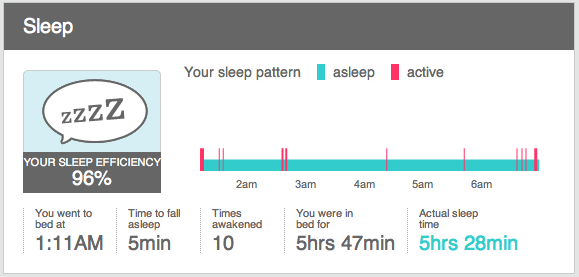
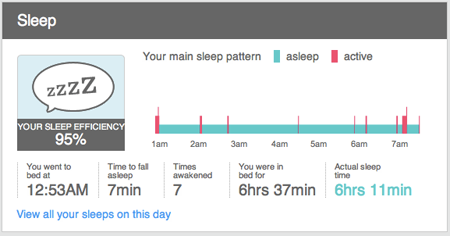
A night's sleep - 95% efficient, I am told, despite Diet Coke addiction.

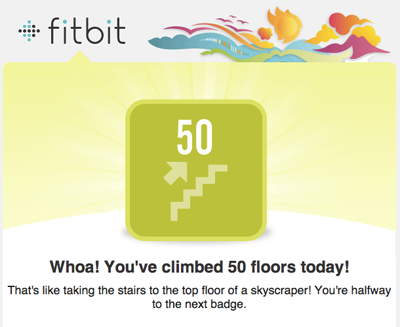
Gaining one's first badges, such as 5,000 or 10,000 steps, or 10 flights of stairs traversed, is pretty straight forward. But I wanted more. When I got home and put the kids to bed, I was at a mere 14 flights of stairs, so I literally, alone in a quiet house, went up and down my 15 stairs at home 11 times, to get to 25 flights. It must have been quite the sight. That got me a 25 flights badge, and later, when I interrupted each chore with 5 more flights, I finally made it to 50 flights of stairs, which earned me a new badge, not to mention a little bit of sweat and some tightness in my calves, which said the exercise might actually have been working. Tricked again!

A badge for 50 flights is one thing. What about 100 flights?

Had it not been for the allure of the 50 floors badge, there's no question I wouldn't have been hiking up and down in my house in some solitary unfulfilling challenge. Had it not been for the intrigue of comparing my daily steps accumulated against my friends, and seeing if I could walk more steps than the previous day, or sleep more efficiently one night versus the previous night, I wouldn't be thinking about it at all. Once the scale arrives and threatens to send my weight to my own internal profile, I wonder if it too is going to impact how I eat, measure and commit to something that resembles good behavior.

As for the Fitbit itself, I can't complain at all. It's very light, inconspicuous, and the software is practically invisible. Just connect to the computer, hit sync, and it's good to go. I'm now addicted to these stats, like any blogger chasing page views, or your favorite fantasy football fan whose future hangs on every rushing yard. The badges are driving the behavior. So if you have a Fitbit and want to challenge my stats, invite me by email. Let's do this.

August 12, 2011

Tracking Commute Speeds and Slowness With Foursquare

Tracking Commute Speeds and Slowness With Foursquare

While many people see Foursquare as a strictly social experience, to alert friends to their comings and goings, or to highlight their incredible coolness factor by checking into happening venues, I've long held to the service playing a role of utility. I don't filter my check-ins, and have always been willing to bend the rules a bit, through proximity check-ins, drive by check-ins, and just having a little bit of fun. Having recently been commuting regularly for a new Paladin client, I've found I can use Foursquare to determine the usual commute times, not just for the whole trip, but from points of interest along the way. With every check-in, it also signals to colleagues I'm on my way.

What I've found is that despite any matter of grousing on my part from day to day fluctuations in traffic, from backups on the Dumbarton Bridge connecting the Peninsula to the East Bay, crawling on 880 North, or navigating the 980 to 580 to 80 East maze into Emeryville and Berkeley, where RepairPal is headquartered, the minor annoyances actually have little impact on the average commute time. In my sample size, the time between consistent points is surprisingly stable.

Three Days of Routine Checkins and Timestamps on Foursquare

For the local folks, my usual commute over the last few weeks has me taking 101 North from Sunnyvale, exiting Willow Road toward Dumbarton (Highway 84) and then going north on 880 past the Oakland Coliseum before exiting toward Emeryville. On the way, I've made it a habit of checking in at the same places each time - starting with the new Facebook Headquarters in Menlo Park, followed by the Dumbarton Bridge, then the O.co Coliseum (where the Oakland A's and Raiders play) and then finally RepairPal.

The Daily Trek from SF Bay Corner to the Other

Today, the check-in at Facebook happened at 8:08 in the morning, followed by 8:12 at Dumbarton, 8:33 at the Coliseum and finally 8:49 at RepairPal. A similar trek that started 16 minutes earlier at Facebook saw the same three minute gap to Dumbarton, 22 minutes to the Coliseum, and a total trip of 42 minutes from point to point to RepairPal. Previous days show the total trip as 44 minutes from point one to point four.

So what and who cares? Not too many people, of course, which is why I toss all my silly check-ins to Twitter on a dedicated account (@lgloco) and don't post updates to Facebook. But by using the exact same route and checking in at the same places in the same order, it gives very precise indications of the time between points on any typical weekday, and lets colleagues anticipating when I'll arrive pretty much track my debut to the minute.

I'm also one of the people who keeps Google Latitude running constantly to provide closest connections with a precise knowledge of my whereabouts, but running Foursquare this way helps move the game-driven toy intro something more useful as a metric. If enough people followed the same approach, with consistent check-ins at specific points on a regular basis, you could safely estimate real-world timing between distances in practically any geography.

If you don't mind my nonsensical check-ins, you can follow @lgloco or see me on Foursquare here: https://foursquare.com/lgloco.

Disclosure: RepairPal is a Paladin Advisors Group client, where I am managing director of new media.

April 17, 2011

Foursquare Day 2011: 3M+ Checkins, The Most Ever

Foursquare Day 2011: 3M+ Checkins, The Most Ever

Saturday April 16th was not just officially recognized as "Foursquare Day" by fourteen different cities this year, including the company's home base of New York City, but it also marked the busiest day the service has ever recorded, with more than three million checkins around the world - the first time this number has been achieved. To give an idea to the magnitude of this achievement, in March of 2010, the company announced its biggest day ever was 275,000 checkins, making Saturday's mark more than 1,000% higher.
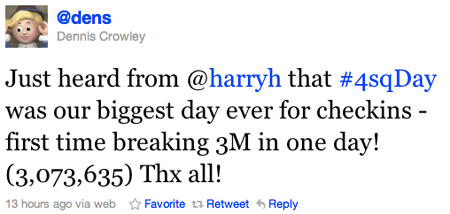
The number was calculated by Foursquare's Harry Heymann, shared by founder Dennis Crowley on Twitter, and repeated by Siobhan Quinn and other team members.


Foursquare reports it now has more than 8 million registered users, achieving the 8 million mark two months after it reached 7 million in February, 6 million in January and 5 million in December. Loosely tracked, the service is expanding around a million new accounts a month, and the number of checkins on Saturday accounted for roughly a checkin per two and a half registered users. Those active on Saturday (myself included) landed the Foursquare Day 2011 badge, an annual tradition.

After initial skepticism on the service, I bet on it following the hire of Blogger's Siobhan Quinn and other smart folks, including Dolapo Falola, formerly of Google, via Thing Labs and AOL. Now even my wife, not an early adopter, is checking in from place to place, and racking up her unfair share of badges. We both counted among Saturday's statistics.

March 16, 2011

SXSW 2011 "Winners": Foursquare and Hashable

SXSW 2011 "Winners": Foursquare and Hashable


The crowds at the South by Southwest (SXSW) Interactive event in Austin this week were said to be 20-30 percent higher than the previous year, which led to longer lines, more crowded venues, less parking, and far-flung panels and events at hotels well beyond walking distance. Even bigger than the larger crowds were the expectations many people had for startups targeting the show for major visibility and possibly, stardom on the level much glorified with Twitter's rise to public awareness in 2007 and Foursquare's launch in 2009. But the reality of it was that of all the noise one heard before the show and during the show, the old brands seemed to hold serve, and most of the challengers made minor impact.

Two years removed from their buzzy debut, Foursquare doubled down ahead of the SXSW event with version 3.0 of their location app on both Android and iPhone, making the application much more fun than before, and introducing an "Explore" function which promoted trending venues, highlighted a running 7-day leaderboard for friend connections, and smartly added historical data to every checkin, letting you know the last time you were in a space, and marking the first time(s) you had checked in with other friends.

This, combined with a rollout of many challenging to obtain SXSW specific badges, and a large presence with shirts galore and a real foursquare court surrounded by easily approachable Foursquare employees, put the app in front of everyone. For all the talk of group chat, it was Foursquare I saw picked up time and again from venue to venue, leading people to the next destination, to watch as party attendance rose and fell, or to see what was swarming. I look forward to the post-SXSW update from Foursquare that gives the full rundown of statistics, but despite a big push from Google for Google Places and Hotpot, and some work by Gowalla, the LBS world was extremely one sided.

When people were group texting, the usage seemed pretty split, but from what I could tell, there were few converts. Those using GroupMe before the show kept using GroupMe, and those who liked Beluga kept using Beluga. Meanwhile, TextPlus' much larger audience, which I was told is pushing upwards of thirty five million messages a day to eight million accounts, is not the typical SXSW attendee. Yobongo got a fair amount of press for its unique iOS app as well, but lies tangential to the group text space.

The one new application I left SXSW using that I wasn't before, was Hashable. Though skeptical at first about its utility, I sat down with the company's CEO, Mike Yavonditte, and learned more about how the company's service has you checking into people instead of places, and how it could serve not just as your new business contacts database, but as a potential replacement for LinkedIn, acting not just as a repository for former business connections, but one for new links and intros from within your network. As I checked in from place to place with Foursquare, I was also tapping Hashable to say who I was with, who they were and what we were doing. Meanwhile, those in my "inner circle" were doing the same.

Now back home from SXSW, I expect the frenetic pace of checkins and connections to decrease. It's also possible that many of my most important meetings will be noted privately in Hashable, rather than broadcast to the world. Similarly, those confidential introductions I'll do between people might take place outside of the app and in email, until I get a full grasp on what's public and what's private with the world. But this said, Hashable has a place now that is not filled by any competitor, and they're now in my social repertoire.

No one service "blew up" at SXSW and captured the imagination. Beluga sold before the show. Fast Society tried to be visible and you couldn't go too far without tripping over a Chevy, Pepsi Max or some other corporate gimmick. But Hashable is in the vernacular now and may prove very useful, while Foursquare surprised many of us and smartly cemented its position as a major tech leader. They're still young, but they're the kings of their space and should keep it. For what it's worth, I didn't hear a single mention of Facebook Places. Could be the crowd, but I assume if you take something fun, take the personality out of it and flatten it out for the masses, nobody talks about it any more.

February 2, 2011

Foursquare Passes 50 Employees, Adds @Dolapo from AOL

Foursquare Passes 50 Employees, Adds @Dolapo from AOL

One small and unwritten bit of subtext in July's rumors of a Foursquare and Brizzly engagement was knowledge of Thing Labs' Dolapo Falola moving to New York from the Bay Area. While Thing Labs ended up at AOL later in the year, not part of Foursquare, Dolapo eventually did. The former Googler, Thing Labber and AOLer is now part of the 50-plus strong contingent at Foursquare trying to make the world a geosocial place.

Dolapo (@dolapo) started his software engineering career at IBM before 4 years at Google and moving to Thing Labs in the summer of 2009, where reunited with Google Reader teammates Jason Shellen (@shellen), Chris Wetherell (@cw) and Ben Darnell (@bendarnell), the team created a new Web-based approach to real-time feeds from Twitter and Facebook, spawning the group chat platform, Picnics, now part of AOL's AIM property.

From mid-January, Dolapo Signaled a Change
Today, He Confirms Joining Foursquare

His addition to the Foursquare team pushes employees at the company beyond 50, according to the firm's team Twitter list. (http://twitter.com/#!/foursquare/team/members) The list also includes product manager Noah Weiss (@noah_weiss), another former Googler whose joining was mentioned by Business Insider in mid-January.

January 31, 2011

This Valley Bubble is Not of Valuation, but Optimism

This Valley Bubble is Not of Valuation, but Optimism

Having worked at startups practically my entire adult life, with more than 12 years in Silicon Valley, I distinctly remember the hallmark elements of the dotcom rise and fall, the rise of Web 2.0 companies and the fizzle of most, and I am seeing people talk again in similar ways about whatever state we are in now - with an almost giddy eagerness of people to claim that a world with skyrocketing valuations for companies like Twitter, Facebook, Groupon, Foursquare and Quora is one that is a bubble. I don't think that this is the case. These elite private companies are possibly fairly valued, much more so than the vapor dreams of years past, and the very real disconnect is in fact, more closely related to the Valley's separation from the outside world, one more fraught with concern and continued pessimism following exposure to the world's most dire economic crisis in generations.

In the late 1990s, as most of us know, companies with almost zero business plan were going public on pageviews alone. Companies that measured Web statistics, like Media Metrix, were turned into rockstars, vying for time on CNBC. Even Media Metrix itself filed to go public in early 1999, raising $51 million in an IPO, eventually trading under the ticker symbol of MMXI. There were stories in the press of companies that filed to go public on the very day their Web sites were announced. Many companies were public entities despite never having turned a profit at all.

In parallel, companies that had plans of going public could easily command double digit million dollar raises. The company I joined in January 2001 raised $72 million at a valuation of more than $350 million, on the hopes of a strong beta plan at customer sites. The company eventually raised more than a quarter billion dollars, including subsequent $47 million and $29 million chunks during tougher times, and is still out there, not having gone public or having been acquired, despite a false-start $100+M IPO filing ourselves back in 2007.

That world is much different than what we have now. Facebook and Twitter and Groupon, all valued in the billions of dollars, are the exception, not the rule. Facebook and Groupon are both suggested to be potentially in the billions of revenue already, and Twitter has established itself as a household name with a morphing business model. Meanwhile, even my wife has seen value with Foursquare coupons and loyalty programs, and Quora is getting incredible visibility with early adopters, becoming a potential top property for the future.

Below this lofty echelon of companies, I am not seeing the bubble-like activities that have marked years past. Funding rounds are usually being announced in the single digit millions, or less. For every big investment from Digital Sky Technologies (DST), startups are fighting for their first $150k at Y! Combinator. I have spoken to many small companies who are finding today's angel investor climate challenging - where good ideas are competing with other good ideas, and wallets are tentative. But the optimism remains. Maybe rounds that took weeks to months to close in the past can take six months or more now, and maybe valuations are lower and total amounts raised are less high, with real revenue and profits being required.

Meanwhile, as we debate valuations and revenue, world news is still difficult. On a recent drive home, the hourly news talked about record high gas prices, and potential inflation - offset only by continued high unemployment, which helped to keep costs down, with demand being down as well. This news was followed by comments that unemployment numbers were making progress, only because many long-time job seekers had given up. Next, we heard from continued depressed home prices, and high foreclosure rates, with the state of California possibly needing to file bankruptcy, assuming drastic measures would not be taken to get back into the black after years of overspending versus tax receipts.

The dramatic disconnect between our debates of rockstar founders and infighting for designers and developers versus doubling class sizes, tax hikes, unemployment and home losses is a much bigger issue in my mind than that of assumed valuation issues and any "bubble." I don't think there is a bubble. Not like before and not out of control at all. Facebook is growing a tremendous business, as is Groupon. Twitter is just behind. LinkedIn was patient, and now has revenue of greater than $160 million a year, before filing to go public. This is no bubble. It's a new tougher reality. But we can't be blind to the world outside us which continues to struggle.

December 13, 2010

Solving Privacy On the Web: Be Smart, Not Scared

Solving Privacy On the Web: Be Smart, Not Scared

When it comes to the amount of data I share about myself and my family on the Web, there's little question that I am at the odd end of the bell curve. It's not a secret what my family structure looks like. My kids' real names are out there to be discovered, as is my birthday, hometown, religion, political preference and much more. You can see real photos of me and my family if you search hard enough, and videos too.

I use Foursquare to share location data. I use Blippy to share purchase history, and I even use OneTrueFan to make my Web visits public. This hasn't been done with a reckless approach to privacy where I have thrown caution to the wind, but instead, has been more calculated. I believe the major trends on the Web encourage sharing, and if I can be the one sharing and not reacting, I am ahead of the game.

See CNN: The Internet and the 'End of Privacy' for their insight into my sharing behavior.

Some would look at what I choose to share and could suggest I feel that privacy is "dead". I don't believe this at all. What I do believe, however, is that intelligent sharing and knowledge of where personal data is distributed can bring value. Rather than take a more conservative approach, locking down what in other generations would be secret, I've opted to own what is shared, and to operate my life as if what I was not sharing explicitly would not be a disaster if it eventually were to be surfaced.

One needs to look no further than Facebook, the world's dominant social network, to see how the company's approach to privacy has changed in the last few years. Once a stalwart site prized for how it protected your content from prying eyes, more content has become public in practically each update. While some have suggested the best solution is to lock down one's profile, I have instead assumed the content will eventually become public and discoverable, shared to advertisers. This was one reason I downloaded an archive and self-hosted it, making the full copy available myself. (See: http://www.louisgray.com/facebook/)

But even with my level of publicness comes limits. I don't think it makes sense to chronicle the minutiae of my day through status updates. I don't muddy my main broadcast channels with location details, shopping updates or entertainment. I don't air embarrassing scenes with my wife or my kids. I don't post content of them that would be unflattering. And I try not to bore people with inane blather.

For me, the major reason I don't share some things is not because I am frightened my content will be used against me. After all, it took a simple e-mail account hack to get me fighting back on that front earlier this summer, and it wasn't tracked to my use of any of these sites. The major reason I don't overshare is because I believe it wouldn't add value and it would be boring to all who saw it.

In a conversation I recently had with a reporter from CNN.com, he asked if there were parts of my life I would be reticent to share if my transparency were further peeled back. The answer was essentially no. The trick is to live your life in a way that if your employer or future spouse were checking in on you, you would have nothing to fear. This doesn't mean you can't have a good time, but you should assume a consequence if your actions were to become public. Manage yourself well and what's discovered shouldn't turn an eye.

We live in a world with many imperfect people, and some really bad ones. That's no question. But I don't think being afraid to share and reducing the amount of personally identifiable information is the right approach. It makes more sense to assume the world is full of great people, cultivate the ones where this is known, and to be smart about what you share, and where you do. Watch the big networks to see if you think they are taking liberties with your data and prepare for the eventuality if they do.