
The tech industry, and Silicon Valley specifically, has long set out to 'change the world'. The clear eyed idealists will tell you the long hours and dreary social lives they espouse are a worthwhile exchange for making lives easier, helping people achieve more, connecting with one another. Discovery. Invention. The cynics will tell you it's a smokescreen - a sprint for riches, to aid the most greedy to take an even bigger share, all while diminishing opportunity for those with less. Advancements and progress for some may come at the expense of others, who encounter reduced job opportunities, stagnant wages, increased commutes and pollution.
Apple cofounder and one-time CEO Steve Jobs famously said, "We're here to put a dent in the universe. Otherwise, why else even be here?" Google cofounder and one-time CEO Larry Page, perhaps a little less famously, said we should have "a healthy disregard for the impossible." Those are massive goals, but many find themselves a little skeptical.
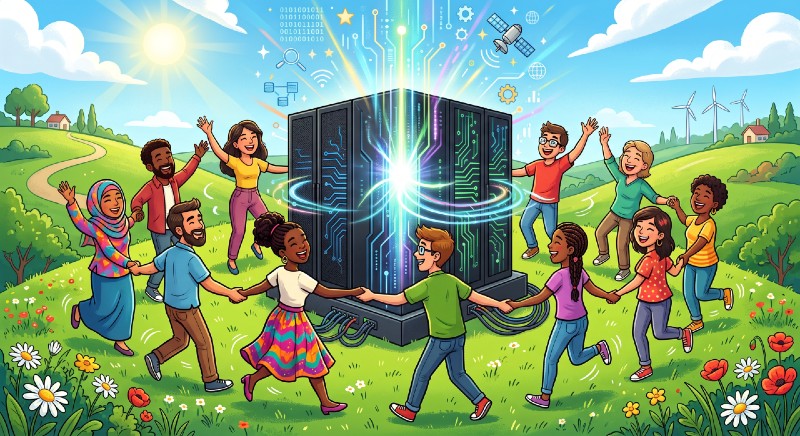
Will the machines deliver a future of perfect harmony? [Graphic via Gemini]
Every evolution, every wave of progress, requires adaptation. It was true in the Industrial Revolution, it was true when the Internet evolved our businesses and our interactions, it was true again more recently when we all started carrying smart phones (and almost never putting them down), and it's again true with AI. It can absolutely be uncomfortable -- forcing us to question our own strengths and capabilities, and even whether what we see or hear actually happened, or was it just AI?
AI actually isn't that particularly new. In 1983, the very same Steve Jobs took questions about AI a full year before the debut of the Macintosh, contrasting the human's consciousness with the computer's ability to do simple things, while forecasting scientists would look at the human brain and teach computers to think. Alan Turing brought the ideas of machines learning to the public in the 1950s, and the Turing Test remains the benchmark for measuring if a computer is human enough to make you think it's an actual person. What is new is the velocity and the accessibility of AI-powered technology to everyone - helping students with homework, composing documents and emails, answering multi-turn questions, and even performing creatively, for better or worse.
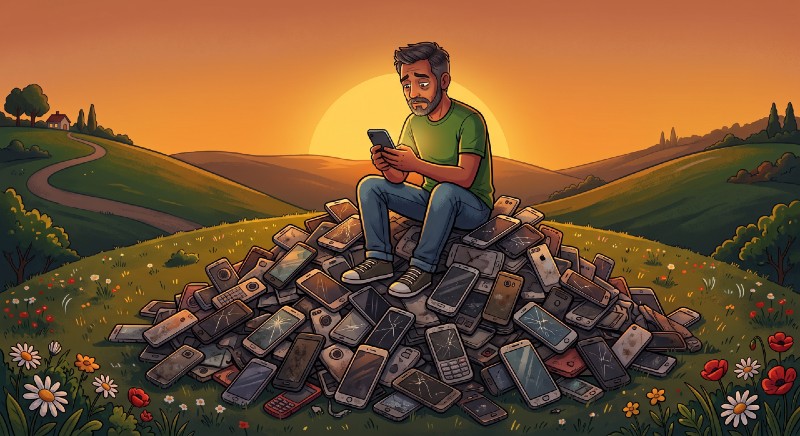 Technology marches on with benefits, and drawbacks too. [Graphic via Gemini]
Despite my sometimes bot-like behaviors, I am human, and this onslaught of AI tools can be daunting, even for a self-proclaimed early adopter. What value is being able to write well if everyone can? What value is knowing history if everyone can look it up? What value is being able to code if the AI can code faster and better? It can be humbling and scary. When faced with this challenge as AI tools increasingly marched from recommended to required, my initial reaction was just no... no, I don't want to do that. I'm perfectly comfortable doing things the way I always have, with the tools I know well. But I also know my 2026 workflow is vastly different than it was in 2016, and even more so than it was in 2006. New entrants to the workforce will have grown up with these tools, be comfortable with them, and could run circles around me. So I've adapted, and found new ways to automate, reduce friction, and just do more.
To remain relevant, we have to evolve and we have to rethink our role. Engineers and product managers can now use AI tools to build creative presentations and handouts in moments. Marketers can now build complete working demos and products from scratch instead of just describe them. Colleagues who once studied hard to be awarded readability in various computer languages now tell me they don't write code, but instead load up prompts in their IDE and instruct the AI to build what they used to do by hand. I can now spin up working arcade games in the web browser in minutes that used to require entire teams. It's wild. But it's also exciting -- in a good way.
Vast adoption of the Internet hasn't yet led to the downfall of civilization. It has led to challenges with communications in some ways, helped spread misinformation, broken down people's attention spans, and enabled isolation for some, but it's also enabled a steady evolution of how we live. Our constant attachment to smartphones has changed the way we engage with one another and are entertained, and yes, it too comes with downsides. AI will no doubt do the same. It will find its lanes where its use makes the most sense, and also try and show up in places where it's not welcome. We will know the difference. Our responsibility is to reaffirm what makes us human, taking the best of technology and using it where beneficial, and celebrating our individuality in all other places. It's going to be bumpy.
Disclosures per always: I work at Google and use our Gemini and Antigravity tools a lot. I wrote this post by hand.