Showing posts with label Advertising (37 posts). Show all posts

May 27, 2011

Bre.ad Rises in June, Adding Billboards to Social Sharing

Bre.ad Rises in June, Adding Billboards to Social Sharing

Everybody and their mom has a URL shortener these days. With 140 characters being the new 1,000 words, shrinkage is no longer a bad thing. But not all URL shorteners are the same. Bre.ad, which promises it will be opening to the public in June of this year, gives its users an option to deliver a customized digital billboard attached to every share, be it for a favorite brand, cause, charity or anything else. Have something to promote as well as something to share? Bre.ad hopes you'll join their bakery.

Bre.ad enables you to share to three places - their own site, aggregating all shares within the network, ordered by chronology, as well as the standbys, Facebook and Twitter.

I Make a Toast to Charity Water

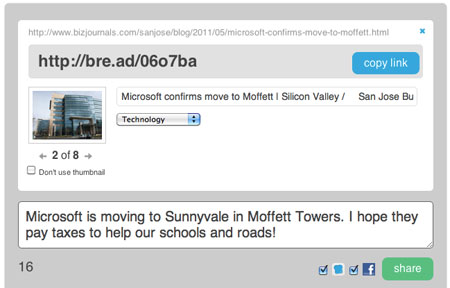
Before you share on Bre.ad, you first select an interest, brand or charity that you want to promote to your friends and make "a toast" explaining why you selected that cause. Having selected this promo, then you're ready to bake some bre.ad links.

Sharing My Link to Bre.ad

From that point, sharing links is pretty similar to other shorteners, like bit.ly, goo.gl and the rest. Copy the original link, enter accompanying text, and you're on your way. But Bre.ad also lets you pick a thumbnail for the share and a category, helping the bre.ad network know how your link should be categorized.

The resulting Tweet and Link. 

When friends bump into your bre.ad links on Twitter or other services, before they reach your link, they see your promo, which can last five seconds. For me, I picked Charity: Water, the fast-growing and incredibly interesting charity that's bringing clean drinking water to places that need it. For you, you might pick Apple, Nike, Lady Gaga or whatever you find interesting.

Think your connections won't mind a small ad before your content? That's what Bre.ad is betting on. You can sign up for their beta now. Doors are opening soon.

March 18, 2011

Finicky iOS Users Rebelling Over Rovio's Angry Birds "Ads"

Finicky iOS Users Rebelling Over Rovio's Angry Birds "Ads"

Mobile app downloaders have come to expect a lot from their apps. iOS reviewers on Apple's iPhone, iPod Touch and iPad platform are notorious for being among the harshest raters across the app store landscape - as likely to drop a single star rating as a glowing five start mark, and practically demanding that advertising be limited to free apps.
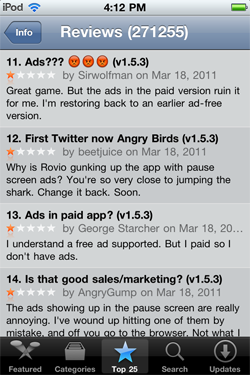
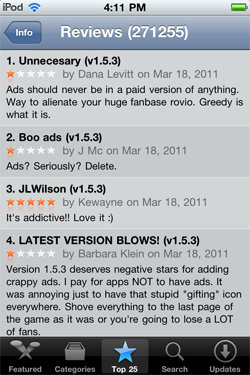

A point upgrade today to the seemingly invincible Angry Birds franchise from Rovio has iOS reviewers up in arms, thanks to in-game house ads that tout other extensions of the brand, from stuffed toys to begging for Facebook likes and YouTube views. The result, the practically permanent high flier has crashed down in a fluff of feathers with a deluge of one-star rants.

As Angry Birds all too excitedly notes in the latest revision of the game, the average rating on the iTunes Store for the app was 4.78 stars out of 5. Users love flicking birds at pigs. It's a given. But with version 1.5.3, the 99 cent app brought ads that appear when the game is paused - just as on the Android platform - and this alone has dropped the franchise into hater territory. The current version is bumping along at an average of 3 stars, rising with each upvote and dropping with each slam, and the stream of comments is mercilessly opposed to this new tactic.

   
A sea of 1 star ads for the latest Angry Birds Update

"Ads should never be in a paid version of anything. Way to alienate your huge fanbase rovio. Greedy is what it is", writes Dana Levitt in her one-star review. 
"Version 1.5.3 deserves negative stars for adding grappy adds. I pay for apps NOT to have ads." piles on Barbara Klein in her one-star missive. 
"... I (like others) am incensed at the barrage of ads when you pause the game," says MadDownpour.
There are many more just like this (as you can see on the iTunes page hosted by Apple).
The Hated Ads Show When the Game is Paused


The one-star ratings for the previously beloved game are plentiful, and the reasoning seems pretty straight forward. Users believe that if they have paid good money, even if it's 99 cents, they deserve to go ad-free, no matter what type of ads those are. Given Rovio is soaring right now, with talk of an IPO, the movie tie-in with Rio, and months in the spotlight, it'll be surprising to see if they are tarnished by ticking off this excitable user base.

As for us on Android? The banner ads are a pain, but you're not charging, so I think we can deal with it.

January 24, 2011

Please Track Me and Personalize My Ads

Please Track Me and Personalize My Ads

In the tug of war between privacy and personalization, there can sometimes be a visceral reaction to learning that a company to whom you may not have explicitly granted permission to learn details about you actually has that information - even if it's public. One doesn't need to look any further than the much-maligned Spokeo, who in becoming a next-generation people search engine, practically has to defend its business with every other blog post, even as traffic continues to balloon. Now, news that Google is offering a Chrome extension to opt out of advertisers' tracking services has put the issue of personalization and "Do Not Track" back on the front page. Unfortunately, many people are likely to download it, thinking the result will ensure greater privacy, when in actuality all it does is ensure off-target ads with a crappy experience.

In my view, almost all advertising online is very poor. There are two reasons I find most advertising bad. The first is that it is interruptive, and the second is that it is irrelevant.

1. Interruptive ads quite simply get in the way and can prevent you from seeing what it is you want to see, when you want to see it. I despise pre-load pages on news sites and pre-roll before videos, thinking, for example, that watching breaking news on CNN should not be preceded with ads for prescription drugs, or that I want to see a full-screen ad for a network switch provider when trying to read Network Computing. Almost without exception, I don't.

2. Irrelevant ads are all those who fill up your screen with offers you would never accept, products you would never buy, and sheer randomness. The click-throughs for all the non-targeted messages that surround and cram their way into your content have got to be pretty poor. That's why many studies have said an extremely small minority of users are the ones clicking on all those stupid ads. The rest of us have simply turned on ad blindness.

This isn't to say advertising is dead and ineffective. It's not. Great commercials and campaigns are memorable and can stop us in our tracks - be it Apple commercials that are dissected and analyzed fifty ways, or notices from your favorite band that their latest album has gone on sale. The issue is that most of the time, advertisers know very little about you, aside from the content of the page you are currently viewing, and even when demographic data is out there, it's either inaccessible, or only allowed to be used in aggregate.

For the most part, this aggregate data does not accurately reflect you as an individual. Facebook and other social profiles potentially have a wealth of data about you on their networks, but it is not yet being fully utilized at the ad level to bring targeted messages to you, and this has to change. What I am looking for, instead of more head-in-the-sand responses to information gathering is to work with advertisers and give them as much of a headstart in getting to know me as they possibly can. I want my social profiles to be leveraged everywhere, and I beg, plead for somebody to get personalization right when it comes to ads.

By opting out of ad tracking models, all we are guaranteeing is that advertisers will be randomly posting their offers in a hope that you're the one in a million customer they are looking for. But the true win becomes when they can deliver for you a personalized message at the right time in the right context for you as an individual. We should not be running from this type of innovation, but instead embracing it.

For almost two years now, I've been asking ad companies to leverage my social profiles online. I am tired of getting singles ads, or mortgage ads or used car ads or any type of ads that don't match me as an individual. I've complained about low-quality offensive ads on sites just out to make a buck, embraced Twitter advertisements, assuming relevancy, and did the reverse for the poor Facebook ad experience. So whether you're like CNN.com and want to make me the poster child for the seeming end of privacy or not, my stance on this has been consistent for some time. I would be more than eager to put more data into the system to make it a better system, including all the ads everywhere I go.

So instead of embracing these ad blockers and cookie strippers, let's find a way to make the quality of the ads more personal, more relevant, and simply better overall. Please.

October 31, 2010

20 Halloween Scares to Put Fear Into Every Google Fan

20 Halloween Scares to Put Fear Into Every Google Fan

20. The development teams behind Google Reader and Blogger are unified following a reorg, under a new project called "Google Breeder".

19. The Google New project accidentally gets uploaded to the wrong set of servers and overwrites Google News with internal company project updates.

18. Twitter becomes so successful that long-form writing is considered anything which is between 135 and 140 characters. As a result, Google runs out of interesting things to index.

17. Google's goats get an agent, defect to Zynga to promote Farmville.

16. Google's book indexing project fizzles as its realized nobody actually reads any more.

15. Due to an impasse with broadcast networks and cable's fear of Google's growing impact, Google TV traction stalls as only commercials are available.

14. With the founders of Wave, YouTube, AdMob all leaving or changing roles in the last weeks, leaders of all project teams within Google dust off their resumes and post them as shared Google docs with high-priced executive recruiters.

13. Aggressive legalities determine that Google has to take another photo of your home on StreetView if you don't like the current one.

12. Somebody actually asks a question to Larry Page or Sergey Brin about the future of Google Knol or Google Base in a public forum.

11. The code base between Google's new robot cars is mixed with the Android code base, making our phones autonomous beings that call and leave messages with text to speech to anyone in our address book whenever they want.

10. Google Buzz is discontinued after unfavorable press coverage. The Lively team is persuaded to come back, and is given the keys to "social".

9. Eric Schmidt loses a bet to Carol Bartz, is forced to buy Yahoo!. The new company is called Yahoogle. It passes anti-trust scrutiny somehow.

8. Yahoo! is determined to own the patents to Pay Per Click following their acquisition of Overture, Google forced to remove PPC from their offerings.

7. AJAX is the new Flash.

6. Jimmy Hoffa is found buried in Google's famous ball pit.

5. Microsoft cracks the code behind Google's search algorithm. Using SEO, Bing results flood Google's index for all terms.

4. An overzealous team of programmers looking for career advances takes Eric Schmidt's off the cuff remarks seriously, embarks on setting up programs to help people move and change their names at age 18.

3. Paul Buchheit is determined to own the intellectual property and trademarks to Gmail and its underlying code. Thus, Gmail and its users become property of Facebook.

2. Apple's suit against HTC is successful, freezing the development and deployment of Android for all partners.

1. It is revealed that the same 50 people click on 99% of AdSense ads, and most of them are marketers just demoing the product to potential clients.

May 26, 2010

MyLikes CEO Says User Plugs Don't Cross Twitter Ad Rules

MyLikes CEO Says User Plugs Don't Cross Twitter Ad Rules


Increasingly, some of the new rules issued from popular Web platforms, including Facebook and Twitter, are raising more questions than answers, with words so carefully interwoven as to be interpreted any which way. The call for clarity from Facebook around privacy and from Twitter around what is permitted in users' streams from developers and programs alike seems to be unending - and it seems at times that the companies are being obtuse so they can be selective on how they choose to endorse the rules down the line. Monday's announcement from Twitter on blocking "injected paid tweets" on any service that leverages the Twitter API had a lot of people asking what this meant for services who derive revenue from posting content to the service. MyLikes, a company I advise for, was one that received questions. I spoke with CEO Bindu Reddy (@bindureddy) that night to gain her take and get some of the answers myself.

As best as I am able to understand it, Twitter is continuing to try and improve the user experience on their service, which at times has been less than fantastic. On the back of their efforts to weed out spammers, reduce the artificially-inflated visibility of hand-selected celebrities, reduce negatively-intended automation, improving uptime, and expanding a familiar presence to onboard new users, Monday's announcement looks like they want to improve the clarity of sponsored content on the network, while also protecting their own revenue stream.

The relevant line in question from Twitter COO Dick Costolo, says: "aside from Promoted Tweets, we will not allow any third party to inject paid tweets into a timeline on any service that leverages the Twitter API." This line particularly focuses on the use of API for automation, and also the phrase "paid tweet", which is open for interpretation. What is promising in the piece is that Costolo says the company does not seek to control the content on the service, and that companies are open to sell ads, build vertical apps and analytics, and that the company does not always need to participate in revenue generated from their service. It sounds to me that Twitter is planning ahead for future battles with nefarious networks that are not in users' best interest, much more so than they are seeking to slow legitimate companies that have been built around their ecosystem.

As I mentioned when I first announced my affiliation with MyLikes, I am attracted to the company's model because the ads posted to Twitter, blogs and other networks are done by hand, by the users themselves, with the user creating the message. There is no automation on the user's behalf that they have not created themselves, and all the activity is above board.

In talking with Bindu, she agreed this sets the company apart from Twitter's foes. Also - a MyLikes generated tweet is as much of a personal endorsement as it is an ad, leaving this activity free and clear. In fact, while Costolo's post was somewhat confusing, we both agreed Twitter's move was one that continued their path toward maturation.

Update: You can also see Twitter API Lead Ryan Sarver (@ryansarver)'s comments on the situation here.

To hear more of Bindu's thoughts, check out the Cinchcast I recorded below:


DISCLOSURE: I am an unpaid advisor to MyLikes. I hold a small equity stake in the company. My comments on the company's product are always independent, and do not pass their way in advance.

April 13, 2010

Advisory News: MyLikes Announces Funding, Advisory Board

Advisory News: MyLikes Announces Funding, Advisory Board


Today, MyLikes, formerly Likaholix, announced they have raised more than $600,000 in funding from former Googlers, and the addition of a few names to their advisory board, myself included. As you know, I've been watching Likaholix (and now MyLikes) since their launch in March of 2009, and outside of the blog, I have had numerous conversations, by phone, e-mail and in person, with co-founder Bindu Reddy on the company's progress, morphing from a social recommendation engine, to one focused on word of mouth advertising for the Web. It will be a fun challenge to have a helping hand in the company's move to the next stage.

As I have said many times here, I am not a fan of unfocused advertising or low-quality ads and for the most part, I am not a fan of advertising for advertising's sake. But I am a big fan of relevancy, and leveraging one's social graph to discover what people are not just liking, but recommending, and actually buying. Those are reasons I have been working with my6sense on relevancy, and what attracted me to sites like FriendFeed and Likaholix in the first place - as well as Blippy, where I am a happy oversharer of my actual purchasing history.

MyLikes Lets Me Select Available Advertisers And See Potential Revenue

MyLikes' attraction to me is the platform's ability to have people act as influencers in their community, promoting items and services that make the most sense for them, to their friends, and getting rewarded for spreading the word. It's something I do informally all the time as I praise some products and ignore others, and while I may not be the perfect target for this kind of affiliate model, others are finding the approach to be significantly improved, in terms of click-through rates and payouts, than standard keyword advertising.

Creating an Ad in MyLikes for Google Apps

The Ad, via MyLikes, Posted to Twitter

Ads on influencers' blogs or tweets or other social activity, which are hand-selected by the individual, carry much more weight than those selected by a generic ad network. And as Twitter has made a lot of noise around their own approach to revenue, enabling big companies to promote their services in the tweet stream, MyLikes lets the users benefit from similarly promoting exactly what they like and signing their name to it - extending beyond Twitter, but to blogs and other sites as well.

Given my history of not embracing off-topic advertising, I am looking forward to working with MyLikes to drive quality through the system. You can be sure I will be one of their more interactive advisors, and they will hear from me often.

DISCLOSURES: I am an unpaid advisor to MyLikes. I hold a small equity stake in the company. In addition, my6sense is a client of Paladin Advisors Group, where I am Managing Editor of New Media. My comments on the company's product are always independent, and do not pass their way in advance.

March 27, 2010

Facebook Sharing Data Webwide Promising, Difficult

Facebook Sharing Data Webwide Promising, Difficult

Despite its walled-in history, many of Facebook's recent strides have trended toward making what was once private public, and that which was previously unavailable to search engines discoverable. The company, cognizant of the failures experienced by data hoarders of the past, appears to have the desire to change - and will need to do so progressively, as to not upset the apple cart, inviting the fire and brimstone from a mob wronged. This week's tea leaf readings spell out plans for Facebook to share data from your personal profile with third party Web sites you visit, letting them tailor your Web content (and ads) just for you. The result, a much more relevant Web experience, would likely have big benefits for consumers, advertisers, and of course, Facebook, but it sets off the same alarm bells that rang with Beacon and other companies who have changed the rules in the middle of the game. The question is, can Facebook make the leap in such a way that it can still be trusted?

I've talked a lot about my own desire for companies serving ads to leverage the social profiles I have created around the Web, so I don't have to constantly be bombarded with off-topic dreck. (See: I Wish Ad Companies Would Truly Leverage Social Profiles and I Just Marked All Facebook Ads as Offensive. So Should You., both from 2009) So the news from various outlets saying that Facebook is planning this very thing, to share data with third party Web sites, has me nodding in understanding, while at the same time cringing, thanks to a lack of transparency to the process, and the knowledge that many people won't be very excited about the move.

If I were to look at the situation from Facebook's perspective, I can see how the company is at a crossroads, tied to the old rules they've had since inception, but trying to be nimble enough to compete with companies that haven't had the same restrictions. Facebook is sitting on a gold mine of user information and attention data, and advertisers are as keen as ever to find the right targets and deliver relevant advertising or content. Facebook doesn't have the luxury of starting anew and trying to develop a new company that doesn't have the shackles of the past which it does, but has the opportunity of a network with 500 million users. The hardest part is seeing how they can get from Point A to Point B without leaving a bloody trail in the streets.

Shortly after the debate on Google Buzz and its own privacy issues, and my posting of an article where I said I thought the cries were dramatically overblown, I met up with Dare Obasanjo of Microsoft at the South by Southwest Interactive conference, and we talked about this balance of business versus privacy. In his opinion, social networks can never sacrifice their ideals on privacy, not matter the opportunity ahead of them. He told me, in a CinchCast (which blew up halfway through), that Microsoft had the opportunity to turn MSN Messenger and Hotmail into an open network like Buzz, but they chose not to because they determined it would be wrong. Buzz went through this process with Gmail, and they paid for it in the world of PR and trust, even if I thought the reaction was too strong. Facebook has had its struggles before with the same issue. For every public statement by the team's executives about the changing concept of privacy, and users like me who don't mind it at all, there are others who think their trajectory has them at odds with their user base.

I want to trust Facebook in the same way I have trusted Google and other networks with my data. I personally would not object to Facebook's sharing my information with third parties and advertisers, because I am not anti-ads, I am pro-relevancy, and I want to help solve these issues of quality. I think a world where third party sites know their targets better can only lead to more responsible business transactions and more commerce, period. I can see Facebook struggling to get 500 million people on its network to "opt in" to a system that shares their information, and them seeing pushing forward in a brutal way as the only option. It's a rough situation, where the end result would be great and the process in between would be a mess. I want the relevancy, but will everyone else find the cost worth it?

March 15, 2010

The SXSW Keynote With Ev Williams You Had Hoped to See

The SXSW Keynote With Ev Williams You Had Hoped to See

This afternoon, as most of you know, Ev Williams, CEO of Twitter sat down for a much-anticipated and heavily-attended keynote interview at the South By Southwest conference in Austin. After thousands of Twittering geeks and quasi-geeks alike had settled in to the packed exhibition hall and overflow rooms to hear the latest updates delivered straight from Twitter's leader, their excitement soon turned to boredom and finally, severe annoyance, as the interview's pace, tone and content fell well below expectations. After an hour's time, the halls in Austin were more than half empty, and an opportunity to showcase one of technology's biggest successes in the last few decades was for the most part lost.

For a huge number of attendees at SXSW, Twitter epitomizes a new form of communication. Their friends are on it. It's where they chronicle their lives and connect with like-minded people and businesses. That the keynote was the draw of the week would be a dramatic understatement. As I sat upstairs in the Austin Convention Center, letting my laptop get some electricity in anticipation of live-blogging the keynote, the escalators jammed with hopeful starry-eyed nerds awaiting a visit from their blue-tinged oracle.

I have met Ev twice myself, including quickly Sunday night at the Google Reader/Blogger party, exchanging a few pleasantries and shaking hands, but by no means consider us close. That said, I expect I will see him again, while for many of those attending today's event, this could be their first and maybe only time to hear Ev's words directly. He doesn't do major speaking opportunities often, and SXSW is one of the biggest geek meccas of the year. Even if it was not an opportunity to announce something amazing, both Ev and the interviewer would have a huge platform to talk to the audience and be interesting. And they failed. Ev may not be the charismatic leader in the image of Steve Jobs, but he really had no chance, being served a syrupy mosaic of cotton-ball soft questions that dealt with feeling, culture and "awesomeness."

As I summarized the keynote in a running transcript on Google Buzz, I hoped my own fatigue wasn't seeping through the text, but the pedantic non-inquisitive approach had me fidgety, featuring insightful questions such as:
"It was you or Biz that said if it was awesome people would use it, and when you talk about creating something, it is about awesomeness? What is awesomeness for you guys?"
At other points, I wrote... (Questioner keeps agreeing with Ev and saying that's "cool" rather than asking questions) and (Questioner recaps his own previous blog posts).... When I looked up at the conclusion of the keynote, the once-packed overflow room I was in was tired, quiet, and very empty. The row I was sitting in, once packed elbow to elbow, sported five empty chairs to my left, and a pair of folks to my right with a few empty chairs in between. The talk had clearly missed the objective, and people were sorely disappointed, compared to what they had obviously hoped would be something special.

Here's what should have happened.

For me, the keynote speech fell far short, not because the questioner was friendly, but because there was very little substance. One can question a speaker in an interesting way without being contentious. What failed to happen was any detailed questioning into competitive markets, technology, challenges or relations with developers. Instead, we got questions about management principles, overly long descriptions of Wal-Mart, ambition, whether partnerships should be "win-win", or if Twitter could be a force for good.

I respect Ev and think he had hoped for a lot more. I would have challenged him and asked:
  1. Has Twitter finally escaped the scalability problems that plagued the service in 2008? If not, what's left to solve, and what kind of technical challenges remain?

  2. There was talk that Facebook once was interested in purchasing Twitter, and you chose to remain independent. How do you see Twitter's role in a world alongside Facebook? Where do you compete and where could you potentially partner? How did their acquisition of FriendFeed change things?

  3. When you saw the launch of Google Buzz, did you feel like the old company you once worked for was looking to stab you in the back?

  4. You talked about being an open company hoping to foster strong developer relations. How can developers on the Twitter platform be sure advances in your own services won't compete with them and put them out of business?

  5. While you have opened up the firehose to select partners for revenue, can anybody who wants to pay gain access to the firehose feed? If not, how do you set the criteria for doing business?

  6. There are many different Twitter clients out there. What are aspects of third-party clients which you like the most? What attributes of these clients can we expect to see in Twitter.com?

  7. The Twitter search engine still is extremely broken and only returns a few days worth of tweets. Will this ever be solved, and how big of a priority is it for your team? What is left to do and how soon can we see the true search engine come online?

  8. The company has recently reversed its approach to a Suggested User List, but as you know, many people on Twitter have followings in six or seven figures that benefited from the old model, and have incredible reach or influence because of that approach. How can the playing field be leveled?

  9. It is assumed that your relationship with Betaworks has also led to your use of Bit.ly as the primary URL shortener on the service. How soon until you purchase Bit.ly outright? Should we also assume closer relationships with other Betaworks companies, such as TweetDeck?

  10. So far, it appears you are avoiding revenue models that include advertising in the stream, similar to Google AdSense, but we have also been promised advertising we will love. Can you explain how this advertising will work, and if I can block it?
To sit down with the CEO of one of the most interesting companies in all of technology and not talk about technology or competition or specific tools in any meaningful way was a dramatic letdown. That the interviewer did not recognize the fatigue of the audience as they scurried out of the cavernous halls was shocking, and now, Ev, who seems to be more on the shy side than the screaming and yelling type, like Steve Ballmer, may think twice about another opportunity, which is unfortunate. I recognize a public interview on such a stage can be a real challenge. We all learned about Sarah Lacy's struggles in that space back in 2007. But those of us who use Twitter and really care about these products deserved more. The SXSW community deserved more. They voted with their feet and they voted with their retweets. While one can remain civil and not throw barbs at the speakers, there was no question this could have gone a lot better than it did, and Twitter will have to promote its new @ Anywhere platform in a better way, for today, it was seriously overshadowed by a train wreck we found ourselves stuck watching.

February 25, 2010

GMail Ads on Buzzed Reader Items Attract Controversy

GMail Ads on Buzzed Reader Items Attract Controversy

Given the ease of distribution of content from site to site and network to network, with RSS or any other model, it's no surprise that scrapers galore are stocking away our unique copy and then trying to make a quick buck from ads surrounding it. Even though the copyright is not theirs, they are trying to make an end run around the system. As new aggregators and networks have hit the market, those of us creating the content have had to reevaluate what constitutes good practices, and what constitutes bad behavior - whether well intended or otherwise. Google Buzz, which has gained its unfair share of criticism for perceived security holes in the weeks since its launch, has finally gained a more valid critique, from Jesse Stay, who alertly noted, as I had earlier in the week, that the act of putting Buzz in one's GMail meant that content too can flow through Buzz, with Google pocketing cash on ads around your content, without the content originator getting a dime. It's the latest twist in the evolution of content and copyright in a fast-changing Web.

One Shared Item from Me on February 21st in GMail, With Ads

As you know, I don't try to monetize my content here on the blog. I don't run advertising, and I have long said that I don't mind if my content gets shared here and there for more comments. I want my content to be shared, as information, wherever you are comfortable. But yes, scrapers bug me. They mess up search alerts, and negatively impact the perception of this mirage-like image of a personal brand.

I don't believe for a moment that a new network like Google Buzz is an intended scraper, any more than I thought Shyftr was trying to steal comments from your blog when they offered shared comments on full feeds. But, thanks to Buzz living in your GMail, and many people, like me, pulling Google Reader items through Buzz, you can see how one's full content could feature advertising that benefits Google and not me. To some, this is the definition of a scraper.

Another Shared Reader Item from Me In Buzz in GMail With Ads

As a huge Google Reader advocate, and fan of the nascent network, Buzz, I do not mind in any way that my full content is being distributed. I love RSS. It is fantastic. But when I saw the ads in my GMail against others' content this week, it did strike me as odd, because it violated the unspoken rule that it's something you flat-out don't do.

I recognize that "fixing" this perceived flaw is hard. If I am the Buzz team, the act of removing ads against shared Reader items in Buzz while in GMail is probably non-trivial.

But I also can see their potential response. In theory, they cannot prohibit somebody from forwarding your content in full by e-mail, and GMail is an e-mail system. In theory, Google Reader shares are equivalent to e-mail forwards, and thus, the same as any other content being shared in this way.

Jesse asks, "Google, how is this not evil?", calling it copyright infringement. Unlike the overreactions this month, he's a lot closer in this criticism than others. I still hold that Google is not evil and is not trying to be evil, but it's more in the gray area than we would like. I assume if this holds, then we as content creators are going to need more re-education in terms of what the new rules are, and how we should adapt.

UPDATE: Jesse Stay reports the "scraping" issue will be solved early next week.

February 1, 2010

Low Quality Offensive Ads Degrade the Web Experience

Low Quality Offensive Ads Degrade the Web Experience

An ever-increasing percentage of the world's population is creating and consuming content from the Web and social networks. Surrounding much of the content on these networks is advertising, be it banner advertising, keyword advertising, behaviorally targeted ads, CPM ads, CPC ads, interstitials... they're out there, in an effort to bring the host site some revenue.

Despite the fact the Web offers an unprecedented amount of targeting to tailor the right message to the right people, I find we continue to be bombarded by off-topic, low quality garbage that certainly is degrading the reputation of the networks running the ads in the first place. Today's most recent jaw-dropper? An advertisement for car insurance on Facebook that featured the bearded visage of America's least favorite terrorist, Osama Bin Laden.

Now just whose bright idea was it that came up with the idea that Osama Bin Laden's stare was going to get me to change my insurance?

Never mind trying to find out if the advertiser tracked down Osama and found out where he lives in order to send him royalty checks for using his image... one simply needs common sense to know that this ad is offensive, and yet it's pretty much par for the course on the Web. Combined with rump-shaking mortgage advertisers, Obama grins in medical scrubs and the like, and it's hard to believe we've made much progress from the dancing bananas, or punching the monkey, as we did in Web 1.0.

Do you think Obama approved the use of his image here?

Put bluntly, the low-quality advertising directly damages my perception of Facebook and other networks where I see these ads. While the outlets may claim they did not personally approve every ad's content, it is part of the user experience I see when viewing their pages, and they definitely impact my experience.

I have been asking companies like Facebook and others on the Web to leverage my social profile online and present me ads that are interesting. I once got so tired of Facebook's low-quality banners that I went on a rant and marked them all as offensive. But it seems like that hasn't had any effect, or the companies displaying the ads just don't care.

Amusingly, I did a search on Google for the word "Targeted", and the first response, based on my login credentials, was that of a page on Facebook advertising. So what was particularly targeted about the Bin Laden ad? The advertiser said that 32 year-old males can get a specific rate on car insurance. Well, congratulations on figuring out my age and gender. But did I also sign up to be a "Fan of Osama Bin Laden" on Facebook? No. Nor did I put myself as a candidate for male breast reduction surgery over the weekend, or tell Facebook that I wanted to hook up with any hot single ladies looking for an "overnight match".

In November, after hearing Twitter's promises that they would eventually debut an advertising system that we would love, I said I would embrace that approach. I am not anti-ads (despite my occasional complaints), but I am pro-relevancy.

My #1 Result In Google for "Targeted". Right...

Before anybody says that beer commercials on TV and in magazines are offensive, and this type of approach is just making its way to new media, consider the likelihood of Geico or other auto insurance promoters pushing a photo of Bin Laden in a 30-second spot during Jeopardy or the Today show. It wouldn't happen. Why? Because it's wrong, they are professionals, and they know better. So why, when we have more opportunity to better target our ads, and we have customers willing to buy things online, do we get surrounded with such complete dreck? This is not acceptable, and I challenge companies that are enabling this train wreck to shape up.

December 16, 2009

Videos: Talking About Advertising, Social Media in Business

Videos: Talking About Advertising, Social Media in Business

A few weeks ago, I sat down with good friend Sunshine Mugrabi, and she picked my brain on a number of topics, ranging from the best ways for businesses to leverage social media, to my thoughts on relevancy, social networks, advertising on blogs and Web services. After some editing (which makes it sound like I am talking only with myself), she posted both videos in a pair of posts on her site. (Part One and Part Two)

While I am just going to have to ignore the non-glorious look I have in the paused frames of both videos, some of the content might actually be relevant to you. So check them out if you like. You can find Sunshine on her blog, and on Twitter at http://www.twitter.com/sunshinemug

Louis Gray on Advertising from Sunshine Mugrabi on Vimeo.


Louis Gray on Participating in Social Media from Sunshine Mugrabi on Vimeo.

December 14, 2009

Companies That Set the Market's Agenda Win

Companies That Set the Market's Agenda Win

When I was very young, I remember hearing the debate in advertising of whether you should mention your main competition by name, or simply allude to them, such as saying "the leading cola brand", or "the leading paper towel", when comparing your product to theirs. While I've often been told you should never introduce your competition into the conversation when with a potential client, the vagueness of alluding to the competition actually has the reverse effect - getting the viewer or reader to think in their mind of just who that leader is, instead of taking in your message - defeating your sneakiness.

If you are a frequent consumer of news or advertising, you can see who is also being smart in terms of setting the agenda by which other competitors are measured, or putting them on the defensive. As a big Apple fan, it is very easy for me to see when Cupertino is pushing the agenda, and when they are not. When they are not, the situation is always much worse. But for any company, if they can set the agenda, and the stage, forcing competition to play by their rules, they have a significant advantage.

The iPhone Agenda: Thousands and Thousands of Apps

First, take a look at the iPhone's success and message:

The phrase "There's an app for that" and the climbing total number of applications has had Apple in a happy place - blowing past 100,000 individual programs. By setting the focus on how many total applications, the handfuls available for the Palm Pre, and the admittedly rapid growing ten thousand from Android seem relatively small. Apple set the stage in terms of how smartphones were measured, not just in terms of forcing a touchscreen, but also in the yardstick being the application store itself.

So long as Apple keeps the lead in total applications, other companies are going to be in a defensive posture when talking about how many programs they offer, or trying to suggest that most people only need a few, or that they have higher quality. It's not a good message.

Verizon's Agenda: Our 3G Coverage Is Better

But look how Verizon changed the game, and threw AT&T under the bus:

After months and months of hearing "There's an App for That", Verizon got sick of it, and started their "There's a Map for That" campaign, saying that Verizon's 3G service is much more widely available than is AT&T. Even if most pundits say that AT&T's 3G service is faster than that of Verizon, the image that remains with people is one full map for Verizon, and a sparsely dotted one for AT&T. AT&T's response to Verizon has been lackluster, not just because they were thrown together quickly, but because they were fought on Verizon's turf, by their rules.

Apple has even had to jump in to bail out their ball and chain network buddy, by trying to highlight the use of the iPhone for voice and Internet at the same time. But the whole time, we're thinking of those darn maps. Point to Verizon.

I'm a Mac, and You're a PC

Sticking with Apple for a bit, the company's Mac vs. PC commercials, as long in the tooth as they are, have set the agenda for how PC users are perceived and how Mac users are perceived, for better or for worse.

Microsoft tried to fight back, on Apple's turf, with it's "I'm a PC" ad line, but that was largely panned and ineffective, because they were unable to wrest control away from Cupertino's mindset.

It wasn't until Microsoft was able to turn the conversation away from "I'm a PC" and to "Lauren" with her low budget to push a different agenda around price that Apple was caught on the defensive.

Setting the agenda is important for any company to promote their agenda. If you are Google, you might once have said your search index is bigger, due to its billions of indexed pages, and that was why you are better - forcing competition to try and show how large their own index was, and coming up short. If you are Facebook, you will highlight your vast population of users, in the hundreds of millions, making competitors fade in comparison.

Will Android Force a New Agenda?

The battle for an agenda is especially interesting in markets that are unsettled, or at a point of change. In addition to the Verizon vs. AT&T battle mentioned before, we are at a very interesting point in the smartphone battles, with Google pushing Android into the market with Motorola's Droid, HTC's Eris and the rumored Google branded phone (coming soon). Droid has tried to make a mark on Apple by saying it "Does" things that Apple's iPhone cannot, but there hasn't yet been a cohesive approach by all Google-powered handsets to promote whatever their agenda will be. Will it be on openness in software? Will it be on openness in terms of supported voice and data carriers? Will there be a killer app that is on Android and not the iPhone at all? And if you are Microsoft or Symbian, or God forbid, Palm... what do you do? You can't win on total apps or touch, or openness, so do you make a new agenda, or call it quits?

I've seen the agenda game play out at previous jobs, and seen colleagues struggle to try and meet the criteria set by the competition - fighting a never-ending battle of certifications and partnerships or benchmarks. While we (and others) spun in place trying to catch up to others' previous mark, the competition nimbly pushed ahead with the new agenda, and changed the game again. It would make more sense to find out, for each of us, what your benefits are and how you can present the agenda to win.