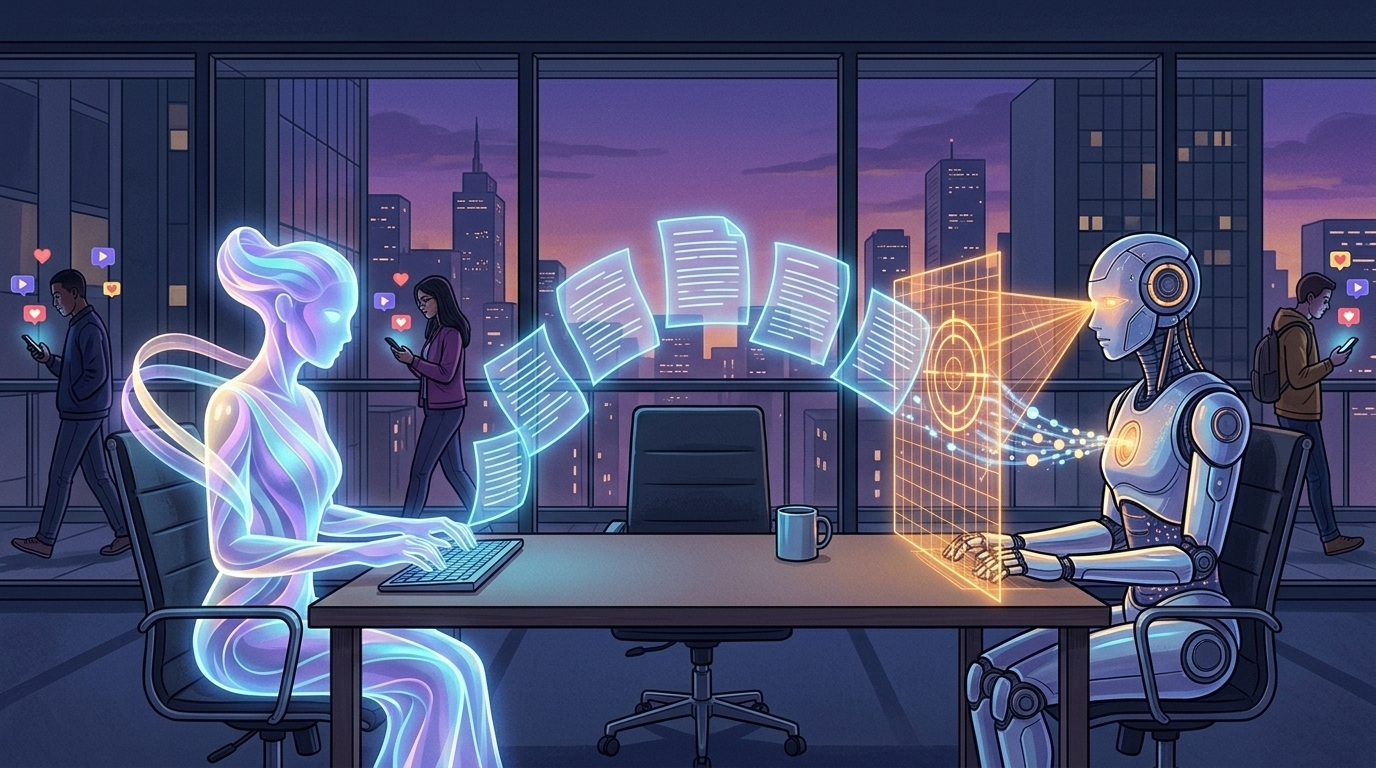
AI writes, AI scans, and the human chair stays empty. [Image via Gemini]
 We're in a funny spot with AI at the moment. As people debate its value, with one side arguing it's the greatest invention since fire, all while the other calls anything it touches pure slop, AI is actively finding a foothold in evolving how business is done, in all facets. To claim otherwise is ignorant at this point.
Software is being written more quickly with AI. Security gaps are being both exploited and solved more quickly. All matter of communication is being authored and adjusted more quickly. As I said in my first post after multiple years' hiatus, we will need to find out the best place for AI and humans to coexist, and I truly believe the discussion of AI will eventually fade to the background, just like our flareups about social, mobile, local, and whatever transformative buzzword at the moment happened to be. This is not to undercut the actual value and impact of AI, but to optimistically suggest we as humans are great at adjusting.
Our eyes and our minds have been trained since the day we were born to understand what humanity looks like. Since we all first started to learn to read or watch TV, we have absorbed what it means to be "real", and we visibly react when something feels synthetic. We all have a visceral reaction when special effects seem too special, an ad seems too perfect, or a visual defies comprehension. Something feels "off". But as the models train and get better, learning through feedback and continuous reinforcement, their images and video get better, and so does their writing.
Techmeme is aflutter this weekend about a Bloomberg report that shows where we are in this particular cat and mouse game. As AI writing becomes more human, more humans can get outed for sounding too much like AI. The end result is predictable, with people intentionally making mistakes, and writing in a way that bots won't, so they don't get accused of shortcutting their work, or leaving the hard work to an LLM. If you think the bots can't adjust to make typos on their own, or to follow instructions to sound even more human so even the bots will fail the AI detection test, well, you haven't thought this through. Maybe you've even seen the viral posts that say Mary Shelley's novel Frankenstein would be considered full AI generated because the models themselves were trained on the book.
Since kicking off my first posts here two decades ago, I've had more than 3,000 posts and countless words hand typed into a myriad of open CMS windows. I've written buckets of emails or social posts and Slack messages all over the place. But I also know that in 2026, it might make sense to let the bot do a first draft, especially when it solves the blank page problem. What I do worry about, eventually, is if the AI is doing the writing, and the AI is doing the distilling and the summarizing, what if no actual humans consumed and fully took in the content? We are all very busy people, and if not, we all prefer to be seen as such, and we fill the edges of our time with things we'd rather be doing than reading text slop.
Running a script against your content to hide em dashes or add typos to seem fallible isn't going to automatically flip the lever that confirms you're a human and the AI is not. It takes an entire body of work, a corpus that no machine has, with a real personality that's adjusted through experience.
Nearly twenty years ago, I wrote that your blog is your brand, and later, that blogging remains the foundation for who you are online. The latest generation has grown up with blogs being too slow, perhaps, with TikTok and Instagram being more visual quick hits of dopamine and long form being less valuable. Now Gen Z is approaching college and a daunting workforce where AI has always been expected and accepted, even as its place is evolving and being debated. Some of them are definitely writing their course papers with AI. Some aren't. But the reckoning won't come from somebody getting outed for asking ChatGPT, Claude or Gemini to be their scribe. It will come when everyone is distracted by something more exciting and nobody was reading anyway.
Disclosures per always: I work at Google and use our Gemini and Antigravity tools a lot. I wrote this post by hand. But how would you know?