Showing posts from 2014 (37 posts). Show all posts

December 25, 2014

A Successful 100k Steps Leads to a Sore, Yet Happy, Christmas

A Successful 100k Steps Leads to a Sore, Yet Happy, Christmas

Monday's personal record setting Fitbit dashboard

Last week, I introduced a crazy and audacious goal, of knocking out 100,000 steps (as measured by Fitbit), in the name of personal achievement and to raise money for Camp Taylor, a summer camp for children with heart disease, in honor of colleague Ken Norton's son, Riley. And I'm beyond happy to say our adventure was a success.

As chronicled on all the social channels (Twitter, Facebook and Google+ for starters), +Stephen Mack and I passed the 100,000 mark shortly before 10 pm Monday night, after 16 hours of pavement pounding fun that covered more than 46 miles - seeing us start before dawn, and keep pressing forward until daylight was a distant memory. And better yet, our efforts were not in vain as many of you were eager to support us through nearly $5,000 in donations to Camp Taylor, beating our target of $4,500.
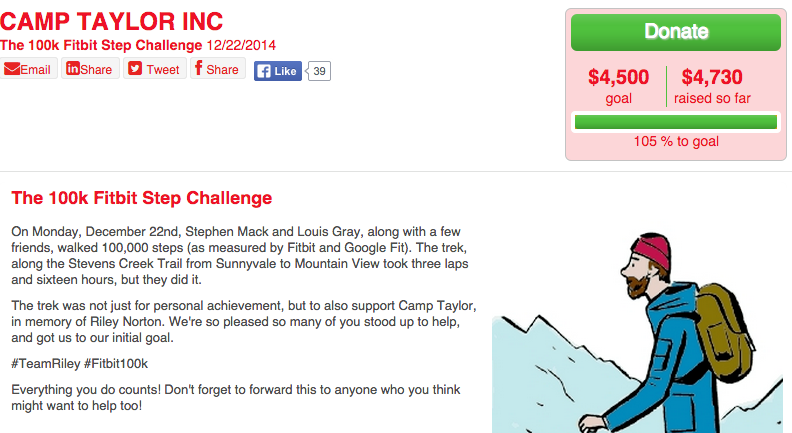
Our fundraising goal for Camp Taylor: Achieved!

As I set out in our planning, Stephen and I got nearly all our walking in through three trips along the Stevens Creek Trail, which connects Sunnyvale to the San Francisco Bay through Mountain View, just past the Google campus. We grabbed backpacks with essential snacks and fluids, multiple phone chargers for guaranteed power, and thought ahead - bringing bandaids and Advil for inevitable pain, and head-mounted lamps to break through darkness.


Some scenes from early morning Monday, before the pain.

Our initial pace was quick, as I'm accustomed, and Stephen did a solid job adjusting, as we maintained strides through most of the day, even beyond the 10, 20 and 30 mile marks. And we were lucky enough to be joined for much of the journey by friends, each of whom did a lap with us, meaning we were marching in a group of three for about 80 percent of our trek, sharing new pains, stories and sights with one another.

Having walked greater than 50,000 steps a few times myself, I knew I could hit the 100k as a stretch goal, so long as life didn't get in the way, but as our mark neared, I absolutely felt the fatigues and aches that threatened to make finishing difficult. We were each battling aches in practically every part below our waist, and our feet were a mess of blisters and soreness that wouldn't be solved until we were done.

By the 92,000 mark, just an hour and a half away from the proverbial finish line, I was nearly overcome with dizziness and a slight spell where I was a bit concerned I'd pass out and fall short. Whether I was dehydrated or had just hit a wall, I'm not sure, but with water and about 10 minutes rest, we were able to continue marching, and eventually things settled back to where they were at a good rhythm through the end.


Hitting 100,000 Fitbit steps just before 10 p.m. Monday night.

As my math had planned, we made it back to my house the final time with 99,000 steps complete. We dropped off our heavy bags, and took one last victory lap around the block, reaching 100,000 steps at 9:52 p.m., after a momentary scare that Fitbit couldn't handle six digits and our walk would have been mocked at the very end. My tracker had stuck at 99,999 steps and then jolted forward to 100,007, so no pictures of perfection exist, but we had done it. We wearily high fived one another and then trudged home to call the event a success.

As I told Ken, I promised I would do the full 100,000 steps, and we had done it. Our promise to Camp Taylor, and those supporting us with their donations, or words of encouragement in the streams, was that we would make our full effort, despite fatigue or soreness. And of course, our momentary strains that are nearly gone a few days later are nothing like the prospect of heart disease the youth we were walking for live with each day. So we had pressed on.

Tuesday and Wednesday saw little walking at all, as you can imagine. I completed the Christmas shopping Tuesday and walked around a bit Wednesday, but didn't even crack 10,000 on Fitbit. I hope you'll understand. But I wanted to thank Stephen, and his sister Joanna, our friends Roger and Ken for walking with us, and the more than fifty people who donated to Camp Taylor and really had our back. What we did was hard and fun, and it was made easier with a real and virtual team. This is the experience I'll most remember from this year's Christmas season.

If you haven't yet made your donation to Camp Taylor count, our page is open for one full year. They need all the help they can get. https://www.firstgiving.com/fundraiser/louisgray/fitbit100k
December 18, 2014

Taking the 100k Steps Fitbit Challenge and Raising Money for Charity

Taking the 100k Steps Fitbit Challenge and Raising Money for Charity

On Monday, I have a crazy plan to set a new personal record for Fitbit steps. The goal? 100,000 steps in a single day, blowing away my previous personal best by more than 50 percent, and coming close to fifty miles walked - while also helping raise money for Camp Taylor, a free summer camp for children with heart disease, in memory of Riley Norton, the son of my friend and colleague Ken Norton.

Ever since getting my Fitbit and being hooked on challenging myself to walk further and compete with friends, I've seen the allure of reaching new marks. I had my first 50,000+ step day in December of 2012, and managed more than 60,000 this September, even when I stopped pounding the pavement around 10:30 that night. I've walked 40,000 steps pushing three kids in a stroller, managed more than 200 flights of stairs in an evening in my house, and know that each personal record simply put the bar higher to make the next mark even more difficult.

But as I've seen my numbers increase, the math has a strong magnetic pull toward one-tenth of a million steps in a single day. If one averages 100 steps a minute at a good walking pace, it's fairly easy to hit 6,000 steps in an hour. Given there are 24 hours in a day, managing 16 hours of walking (plus a bit) to reach 100k is absolutely doable, assuming I can push myself to keep going.

So I've been eyeing this 100k mark with some anticipation - looking for a day where I'm out of the office, where my kids are taken care of, and I can just go, walking in a straight line until the day is finished.

This week, as I told my friend (and TiVo employee +Stephen Mack) of my plan, he said he wanted to join in the adventure as well. Stephen, who I profiled on the blog more than five years ago, has been among my most consistent Fitbit competitors for the last two years, and has yet to see a fun contest that he'll turn down - especially if it can keep you in good shape. So we've made plans to set off early in the morning Monday and achieve this goal together.

My comparatively bumpy activity from September's 60k day.

To be clear, walking at a normal pace for most of a day is by no means the toughest endurance challenge one's ever seen. It's harder to run a marathon or a 50 mile or 100 mile endurance challenge. There's no swimming or biking. No weight lifting, beyond our feet. But it requires the will to keep going even if the effort seems monotonous or never-ending. And having a second person there will make the challenge more fun.


The ideal course  will allow for us to keep walking all day without crazy hills or interruptions, even as small as traffic lights. We should be close enough to food so we can refuel beyond what we can carry, and have proper rest stops where they make sense. So I've sketched out a plan for us to navigate the Stevens Creek Trail between Sunnyvale and Mountain View, all the way to the San Francisco Baylands beyond Google's Mountain View campus. With three laps of this trail, we should be more than on our way to the 100,000 mark, and if not, we'll find a way to get there.


So you might ask... why do this? Are your egos so big that you have to take the whole day for a silly hobby of virtual badges? Are you raising money for charity or something? Well, the first answer is "because we can." The math says it's possible, and data exists so we can measure it. And the second answer is also yes. While I'm doing this no matter what, it's also great to have the wind at our backs by doing this for a good cause. So I've started a page to support Camp Taylor, and extension, Riley, who passed away in October far too young after a lifelong battle.

Our walk toward inevitable soreness and personal achievement starts in the dark hours on Monday. I'll be posting our progress as often as I can, batteries depending, with the #fitbit100k hashtag on Twitter, Google+ and all our streams. Good luck to us.

December 17, 2014

Tablets, Touch and Talk: Technology Through the Eyes of a Child

Tablets, Touch and Talk: Technology Through the Eyes of a Child

Braden With my Nexus 5, Watching the MLB At Bat app.

My children have never known a world without high speed Internet, streaming movies on demand, and a seemingly all-knowing personal assistant, available to answer their every question when asked. They've grown accustomed to concepts which once seemed fanciful, like the ability to order all sorts of items on your tablet and have them delivered in the same day, having every photo you've ever taken available to you from any device, or having video chats with just about anyone instantly. For them, there is no such thing as technology. There's just the real world, which is directly impacted by pervasive Internet.

As the major enabler of this, and someone who largely has converted from analog to digital at every opportunity, I've been especially excited to see how this impacts the way they interact with each other, what they choose to learn, and how quickly they grasp ideas - even when, to them, there is no user manual. I'm naturally curious to see what they choose to do and choose not to do, and what simply proves too hard.

My twins are now six years old, and Braden (pictured) is four. The twins are in first grade, and Braden is in preschool. The older two can read well, and do some writing, but while Braden recognizes letters, it's not as if he's sitting down with a good book yet. Despite the mild illiteracy, all three can breeze through tablet usage - from memorizing a pin or lockscreen, to finding applications, launching apps, moving them to folders, and even downloading new ones from the Google Play store. And it's not far-fetched to say Braden is actively learning to read from applications you'd never expect, like Major League Baseball's At Bat, where he's working hard to memorize stats and names of players I've never even heard of. (See also: Wired: How Videogames Like Minecraft Actually Help Kids Learn to Read)

Braden Seeing Baseball Highlights from the Majors on my Nexus 7

Given my kids' capabilities, it should come as no surprise that their primary interaction with the Web is through touch on tablet or phones. They were exposed to iPads and Android tablets early on, and have grown familiar with the practice of touching an icon to launch and app and how to navigate the apps - including the always important ability to hit the small X in a corner to close ads. And when the app isn't what they are looking for, they just ask Google. Depending on how well they ask, Google should find them what they want, whether they are looking for "videos of cupcakes", "pictures of beagles" or whatever strikes their fancy that day.

It'd be easy to say kids, like us, use technology to be entertained. They each have favorite games, and frequently open Netflix or YouTube to watch videos - or, as Braden does, the MLB At Bat app, to see highlights from all of the previous days' games. But they also use applications to draw, or for education, whether they are matching games, flashcards, or adventures that teach them language or math. And on more than one occasion, I've found my Google Express shopping cart full, with hundreds of dollars of items, from everything to do with Disney's Frozen or Minecraft, to books, toys and food. Luckily, they haven't yet figured out the last steps of the purchase, so I've always been able to clear the cart before having to explain away crazy charges.

Sarah posts to YouTube, complete with titles and emoji.

They've each also figured out the tablets and phones are capable of creative work as well. I was recently surprised with an email notifying me that I'd successfully uploaded three new videos to YouTube. After momentarily thinking I'd been hacked, I realized my daughter had not only filmed three new videos, but correctly titled them and uploaded them to my account. Meanwhile, the automatic backup capabilities of Google+ come in handy when we want to see pictures the kids have taken with our devices, from their perspective. Sarah has also been known to tell me to take a photo of something she's proud of, with the intent of my sharing it on Google+ or Facebook, saying "Daddy, take my picture and put it on the Internet."

"My" invite to Brian to join Ingress, sent by Braden.

Last week, just before I wrote my post about Ingress, I got a note from my friend Brian Fitzpatrick, thanking me for inviting him to the game. But I hadn't. Braden did. While I was at the office, Braden had opened up Ingress, sent off a dozen or so invitations to people in my address book, and unhelpfully, dropped some of my equipment into the front yard, for me to reacquire when I got home. That was amusing, and luckily for me, he didn't mess up my account any further. And this Sunday, Braden jacked up our thermostat to 82 degrees, using the Nest app, before I realized things were more than a bit toasty.

On Sunday, we were a comfortable 80 degrees in our house. Thanks, Braden.

Just as important as seeing what they're doing with my devices is seeing what they aren't doing. Aside from the Ingress invites, I've never seen the kids interested in opening up Gmail, or posting to any of my social networks. No fun tweets or posts to delete. No mass apologies to coworkers for toddler missives to internal mailing lists, and no inadvertent likes of odd posts in the stream. They're not interested in Google Drive or browsing the Web, and they've only fired up Sonos to blast music in our house a couple times. For them, the tablets are purpose driven. They have a short time to delivery of the content they're looking for, and if they can't find it, they'll ask Google in a different way, or go back to what they know works.

Just like many of us find we struggle with handwriting after years of regular typing, I'm interested to see how my kids are going to operate with analog assignments that may require pencil and paper, or if textbooks might be the rule, instead of downloadable equivalents. I'm curious to see if they'll master speed typing at a faster age than I did, thanks to the availability of computers, or if touch and voice will rule the day so they might not have to make it a priority. But for now, they're especially handy on the tablet - be it a 5 inch phone, or my Nexus 9, which Braden calls my "big tablet", as opposed to my "medium tablet" Nexus 7. And as Google Now improves, time between what they want and what they find should even further decrease. It's a lot of fun to watch.

Disclosures: I work at Google and enjoy products of ours I mentioned in the post, from Android to YouTube, Gooogle Drive, Gmail and Ingress. So do my kids.

December 9, 2014

Ingress: The Incredible & Addictive Covert Game Being Played All Around You

Ingress: The Incredible & Addictive Covert Game Being Played All Around You

A little over two years ago, a small team within Google called Niantic Labs introduced Ingress, a game that adds a virtual reality layer on top of the entire world, which you can claim, defend or destroy for your cause - depending on which side you've chosen. And while I tested early versions of the game while it was developing at Google, and dabbled with it just after launch, I put it aside before jumping back in with both feet two months ago, when a pair of colleagues on my new team couldn't stop talking about it. And now I won't stop talking about it either.

Simply put, in my view, it's the most well-designed, intelligently deployed concept I've ever seen for an immersive experience on mobile, which encourages you to get off your butt, explore the world around you, and find new people to help you achieve goals together. Every facet of the application, even while it seems mysterious, is designed to help you get out of house, to explore new crannies of your neighborhood (and beyond) and discover people on your faction who need your help to achieve what would be impossible alone. I've never seen anything like it.

Some shots of Ingress badges and live portals.

As you know, I've been an avid wearables and personal fitness tracking nut for the better part of more than two years. Fitbit has been counting my steps and Moves has been showing where I go. But while Fitbit only counts my activity, it doesn't provide direction or give me a specific mission. Ingress does - making my steps matter, as they are pulled toward each new destination, and seemingly every turn provides yet another opportunity to take down an opponent, power up or build on my own space, or hack away and get new equipment to make me stronger. This combination has accelerated my near-constant walking and movement into personal record highs, consistent leaderboard domination, and I've fallen way behind in any regular TV watching.

There are many other sites dedicated to the gameplay of Ingress, so I won't go too deep, but at its heart, Ingress is a battle for the hearts and minds of humanity. In the storyline, the Earth has been seeded with exotic matter (XM), and you either believe this XM will enlighten us all, or you will resist it. So from the very begining, you choose a side: The Resistance (blue) or The Enlightened (green).

The Two Factions of Ingress: Enlightened and Resistance

Once you pick a side, you then have three primary functions, much like other multi-player games. You can build sites for your faction, you can destroy the opposition, or you can continually farm for new equipment to make you stronger. This is done by visiting sites, known as portals, which consist largely of landmarks across the world, from water fountains to murals, sculptures, churches and standing structures. If it is something that can shape your mind and appears exotic, there's a good chance it's a portal.

Ingress is played globally as teams battle for position.

As one friend of mine tastefully said, you can't play Ingress "from the comfort of your own toilet." You have to move. And in especially dense places with plenty of landmarks, the next portal can be just another block or less away. So if you find yourself out to build, farm, destroy or explore, the only limit to how much you participate is your own time, and how long your phone can hold a charge. That's led to something of a cottage industry for Ingress players lugging around external phone battery charges so playing doesn't stop short at the worst time.

Now that Ingress has you out of your house, and walking with specific destinations, with the next stop just a little bit further away, you're being stretched. Stretched to find new places in your community you hadn't previously seen, new spots in other cities you've never visited, and it sets you up to be territorial, knowing that particular portals are valuable to you or your side.

The Denver, Colorado Ingress Scene: A Mess of Blue and Green

But if you really want to have an impact, you can't just go it alone. Even the most experienced Ingress player can't build a portal up much more than halfway to full strength, thanks to features in the game that limit your ability to power up portals. It takes two players to take a portal to 75%, three can take it to just over 80%, and in order for a portal to reach 100% strength, it take contributions from eight individual players. So you can deploy and hope, or you need to find people on your side who are often more than eager to help and build, destroy or hack together - spurred on by built-in communications in the app, or augmented through dedicated communities on Google+, Hangouts and other chat tools. There, people will arrange times to meet, secret build or teardown events, or provide updates about activity in their neighborhood.

One Los Altos portal in our neighborhood.

I recently heard somebody say you either go deep into Ingress or you don't go at all. And it's probably true. I originally didn't get the attraction, as a low level player. But now I've seen things I build at midnight before heading home get taken down at 1:30 in the morning, or by six a.m. the next day. I've started to recognize and greet players on both teams, and you learn the patterns of the game, as one faction gains control over a geography, or specific people just refuse to ever give up, and seemingly play around the clock. And once you go deep, it really becomes a numbers game, as every activity is counted. Every hack. Every deployment. Every link from portal to portal. Every field. Every destroyed opponent portal. The more numbers you get, the more abilities you have and the stronger you are against the competition, and the more they need to be prepared for you.

Joining the Enlightened on Ingress has brought destinations, goals and missions to the activity I was already doing with Fitbit. It's dramatically reduced (even further) my idle sitting time, it's made me see and enjoy experiences I hadn't yet gotten to around town and in neighboring cities, and I'm getting new relationships with people from a variety of backgrounds, who all hold at least one thing in common - that we're playing Ingress, and working to expand the minds of humanity. It's more than a game. It's the true reality. I hope you do check the game out, and see what it does to your daily routine. And while I don't mind more competition, it'd be awesome if you saw the world in a new light by joining the Enlightened.

Grab Ingress on Google Play for Android and on iTunes.

Disclosure: I work at Google, and the Niantic team works within Google.

November 25, 2014

You Can't Achieve Equality by Expecting Everyone to be the Same

You Can't Achieve Equality by Expecting Everyone to be the Same

There's not much a fairly privileged white guy who hails from the suburbs can say about diversity or racism without being questioned. Compared to many other people who don't hail from WASP backgrounds, most of my challenges are pretty easy. I don't come into life fighting against a biased expectation of who I am or what I'm capable of. I don't immediately find that people assume I'm not smart enough, or honest enough, or trusted enough to participate in their workplace and their communities. Things are remarkably comfortable.

Speaking up or talking about hard issues like racial bias or diversity, or calling for attentiton to inherent problems, makes it possible I'll misspeak and say something quotable where I don't want it. It's instead much easier to sit quiet and let other people fight their battles - to watch big conflicts and flareups remotely, trivializing someone else's experience, as something that's not happening here. But even in the 'burbs, and in our corporate offices, there are issues. We may not see unarmed men shot 12 times and killed in our hallways, but there are opportunities to bring down or build up our peers daily, and most of us aren't doing much to aid their quiet struggles.

Earlier this month, one of my best friends, +Erica Joy, who works with me here at +Google, talked about how bias has worked against her, as a black woman, in a predominantly white and east Asian world. Her piece "The Other Side of Diversity" removes the abstract anonymity of company statistics and tells you the direct reality of what it's like as someone who walks into a position where people may have already made their mind up about you, where your mere presence may make them uncomfortable, and where artificial limits are put on your potential.

Lunch With +Erica Joy in 2013 #throughglass
(And she'll hate that I shared this photo...)

I've known Erica for about seven years, and have been colleagues with her for the last three plus. She's the kind of person who I've always felt free to open up to and tell her just about anything. She's clever, insightful and hilarious - if you take the opportunity to know her. She's also especially thoughtful. She can be a sharp critic when our products don't work well, and she can push back on me if I say something daft that needs revision or clarification. And yet I know not everyone is open to finding out her personality, and as she spells out in her piece, as well as the follow-on "No Solution", her professional career (and personal no doubt) has been impacted, multiple times, by the shortsightedness of others.

While I may comfortably sit on the side where I don't have to fight for inclusion, it's incredibly frustrating to see this happen time and again, whether people are strong enough, like Erica, to speak up about it, or they remain in silence. For no matter how you carve up the numbers being shared from our workplaces, we have some obvious gaps in our nurturing, recruiting, hiring and retention practices - which extend a gulf in our representation of women and minorities in tech. This is a systemic issue at all levels, and while I know companies (including mine) honestly are working hard to improve things, the day to day realities can't be glossed over with an expectation of prettier futures.

Sometimes when Erica and I get together, we joke about seeing if we can hit a quota of spotting more people like her (namely black women) on campus - like the proverbial unicorn. If we can find two more (not including her) over a standard lunch visit, we've done pretty well. Sometimes, depending where we walk or where we're eating, we see more. Other times, none, as streams of geeky white guys (like me), and assorted people from all other directions walk by.

But it shouldn't be a numbers game. One shouldn't have to try and play "Where's Waldo?" to find peers who share their same background. One shouldn't have to try and mask their identity to be included, or assimilate as to not draw attention. As I read Erica's first post pre-publishing, as a friendly editor, what struck me the most from her experience was one of her last bullet points:
"I feel like I’ve lost my entire cultural identity in effort to be part of the culture I’ve spent the majority of the last decade in." -- "The Other Side of Diversity"
If you have to change who you are to fit into the culture, maybe it's the culture that needs changing. I've been lucky enough, even as a dumb white guy from the burbs, to have had some experiences in fairly open communities. I'm glad I attended UC Berkeley, which was even more diverse when I attended school there in the late 1990s than it is now, and for all its continued challenges, I believe Google has its heart in the right place to empower people from all different backgrounds, and is working on it from multiple directions. While my neighborhood isn't the picture of diversity, I've always followed and engaged with stimulating people online, no matter their racial makeup.

As a numbers exercise, I did a quick count a week-plus ago of those whom I'm connected to online. Of the 246 people I'm mutual friends with on Facebook, for example, only eight are black. That's 3.5%. If I edit the count to remove immediate family members, or colleagues, to only include friends I've hand selected as acquaintances, that goes up to 4.5%, ahead of the Santa Clara County percentage of 2.9%, but behind the California percentage of 6.6% and the national census of 13.5% or so who self identify as black. And really, what constitutes a good number anyway? I can't look at my social networks, pick a few dozen black avatars, add them to my circles and call it a day. There's no seal of approval that clarifies whether I'm part of the problem or part of the solution.

The Ferguson incident and its ongoing echoes has the topic of race back in the headlines again. And eventually our short attention spans will migrate on to some other hot issue of the day, while the family and community suffers permanent scarring. But for many of our friends and peers, this is not a one day, one week, one summer type of challenge - but a lifetime.

We can abstract the Valley's diversity issues into sets of percents, charts and graphs, and cite our efforts with dollars spent or scholarships awarded, but whatever we do, we have to keep pushing and it starts with a recognition that something is broken, and we need to be aware of it. We need to encourage people who run into these trials daily to speak up, and to please be themselves. We are better because of our differences.

November 7, 2014

Our Smartphones Have Surpassed Their Role as Computers In Our Pockets

Our Smartphones Have Surpassed Their Role as Computers In Our Pockets

The prevailing mantra holds that as our phones become increasingly smart and constantly connected, that we're walking around with the equivalent of computers in our pocket.

These intelligent devices can do practically everything their PC predecessors could, from email and web browsing to document sharing and creation, music and photos, and any application you can think of. In fact, I'd argue that we're not only seeing people spend more hours with their mobile devices than traditional PCs, they're more functional as well - as the smartphone has surpassed the PC. Ever try taking photos with your iMac? It's tough.

Now, instead of considering these phones and tablets as miniature computers, which are used to access our desktop content on the go, we're seeing the reverse take place. The smartphones are initiating the activity, and the desktop connects us to the results. Instead of many small computers in our pocket, our PCs are essentially larger versions of our phones - and we come to our Web browsers and desktop apps to pick up where our phones left off.

Rachio's Web site is as Functional as the App

Not too long ago, it was common to expect apps to be made for our smartphone platforms that were extensions of our Web experiences. These simple mobile apps were wrappers for our cloud-based data, or simply sucked down web pages and media, but didn't offer experiences that were enhanced by being mobile. It was just a mirror of what you could get on the desktop. However, as the app ecosystem exploded for iOS, Android and other platforms, coding for the smartphone became the primary destination and effort for new companies and ideas.

Automatic's Web dashboard leverages data from the mobile device.

You could see this evolution go in a a three step process, from "Mobile too" to "Mobile first" and in many cases now, "Mobile only." Mobile experiences can't just be a shadow of the desktop version, but instead are now carefully crafted to meet rigid design expectations, with a user experience that adapts for smaller screens, and gets better with understanding of the user's location data or other apps installed on the phone. We're spending more and more time inside of our mobile apps, which can be our primary messaging and sharing vehicle, our second screens while watching TV or using the desktop, or a constant companion - to the point we hold them in our hands as we walk everywhere, or put them out on the table in front of us wherever we may go, waiting for the next chirp to grab our attention.

Fitbit takes its data and makes smart charts and graphs on their site.

The natural evolution of this mobile first, mobile centric reality is that we're now no longer going to our phones to pick up where our desktops left off, but the reverse. And when I do end up in front of a full-sized keyboard and monitor, I'm clamoring for smart Web experiences in my browser that reflect activities that have happened on the phone. If it's a miss, I may end up closing my laptop and picking up my Nexus 5 instead.

For applications that are primarily experienced on mobile, seeing a strong Web interface that contains the same data as on mobile is a pleasant surprise. You can see this difference in the way Fitbit has worked hard to have a great Web experience to mirror mobile, while the Moves app does not. Automatic and Rachio have a workable Web experience to match their mobile version.

Managing the Nest thermostat via the Web - same as the app.

Not too long ago, trying to use the Web and get data on our phones was exasperating. We had subpar experiences, had to make excuses for short email replies, or say we'd get to something when back at the desktop. But now, often, when at the PC, you're pining for what's on the phone - even if you can send texts or make voice and video calls from the browser. It's delightful to see when the two are working in sync, and the desktop experience makes the phone experience better. As a user, I'd be delighted to see the front-end experience for the same shared back-end data become more in sync and know the devices are working well together for every service.

Disclosures: I work at Google, who is behind Android, owns Nest, and makes browsers and apps for desktop and mobile. I work on the Google Analytics team, which has a great web experience and mobile apps for Android and iOS. (The first version of this post incorrectly said Nest didn't have a strong Web interface. I was wrong.)

October 17, 2014

Fitbit Launches Challenges to Push You and Friends to Go Further

Fitbit Launches Challenges to Push You and Friends to Go Further

The charm of Fitbit has always been more than just counting steps and seeing how far you've meandered in your day. Even more than the virtual badges you can collect for hitting new personal records, one of the most engaging pieces of this smart wearable has been informally competing with your friends for a place atop the leaderboard, learning who is the most active, and seeing just how much further you need to go to land a spot at the top.

With a new feature rolled out quietly last week, Fitbit has formalized these challenges, encouraging you to take on your friends directly.

New on Fitbit: Challenges to Take On Small Groups of Friends

Available on the mobile app for both Android and iOS, Fitbit has started with three separate challenges for you to extract steps out of your fitness social circle - namely Weekend Warrior (for the Saturday/Sunday stomper), Daily Showdown (for 24 hours of high stepping action) and the Workweek Hustle (to get you out of the cubicle Monday through Friday).

The challenges are pretty straight forward. The clock starts ticking at midnight in the time zone of the friend who proposed the challenge. Those who accept the challenge have their steps measured against other participants, and you can see microevents of who's adding on, whether people are practically tied, or if anyone has achieved their own daily personal goals.

You can also challenge people head to head and see updates.

Like any gamified app, the expectation is that a change in the virtual world will deliver a change in the real world. If my friend takes me on a one day challenge, am I more likely to sit on the couch, or go walk a few blocks to make sure I take the gold medal? And for those of us who've amassed large friend lists in Fitbit, due to non-dramatic promiscuity, the challenges act as a way to focus on specific people or a small group. In one head to head challenge, I had a friend with a planned 15k race at the end of the day, who effectively was sandbagging his activity in an attempt to finish first. Unfortunately for him, he finished just short, as my consistent walking was too strong. After all, my competitive streak doesn't have an off mode. Challenge me here. I plan to win.

October 14, 2014

What If We Redid the 2000 .Com Monopoly Edition for Today's Web?

What If We Redid the 2000 .Com Monopoly Edition for Today's Web?


In the year 2000, as the .com bubble was at its peak, it seemed new tech names were going to rapidly eclipse the old guard. Emails and downloads were new conversation topics, and if you weren’t still on AOL, debates would ensue over which ISP you should choose, or which search engine or portal was the best. Sun was the dot in .com and Linux seemed poised to take over the desktop. Obviously, not everything turned out that way, even if some of the names are still around, and even strong.


The 2000 .Com Monopoly Board

One of the fun collectibles that came out of this time was a .com edition of Parker Brothers’ Monopoly. Instead of properties around Atlantic City streets, you had websites. Community Chest and Chance were replaced with Email and Download cards. And you couldn’t buy property for a few hundred bucks, as everything was in the millions of dollars. Not too soon after the game came out (and of course, I still have it), the .com market was decimated, as the companies of the future weren’t built for the present. Now the game board itself looks like a relic of a short-lived era gone by.

The 2000 List of Companies and Categories


As something of a lark, and thought exercise, let’s consider who would take these 2000 era companies’ spots on the board. I’ll go first with my take on today’s cast of characters.


Dark Purple
2000 .com Monopoly edition: Sportsline.com and FoxSports
2014 .com Monopoly edition: Deadspin and ESPN.com


Commentary: Back in 2000, ESPN, as part of Disney, didn’t have a great approach at owning its web presence. It was part of the Go.com family, one reason it missed the original .com board. Now, ESPN represents sports on all media. Deadspin is an exceptional alternative with sharp commentary that is a must read for serious sports fans. (Apologies to SB Nation)


Light Blue
2000 .com Monopoly edition: GeoCities, Oxygen and iVillage
2014 .com Monopoly edition: Pinterest, SnapChat, and WhatsApp


Commentary: The 2000 edition definitely had a bent toward community. With iVillage and Oxygen, two of the three properties were focused on women. GeoCities didn’t age well and was retired. Pinterest, SnapChat and WhatsApp have become some of the fastest growing communities for pretty much all ages and both genders.


Light Purple
2000 .com Monopoly edition: Shockwave.com, Games.com and E! Online
2014 .com Monopoly edition: TMZ, Buzzfeed and Reddit


Commentary: Shockwave? Really. Let’s move on. For fun entertainment and burning hours of Web surfing, TMZ, Buzzfeed and Reddit can’t be beat. Reddit is a tough one to categorize, as it calls itself the Web’s front page, but it’s knocked off Digg, Slashdot and others for that title.


Orange
2000 .com Monopoly edition: Priceline, Expedia and eBay
2014 .com Monopoly edition: Square, PayPal and Yelp


Commentary: eBay could easily be a repeat in 2000 and 2014. Priceline and Expedia are still doing fine. But Square and PayPal are how the Web does business these days, while Yelp is often the place to go for recommendations on what to buy or where to go.


Red
2000 .com Monopoly edition: The Weather Channel, About.com and CNET
2014 .com Monopoly edition: Dropbox, Instagram and Tumblr


Commentary: About.com looks like a content farm, and while CNET’s still alive and kicking, there’s been nothing to talk about since its CBS acquisition. The Weather Channel? Please. There’s an app for that. And more than just finding content sites, anybody can create and share content globally with apps like Instagram, sites like Tumblr and share it on Dropbox. (Apologies to WordPress, Box and others)


Yellow
2000 .com Monopoly edition: eTrade, Monster.com and Marketwatch
2014 .com Monopoly edition: Wikipedia, LinkedIn and Twitter


Commentary: Monster.com and eTrade were monsters in 2000. I still use eTrade regularly, but they’re not known for their monkey-centric Super Bowl ads any more. Marketwatch is a snooze. Now, people get their financial and business data from each other via LinkedIn, in real time on Twitter, and check its veracity on Wikipedia. (Apologies to Seeking Alpha and StockTwits).


Green
2000 .com Monopoly edition: Ask Jeeves, Alta Vista and Lycos
2014 .com Monopoly edition: Microsoft, Amazon and Apple


Commentary: In 2000, Search engines took the entire final row of the Monopoly board. But the positions of Alta Vista, Lycos and Ask Jeeves weren’t strong against innovators that got stronger in the next decade. Now, diverse infrastructure plays like Microsoft, Amazon and Apple (for many reasons each) occupy this highly valuable section of the board.


Dark Blue
2000 .com Monopoly edition: Excite@Home and Yahoo!
2014 .com Monopoly edition: Google and Facebook


Commentary: That Yahoo! was the Boardwalk of 2000 is telling. Excite@Home was a $6.7 billion megamerger in 1999, but by 2001 was pretty much in steep decline. Without intending too much bias toward my current employer, Google and Facebook are the 1-2 when it comes to the Web today, from the top destinations to hours spent, tools deployed, etc - and both play a role in discovery for everyone.


Railroads/Stations
2000 .com Monopoly edition: Nokia, MCI Worldcom, Sprint and AT&T
2014 .com Monopoly edition: Verizon, Comcast, Netflix and YouTube


Commentary: Worldcom? Whoops. Nokia? Whoops. Things change, and companies don’t always adapt quickly. The megalopoly of AT&T is now most like Comcast’s ISP/cable monolith, and Verizon (including their FIOS offering) is the big carrier to be dealt with. Fighting the good fight, and using a ton of bandwidth in the process are Netflix and YouTube, which are essential media mediums on every device.


Utilities
2000 .com Monopoly edition: Linux and Sun Microsystems
2014 .com Monopoly edition: WiFi and Cloud


Commentary: We’re still waiting for the year of the Linux desktop, and Sun is now somewhere in Oracle’s beautiful campus. But while you could take a stab at a language or a platform, like Python, Ruby on Rails, or even PHP, generically its best said that the storing of data and access to that data are the true utilities of 2014. Pervasive WiFi (or 3G/4G) and Cloud power every app and every site.


Summary: The Web is dramatically larger, and more global, now than it was less than two decades ago. This admittedly English-first version of the .com Monopoly for 2014 misses out on the international communities like Baidu, AliBaba and others. There’s no place for the Uber and Lyft rivalry, and while Tumblr was included, it’s hard to put Yahoo! on the board, which probably isn’t 100% fair. I wanted to find a spot for Spotify and Hulu, but failed. I’d be ecstatic to see if Parker Brothers was up for another run at the web centric board, and you know I’d buy it.


Disclosures: I work at Google, which is a customer, partner and competitor with many of the names on this board. Putting them on a Monopoly board is not an opening for the company (or any other on the board) being a monopoly joke.

October 13, 2014

Cloud Powered Near Instant PC, Mobile Upgrades Are the New Reality

Cloud Powered Near Instant PC, Mobile Upgrades Are the New Reality

Buying a new computer or getting a new phone used to be a huge pain. Even if everything was up and running right away, you had to plan for hours, or even days, of moving all your data from the old device to the new one. And if you didn’t successfully complete the data migration, or had sufficient paranoia, you could end up with old devices cluttering your home - just in case you might need to get that old content. But with so much of our data moving from local disks to the cloud, and new operating systems improving their sync and account setup, the day of hot swapping devices is here.

As you know, for the past few years, our home has been a ChromeOS and Android family. This started well before I joined Google, and as each OS gets smarter, that move looks to have been the right one - especially when it comes to this issue.

Samsung's 2012 Chromebook Got Bumped for the 2014 HP.


Last week, thanks to a sale on Woot.com, I purchased a new HP 14 inch Chromebook for my wife. One evening, as she was using the 2012-era 11 inch Samsung Chromebook, I told her to close her eyes. I took her old laptop and put the new one in her lap, and when she signed in, she didn’t miss a beat. All her bookmarks were there, even down to the tabs she had open in her browser. With one move, and for the same $200 or so I spent two years ago, she got a faster device, double the RAM, and a larger, more vibrant screen, with no headaches around data.

There was no question of whether she had to back up photos, or copy her songs. No dragging and dropping off folders and documents. It just worked, exactly as I had expected it to. And the next morning, when she had to print to our networked printer, she just told the browser to print, and the printer was listening. No printer drivers, and not even a memory of a CD-Rom or DVD. It just worked.


Meanwhile, on mobile, the story is much the same. Whether it’s due to an accidental drop (which has happened in our home more than once), or a required factory reset thanks to trying new software before it’s ready (that’s also happened), starting over with a new phone or starting the phone over from scratch is no big deal any more either. Signing into my account brings my account information, access to my data, my apps, and my preferences.

In the storage industry, we used to talk about hot swappable units - which would enable upgrades without reboots or interruption of access to data. The dream of upgrading servers, disks, arrays or network equipment without downtime was rarely achieved, but often talked about. On the consumer side, many of us have grown accustomed to the inevitable pains that come with getting new devices or even upgrading those devices from one system version to the next, and it doesn’t have to be this way any more.

Standard Disclosures: I work at Google, the company behind ChromeOS, Android, and great tools that help you sync your content between devices. You can assume I prefer cloud-based data.

September 30, 2014

Automatic and Fitbit Data Show My Car Use Down 50% as Steps Are Up 33%

Automatic and Fitbit Data Show My Car Use Down 50% as Steps Are Up 33%

It seems fairly logical that if you walk everywhere, you're probably driving less. But even as I've been on something of a Fitbit kick since early 2012, I've reached even higher highs in the last month-plus, and increased my daily goal to 15,000 steps (from 12,000), thanks to one simple change - opting to leave my car at home each workday and benefit from one of Google's most visible perks, taking the company shuttle.

Looking at the data from Automatic, my dashboard shows I'm on pace to have set a new low for both miles driven and money spent on gas, this month, a full fifty percent below previous months. And even without the aggressive late evening walks I was orginally doing when losing my extra weight at the end of 2012, my step counts are up more than 30 percent from just a few months ago. You might think that's not worthy of a blog post, but the available data, and correlation from this simple life change is easy to document.

A new low for driving costs in September (via Automatic)

Prior to taking the shuttle, my routine was fairly simple. I'd walk the twins to school, drive to work, walk a bit to lunch and do usual scurrying from meeting to meeting, and get home well short of 10,000 steps. To hit my target of 12,000, I'd still have to head out at night and get the steps in. But now, after walking the twins to school, I head back home to get the laptop, and walk the mile plus to the nearest shuttle stop instead. I work on the shuttle until reaching campus, and by the time I'm at my desk, I've racked up 5,000 to 6,000 steps. I can easily hit 10,000 after walking to and from lunch, and by the time I head home, I'm close to 15,000 steps - good enough for reaching my higher goal. And if I want to head out, be it to walk our dogs or play with the kids or anything else, I'm just padding on, getting closer to 20,000 without too much effort.

Hitting 20k on Fitbit isn't an ordeal with a new shuttle routine.

Meanwhile, my poor car is sitting neglected. Instead of driving into work and doing battle with other Bay Area commuters, the shuttle driver is escorting me (and my colleagues) while I catch up on email, keep our social channels updated, and generally get my first 20-30 minutes of work in - while I'd probably just be listening to the radio and stuck in traffic on the old routine.

When I first got the Automatic dongle back in April, I was intrigued by it catching me going too quickly or doing other bad behaviors while on the road that might cut into my gas mileage. But with few exceptions, the occasional chirp hasn't really impacted me. If I'm on 280, I'm going to drive over 70. It's what the road was made for. And if I'm driving to an A's game in Oakland, there's no question I'll have to hit the brakes occasionally, to avoid making traffic worse. But having the accumulative dashboard is even more valuable. I'm not at the point where I'd consider getting rid of the car, and sharing my wife's minivan, but there are some weeks where I might not even start the car. Google Shopping Express handles almost all our shopping, and we can walk almost everywhere else.

Earlier this month, I hit 60k steps, a new record. Some day I'll get 100k.

Meanwhile, in Fitbit land, thanks to being pretty consistent about promoting this socially connected pedometer for the last two-plus years, I'm continuing to enjoy the daily and weekly competitions, literally around the world. +Thomas Power in London is now tweeting his daily step counts, and harrassing me if I fall behind. In something of a response, a few weeks back I made walking an all day thing, and hit a new personal best of 60,000+ steps. It just took walking on the treadmill while watching TV, and then a stroll to Mountain View after the kids were in bed. It was to prove I could do it, and put the rest of my competition in their place. No car was needed. The new goal? Some day I'll hit 100,000. I just need to get a free day from my wife, and walk around the clock.

So if you're looking for me, I won't be in the car. Find me on Fitbit instead.

September 25, 2014

Blogs Still Trump Streams for Longform Content With a Long Shelf Life

Blogs Still Trump Streams for Longform Content With a Long Shelf Life

Five or so years ago, the idea that one of the most visible bloggers would walk away from their website and completely move their presence to a third party network would have been a step short of scandalous. In fact, when top bloggers even took a month or two off before rejuvenating, that in itself was news. (See from 2007: Are Leading Bloggers Getting Blog Fatigue? and Robert Scoble's response) When the well-read and highly networked Jason Calacanis exited the blogging game in 2008, we all talked about it. When PR lead Steve Rubel deleted his blog in 2011, I was not happy.

For many, the allure of instant feedback on social networks, and simple quantifiable levels of engagement are enough to call in quits on longer form content. When a much labored blog post can only score a handful of comments (if any), and a fun tweet gets dozens of retweets and favorites in minutes, or a Google+ or Facebook post has a deep conversation, the return on investment can have you wondering if blogging is even worth the effort.

Last month +Robert Scoble finally abandoned his blog, which, like mine, used to be a lot more active and engaged than it is now. Yet few people noticed. His choice is to primarily engage on Facebook, and continue a presence on Twitter and Google+. And it's no longer controversial. In parallel, ten years into +Charlene Li's blogging, she writes, "You just can’t beat the engagement that social media platforms provide, something that blogs on their own can’t do."

It's not as if this is a sudden change, obviously. Blogging was (after bulletin boards and newsgroups) the first deep channel one could have to report news, talk to peers and engage with brands on the Web. But when Facebook, Twitter, LinkedIn and so many other social streams emerged, people learned to communicate in real time. By the time blog posts were published, and traveled via RSS to your attention, you might already have seen the news somewhere else. In effect, social media decimated blogging in the same way that the Internet decimated newspapers. Speed wins practically every time.

Just a few years ago, it'd be easy to say "Your blog is your brand (2007)", or, later adjusting, that "Blogging is the foundation in a world of streams (2009)". I still believe deeply in the second part, that all those tweets and social streams have to point somewhere, and if it's not an ad, then it's back to your blog. The rest is just real time noise that is interesting one minute and gone the next. The blog is the place where you can exchange deeper discussions, and the posts live on forever.

Blog posts I made years ago still get thousands of visits a month.

So what of the perceived decline in readers to blogs that once saw incredible attention? Like in the TV world, where one now has hundreds of specialized channels catering to every interest, which has dramatically impacted traditional network market share, the Internet has many more content outlets to choose from, for practically anything you want. You name a topic, you can find a community for it. And entertainment and soft content are winning, just like they do on TV. People love to be entertained, so even the purported news networks like Business Insider, Mashable and Buzzfeed take a tabloid approach and cater to the lowest viewer - tantalizing and teasing their way through your day.

My good friend and colleague on the +Google Analytics team, +Adam Singer, recently took on the disappearing blogs topic in a column for ClickZ, responding to a Marketing Land post on declining blog use for the first time in seven years. His takeaway echoes what I will constantly report: The best analysis is done for your own domain, you don't have to fight with social networking algorithms on whether your content will make it to viewers, and you own your space - the way it looks, your template, and your message.

In 2011, when Google+ just started, some high profile people said they were walking away from their own self-hosted domains and just redirecting to their Google+ profile, which was flying with comments and +1s. I warned against this move, saying "I Gave Away My Web Identity. All I Got Was a T-Shirt." Even when the product you're pointing to is high quality, it's very unlikely a stream-oriented product can match the quality and depth of longer form content that belongs to you.

Having a choice in destinations for your content is important. But it's not just enough to engage in other places. You have to tailor your message for each media, and the blog is still your best container to own your brand and your content for the long term. I regularly end up citing stories I wrote 6-8 years ago, and they still hold up. But good luck trying to find a tweet of yours or another social post from 4+ years ago and saying it has the same solid validity. So while I respect +Robert Scoble and others for adapting to a new world and making a tough call, I think we've lost a lot of good voices and deep thought for a quick fix.

Disclosures (per usual): I work at Google, who is behind the Blogger platform (which I use), Google+ and Google Analytics. I do have active profiles on Twitter and Facebook and LinkedIn, of course.

September 23, 2014

Zillowionnaires Common As Bay Area Property Prices Boom

Zillowionnaires Common As Bay Area Property Prices Boom

While much of the world isn't all that sympathetic to the concerns of a relatively well-off Bay Area population that is home to some of the most successful tech companies on the planet, there's a clear and increasing separation of the exceptionally comfortable (read: rich) group, and those being squeezed by a higher cost of living that is rapidly outpacing any kind of increase in income.

As I wrote just over a year ago (See: DINKs vs SITKOMs and Other Family Finance Disasters), Bay Area housing costs are putting incredible pressure on families who haven't been lucky enough to partake in an IPO or acquisition (or two). Neighborhoods that seem average can be shockingly full of homes valued well over a million dollars, putting mortgages well out of reach, and rents continue to skyrocket. For those who already own a home, this can be a great source of comfort, but for those on the outside looking in, the circumstances aren't getting any better.


This summer, a home with an identical floorplan to our own went on sale, and spent less than two weeks on the market before a bid was accepted. Curious, given the continued balloon in costs in our neighborhood, I awaited the final results. Eventually, Redfin and Zillow updated to show the home had gone for $626 a square foot, 52% higher than the $412 a square foot my wife and I paid when we bought our home just four years ago. The buyers, unsurprisingly, have two working parents - one employed at eBay, and the other at Google. They could afford it. But being a single income parent, it's pretty unlikely that I could afford to move into our own neighborhood today. I'd be priced out. Even a two bedroom, one bathroom home with 1,160 square feet can clear $1.1 million on the asking price, thanks to location, and a sizeable lot.

Zillow Shows Sunnyvale With Million Dollar Homes a Plenty

Having worked in Silicon Valley since 1998, I've seen the rise and fall in the economy following the first dotcom boom, the 2001 recession following the 9/11 terrorist attacks, another recovery and the bank and housing collapse in 2008 and 2009, which saw many people, even in the Bay Area, underwater. But the rise and fall of property prices hasn't kept the trend steady. For example, the two bedroom, two bathroom apartment I shared with a roommate from 2000 to 2002 initially cost $1,350 a month. It rose to $1,950 during our stay there, and just a decade-plus later, is now $3,519 a month. That's a 161% rise from our $1,350 mark, and 80% over our top price, which was a direct reaction to demand from dotcom money chasers.

Zillow Zillow Everywhere, and No Sub $1Ms to See

For those lucky enough to have been in the right place at the right time, the rise in property assets outstripping cash assets can be a funny thing. Why aren't there opportunities out there to sell equity in your home, and take the cash to pay off your mortgage? The buyer would retain percentage ownership, and have the option to sell the share to another buyer, or wait for the entire unit to be sold to cash out. Assuming a continued rise in prices, the partner would make money on the final transaction, and the current owner would save money through eliminating interest payments to the bank. And there's always selling at a perceived high point and high tailing it to a lower cost state or community, in exchange for reduced access to the go-go Silicon Valley network and economy.

It's pretty nuts. I can basically open the Zillow app practically anywhere in Mountain View, Palo Alto, Sunnyvale, Cupertino, Menlo Park and Belmont and not have to confront properties with the dreaded K. But the high price of living comes in exchange for higher chance at bigger success. You have to be in the game to win the game, even if the stakes are incredibly high.

September 22, 2014

I Heartily Endorse This Event Or Product

I Heartily Endorse This Event Or Product

Everyone's a cynic. Or at least it can often seem that way, when the concept of 'balanced' reporting means to find the gray cloud for every silver lining, giving equal weight to unequal issues or looking for ulterior motives from well intended people who genuinely find value from products, groups or communities.

Many years ago, I made a decision to use my blog for good and not evil, per se. I recognized there was little value in tearing things down, and that my readers and I would benefit more from a series of highlights than a trolling muckery through half-finished products and half baked business models. (See: Does Negativity Deliver Credibility? If So, That's Nuts.) There are enough good companies and good products that you can showcase the very best - something I've gotten even tighter at since reducing my regular posts here to something less frequent.


But when I do find something I really enjoy, and use regularly, I want to tell you about it, and that position is a genuine one. I want you to see the same benefits I do, and give the company or service more users, improving their chance at success, and extending the network effect, which often brings me value. As +Mark Hopkins said back in 2008, regarding my consistency: "Forget product evangelist. When he likes something, he's a one man crusade."

This weekend's Twitter discussion about sponsored posts.

In a world where many people are using their streams to promote self interests, be it their companies, their stock investments, or pimping their latest book, I'm hyper aware of being trusted. My posts aren't sponsored. So this weekend, after highlighting MightyText, a personal favorite app I helped unveil and have since covered regularly, one Twitter user snarkily suggested the update was an ad, or sponsored. And that's annoying. With Twitter being at times overrun by self-promoters and shillers, it's no good to be lumped in with the dreck.

I use MightyText daily because it's an exceptionally fast way to text from my computer or tablet. I switched to Android more than four years ago because I was very happy with the product's direction and the wealth of choices available compared to iOS, let alone Blackberry or Palm. My preferring one over the other doesn't mean that your choices are bad or that I wish ill on anyone who has selected an alternative. It's just what I prefer, and I'm more than eager to tell you why.

If you're pushing products you don't actually care for, you're in danger of losing the trust earned with those in your community. Sonos and Spotify made sense to me right away. ChromeOS was alluring and is now my go to OS all the time. I've been a happy eTrade user for 15 years. Sunrun and Rachio are saving me money and helping the environment at the same time. The list of brands I've interacted with that I can point you to are many. But it's not because I have hollow self interest. If I did, you could wait to see my disclosures. That's what they're for.

Disclosures: I work at Google, which in some ways competes with Sonos in hardware, Spotify in software and MightyText for messaging. But I still love those products. And Sunrun has a great referral program. But that's not the point.

September 16, 2014

Rachio Users Save 10 Million Gallons of Water Amidst Drought

Rachio Users Save 10 Million Gallons of Water Amidst Drought

California, and much of the Western United States, is in the midst of an incredible drought. But despite the dire warnings to stop wasting water, most sprinkler systems are still pretty dumb, or are just too obtuse and challenging to operate, putting homeowners on the wrong side of conservation. Rachio, which makes a smart, good-looking system you can schedule with a mobile app, just told early users, myself included, that their combined efforts saved more than 10 million gallons - more than a drop in the bucket.

Rachio's Note to Customers Today Reports 10M+ Gallons Saved

Unfortunately, in our home, we know we're higher on the end of water consumption than we'd like to be. Our three kids need baths far too often, and we do our unfair share of laundry and dishwashing. But through heightened awareness of using less water, and our own switch to Rachio, we've been able to cut down our water usage forty percent year over year, and are down 60 percent from just two years ago.

We've dropped our water consumption 60+% in 2 years, and 40% year over year.

Like our move to Sunrun for solar energy, we'll never be perfect, but we're doing better for the environment, and for our wallet. In our bimonthly statement, by switching from a dumb sprinkler system to Rachio, we've already saved more than $100. Two to three more months of savings like that, and our Rachio has paid for itself, in addition to being easier to schedule and just plain looking better.

The Rachio App In Action for a Quick Drip

If you believe this drought is going to continue, or expect that sunny days are going to greatly exceed rainy ones for the near future, there's really two major moves you could adopt to take advantage of it. First, make energy from the sun that's hitting your house anyway, and second, stop using all that water. If you must use your sprinklers, do so sparingly, and overnight, when it's more likely to have impact and not evaporate. You won't catch ours running during the day and spilling into the gutter - thanks to Rachio.

September 10, 2014

If Content is Portable, Where You Consume It Doesn't Matter

If Content is Portable, Where You Consume It Doesn't Matter

My good friend and colleague +Adam Singer lit a thought bubble with his latest rant against the dumb pipe of television, saying the formulaic, reality show centric content there is no longer palatable to generations growing up with many more choices - dominated by the on demand, everything's available alternative of the Internet. The summary, he says... is that who actually watches TV is "the old", backed by data from the Washington Post echoing the same.

The argument that the Internet is supplanting TV is one that can't be denied outright, but I believe it's the wrong discussion. What's happening is that the consumers wield incredible power in terms of deciding what they want to watch, when they want to watch it, and where they want to consume it - thanks to dramatic developments in on demand libraries like Netflix, YouTube and others, content destinations, including the smartphone, tablet, and PC, in addition to the TV, and, yes, the humble DVR, which extended the first volley from the VCR (remember those?) and timeshifted our entertainment to take place whenever we wanted it, not when it first aired.

I agree 100% with Adam that a good chunk of the content that fills TV's many channels is low quality stuff that has no redeeming educational value. Then again, the same could be said for much of the Internet and the many social networks we all participate in. Humans love turning their minds off and being entertained. I prefer to not watch reality shows and soap operas, but I do watch TV for live events, and have a list of serial dramas that I watch with my wife - in addition to late night fare like The Daily Show and Conan O'Brien.

One taking a pro-Internet vs TV stance could say, wait. You can watch The Daily Show or Conan online after they air, just like you watch them on your DVR. Sure. You could also, assuming Major League Baseball lets you, watch streaming games live on your tablet through their app. And you can now watch many of those comedies or dramas the same day or later through various network-led outlets online, or on Hulu, YouTube, Netflix, iTunes or some other place.

And at that point, I think the conversation changes. If you're watching The Daily Show online instead of on TV, you've just changed the destination screen, but are still watching the same content. If you're watching a movie on your tablet instead of on your TV, again, you're watching the same content - and the content producers are still bringing you value, whether you're watching on a 5 inch screen or a 50 inch screen.

As an individual, what I've observed in the last decade or so is that as traditional network television has taken fewer risks with their content, and tapped into a soft pudding of reality shows and 24 hour gab events, the premium cable networks are the ones that have delivered an overwhelming amount of perceived high quality content. From Breaking Bad to Dexter, Homeland, The Killing, Ray Donovan, and others, I'm spending a lot more time watching content on AMC, HBO and Showtime than I do on the stalwarts of ABC, CBS and NBC. And I'm paying them money for the privilege.

The success of shows like Breaking Bad on AMC has seemed to lead quickly to top-notch shows like House of Cards and Orange is the New Black skipping the TV route altogether and debuting on Netflix. Netflix marries the quality of premium channels with Internet delivery and on demand, which the new generation likes - leading to binge watching instead of scheduled consumption.

But my enjoying those shows instead of reality tripe on network TV doesn't mean the Internet has won. After all, if House of Cards were to be the exact same, only on CBS, I'd still watch it. When I'm making a decision on what to watch, I'm not selecting the show due to any loyalty to a network, a medium or a device. I'm watching it because I want to be informed or entertained. If the only way I can get live sporting events is on my television, that's where I will go. If the only way I can get House of Cards is on Netflix, that's where I will go.

I never bet against the Internet. I have long been a huge advocate of migrating from analog to digital, and bringing content on demand - all of it - to be available any time anywhere. But it's not a contest to consume on one screen instead of another - even if it makes me seem like an old fuddy duddy.

Disclosures: I work at Google, which loves the Internet, and owns YouTube.

September 4, 2014

Striving for Streams of Serendipity or Inbox Zero?

Striving for Streams of Serendipity or Inbox Zero?

Nobody really likes spam - those unrequested commercial emails that join your email box. They interrupt you, distract you, mislead you, or maybe worse - trick you into giving up your money or personal information. And over time, most email services have been pretty good at determining just what is spam, and what's not, while we, as consumers, are getting better at refining just what content we want on all our screens, be it our email box, or our social streams.

With this experience, what we've labeled as spam now not only encompasses the obvious scam message, but practically anything that enters our view that we didn't explicitly ask for, or surprises us. Most of us living in a social media powered world have taken a lot of effort to refine our content sources, to the right sets of blogs, and the right friend groups on social networks. When we log in to Twitter, Facebook, Google+ or anywhere else, we pretty much know what we're going to get.

Many of these social networks, dating back to the first blogs, are sorted chronologically, with the newest content at the top. With some effort, you can quickly scan to where you last left off, and feel complete. There's no more to read, and you can move on to the next thing. It's a permuation of the famed "In Box Zero", which says your task is complete.

But increasingly, thanks to pressure to fill streams of less active users, or to increase engagement from regular users, it's become more commonplace to push content that's not explicitly requested into user streams. This can be "Friend of a Friend" content, like we saw back in early 2008 when FriendFeed first introduced the feature, or more recently, items that your friends on Twitter have retweeted or favorited, that Google+ friends have +1'd or Facebook friends have Liked.


It's assumed the more signals given to the network about what your friends like, the more likely it is that this piece of content is also relevant to you. It's not necessarily wrong, but it's a change, unwelcome to people who like to perfectly curate their streams - while possibly exciting to those who do want to take signals from the network - believing they aren't the one perfect arbiter on whether an item is interesting or not.

In 2008, FriendFeed spoke to this change, saying, "Our goal is to make the most interesting shared items more prominent so your FriendFeed has a higher percentage of interesting stuff and active discussions." And it worked. If I believed +Paul Buchheit had high quality interactions, I could be alerted to items on the stream that he had liked. But FriendFeed also gave me the option to turn it off, and many people did.

In 2014, Twitter is a lot bigger than FriendFeed was six years ago. It's a world-recognized stream for real time communication, so their moves get a lot of attention. Every minor change in the stream is especially scrutinized. After already taking for granted the fact that retweets from friends would be sent to my stream, the occasional tweet now appears, simply because someone I follow added it to their favorites. Unsurprisingly, this experiment, which is easy to spot on their mobile app, set the tech blog debates abuzz again - trying to figure out how it worked, and whether it was good or bad.


It's widely assumed putting content in user streams benefits the service provider. Twitter should see higher engagement, higher relevance and more clicks. For the OCD "In box zero" types, these serendipitous pieces disrupt their worldview, and, unsurprisingly, those who write about tech and social media all day are more likely to be of this type than the general population.

When +Barak Hachamov and I were working on my6sense, we were more than happy to rank social streams based on your activity and implicit interests. The solution, in my view, hasn't seen an equal, even in the three plus years it's been gone from consumer's hands. We offered a stream based on relevance, with your interests playing a huge role, a toggle to view the stream chronologically, and yes, we promised occasional serendipity to deliver surprise - to get you out of a knowledge rut, which can come from seeing the same topics debated and shared by like minded thinkers.

Relevance vs Time in my6sense

What we've learned from the Web is that we tend to gravitate to people who reinforce our own views and agree with us. Debate happens, but we don't actively seek out opinions from those with opposing takes on political, religious or even sports. (I wrote about this in 2006: Blogging Bifurcation - A Web Divided) The Web, despite being especially diverse, leads to us forming cliques, with friends, with what we read, and where we choose to congregate. Our three social pillars are what I called out back in 2009: Technology, Community, Relevancy. Most of us active in social streams have bought into the technology, and crafted our community, assuming the community's thoughts are themselves relevant. And by seeing new content, we immediately question its relevance.

For the 95%+ of people who haven't put hundreds of hours into scanning their streams to never miss a post, and who haven't taken time to set up lists, form circles, or fully understand Facebook sharing settings, the serendipity of surprise is as important as what they've explicitly asked for. While those of us on the tech edges react to the surprise with shock, we should know this is something we give in exchange for participation in somebody else's stream. The only thing I'd ask is that, like FriendFeed, we always have the option to please, kindly, be able to turn something off. Then we'll all be happy.

Standard Disclosures: I work on the Google Analytics team at Google, which provides Google+. Various services from Google partner with or can be assumed to compete with products from Twitter and Facebook. Also, from 2009 to 2011, I had a consulting relationship with my6sense as part of my work with Paladin Advisors Group. Disclosures are fun.

August 19, 2014

Joining the Google Analytics Team to Help Make Data Count

Joining the Google Analytics Team to Help Make Data Count

Starting tomorrow, my six year old twins begin the next steps in their education, as they begin the school year in first grade. Similarly, I've made a move here at Google that I'm excited about, focused on education, advocacy, and like most good education offerings, lots of numbers and measurement.

As I approach three years at Google since joining in August 2011, I'm moving to a new role, leading the Advocacy team for Google Analytics, giving me full-time focus on one of the most fundamental and impactful products that powers the Web. From casual part-time bloggers (like me) who rely on Analytics to learn what stories gain traffic, to e-commerce analysts who want to optimize the customer flow on their website and digital marketers aiming to learn what campaigns are delivering measurable impact, Analytics is the common thread that translates data to results.

Google Analytics Tracks My Visitor Data

One of the big draws of a company like Google is exposure to smart colleagues taking on new challenges with a wide variety of applications, from wearables to mobile, social, and infrastructure. Moving between teams is encouraged, as we pick up new skills and expand our exposure to new ideas and people. At this stop, I'm joining +Justin Cutroni, +Daniel Waisberg and +Adam Singer on the Advocacy team, to name a few. Teaming up with them, and Adam specifically, who I referred into the company in early 2012, should be a high quality experience with plenty of challenges as we push each other and our own expectations forward.

Speaking of Counting... This is Post #3000 on louisgray.com.

To stay on top of what we'll be doing in the world of Analytics, subscribe to our blog and follow us on Google+ and Twitter. Now... back to work.

August 16, 2014

When Priced for Perfection, Startups Not Given Room for Error

When Priced for Perfection, Startups Not Given Room for Error

While I maintain the meme of a "billion dollar startup" is a myth, there's a clear reality that some early stage and often pre-revenue, companies are quite publicly obtaining historically high valuations. These big bets by angels and venture capitalists are made with the expectation their investments will pay off, and masterfully well.

Sometimes they do, but often, they don't, and the gap between initial expectations and reality can put incredible pressure on the funded company - not just from those who put money in, but from a closely watching press, and users who want to be part of something exciting.

When a private company sees incredible media visibility, and scores a fast-ramping, highly active customer base, it's usually assumed similarly climbing revenue isn't far behind. For game changers like Facebook and Twitter, who commanded sky high valuations privately before earning them publicly, this made sense. But for companies who are seen to have missed expectations, the descent in public perception and media love can be fast and steep - forcing pivots and other odd behavior  that can be somewhat puzzling to the outside world.

Hey, Didn't You Use to Be Cool?


This awkward stage is where you see one time shoo-ins for the next big thing, including names like Foursquare, Path, Fab.com and even Square - who now have many people scratching their heads. Instead of talk of near-term IPOs and exceptional user adoption, you see things like Foursquare taking on debt financing and spinning up new apps that bear little resemblance to the much loved 1.0,  Path taking money from an Indonesian VC most people in the Valley have never heard of, Fab.com enduring many rounds of layoffs and Square also taking on debt financing after a rocky year. None of those moves are what I'd bet their founders were hoping for just two or so years ago - when they were rumored to be turning down acquisition offers and debating preferred ticker symbols.

These mega-hyped startups aren't "too big to fail", but they just might be "too big to pivot", and expectations are so stratospheric, that anything less than perfection is perceived as failure.

My Own Experience With a Priced to Perfection Startup

If you allow for a little self-indulgence, I experienced this very thing at BlueArc early in my career, at the end of the first dot com bubble, when next generation storage companies seemed poised to take advantage of unprecedented data growth, and quite possibly unseat market behemoths like Sun Microsystems, EMC and NetApp. In May of 2001, we raised a stunning $72 million round, for 20% of the company, valuing us at about $360 million. Adjusting for inflation and the sky-high valuations of today, that's probably comparable to being valued above a billion now.


Our $360 million valuation was based largely on promise. We had exceptional technology, smart leadership and a good customer pipeline - or so we thought. But we didn't even have revenue yet. And over the next few years, as things didn't go perfectly, we saw the CEO replaced more than once, and later funding rounds forced employees to accept reverse stock splits - first at a whopping 550 to 1 exchange, and later, at a 40 to one exchange. This made my 15,000 options I'd gained when joining the company essentially worthless, and there wasn't a week that went by when we weren't confronted with press inquiries or rumors on the street that we were about to go out of business. (See: How My Stock Got Reverse Split 22,000 to One)

While the company was eventually sold (and not for pennies) to Hitachi Data Systems in 2011, the decade-long road, executive turnover and significant rounds of layoffs weren't anything like those first investors had hoped. The people behind funding our Series A, B and C rounds were largely absent in later raises, as was practically the entire management team. Our customer base also was radically different, as were the market players, with peers like 3Par and Isilon seeing significant success (and larger exits). While we didn't crash and burn as naysayers thought we might, we were victims of our own predicted fast route to success.

So What's the Solution?

There are multiple views to raising and using venture funds. Some would argue to raise only what you need to get you to the next stage, to reduce dilution, maintain control, and lessen demands from outside influencers. Others would say to get as much funding as you can, to provide a long runway, allowing for tinkering and learning what works best. Others still say to raise about 18 months worth.

By taking the big money at big valuations, you're essentially asking for the spotlight, and if things take longer than expected, or aren't as dramatic a success as expected, people's patience grows thin, and the gap between reality and expectations can take a toll. It seems the biggest complaints about these awkward companies who were once youthful darlings isn't that they don't provide a good service now, but that they're not what we expected. After all, you can still get great tips on Foursquare, buy interesting products on Fab.com, take payments on Square and share your moments with friends on Path. But doing so in 2014 feels a little different than it did in 2011, when you were the start of something new.

In some cases, the startups (if that's what they are) are victims of their own rapid rise to success and visibility. If they had instead raised less money, at lower valuations, and not milked the hype machine for what it was worth, they'd be given the benefit of a longer road to success. What I'm seeing now is that we expect them to grow up fast - and if they don't hit it big, we're on to the next thing. But industry interrupters like Google, Amazon, Twitter, Facebook and their equivalents don't come around all too often, and they have become household names in large part because they are the unicorns - the exception to the rule, and not the rule itself.

Just like individual investors can get caught up in fast-rising markets, and find themselves buying at the peak of the market, their funds trapped as value of their owned stock decreases, so too can company executives and employees, with underwater options, or VC partners holding underperforming funds. After a while, you just want to make something out of that investment, just to see some kind of return. And when that pressure finally reaches a tipping point, it gets really uncomfortable. If priced at perfection, there's really no pleasant alternative to just getting it all right.

Disclosures: I work at Google, which partners with and competes with many of the companies mentioned here. No bias intended. I spent 8 1/2 years at BlueArc, and we also occasionally competed with or partnered with the many storage companies mentioned. I did get a check as a common stock holder of BlueArc shares when HDS finally bought them in 2011, but I certainly wish it had been bigger.

August 14, 2014

Achievement Unlocked: Throwing Out 1st Pitch at an A's Game

Achievement Unlocked: Throwing Out 1st Pitch at an A's Game

Over the last 25 years, I've attended hundreds of +Oakland Athletics games. From 2005 to 2008, +Kristine Gray and I had season tickets that saw us attending as many as 40 games a season. We've seen dramatic home runs, 20-2 blowouts and plenty of controversial calls and tough losses. But before this month, there's one thing I'd never done - stepped onto the field and thrown out the ceremonial first pitch to get the game started. On August 1st, I did, and I'm happy to report it was a quality throw, which will prevent me from being immortalized on YouTube or Sportscenter for all time.

Some of you may have seen my Google+ post on how I got this "Bucket List" opportunity. But if you didn't, I got a surprise phone call at work in late July from +Sunrun CEO Lynn Jurich, who thanked me for my being a good Sunrun customer, and then extended the option to throw out the first pitch at the game on August 1st, where the company was sponsoring that night's fireworks display. After some schedule flexing, I agreed.

In preparing for throwing out the first pitch, one must understand you essentially have one minute of fame, tops, and you only get one pitch, so it had better be a good one. There's no "best two out of three" or do overs. You walk to the mound, throw, and then leave. Not being a regular pitcher from just about 60 feet, I guesstimated the distance in our backyard, and in the week prior, practiced throwing the full length of our backyard, enlisting my kids to act as retrievers, picking up the ball after my pitches, and throwing it back. When the day came to actually do the same in front of what was eventually a sellout crowd of more than 30,000 in Oakland, I was confident I wouldn't make a dramatic mistake.

The game was at 6:35 p.m. that Friday, and I was asked by the A's to be in my seat by 6. At that time, an A's representative would pick me up and escort me to the field. I was given a lanyard that granted me access to the field, and I was awaiting my role by 6:10, standing just off the A's on deck circle. I was given a brand new +MLB ball, and was told that A's relief pitcher Fernando Abad would be playing the role of receiver. As I assumed, and was told, any player in the starting lineup is not going to step in for the ceremony, so it always falls to whomever has nothing to do.

I remarked my biggest concern, beyond making a fool of myself, was possibly injuring the player with an errant toss. My guide said the players were instructed to make the guest pitchers "look good" but not to get hurt. Simple enough. I was also told to throw as if I were playing catch in the backyard, and not to fire it in, as many people end up spiking the grass, not prepared for the ball's descent.

It turns out there were to be two ceremonial first pitches that evening, and I was to go second. As our time came, the first pitcher approached the mound and made his throw, while I stood just off the third base foul line. Then it was my time to stroll up. As I did, despite not being nervous up to that point, I started to be very aware I had a chance to make a mistake. The ball started to feel lighter in my hand, and I didn't want to overgrip or undergrip it, which would send it sailing way beyond my target.

My first pitch, to Abad, courtesy of the A's and G+ Auto Awesome.

Over the loudspeakers, A's public address announcer Dick Callahan introduced me, as representing Sunrun, his familiar voice drawing out the vowels in my name: "Loooouiiissss Graaayyy..." Then he guided along, "Go ahead, Louis." (Catch the video from +Drew Olanoff on Instagram)

I got the nod from the A's guide on the third base line, and fired a strong throw with good velocity. Instead of it being in slow motion, as you might expect, I simply saw the ball hit his mitt, like I'd seen so many thousands of strikes do before. He barely moved. The throw in reality was much better than I'd even had in my head. Over the speakers, Callahan commented, "Nice pitch." Then I got off the mound, and strode quickly toward the third base line, knowing my moment was up.

My pitch, smack in the middle of real and would-be celebs. (via @darth)

Abad, as is customary, came by to sign the ball. There were photos, which I'm told I'll get in a couple weeks. We stayed on the field for the national anthem, and at the song's conclusion, walked past the A's dugout as the players readied for the game, re-entered the stands, and the ceremony was over.

Selfie with +Terrie Gray and two photobombing guests.

When I got back to my seat, I was just me again. Just a fan, sitting with my wife and parents, watching the A's play a game. And despite my nice pitch, they lost 1-0 to the surging +Kansas City Royals. It was a fantastic event, even though they lost, but like any good fan, I'd have traded it for a win. Thanks a ton to Lynn, +Christa Keizer and the Sunrun team for inviting me for an unforgettable experience.

July 28, 2014

Life By Numbers and Notifications

Life By Numbers and Notifications


From morning until night, I'm led by numbers and notifications. These numbers prompt me what to do next, what actions to take, and often, can be used to inform whether my decision was the right one. And throughout the day, all my devices, working in concert, alert me to what they believe is the information I need to know right now. As we've seen a graduation of our primary content consumption from longform text to microtext, we're moving again to the notification being the central medium by which our get our updates.

Like most of you, my day starts with an alarm clock - mine being on my Nexus 7. When the time hits a certain number, the familiar tone blares. I pick up the device and am confronted with two things: Notifications, which catch me up on the emails I received, responses on Twitter, and any texts or instant messages that came overnight. The next scan goes to the numbers. How are the stocks I watch doing? Up, down or unchanged? How many emails do I need to respond to, and do the social networks (Google+, Twitter and Facebook) need responses?

With the essential bits out of the way, I move on to the next numbers - which usually means opening up my laptop and using Feedly. Feedly, like Google Reader before it, catches all my RSS feeds and lets me know how many items are new, I hit J and K to get caught up, share the very best to Pocket (which then flows to LG Stream on Twitter), and bring that number down to zero.

Only with my email box empty, social networks made whole, and Feedly brought down to even can I move on to the next steps. No pun intended, that means getting ready for the day and making sure I have my Fitbit on - and have weighed in on the Fitbit Aria scale to track progress. If I'm completely wired, I might be sporting an Android Wear watch (I have the Samsung Gear Live), my Nexus 5, and the Fitbit. All three devices are counting my steps, and the Nexus 5 (thanks to the Moves App) actually tracks exactly where I've been and how long I stayed there - my every movement being tabulated.

   
Moves Tracks My Every Step in Parallel with Fitbit

The drive to work gets counted. Automatic scores me on a scale of 1 to 100 on whether I've driven too fast or wasted gas on the way. My GPS tells me how many more miles it is to reach my destination, and how many minutes it expects I'll sit in traffic and peek at my colleagues who are looking at their notifications on their devices while driving.

While I'm at the office, my Nest thermostat works in the numbers to keep the home temperature feeling just right. My Sunrun solar panels are taking in heat from the sun and converting it into Kilowatt hours of energy. If the numbers produced are higher than the numbers consumed, and they almost always are, then we saved money that day. The Rachio sprinkler system checks to see if expected rainfall is above a specific numeric value, and if it is, they simply won't run.

If I've updated my content channels, at home or at work, the numbers tell me what's happening - through Google Analytics, Twitter and Google+ Insights. Who's watching and engaging and sharing the content? I can be alerted if one of my posts has reached the top of Hacker News, or is shared by Marc Andreesen on Twitter. The numbers always tell the story.

The Hacker News bump begins.

While most of those numbers are a holdover from the PC and even mobile-centric world, the new age of devices is driven almost entirely by notifications. Google Glass, in addition to being a first-person perspective camera, is a notification machine, getting you the updates you need directly, and giving you the option to engage. Android Wear goes beyond the clock and brings the notification (and engagement) to the wrist.

Android Wear is here. You can get yours on Google Play.

Application developers are getting smarter about how they can make their app less passive and more active. If it can justify notifying you to an update - be it ESPN's SportsCenter alerting me to trades or Google Now telling me it's time to drive home, then the app stays on my radar. Abuse the privilege, and the app (often games) will get uninstalled.

The day's efforts becomes a balance of managing the numbers and the notifications. Answer the emails. Read the updates in Feedly. Respond to Twitter and Google+. Answer the instant messages.

There are three checkpoints to tell you how you're doing. The first comes at 1 p.m. Pacific (4 p.m. Eastern) when you find out how your stocks did on the market. Did you make money or lose it? Mint.com and the Check app can give you updates on your daily progress. The second comes at the end of the workday when you get home. Did you whittle down your work to inbox zero or have more to do when you left than when you started? And the third comes at the end of the calendar day. Did you walk enough to get your step goal? Did you drive well enough to keep your score at 100? Did your favorite team win? What was the score?

Then you get ready for the next day by setting the alarm and seeing, in clear numbers, how many more hours you have left before starting the numbers and notification race again. There's an app for that. Now if you'll excuse me, I have some notifications and updates to clear.

Disclosures (per usual): I work at Google, which owns Nest, and is behind Android Wear, Google Glass and the Nexus 5 and 7. Our friends at Facebook now own Moves, and we occasionally partner or compete with Twitter and others on various bits.