Showing posts with label SXSW (27 posts). Show all posts

March 8, 2012

Ahead of SXSW, Yobongo Is Acquired-ongo

Ahead of SXSW, Yobongo Is Acquired-ongo


A year and a half ago, Caleb Elston left his cushy job at Justin.tv to try out a new role as startup founder and CEO, at Yobongo. His project tapped into a previously underserved market of people who wanted to chat with others nearby, regardless of existing social connections. Yobongo launched as an iOS app, and placed you in a public mobile chat room of sorts to talk to people in your area - not around specific topics, not requiring invites to a specific event, and not requiring you to know anyone - much like the public AOL chatrooms of old.

Yobongo was swept up in the mobile group chat mini-boom approaching SXSW in 2011, alongside Beluga, GroupMe and many others, most of whom have seen significant change in the year following, with Beluga's acquisition by Facebook and GroupMe's acquisition by Skype being two of the most memorable. Today, Yobongo joined the M&A crowd, sending a note to all users that they had been acquired by Palo Alto-based Mixbook, a photo book and calendaring company.

If it sounds like there's a mismatch from the initial product scope and new acquirer, then you guessed right, as the mission statement has changed. Elston's note says, "Today, we are excited to start a new chapter in helping people communicate. Together with Mixbook we will accelerate our efforts to help people communicate with their photos." So what you know about Yobongo has changed and they are on to something new. As a longtime watcher of Elston's products through their many iterations, starting with Toluu back in March of 2008, I wish him and the team the best at their new adventure as one door closes and another opens.

March 16, 2011

SXSW 2011 "Winners": Foursquare and Hashable

SXSW 2011 "Winners": Foursquare and Hashable


The crowds at the South by Southwest (SXSW) Interactive event in Austin this week were said to be 20-30 percent higher than the previous year, which led to longer lines, more crowded venues, less parking, and far-flung panels and events at hotels well beyond walking distance. Even bigger than the larger crowds were the expectations many people had for startups targeting the show for major visibility and possibly, stardom on the level much glorified with Twitter's rise to public awareness in 2007 and Foursquare's launch in 2009. But the reality of it was that of all the noise one heard before the show and during the show, the old brands seemed to hold serve, and most of the challengers made minor impact.

Two years removed from their buzzy debut, Foursquare doubled down ahead of the SXSW event with version 3.0 of their location app on both Android and iPhone, making the application much more fun than before, and introducing an "Explore" function which promoted trending venues, highlighted a running 7-day leaderboard for friend connections, and smartly added historical data to every checkin, letting you know the last time you were in a space, and marking the first time(s) you had checked in with other friends.

This, combined with a rollout of many challenging to obtain SXSW specific badges, and a large presence with shirts galore and a real foursquare court surrounded by easily approachable Foursquare employees, put the app in front of everyone. For all the talk of group chat, it was Foursquare I saw picked up time and again from venue to venue, leading people to the next destination, to watch as party attendance rose and fell, or to see what was swarming. I look forward to the post-SXSW update from Foursquare that gives the full rundown of statistics, but despite a big push from Google for Google Places and Hotpot, and some work by Gowalla, the LBS world was extremely one sided.

When people were group texting, the usage seemed pretty split, but from what I could tell, there were few converts. Those using GroupMe before the show kept using GroupMe, and those who liked Beluga kept using Beluga. Meanwhile, TextPlus' much larger audience, which I was told is pushing upwards of thirty five million messages a day to eight million accounts, is not the typical SXSW attendee. Yobongo got a fair amount of press for its unique iOS app as well, but lies tangential to the group text space.

The one new application I left SXSW using that I wasn't before, was Hashable. Though skeptical at first about its utility, I sat down with the company's CEO, Mike Yavonditte, and learned more about how the company's service has you checking into people instead of places, and how it could serve not just as your new business contacts database, but as a potential replacement for LinkedIn, acting not just as a repository for former business connections, but one for new links and intros from within your network. As I checked in from place to place with Foursquare, I was also tapping Hashable to say who I was with, who they were and what we were doing. Meanwhile, those in my "inner circle" were doing the same.

Now back home from SXSW, I expect the frenetic pace of checkins and connections to decrease. It's also possible that many of my most important meetings will be noted privately in Hashable, rather than broadcast to the world. Similarly, those confidential introductions I'll do between people might take place outside of the app and in email, until I get a full grasp on what's public and what's private with the world. But this said, Hashable has a place now that is not filled by any competitor, and they're now in my social repertoire.

No one service "blew up" at SXSW and captured the imagination. Beluga sold before the show. Fast Society tried to be visible and you couldn't go too far without tripping over a Chevy, Pepsi Max or some other corporate gimmick. But Hashable is in the vernacular now and may prove very useful, while Foursquare surprised many of us and smartly cemented its position as a major tech leader. They're still young, but they're the kings of their space and should keep it. For what it's worth, I didn't hear a single mention of Facebook Places. Could be the crowd, but I assume if you take something fun, take the personality out of it and flatten it out for the masses, nobody talks about it any more.

March 12, 2011

Path Planning Photo Imports for Historical Memories

Path Planning Photo Imports for Historical Memories

On Friday, I participated in a panel at SXSW discussing the rising world of mobile photo sharing, specifically addressing two approaches - mass broadcast of photos through sites like Twitter and Facebook, or limited sharing, such as that espoused by Path, who famously has limited sharing to your self-selected network of 50 people. During our panel, Danny Trinh of Path let slip that the company is planning a feature that will let you tap existing photo sharing accounts you may have, and import them into your Path, making the service a better and more full account of your event history.

In our discussion, Trinh doubled down on the service's limited sharing approach, advocating the select network more accurately reflected human nature, best exemplified by the famous Dunbar's Number (150) which shows humans typically interact with a smaller number of close friends, rather than blasting out to thousands of loosely connected followers. For Path, the magic number isn't even 150 or 50, but 15 - fifteen amazing connections upon whom you could call to ask for help if you were in the hospital, for example, he said.

Trinh spoke to how sharing photos with a select group of people sets up memories - and how scrolling back even a few weeks of photos brings back the feelings of the event where the photos were taken. With this in mind, combined with the service's relative newness, he said the company was investigating the option to let users import photos from external photo sharing sites (assuming Flickr and Facebook are top of the list) to extend these memories within Path itself, even if Path was not the original source. The idea could possibly be like MemoLane, where one could scroll right to left to go back in time and see one's prior history.

During the panel, Trinh also spoke to the company's design philosophy, saying features often would make it to the very edge of code release only to be pulled at the last minute because they weren't quite perfect. He also promised Android support was planned in the near future, and speculated the company might eventually move into including video as part of one's Path. But if you're expecting Path to open up outright, don't hold your breath.

March 11, 2011

Going Cloud-Centric & Apple Free at SXSW, Thanks to CR-48

Going Cloud-Centric & Apple Free at SXSW, Thanks to CR-48

Here in Austin for SXSW for my third time at the conference, one thing has already been achieved which I never attempted before - a completely Apple free experience. After some thought, I opted to join this year's conference while leaving my MacBook Air at home, in its place taking the ChromeOS powered CR-48 notebook from Google's pilot program instead - not due to some ill will toward Cupertino, but as the device helps solve some of the major issues that plague industry events of this type - network access and power. Seeing my fellow Apple addicts clustered around power outlets with white cords draped to and fro today has already helped validate that decision. Meanwhile, Google has quietly been upgrading the ChromeOS experience, so we early beta testers can feel more confident using what's not intended to be the final user experience.

As noted in my initial feedback on the Cr-48 at the end of the year, the device sports an incredible battery life, approaching that of the exceptional span seen in tablets from Apple's iPad to Android tablets including the Samsung Galaxy Tab. Instead of the less than two hours of uptime I've come to expect from my MacBook Air during typical use, the CR-48 easily bests six hours of steady work, and probably can do eight if I'm not making it sweat.

Meanwhile, as regular event goers know, between 3G network access and WiFi, it's not uncommon for one or both to be down at a megaconference like SXSW, even with great planning and best intentions. The CR-48 gives me something of an escape hatch - coming with 100 MB of free 3G network traffic from Verizon, which I tapped into a couple times with WiFi going wonky. This isn't an option on the MacBook Air, of course, barring the laptop's tapping into my Android through a WiFi hotspot.

Planning ahead, I knew it made sense to overweight the convenience of power and WiFi with the CR-48. Since the December review, ChromeOS has been regularly updated over the air, including fixes to the much-maligned trackpad, and new in the last day or so, the addition of true windowing, going beyond a series of tabs in the Chrome browser to separate windows that act as separate screens, much like Mac OS X's Spaces functionality. Now, I just have to hit Control-N to spawn a new browser window, and click the new window icon in the top right of the screen to switch between panes. Considering the overwhelming majority of my own activity with my laptop is Web-based, with increasingly less being done through desktop software, my cloud centric life is very comfortable on the CR-48.

Barring an overwhelming tractor beam pull from the makeshift Apple store featuring new iPad 2s, I expect to leave Austin on Monday with the same number of devices I came here with - three. Between the CR-48, my Samsung Galaxy Tab and my Android-based Samsung Epic, I can do everything I need to, including schedule my SXSW itinerary with the show's dedicated app. My weapon of choice doesn't have any branding on it - it's a black monolith that simply executes. I don't expect to see a lot of other CR-48s here at the show, but maybe by 2012, there will be a greater ChromeOS contingent. If they keep the battery and wireless strengths a focus, I can't see why not.

March 7, 2011

LiquidSpace Connects Mobile Employees With Fluid Offices

LiquidSpace Connects Mobile Employees With Fluid Offices

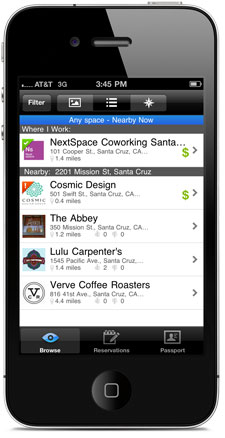
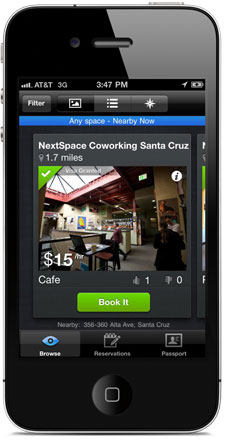
Just in time for SXSW 2011, LiquidSpace is opening its doors to mobile workers looking for flexible meeting and office space on demand through an innovative application for iOS that lets you track down and book available meeting spaces, based on location, availability and features. But which doors exactly? Well, any of them - for LiquidSpace is leveraging advances in technology, such as location awareness and the ubiquity of mobile applications, with trends in real estate that see employees working "all over the place" in a world where many buildings are significantly underutilized. The combination has delivered an opportunity for someone to step in with a solution for both - putting people to work in buildings that could spare it. LiquidSpace smoothly offers a real solution.

The founders, Mark Gilbreath and Doug Marinaro, over the last decade became familiar with how traditional real estate models with fixed leases were "completely at odds" with dynamic and growing companies. With commercial real estate responsible for 60% of our carbon footprint and money being inefficiently spent on holding space for people who might not be using it enough or would demand it too much, the pair determined there had to be a better way to get things done.

LiquidSpace Shows Available Venues In Your Area

Enter LiquidSpace. The concept is two-way, like Foursquare, for users to check into a location that offers a space, and for owners to claim a venue to set up description, hours of availability, and pricing. Venues can be slugged in one of three ways, namely:
  • Public Venues (such as a cafe)
  • Paid Venues (such as a shared work space)
  • Private Venues (such as a incubator or VC office)
In the Bay Area alone, we've seen incubators rise with notable hotspots such as the Founders' Den and Dogpatch Labs, which have helped to move the market in LiquidSpace's favor, delivering private venues withs hared work spaces, often including conference rooms and kitchens. LiquidSpace essentially tries to deliver a location-aware search with a unique piece of real estate that matches the scenario you are working to.

Booking a Workspace on LiquidSpace

The application is quite robust for not having yet officially hit the App Store. You can find meeting places by location, sorted by private workspaces, public venues or meeting rooms, see their free/busy schedules, and can book well in advance if you like. Venues can set criteria for you to book the spot, and you can even use your confirmation from LiquidSpace as your identification at the front desk when you show up unannounced.

For the home office worker, an app like LiquidSpace comes none too soon. Are partners from out of town looking to meet face to face over PowerPoint? Forget about Starbucks or your living room. Fire up LiquidSpace, find a private meeting room in your area and book it. Get a call from your boss when on the freeway that you need to be on a Webcast in 20 minutes? Pull over, open up your iPhone and book the nearest LiquidSpace location. The more you think about the possibilities, the more an application like this makes sense.

I won't hold it against LiquidSpace that they're iOS only right now. In my discussions with them last week, it was clear they were thinking big on how to crack the Blackberry-carrying mobile worker, and the growing Android population. We even talked about whether their next step should be to make a Web app available in HTML5, which I'd strongly recommend. But before all that, if you happen to have an iOS-capable device, and you want a meeting place on demand, and are in a supported area, LiquidSpace sounds like a great idea. If you're attending SXSW this upcoming weekend, you can even book a space in Austin now. So do it before all the meeting rooms fill up.

February 21, 2011

Yobongo: The Open Chat Room In Your Pocket (Preview)

Yobongo: The Open Chat Room In Your Pocket (Preview)

In the four months since Yobongo first gained attention, CEO and co-founder Caleb Elston has been working to prepare his product for the visibility and scale potentially demanded by what's potentially the world's biggest tech event, SXSW, an environment which can catapult new sites into the stratosphere, or should they fall flat, have them forced to regroup. The service, currently in private beta on the iOS platform, has seen increasing activity at practically all hours, the equivalent of an open bar for discussion with members of the local community, which never closes.

In the last few weeks, I've finally found a reason to keep my iPod Touch nearby, in a home full of Android devices. The magnet-like pull is from Yobongo, whose goal is to bring people, potentially perfect strangers, who share a geographic location, together to talk about anything. The application's real-time nature, enabling true conversations between friends and others, goes beyond the world of serve and volley status updates or Q&A, putting the focus back onto the world of conversation instead of performance and counting of replies, retweets and likes. In fact, there are no points of feedback for updates - just a constant flow.


Yobongo in Action. Note notifiers for private messages, number of people chatting.


The concept hasn't changed since October, with the idea being people in shared spaces may discover they have common interests and can engage in intriguing discussions. For the many of us who routinely bump into the same faces and avatars on every network, this could be refreshing. Yes, just like any other social situation, it's easier to talk to those you know than those you don't, but Yobongo eases that process by mixing everyone in a single space.

So each morning, after turning off the iPod's alarm, I peek at Yobongo to find Caleb talking with users in the private beta. Some folks I know, and others I don't, but I am getting to know. And it's incredibly easy to jump into the stream of consciousness. For one, your avatar displays when you open the app, so they can welcome you. Second, the app doesn't start with a blank screen, but shows all the text flowing through the river - with the newest updates below. Should you want to, you can scroll up and see how the conversation evolved, see updates from people whom you may have missed, and get caught up.

Posting to the site couldn't be easier. There are no groups to join, as with other apps, some I like a lot (including Beluga and TextPlus). There are no demands to friend folks, as you're already connected to everyone live. And once you start typing, everybody knows because the system lightly says "... is typing." If more than one person is typing, the system updates there too. So you immediately, even in a small space like the iPod Touch, get an idea for all the participants, the ongoing messages, you can get updated on private conversations and see the thread as it evolves. Not bad.


An active Yobongo chat and a separate private message.


Caleb, previously highlighted on this site for his work with Toluu, Kallow and Kickpost, started the project with fellow Justin.TV ex-colleague David Kasper, who is responsible for engineering while Caleb handles product, the "yin and yang" of the operation as it stands now, he told me. While the company has been mentioned in the same breath as big group chat monoliths like GroupMe and others who have raised millions, Yobongo has not yet taken any funding. Lucky for them, they do have free residence at Dogpatch Labs, courtesy of Mike Hirschland and Ryan Spoon of Polaris Ventures, who would probably have the first in to a round A if Yobongo wanted to be YoFunded.

Like Quora, Facebook and other sites, Yobongo holds a few rules to help avoid abuse of the system. It's preferred that guests use real photos and use their real names. The app's short community guidelines ask to "be friendly", "be respectful" and "be authentic".

Does the world need yet another place to chat beyond the big social networks, and new places like Convore or the host of group messaging participants, including Beluga, GroupMe, MessageParty and TextPlus? It seems to me there is room for a lightweight system that doesn't feel like work, that is open to all who arrive, and leverages proximity. Whether Yobongo is the solution to an event like SXSW or not, only reaching those on iOS, remains to be seen, but I can see clear value to talking with both the friends you know, and the friends you don't yet know.

You can get in on Yobongo's private beta list by heading to http://www.yobongo.com. The service's first official intro video is below.

January 22, 2011

Beluga's Pre-SXSW Buzz Builds A Month Into App's Life

Beluga's Pre-SXSW Buzz Builds A Month Into App's Life

With services such as Twitter and Foursquare gaining incredible boosts through high visibility at the yearly South by Southwest event (SXSW), it has become something of a pastime to predict which service will be the breakthrough this year, if any. If early response to Beluga is any indication, the application, in addition to other candidates, such as Yobongo, is in the driver's seat to take that role in 2011. Only a month after the application debuted, the group texting service has gained high-profile mentions in publications as varied as Fortune and TechCrunch, and I can see new contacts joining the service every day - as each new connection from my address book notifies me from within the service.

As debated on Quora, it's widely assumed the best candidates for a boost from SXSW would be those useful at the event itself, be it for discovering top parties, debating keynotes and panels, and enabling people to communicate in the sometimes frenetic venue with spotty wireless support. This leads us to Beluga and Yobongo - the first enabling free texting between friends with intelligent linkage to location data and photos support, and the second offering location-based chat with complete strangers. But Yobongo doesn't have multi-platform support yet (including Android), and Beluga is already seeing good cross-platform engagement from early adopters, former Googlers, and is gaining awareness in the mainstream, especially after having been featured in the Android Market this week by Google - goosing the app's download numbers significantly.


Updates from Beluga With Photos and GeoLocation


The group chat field is one that is becoming increasingly crowded, with TextPlus, GroupMe and now Beluga being the best-known players. But Beluga, without the 10 million in funding gained by GroupMe, already has an extremely smooth application that integrates well with both mobile and Web-based activity, supports multiple mobile OSes and is very lightweight. As I've seen new "pods" started within my groups of friends, for the casual to the more business-oriented, it's obvious that a simple and fast way to exchange messages in groups, independent of the larger networks, like Twitter and Facebook, is much desired.


Tony Hung and Siobhan Quinn Rave About Beluga In the App
(Note Also the Geographical Reach of this Pod)


Guessing where the application could go in the future would be especially interesting as well. Recall how Brizzly Picnics had both private and public options, letting you publish question and answer chats to the Web for all to see? Today, all Beluga Pods are private to only the participants. There could come a real opportunity to make select Pods public, or even to established tiered roles for such Pods, so you could have read-only participants and moderators for public events, such as SXSW and others.


Foursquare's Dennis Crowley on Beluga's Growth Beyond the Mainstream


If it wasn't enough to just speculate about how the app could perform on the public stage, I was backed by Siobhan Quinn, product manger at Foursquare, who said in one of our Beluga Pods that "Beluga is going to blow up SXSW." Activity in individual pods is jumping, users are joining and feedback so far has been very good. It's been an eventful month for the service already, even over a usually-quiet Holiday break, but the next few months could be very loud indeed.


New Friends Are Joining Beluga All the Time


If you're not already using Beluga, go check it out at http://belugapods.com. Want to add me to a pod? Just use my email address and I'll join.

March 15, 2010

The SXSW Keynote With Ev Williams You Had Hoped to See

The SXSW Keynote With Ev Williams You Had Hoped to See

This afternoon, as most of you know, Ev Williams, CEO of Twitter sat down for a much-anticipated and heavily-attended keynote interview at the South By Southwest conference in Austin. After thousands of Twittering geeks and quasi-geeks alike had settled in to the packed exhibition hall and overflow rooms to hear the latest updates delivered straight from Twitter's leader, their excitement soon turned to boredom and finally, severe annoyance, as the interview's pace, tone and content fell well below expectations. After an hour's time, the halls in Austin were more than half empty, and an opportunity to showcase one of technology's biggest successes in the last few decades was for the most part lost.

For a huge number of attendees at SXSW, Twitter epitomizes a new form of communication. Their friends are on it. It's where they chronicle their lives and connect with like-minded people and businesses. That the keynote was the draw of the week would be a dramatic understatement. As I sat upstairs in the Austin Convention Center, letting my laptop get some electricity in anticipation of live-blogging the keynote, the escalators jammed with hopeful starry-eyed nerds awaiting a visit from their blue-tinged oracle.

I have met Ev twice myself, including quickly Sunday night at the Google Reader/Blogger party, exchanging a few pleasantries and shaking hands, but by no means consider us close. That said, I expect I will see him again, while for many of those attending today's event, this could be their first and maybe only time to hear Ev's words directly. He doesn't do major speaking opportunities often, and SXSW is one of the biggest geek meccas of the year. Even if it was not an opportunity to announce something amazing, both Ev and the interviewer would have a huge platform to talk to the audience and be interesting. And they failed. Ev may not be the charismatic leader in the image of Steve Jobs, but he really had no chance, being served a syrupy mosaic of cotton-ball soft questions that dealt with feeling, culture and "awesomeness."

As I summarized the keynote in a running transcript on Google Buzz, I hoped my own fatigue wasn't seeping through the text, but the pedantic non-inquisitive approach had me fidgety, featuring insightful questions such as:
"It was you or Biz that said if it was awesome people would use it, and when you talk about creating something, it is about awesomeness? What is awesomeness for you guys?"
At other points, I wrote... (Questioner keeps agreeing with Ev and saying that's "cool" rather than asking questions) and (Questioner recaps his own previous blog posts).... When I looked up at the conclusion of the keynote, the once-packed overflow room I was in was tired, quiet, and very empty. The row I was sitting in, once packed elbow to elbow, sported five empty chairs to my left, and a pair of folks to my right with a few empty chairs in between. The talk had clearly missed the objective, and people were sorely disappointed, compared to what they had obviously hoped would be something special.

Here's what should have happened.

For me, the keynote speech fell far short, not because the questioner was friendly, but because there was very little substance. One can question a speaker in an interesting way without being contentious. What failed to happen was any detailed questioning into competitive markets, technology, challenges or relations with developers. Instead, we got questions about management principles, overly long descriptions of Wal-Mart, ambition, whether partnerships should be "win-win", or if Twitter could be a force for good.

I respect Ev and think he had hoped for a lot more. I would have challenged him and asked:
  1. Has Twitter finally escaped the scalability problems that plagued the service in 2008? If not, what's left to solve, and what kind of technical challenges remain?

  2. There was talk that Facebook once was interested in purchasing Twitter, and you chose to remain independent. How do you see Twitter's role in a world alongside Facebook? Where do you compete and where could you potentially partner? How did their acquisition of FriendFeed change things?

  3. When you saw the launch of Google Buzz, did you feel like the old company you once worked for was looking to stab you in the back?

  4. You talked about being an open company hoping to foster strong developer relations. How can developers on the Twitter platform be sure advances in your own services won't compete with them and put them out of business?

  5. While you have opened up the firehose to select partners for revenue, can anybody who wants to pay gain access to the firehose feed? If not, how do you set the criteria for doing business?

  6. There are many different Twitter clients out there. What are aspects of third-party clients which you like the most? What attributes of these clients can we expect to see in Twitter.com?

  7. The Twitter search engine still is extremely broken and only returns a few days worth of tweets. Will this ever be solved, and how big of a priority is it for your team? What is left to do and how soon can we see the true search engine come online?

  8. The company has recently reversed its approach to a Suggested User List, but as you know, many people on Twitter have followings in six or seven figures that benefited from the old model, and have incredible reach or influence because of that approach. How can the playing field be leveled?

  9. It is assumed that your relationship with Betaworks has also led to your use of Bit.ly as the primary URL shortener on the service. How soon until you purchase Bit.ly outright? Should we also assume closer relationships with other Betaworks companies, such as TweetDeck?

  10. So far, it appears you are avoiding revenue models that include advertising in the stream, similar to Google AdSense, but we have also been promised advertising we will love. Can you explain how this advertising will work, and if I can block it?
To sit down with the CEO of one of the most interesting companies in all of technology and not talk about technology or competition or specific tools in any meaningful way was a dramatic letdown. That the interviewer did not recognize the fatigue of the audience as they scurried out of the cavernous halls was shocking, and now, Ev, who seems to be more on the shy side than the screaming and yelling type, like Steve Ballmer, may think twice about another opportunity, which is unfortunate. I recognize a public interview on such a stage can be a real challenge. We all learned about Sarah Lacy's struggles in that space back in 2007. But those of us who use Twitter and really care about these products deserved more. The SXSW community deserved more. They voted with their feet and they voted with their retweets. While one can remain civil and not throw barbs at the speakers, there was no question this could have gone a lot better than it did, and Twitter will have to promote its new @ Anywhere platform in a better way, for today, it was seriously overshadowed by a train wreck we found ourselves stuck watching.

March 14, 2010

Gmail Failures, Crazy Ideas and Wave's Leapfrog

Gmail Failures, Crazy Ideas and Wave's Leapfrog

On the Web, there is a lot of confusion over where Google Wave fits alongside the recently-introduced Google Buzz, or even if Wave is supposed to be a companion or competitor to Gmail - which could potentially cannibalize the company's extremely visible (and profitable) e-mail business. Today at the SXSW conference, the team leading Gmail said the company has to take risks, learn from mistakes, and yes, even sometimes build products that are in conflict and may replace one another - in the name of keeping competition from doing it themselves.

As it was described this afternoon, Google Wave, which debuted in early beta last year, is a "leapfrog project", which goes beyond today's environment, but is set to impact a future Web. The team working on Wave, as discussed with the product launched, is looking to do more than just build a collaborative service, but to possibly even replace e-mail itself, something the GMail team recognized might seem at conflict to their core mission.

"When people ask if we are cannibalizing our own services, we would rather cannibalize our own services than have other people do it," said Todd Jackson, product manager for Gmail and Google Buzz.

Putting significant resources into disparate product lines that may come to future conflict might seem crazy, or even a bit paranoid, but it sounds like that is par for the course for the team, which said it likes to take big risks, which might not ever see the time of day, or die when they do. In fact, we learned today that Google Buzz's original incarnation began several years ago.

"Most of the things we try fail," said Jonathan Perlow, software engineer on the Gmail front end, responsible for GMail Chat and Mail Goggles. "We have lots of things that are false starts. We recently launched Google Buzz, and it had some false starts before it launched. We started something like Buzz around when we launched chat four years ago. Good ideas live on, and you figure it out."

Figuring things out for the Gmail team can be very quick. The team boasted of a close-knit engineering environment where ideas can be discussed and coded quickly, and where meetings are the exception rather than regular practice.

But while most failures for Gmail have occurred in testing and not made it outside of the walls of Mountain View, the initial failures for Buzz happened thanks to the team making some core mistakes and not having a testbed of real-world users, relying too heavily on their open corporate mentality.

"Gmail thought that e-mail and chat networks were also the social networks, and we missed the boat there," said Jackson. "(Autofollow) worked really well within Google in a trusted environment. Googlers rarely used block."

While Gmail's focus has changed over the last six years with the additions of Chat, Buzz, user interface updates and other features, the product initially aimed with three main goals: enable users to never delete e-mail, have a spam filter that really works, and build a Web interface with the level of quality of a desktop application - concepts that nobody knew how to do, but wanted to accomplish anyway.

"One of the lessons I learned is that when we start with ideas that are crazy at the time, but we thought we could do, they would be pretty great for users, said Perlow. "They had no idea how to build these things, but had to figure it out."

GMail's Invite Marketing Coup Was a Myth

GMail's Invite Marketing Coup Was a Myth

For the last six years, marketing teams and Web services have pointed to GMail's invite-only approach as on of the most successful examples of driving user demand in a time of scarcity. At one point, GMail invites were so sought after that account-holders were selling off their spare invites on eBay. In fact, that's where I bought mine, as well as a never again used account ID for Orkut, way back in 2004. Today, at SXSW, we learned the move to make GMail an invites-only platform was not a marketing strategy, but instead one driven by fear from engineering, who thought they might not be able to scale under tremendous potential demand.

As is well-known, Gmail's debut on April 1, 2004 was not a massive April Fool's joke that promised a gigabyte of Web-based e-mail at a time when competitors like Yahoo! offered a comparatively measly 50 megabytes. Combined with a new Web-based interface that echoed the quality of desktop apps, and integrated anti-spam, the team thought potential customer demand for the new platform could outstrip available resources - and the engineers pushed for the invite only system.

"People were selling their souls on the Internet for invites," said Arielle Reinsten, Product Marketing Manager for GMail, at SXSW Interactive today. "But it wasn't a marketing idea at all (to offer invites). We were worried about capacity. It was an engineering decision that was seen as marketing."

With GMail now having passed the initial time of scarcity, open to all, the company now focuses on how they can leverage word of mouth from happy customers, and push for activities like viral videos and fan-building activities. Reinstein did say GMail was advertised widely in 2007, in part of a wide push to highlight it's built-in spam protection, but "it was a drop in the bucket compared to the organic growth and the viral growth GMail is known for," she said.

On Monday, the Users Will Strike Back Against Products

On Monday, the Users Will Strike Back Against Products

Although I covered a pair of panels from the South by Southwest conference in Austin yesterday, I didn't go deep and explain why I chose to return to the event, which I first participated in and attended last year. Thanks to work at home and with Paladin, I almost opted out of SXSW in 2010, but after being offered the opportunity to speak on behalf of users everywhere and talk about how we may be losing the battle against products that are poorly designed or don't have our input, I had to accept - and therefore, I am spending the weekend in Austin. Tomorrow, in a core conversation, where I will participate in tandem with Chris Wetherell of Thing Labs (makers of Brizzly), and formerly of Google Reader we will sound the alarm for users to once again get the upper hand.

As users, we for too long have not had much of a voice in the products we are expected to use. We have been dragged through iteration after iteration of beta software, expected to accept poor user interfaces, lost data, incompatibilities and decisions that have been made that benefit the company rather than ourselves. We have seen violations of privacy, we have seen sites that we like abandoned when founders get bored, or when the acquiring company has no interest in supporting the existing community.

In an allegedly social world, we have seen companies think all they have to do is start a Twitter account or beg you to join their Facebook pages, but instead of having real connections, the are sending out their interns to spout coupon codes and collect follower counts. We have seen discussion boards and feedback forums created, and then ignored.

Users are not to be feared. Users are to be embraced - and very often, we may have some fantastic ideas in terms of how to drive your product strategy that will help your company gain in differentiation, gain market share, and outperform the competition.

This is not a game of power users demanding power and access. This is a cry for help, to give us the option to trust you again. Just like every airline reminds us at the end of every flight, yes we have choices, and we are looking for solutions that give us real value. We want to help you.

If you are at SXSW in Austin tomorrow, please take up a torch on behalf of users everywhere, and join us at 11 o'clock to talk about how we can prevent products we like from becoming products we hate - and ask developers to take us seriously. We are in Hilton J, and the session is titled: "Products vs. Users: Who's Winning?"

Join us: http://my.sxsw.com/events/event/770

March 13, 2010

Users vs. Companies: Conflicts over the Real-Time Web?

Users vs. Companies: Conflicts over the Real-Time Web?

If 2009 was the year of real-time Web, with practically every major service finding ways to bring content to its users instantly, 2010 is about optimizing the new real-time world, expanding interoperability between sites, finding more ways for users' content to be discovered, and taking the potential of real-time out of the status world and into the real world. Today, at the South by Southwest Interactive event in Austin, Texas, one panel asked if we were making serious progress in this vision, and if companies, feeling increased competitive pressures, are short-changing users in the process.

Marshall Kirkpatrick of ReadWriteWeb, who moderated the panel, featuring representatives from Collecta, Google, Gowalla and Microsoft, said "the real-time Web is a big, complex and multi-headed beast," adding, "almost as many people you talk to on the subject will give a different perspective."

For most, the real-time Web represents reducing latency from the time updates are published and when they are experienced practically to zero. This can be anything from updates from blogs to downstream aggregators and RSS feed readers, status updates from social networks to other points in the ecosystem, or instant alerts from the Web at large that a saved search you requested has found a positive match.

But one of the existing problems with the real-time Web that has occurred is that despite the focus by many services to solve the same problem, many have done so without delivering true data interoperability - and other services are trying to solve for real-time without having full access to users' public data.

"Back in the day, you couldn't send e-mail from AOL to Compuserve, and today, you can't send data from Google Buzz to Facebook," said Brett Slatkin of Google's App Engine team, and co-author of Pubsubhubbub. "Part of what we are trying to work on is breaking down these barriers that connect to different sites. If I am on Buzz and Marshall is on Identica and Jack is on Twitter, we should all be able to communicate."

Standards have evolved in the real-time Web space, from OAuth to PubSububbub, WebFinger and Salmon (as documented here), but that's not to say there aren't still heated debates over these standards, or even which version of standards should be supported. (See this article for a discussion of OAuth 2.0)

"I try to be a practical person, and when I hear about a family of specifications, it sounds like a family of work," said Dare Obasanjo of Microsoft. "There is clearly a place where we have a common pain that we can work on. There is a bunch of shared pain, and the way you have to get real-time service is to work on APIs, and that is a clear starting point for standards. Pubsubhubbub can help solve that problem, but I get concerned when you have to implement certain specs to solve that problem."

"These specifications we agree on should be useful on their own," answered Slatkin. "When you implement a specification like HTML, you are not buying into an ideology."

As the real-time Web's protocols are debated and deployed, so too does the application of these services. Google Buzz and Facebook have received scrutiny for their aggressiveness in converting assumed private data to public, and Netflix recently canceled an algorithm development contest thanks to concerns of assumed privacy violations.

"When talking about privacy, right now, unfortunately, the social networking market is failing, and they have little incentive to encourage user privacy," said Obasanjo. "I am waiting to see when people find what they thought were private updates as part of trending topics on Google and Bing. Users and companies are in conflict."

Obasanjo gave the example of Twitter needing its users to be public in order to drive value into the system. After all, if users were all private, there would be no trending topics, and thus it is Twitter's best interests for updates to be public. "There is a factor that if a user wants to be private, it subtracts value from the system," he said.

Beyond these concerns, known benefits of the real-time Web are scratching the surface of what could be done with more expanded to real-time data from other sources, it was argued. Slatkin forecast a time where you could query supply chains for inventory and purchase locally instead of from Amazon.com, turning economies of scale on their head. Scott Raymond of Gowalla talked about intersecting real-time Web technologies with geodata to show trending locations and the hot parties of the moment, by decaying the relevance of checkins over time. Jack Moffitt, CTO of Collecta, said a development environment for new tools and applications that leveraged zero latency was becoming "very interesting".

"All these guys are working on realizing the potential right now, working on real-time data," Kirkpatrick said. "Brett Slatkin said it was important people focus on the unforseen future that systems we worked on to support undiscovered use cases - things are going to get real crazy real soon."

Web-wide adoption of RSS and Atom standards has eliminated the problem of publishers providing their data, and tools like Pubsubhubbub are working to get data from one site to another faster. "Polling doesn't scale and you need a push notification to deliver it. It's possible we will have multiple winners, and we have to consider privacy considerations that people won't want their data available to everyone," said Moffitt.

The element of real-time is being layered across the Web, and it seems to be happening even if developers aren't completely in agreement over the tools needed to optimize the experience or if the debates on privacy versus public data are solved. And there's a lot of room for real-time to grow outside of the statusphere and to more traditional markets. The question is can developers provide solutions that don't have users running to the FCC?