Showing posts with label Facebook (198 posts). Show all posts

February 11, 2016

We Need Smart and Personal Streams, Not Just The Latest Updates

We Need Smart and Personal Streams, Not Just The Latest Updates


Once again, the tech web is aflutter about a proposed change in Twitter’s timeline — as they have finally made a choice to offer more than a simply chronological feed of updates displayed in the order they were posted. While a chronological order of tweets can be considered a hallmark definition of what Twitter is today, and truthfully, one of its most addictive features as each new Tweet rolls in, it’s also a detriment to those who aren’t ready to be constantly hooked to the information IV drip.


My 2010 Summary of a Personalized Web future

Twitter is 10 years old now. That’s fairly mature from a Web services standpoint. Its peers, LinkedIn and Facebook, are 14 and 12 respectively. The next generation? Pinterest is just over six. Instagram nearly six. Snapchat is five. And yet it often seems as people are still waiting for Twitter to make that big leap forward to properly sit at the adults’ table.

Twitter as a Media Network, not a Social Network


Ex Twitter PR and comms guy Sean Garrett, now running his own firm, commented yesterday that Twitter’s been done a disservice by being labeled as a social company instead of as a media network. Taking that summary seriously, it clarifies one of the major needs for a personal and intelligent ranking of content, rather than a raw feed of the latest updates. Media companies don’t just give you the very latest updates in order, with no external curation. Instead, they sort it, rank it and deliver them from the most important to least important — whether their medium is television, radio, print or online.

For the most aggressive media consumers, like myself, the idea of seeing content out of order may seem like pure heresy. We read every email, read every blog post in Feedly, and generally catch up on Twitter to the point where we left off. Scrambling that up seems abhorrent. But we’re not normal. We’re seeing that from the tippy top 1% of the bell curve, and hoping the rest of the world will catch up to us. But not only won’t they, but they don’t need to, and we should stop expecting it.

A successful network has an obligation to give its users the best possible experience and do it instantly. But surfacing the right updates for the right person at the right time is a tricky Venn diagram to figure out, be it based on the users’ topics of interest, their affection for the person posting the content, the recency of that content, and obviously, a mix of all those signals and more. Just sitting back and showing the latest stuff only solves for one of those qualities: recency — completely ignoring what I like, who I trust and so on.

Personalized Content Leads to Happier Users, More Usage

From 2009 to 2011, I worked with my6sense, first as a third party consultant, and later as the company’s VP of Marketing, before I joined Google. Their app surfaced content from your social streams in a personalized way, just for you, based on your own implicit behaviors — what you clicked on, what you chose not to, how long you read something, etc. The more you used the application, the smarter it got, and eventually, we would know your interest patterns so well, that we could take our user model and apply it to any stream on the web.


my6sense for Twitter

In early 2011, we delivered a Chrome extension for Twitter, which took the smarts we’d developed and displayed the results of that effort on the Twitter website — giving you two options: your standard timeline, ordered chronologically, and a smart, personalized timeline, from my6sense.

By no means were we the first company to try and bring sense to a social stream. In fact, in 2008, FriendFeed (RIP) offered users personalized recommendations as a feature to their service, aimed for those who’d been away and wanted to quickly catch up. But one aspect important to both of these examples is that they gave the user a choice. You could quickly switch between a chronological feed, which was the default, and the smart feed, personalized to your interests. You could always go back.

But as we found out, the more the user visited the app, and the more accurately we could determine their preferences (which we called digital intuition), the less likely they were to ever visit the unfiltered, unsorted feed. If you became accustomed to a curated feed tailored just for you, going back to one that wasn’t seemed unacceptable in comparison.

Quantity Isn’t Quality. Popular Isn’t Personal.

So imagine you’re one of the millions of users of Twitter (or Facebook, etc.) who doesn’t check in every day. On the rare occasion you do visit, you’re not seeing a feed of updates from people who matter to you most. You’re instead seeing a feed of updates from people who post the most. And quantity rarely was quality. When your selling action to those most likely to leave your service is to give them something low quality and off topic, that’s a problem. And yet, for many services, that’s the default.

Going even further, what many services provide as an option is a leaderboard of popular or “Top” content. It’s assumed the most engaged content is the “best”, but this alone is far from the truth. If you seek out a stream for intellectual curiosity and news, you won’t get that from viral videos and memes, jokes and celebrity news. But many people go to these services to turn their minds off or to relax, and their goal may be in direct contradiction with yours.

Twitter’s Success Really Isn’t the Topic of Debate

Now that Twitter has gone public and its financial success is being graded quarter by quarter, and Wall Street’s public vote on their valuation is there for the world to see, its success could be easily measured solely by stock price. Amid the hubbub of whether Twitter could sustain a billion person audience, like Facebook, or if it’s exceptionally valuable due to the role it plays in the world’s news dissemination and communication, the reality is that it has to do better both for its current user base and those yet to embrace it. And that requires change and evolution.

Twitter should be personal just for me. So should Facebook. And LinkedIn. And the web at large. And my phone and car and so on. If a dichotomy is set up between something that’s smart and personal against one that isn’t, I know I’m going to give the service a chance to give me a better experience — and if not, I should always be able to go back.

Disclosures: I work at Google, a partner and occasional competitor to Twitter. I’ve been an active Twitter user for eight-plus years. I was previously VP of Marketing at my6sense, which built a personalization engine.

October 14, 2014

What If We Redid the 2000 .Com Monopoly Edition for Today's Web?

What If We Redid the 2000 .Com Monopoly Edition for Today's Web?


In the year 2000, as the .com bubble was at its peak, it seemed new tech names were going to rapidly eclipse the old guard. Emails and downloads were new conversation topics, and if you weren’t still on AOL, debates would ensue over which ISP you should choose, or which search engine or portal was the best. Sun was the dot in .com and Linux seemed poised to take over the desktop. Obviously, not everything turned out that way, even if some of the names are still around, and even strong.


The 2000 .Com Monopoly Board

One of the fun collectibles that came out of this time was a .com edition of Parker Brothers’ Monopoly. Instead of properties around Atlantic City streets, you had websites. Community Chest and Chance were replaced with Email and Download cards. And you couldn’t buy property for a few hundred bucks, as everything was in the millions of dollars. Not too soon after the game came out (and of course, I still have it), the .com market was decimated, as the companies of the future weren’t built for the present. Now the game board itself looks like a relic of a short-lived era gone by.

The 2000 List of Companies and Categories


As something of a lark, and thought exercise, let’s consider who would take these 2000 era companies’ spots on the board. I’ll go first with my take on today’s cast of characters.


Dark Purple
2000 .com Monopoly edition: Sportsline.com and FoxSports
2014 .com Monopoly edition: Deadspin and ESPN.com


Commentary: Back in 2000, ESPN, as part of Disney, didn’t have a great approach at owning its web presence. It was part of the Go.com family, one reason it missed the original .com board. Now, ESPN represents sports on all media. Deadspin is an exceptional alternative with sharp commentary that is a must read for serious sports fans. (Apologies to SB Nation)


Light Blue
2000 .com Monopoly edition: GeoCities, Oxygen and iVillage
2014 .com Monopoly edition: Pinterest, SnapChat, and WhatsApp


Commentary: The 2000 edition definitely had a bent toward community. With iVillage and Oxygen, two of the three properties were focused on women. GeoCities didn’t age well and was retired. Pinterest, SnapChat and WhatsApp have become some of the fastest growing communities for pretty much all ages and both genders.


Light Purple
2000 .com Monopoly edition: Shockwave.com, Games.com and E! Online
2014 .com Monopoly edition: TMZ, Buzzfeed and Reddit


Commentary: Shockwave? Really. Let’s move on. For fun entertainment and burning hours of Web surfing, TMZ, Buzzfeed and Reddit can’t be beat. Reddit is a tough one to categorize, as it calls itself the Web’s front page, but it’s knocked off Digg, Slashdot and others for that title.


Orange
2000 .com Monopoly edition: Priceline, Expedia and eBay
2014 .com Monopoly edition: Square, PayPal and Yelp


Commentary: eBay could easily be a repeat in 2000 and 2014. Priceline and Expedia are still doing fine. But Square and PayPal are how the Web does business these days, while Yelp is often the place to go for recommendations on what to buy or where to go.


Red
2000 .com Monopoly edition: The Weather Channel, About.com and CNET
2014 .com Monopoly edition: Dropbox, Instagram and Tumblr


Commentary: About.com looks like a content farm, and while CNET’s still alive and kicking, there’s been nothing to talk about since its CBS acquisition. The Weather Channel? Please. There’s an app for that. And more than just finding content sites, anybody can create and share content globally with apps like Instagram, sites like Tumblr and share it on Dropbox. (Apologies to WordPress, Box and others)


Yellow
2000 .com Monopoly edition: eTrade, Monster.com and Marketwatch
2014 .com Monopoly edition: Wikipedia, LinkedIn and Twitter


Commentary: Monster.com and eTrade were monsters in 2000. I still use eTrade regularly, but they’re not known for their monkey-centric Super Bowl ads any more. Marketwatch is a snooze. Now, people get their financial and business data from each other via LinkedIn, in real time on Twitter, and check its veracity on Wikipedia. (Apologies to Seeking Alpha and StockTwits).


Green
2000 .com Monopoly edition: Ask Jeeves, Alta Vista and Lycos
2014 .com Monopoly edition: Microsoft, Amazon and Apple


Commentary: In 2000, Search engines took the entire final row of the Monopoly board. But the positions of Alta Vista, Lycos and Ask Jeeves weren’t strong against innovators that got stronger in the next decade. Now, diverse infrastructure plays like Microsoft, Amazon and Apple (for many reasons each) occupy this highly valuable section of the board.


Dark Blue
2000 .com Monopoly edition: Excite@Home and Yahoo!
2014 .com Monopoly edition: Google and Facebook


Commentary: That Yahoo! was the Boardwalk of 2000 is telling. Excite@Home was a $6.7 billion megamerger in 1999, but by 2001 was pretty much in steep decline. Without intending too much bias toward my current employer, Google and Facebook are the 1-2 when it comes to the Web today, from the top destinations to hours spent, tools deployed, etc - and both play a role in discovery for everyone.


Railroads/Stations
2000 .com Monopoly edition: Nokia, MCI Worldcom, Sprint and AT&T
2014 .com Monopoly edition: Verizon, Comcast, Netflix and YouTube


Commentary: Worldcom? Whoops. Nokia? Whoops. Things change, and companies don’t always adapt quickly. The megalopoly of AT&T is now most like Comcast’s ISP/cable monolith, and Verizon (including their FIOS offering) is the big carrier to be dealt with. Fighting the good fight, and using a ton of bandwidth in the process are Netflix and YouTube, which are essential media mediums on every device.


Utilities
2000 .com Monopoly edition: Linux and Sun Microsystems
2014 .com Monopoly edition: WiFi and Cloud


Commentary: We’re still waiting for the year of the Linux desktop, and Sun is now somewhere in Oracle’s beautiful campus. But while you could take a stab at a language or a platform, like Python, Ruby on Rails, or even PHP, generically its best said that the storing of data and access to that data are the true utilities of 2014. Pervasive WiFi (or 3G/4G) and Cloud power every app and every site.


Summary: The Web is dramatically larger, and more global, now than it was less than two decades ago. This admittedly English-first version of the .com Monopoly for 2014 misses out on the international communities like Baidu, AliBaba and others. There’s no place for the Uber and Lyft rivalry, and while Tumblr was included, it’s hard to put Yahoo! on the board, which probably isn’t 100% fair. I wanted to find a spot for Spotify and Hulu, but failed. I’d be ecstatic to see if Parker Brothers was up for another run at the web centric board, and you know I’d buy it.


Disclosures: I work at Google, which is a customer, partner and competitor with many of the names on this board. Putting them on a Monopoly board is not an opening for the company (or any other on the board) being a monopoly joke.

September 4, 2014

Striving for Streams of Serendipity or Inbox Zero?

Striving for Streams of Serendipity or Inbox Zero?

Nobody really likes spam - those unrequested commercial emails that join your email box. They interrupt you, distract you, mislead you, or maybe worse - trick you into giving up your money or personal information. And over time, most email services have been pretty good at determining just what is spam, and what's not, while we, as consumers, are getting better at refining just what content we want on all our screens, be it our email box, or our social streams.

With this experience, what we've labeled as spam now not only encompasses the obvious scam message, but practically anything that enters our view that we didn't explicitly ask for, or surprises us. Most of us living in a social media powered world have taken a lot of effort to refine our content sources, to the right sets of blogs, and the right friend groups on social networks. When we log in to Twitter, Facebook, Google+ or anywhere else, we pretty much know what we're going to get.

Many of these social networks, dating back to the first blogs, are sorted chronologically, with the newest content at the top. With some effort, you can quickly scan to where you last left off, and feel complete. There's no more to read, and you can move on to the next thing. It's a permuation of the famed "In Box Zero", which says your task is complete.

But increasingly, thanks to pressure to fill streams of less active users, or to increase engagement from regular users, it's become more commonplace to push content that's not explicitly requested into user streams. This can be "Friend of a Friend" content, like we saw back in early 2008 when FriendFeed first introduced the feature, or more recently, items that your friends on Twitter have retweeted or favorited, that Google+ friends have +1'd or Facebook friends have Liked.


It's assumed the more signals given to the network about what your friends like, the more likely it is that this piece of content is also relevant to you. It's not necessarily wrong, but it's a change, unwelcome to people who like to perfectly curate their streams - while possibly exciting to those who do want to take signals from the network - believing they aren't the one perfect arbiter on whether an item is interesting or not.

In 2008, FriendFeed spoke to this change, saying, "Our goal is to make the most interesting shared items more prominent so your FriendFeed has a higher percentage of interesting stuff and active discussions." And it worked. If I believed +Paul Buchheit had high quality interactions, I could be alerted to items on the stream that he had liked. But FriendFeed also gave me the option to turn it off, and many people did.

In 2014, Twitter is a lot bigger than FriendFeed was six years ago. It's a world-recognized stream for real time communication, so their moves get a lot of attention. Every minor change in the stream is especially scrutinized. After already taking for granted the fact that retweets from friends would be sent to my stream, the occasional tweet now appears, simply because someone I follow added it to their favorites. Unsurprisingly, this experiment, which is easy to spot on their mobile app, set the tech blog debates abuzz again - trying to figure out how it worked, and whether it was good or bad.


It's widely assumed putting content in user streams benefits the service provider. Twitter should see higher engagement, higher relevance and more clicks. For the OCD "In box zero" types, these serendipitous pieces disrupt their worldview, and, unsurprisingly, those who write about tech and social media all day are more likely to be of this type than the general population.

When +Barak Hachamov and I were working on my6sense, we were more than happy to rank social streams based on your activity and implicit interests. The solution, in my view, hasn't seen an equal, even in the three plus years it's been gone from consumer's hands. We offered a stream based on relevance, with your interests playing a huge role, a toggle to view the stream chronologically, and yes, we promised occasional serendipity to deliver surprise - to get you out of a knowledge rut, which can come from seeing the same topics debated and shared by like minded thinkers.

Relevance vs Time in my6sense

What we've learned from the Web is that we tend to gravitate to people who reinforce our own views and agree with us. Debate happens, but we don't actively seek out opinions from those with opposing takes on political, religious or even sports. (I wrote about this in 2006: Blogging Bifurcation - A Web Divided) The Web, despite being especially diverse, leads to us forming cliques, with friends, with what we read, and where we choose to congregate. Our three social pillars are what I called out back in 2009: Technology, Community, Relevancy. Most of us active in social streams have bought into the technology, and crafted our community, assuming the community's thoughts are themselves relevant. And by seeing new content, we immediately question its relevance.

For the 95%+ of people who haven't put hundreds of hours into scanning their streams to never miss a post, and who haven't taken time to set up lists, form circles, or fully understand Facebook sharing settings, the serendipity of surprise is as important as what they've explicitly asked for. While those of us on the tech edges react to the surprise with shock, we should know this is something we give in exchange for participation in somebody else's stream. The only thing I'd ask is that, like FriendFeed, we always have the option to please, kindly, be able to turn something off. Then we'll all be happy.

Standard Disclosures: I work on the Google Analytics team at Google, which provides Google+. Various services from Google partner with or can be assumed to compete with products from Twitter and Facebook. Also, from 2009 to 2011, I had a consulting relationship with my6sense as part of my work with Paladin Advisors Group. Disclosures are fun.

October 15, 2013

You Don't Get Any Participation Medals for Just Showing Up

You Don't Get Any Participation Medals for Just Showing Up

"I need some record of you being in this class," hissed my 8th grade math teacher, looking at me and pointing to my lowly 5% grade to date in his course after ten assignments, by far the lowest mark in the class. My not so glowing 50 points out of a possible 1,000 was the product of many days' not turning in homework, as my continued refrain of "I'll get to it tomorrow" started to become an impossibility to tackle.

Each day I told myself I'd eventually get to the previous day's assignments, taking a penalty for my lateness, but part of me knew I'd just float through the day to day and try to make it up on the tests. For me, it was proving I knew the answers - conveying mastery of the subject. Yet for my grade, it was proving that not only did I know the answers, but I was willing to do the work. Just showing up wasn't enough.

For the past 15 years, I've been working in Silicon Valley, and I've encountered an incredible mix of people who perform as if they are on different gears. Some work incredibly hard, and are driven to succeed at practically any cost, refusing to let traditional limits get in their way. Others seem almost crestfallen if they can't keep up with those gracing magazine covers simply by being in the right place at the right time. And the truth is that life's not perfect. There is an intersection of skill and luck that very often sees great employees at bad businesses punished for their career choices, while less impactful employees at incredible companies gain the benefit of their colleagues' work.

From the outside looking in, Silicon Valley might look like a technology-centric Disneyland, where the future can be experienced today, where dreams can get funded, and you can't walk down the sidewalk without knocking shoulders with millionaires. But every success story you read, and those people who become household names, be they Steve Jobs, Meg Whitman, Larry Ellison or Marissa Mayer, came not as a product of pure luck, but the application of effort against risk.

Risk Is Often Required If Something Is Worth Doing

I remember sitting around our corporate boardroom one afternoon ten or so years ago, as an account manager on our team explained why we had been unable to close a once-promising deal. He said, paraphrasing with some angst, "In his business, the IT manager's job is to reduce risk. At our stage, we're all about risk." And it was true. While our more established competitors didn't have all the whiz-bang capabilities our devices did, what they did offer was a track record of success, integration with top partners, security, and all those things that moved risk out of the data center. We had to look elsewhere to find customers more willing to take a bit and absorb some risk, in exchange for our differentiation.

Which brings us back to "just showing up".

I spent my first three years in the Valley working at two very small startups. The first didn't have any revenue, and some odd ideas. When the founder was let go, the sister company asked me to stay on, and we worked hard at bringing traditional office tasks to the Web. The work was good, and our customers liked our products, but we weren't growing fast enough. When we went out to raise a $10 million B round, we came up light, and that was the end of my tenure. But as we were plodding along with our incremental growth, it seemed like everyone around us was going public, making money and buying homes - which to us was pure fantasy. Some of our best engineers took other jobs, and spoke openly about the frustrations they felt when all their friends were getting rich, while we were still bringing our food in a bag lunch and eating at our desks.

Even in a bubble, showing up wasn't enough. At my next company, where I spent 8+ years, we had enough spikes and troughs to fill a novel. Maybe some day I'll write it. We scored several rounds of venture funding, several rounds of layoffs, and filed to go public, not once, but twice. The company eventually sold for a good amount after I had left, but not before a number of upstarts had soared past us, having much more profitable exits, at valuations anywhere from 4 to 5 what our exit had been. And while we could feel bad about not having hit a home run, I was all too aware of the many other players in our industry who had already gone bankrupt, or returned money to the original VCs, lacking a business model, and other former colleagues who had bounced from company to company in search of something that stuck.

I've always been raised with the mantra that nine out of ten startups fail. I've seen other ratios with different numbers, but the truth is that the overwhelming majority of small business concepts, even those with venture funding, don't have a positive exit, and it's a much rarer one that sees the founders and employees strike it big. For every market sensation like Facebook, Twitter, Instagram, Tesla or Spotify, you have scads of others with software products few wanted, or website plays that have seen their URLs turn into dead links.

In the big race of keeping up with the Joneses, especially in an area ripe with exceptional people who have impacted history, seeing others' success can make it seem easy. Easy to start a company. Easy to start a venture fund. Easy to find customers. Easy to do practically anything. But it's not. I remember the wave of aspiring dotcom millionaires who came from around the country sporting MBAs, only to return when things got tough. And I remember the stories of former Business Development managers loading luggage at the airport when jobs were scarce. Success is not doled out equally and fairly, and the best products and best people don't always get rewarded. But the equation improves with incredible market study, exceptional effort, and the self-awareness to make change where it's required at the right time.

Do read up on the world's successful people, as I remember doing in college, checking out "The Difference Between God and Larry Ellison" from the Berkeley city library. Do make yourself aware of their smart strategies and innovative products. But don't forget the hard work and effort required that set them up with a greater likelihood to succeed. Or you'll be like I was in 8th grade -- getting dressed down publicly by my teacher who questioned why I was even there at all if I wasn't going to do the bare minimum.

Disclosures for fun: I worked at BlueArc from 2001-09 and owned options, as well as stock acquired in the company's 2005 AA round. These converted to shares when HDS purchased the company in 2011. I currently work at Google, and any references to their competitors or partners are just part of the story and presented without intended bias.

September 24, 2013

Two Paragraphs, a Link, and a Cloud of Dust

Two Paragraphs, a Link, and a Cloud of Dust

Our platforms, and their limitations, are changing the way we communicate. Rather than accommodating the many ways we as humans like to share and engage with others, most of the online services we use have limits in how much we can share, how items can be staged, and how easily others can discover or respond.

While Twitter's 140 character platform is only the most well-known of these hard limits, there is an easily observable trend away from long-form content, analysis and conversation, and more toward a brief moment with an ephemeral interaction. Blogs are one of the last outlets we have where the container, like liquid, expands to contain all into it which is poured, while most other outlets are often trying to make us something we're not - be it photographers, clever headline writers or meme artists.

We've moved away from thousand-plus word screeds and dozens of debatable comments over a single item, with a permalink discoverable through search, instead to a moment in a stream that is significantly less relevant tomorrow or next week than it is today. We're valuing our content not in real activity, but in microactivities - be it +1s, Likes, Retweets or Favorites. We're trading points and counterpoints for vague notions of follower counts and popularity.

While it can be a challenge to regularly upkeep an outlet like a blog or a news magazine, consider the permanence and discoverability of this content. One can, with a little effort, read an author's life as it changes, by poring through the archives. Authors can link to previous points and positions to make a deeper case for an idea, and show consistency or evolution of thought. And permalinks can serve as the point of engagement for us to talk something into the ground, or its natural conclusion - whatever comes first.

Consider, if you would, the last really important Tweet or Facebook post or LinkedIn update that you either made or saw. Where would that Tweet stand in the halls of history? While real-time is an amazing tool for the right now, it's not usually a great tool for the later or forever. There's no other solution out there for diving into the world's collective thoughts around television, sports and shared experiences, but it lacks for completeness.

Yet that's where practically all our effort is going.

The most visible entrants and quickly adopted mediums in the social sphere over the last few years are not centered around long-form content. Instagram, for the most part, is a photo sharing site with social interaction. Tumblr, despite the option for longer-form content, is usually a collection of photos or short excerpts -- links to links with the content on the other side. WhatsApp and Snapchat are different beasts altogether, focused on the right now, with the content never intended to have any true longevity.

So our thoughts and our communications are being forced into these neatly approved buckets, wrapping around the presentation of the medium. If you know your network looks best with a headline, a few hashtags, and a sentence, that's all you'll do. If you know it's a beautiful photo with three words at the top, that's what you'll do. Maybe you can make an infographic or a meme out of it and be the most shared image of the moment, only to fade into oblivion the next day.

That's why I'm optimistic about the plans for Ev Williams' work on Medium, as outlined in a dedicated piece for TechCrunch two weeks ago. We've also seen interesting attempts from Dustin Curtis' Svbtle network - a very well designed platform with hand-selected authors. I don't yet have accounts with either, as I'm quite loyal to my +Blogger platform and integrated Google+ comments, but both services seem to be fighting against the stream, so to speak, helping people with longer thoughts share in a better looking way.

I believe as social participants, we can and should do better than a picture with a few words, a tweet that summarizes a link, or a post with a headline and a paragraph. It may satisfy the right now, short attention span theater, but if that's all we have, then what do we tell history that we've done? Do we suggest that those in the future looking back on this age download our archived social stream to best understand who we were? Should they grok our automatically filtered photos and understand our taste for art, or see how many likes a post got to determine its impact?

I would hope we're not letting the containers impact our ability to share the entirety of the message. That's why even while I've got plenty of other work to do, the blog continues to be my foundation in a world of streams, which I first wrote more than four years ago and stand by. So if your favorite social outlet starts to reduce the number of ways you can express yourself, take it somewhere else. Don't cut yourself short, and become dust in the wind.

Usual boring disclosures: I work at Google on Developer Relations. Most of my work is on YouTube videos, short and long. This blog runs on Blogger and integrates Google+ comments. The post is not intended as a post in favor of or against our products or competitors' products. I also like writing long disclosures.

August 19, 2013

The Twitter Google Netflix iPad Dotcom YouTube Facebook Era

The Twitter Google Netflix iPad Dotcom YouTube Facebook Era

As technology has weaved its way into practically every aspect of our lives, it has become something of a challenge for historians, journalists and others to try and encapsulate this new era of near-pervasive Internet, dramatically reduced barriers to publishing, and obsessive gadget accumulation.

I grew up in a world where a whole generation of people could be summarized easily, defined by population bumps like the Baby Boomers, a shared experience in battle, as Tom Brokaw frequently cites in The Greatest Generation, or quite simply, by the assigned letter given to those born in a ten to fifteen year period, like Generations X and Y. Now, newsmakers and analysts alike are trying to explain just what this new era should be called. Is there one device or one company or one shared experience that defines us?

With some quick research, it's clear there are many players vying for the elite status of owning our tech-savvy era. I tapped into Google (disclosure: I work there) for a few examples. Let them play out and see if you favor one over another or have a better option. All screenshots current as of Friday, August 16th, 2013.


The iPod Era: 69,100 Google results
Represents: The iPod at peak was more than half of Apple's revenue, outpacing Mac and all software sales. The iPod was a cultural phenomenon representing fashionable portability of digital media and personalization of music listening.
Is it over? Yes. According to AppleInsider, the iPod Era ended in 2010.


The iPad Era: 132,000 Google results
Represents: The first successful tablet computer disrupted the old way of doing many things, and picked up where Apple's iPod and iPhone had left off.
Is it over? Probably not. The iPad Era launched in 2010. Debate from AdAge questions if it's done.


The Google Era: 259,000 Google results
Represents: Near-instant retrieval of information, and a reduced need to memorize. Ability to scale.
Is it over? Nope, unless you think Business Insider is onto something.


The Twitter Era: 401,100 Google results
Represents: Near-instant ability to communicate and a real-time medium.
Is it over? No.


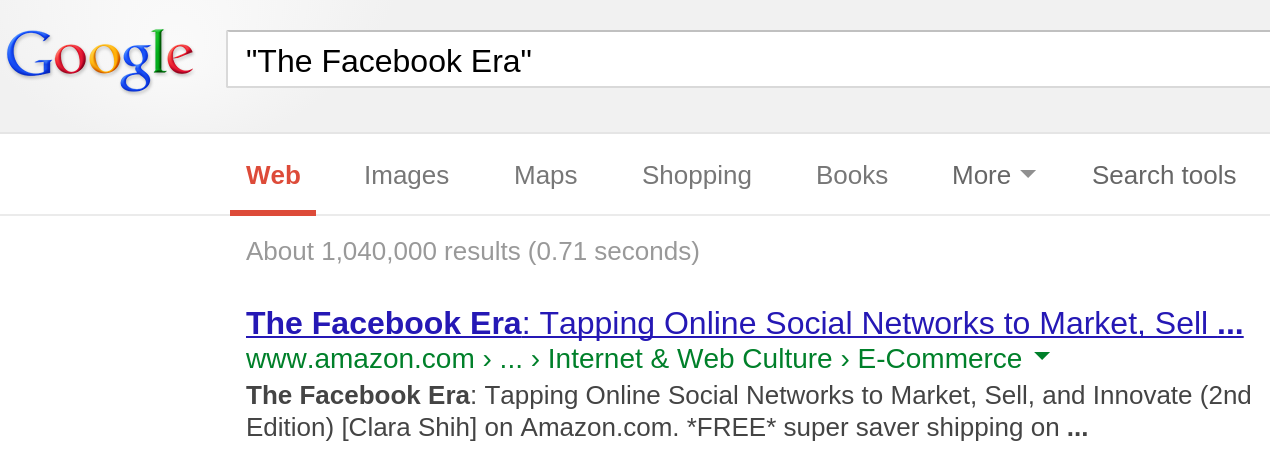
The Facebook Era: 1,040,000 Google results
Hey look! A book: The Facebook Era
Represents: Increased connections with social ties, and ease of discovering personal information.


The myspace Era: 59,500 Google results
Represents: Like Facebook, only earlier, more personal information online, simple creative sharing.
Is it over? Yes. Absolutely. This dude missed the whole thing.


The Blogging Era: 150,000 Google results
Represents: Ability for anyone to publish, in long form, at no cost.
Is it over? Getting there. In 2004, this guy claimed 2014 would finish it up.


The Android Era: 297,000 Google results
Represents: The entry and rapid adoption of Android as a smartphone OS. 
Is it over? No.


The YouTube Era: 210,000 Google results
Represents: The ability of anyone to publish video and have it be seen around the world. Also represents casual video consumption relative to professional 
Is it over? No.


The Dotcom Era: 1,490,000 Google results
Represents: Referred to as much as a bubble as an era these days, the first rush online by traditional services and businesses. Many did exceptionally well. Many more disappeared. 
Is it over? Yes. At least the first round.


The Microsoft Era: 423,000 Google results
Represents: The last few decades of a world where personal computing was dominated by Windows PCs and Microsoft software.
Is it over? Many people think so. In fact, a "Post-Microsoft Era" has been discussed.


The Steve Jobs Era: 67,900 Google results
Represents: Steve's personal impact on the world of technology, design, marketing and one of the most successful companies in Valley and tech history.
Is it over? Unfortunately, yes, as Steve passed away, but his impact lives on.


The Netflix Era: 41,600 Google results
Represents: On demand instant access to a wide variety of films and TV shows, and the business impact for those in more traditional markets. A disruption of Hollywood.
Is it over? No.

So what era are we in? If you went by total numbers, the Dotcom Era had the most Google results, but that's historical by nature. The Facebook Era is in second place, with Google properties, including YouTube and Android having nearly as many when combined. The iPad era is still strong, with Twitter putting on a good rising show, and Microsoft being high in the rankings, given its market penetration.

Other good options I either didn't run or tested but cut so this post isn't a mile long... "The Yahoo! Era", "The Amazon Era", "The Google Glass Era", and more... it's all fun. Can you think of others? What's the winner in your view?  

July 11, 2013

You Have Your Tech Routine. But It Will End.

You Have Your Tech Routine. But It Will End.

In 1995, as a freshman in college attending Cal, I was rapidly trading emails with my friend from UCLA in a heated conversation, hitting “Check Mail” in Eudora, eventually changing my settings to automatically retrieve email every minute. One of my roommates, annoyed at my behavior, suggested I just pick up the phone and call him instead. But I didn’t. 

Obviously, in the near twenty years since, I have expected my messages to come in practically instantly, and to immediately have my attention - so I’m on top of it. But there might come a day in the future, if you can imagine it, where I send my very last email. For just as we’ve “always” done something one way doesn’t mean we always will. The pace of tech, and one’s changing lifestyle, practically commands adaptation.

Switching to a separate firehose of electronic messaging stimulation, we’re nearly a decade deep into the hyperconnected social media phase. We’re long past the time for education and evangelism, for the most part, on blogging, social networking, tweeting, and YouTube - and you’ve got routines.

While not everyone uses every service, and different people have different approaches, there’s a good chunk of you who can’t imagine doing things a different way, and stopping what you’ve always done. You can’t imagine never tweeting again. You can’t imagine never checking in to the office on Foursquare when you arrive at work, and maybe you can’t even remember the last time you had lunch and didn’t take a photo of it to share on Instagram or Foodspotting.

But it will all end.


I often think of that, especially as I’ve reduced pace here... what would my last blog post say? How will I know that I’m done? What will be the reason I would possibly walk away from thousands of posts in the archives? Could I really close down my Twitter account, or delete my Facebook, or even FriendFeed?

And that goes for offline activity too. In my recent adoption of Fitbit, and regular walks to keep my stepcount high, I think about how long I’ll keep the routine. Will this be the last night I’m walking around the block to get a few thousand steps in, for tomorrow, I’ll be back in front of the television instead, having let my Fitbit power down?

On other occasions, the choice is seemingly made for you. In 2009, I once said I wouldn’t stop using Google Reader every day, even if you paid me $25,000. I guess the joke was on me, of course - for it wasn’t really all that long after I joined Google that yes, Reader was closed, and I’ve turned to Feedly to get all my RSS feeds instead. So outside of my control, one day, my routine of opening Google Reader was no longer there. If Reader had remained, I’d probably be in my same routine, as I always had been, consuming content and sharing it, just like I’ve been doing for about six years.

Meanwhile, the removing of Google Reader, and yes, Google Buzz before that even, meant ranking my social content in my6sense no longer was needed, so I found myself deleting that app from my phone last week, despite our history.

Even when it’s not the company or the service shutting down, it could be a simple measurement of priorities for you against what benefits you’ve seen from the app. For the last few months, I’ve thought about this a lot, as I’ve checked in on Foursquare at places big and small, for the important travels and the mundane.

Am I really a Handmade Hero? No. Last Badge...

While my badges and points racked up, the real world benefits were exceptionally rare. I’d met a few people, and saved a few dollars, but today, I deleted my account. No drama. Just decided I was done. That should save a few power bits on my phone, and a few minutes of each day.

As much fun as it has been to play the role of early adopter and use every service to its fullest, I believe we’re well past the mania time of social networking, services and apps. Being on a platform isn’t the same as using the platform well. And if you can’t find measurable or emotional value to participating in a place, there’s no harm in calling it quits - or continuing to have your eyes open for what’s next, so you don’t find yourself entrenched in the way things have always been, while missing new experiences.

Sometimes that means never joining in the first place, analyzing what you’ve seen and deciding if that makes sense for you. Even though I was an early trial user of Burbn, I never got an Instagram account, and I lived. I never got into GetGlue, and won’t. I never liked Turntable.fm, and I’ve never done a Snapchat. Maybe it’s the graying hairs on my head, or being closer to 40 than 30, but I know time is valuable.

Someday all of this will stop, and when I pick up my head from the computer monitor, will I feel as if I’ve missed something, or will I be happy with the results of what I’ve done?

Disclosures and Disclaimers: Yes, I work for Google, in the Developer Relations team. This post is not intended to represent them or favor their services in place of any of those I just mentioned, obviously.

June 15, 2012

Pictures, Or It Didn't Happen on Mobile

Pictures, Or It Didn't Happen on Mobile

Foursquare made waves two weeks ago with the launch of their newest application, which more broadly emphasized recommendations, discovery and tips from friends than the original use of the app - a simple checkin, alongside the race for badges and mayorship as you traveled from place to place. Some sites called it the death of the checkin altogether, not wanting to miss an opportunity to be sensational.

But the application's refresh did more than take the focus of all my minor comings and goings. It made photos an even greater part of the experience, putting pressure on me, more than ever before, to include something visibly pleasing as part of the checkin. With the upgrade, Foursquare joins many other leading social apps that have rallied around photos as a major part of their approach to mobile.

Images from my Path and those from a friend.

Instagram's recent sale to Facebook for a gaudy $1 billion thrust them into the spotlight, as the photo sharing app had users preferring its emotion-grabbing images and filters to the standard fare seen on the largest social networks. Given Instagram's iOS-only approach during its early period, I'd never gravitated toward using it, but many embraced its simplicity - the presentation of photos, and encouragement of light social signals for friends to react.

In some ways, this is similar to the Path app, which initially made waves for going mobile only, and focusing on a 50-friend limit, when other networks let you friend freely into the thousands and tens of thousands. Their push for an intimate network, making every share a selective one, where you can see who has liked a moment, or even just seen it, puts more focus on the user to share something meaningful and personal, instead of the mundane.

Now that Path's on Android, and with people I respect, like Shak Khan (formerly of Spotify) and Dylan Casey (formerly a colleague at Google) on board, I've been using the app a lot more, even if it's just as a simple way to send high quality photos to Foursquare. It's been fun to tap into the casual photos and moments from those friends on Path and see things from their view, in color.

Now I Feel Guilty If I Check In Without a Photo, Even At Home

Of course, like Path, selective sharing has been a hallmark of Google+ since the network's launch a year ago. The idea of getting the opportunity to share the right content to the right people at the right time, parallel to that of how you share offline, has struck a chord for privacy-seeking individuals, families and groups. But it's also been a good showcase for photographers who want to bring the images to the world. Prominent camera slingers like Thomas Hawk and Trey Ratcliff had gained followings in the millions, and there was even a  conference in San Francisco for the Google+ Photographers community at the end of May.

On mobile, as many noted, the refresh of the Google+ app, first on iOS and quickly following on Android, made photos take center stage. Like Instagram, Path and Foursquare, the mobile app displays photos to the full width of one's screen, letting the images do the talking. While Google+ also is home for lengthy comment threads, and longer text-centric posts, if there is an image available to display in the post, it gets the headline, and everything else is below the fold.

Google+'s Mobile App Delivers Full Bleed Photos and Full Color

The move toward photo-centric experiences in social mobile apps is one that reflects a few things - that smartphones are increasingly capable of taking high quality images, but also having improved displays to bring pictures to life, that wireless download speeds can handle the increased demands of a photo-centric experience, unlike the days of WAP and text-only mobile sites, and that users love it when updates from friends come to life.

Facebook Also Pushes Large Images In Its Mobile App

Google's Chrome browser was famously named as a reverse expression of its qualities. Chrome referred to all the borders and features that surrounded the app's content. Chrome took them away, for the most part, going to the edges and trying to put the emphasis on the pixels inside the browser window. These apps, including Facebook, on the news feed and individual timelines, are doing the same - putting photos in the center of the experience, and encouraging lightweight social actions.

As many people are turning to social interactions with micro-updates and away from lengthy text-centric blogs, something beyond incredible prose has to catch one's attention, and it's becoming photos - from memes to LOLCats, Instagram, Path, Foursquare or others, you can see how the photos on mobile really have become as powerful as a thousand words.

Disclosures: I am a Google employee, and have worked closely with the team focused on Google+ Mobile. One can assume that in some way Facebook, Path, Foursquare, Instagram and others could compete with various aspects of Google's different products.

December 22, 2011

Social Networking With Strangers

Social Networking With Strangers

There’s a well-known saying attributed to the poet and playwright William Butler Yeats: “There are no strangers here; Only friends you haven't yet met.”

As social networking has evolved to encompass a significant amount of people’s time on the Internet, divergent approaches to friending and following, sharing publicly and sharing selectively have emerged. Some networks have a solely synchronous relationship, where the bond can be broken unilaterally by either individual, but must be initiated by one and accepted by another, while others are asynchronous, meaning one can follow the content you make available publicly, even if you don’t explicitly pass approval.

The two best-known social networks that primarily rely on a synchronous relationship are Facebook and LinkedIn, preceded by sites like Friendster and MySpace. In September, Facebook introduced a “Subscribe” feature, which is asynchronous, but to be counted as “friend”, the connection must be mutual. LinkedIn connections are also mutual.

Other services, including, most notably, Twitter, but also FriendFeed and Google+, have used asynchronous relationships. For Twitter and FriendFeed, anybody who ran into your content, whether following you directly, or discovering it through search or friend recommendations, could respond to it via a Like, a Retweet, a Comment or Share. The same is true for public posts on Google+, while sharing to limited circles on Google+ reduces the visibility to those you have explicitly selected.

(Disclosure of course: I am on the Product Marketing team at Google+, and joined in August. Comments I make about the service and other social products are done with the best of intentions to be fully accurate.)

That people you don’t explicitly know or have a mutual relationship with can engage on your content can be a surprise, or even unnerving, to some users. While Twitter has seen user following numbers vault into the tens of thousands or even millions for some celebrities, not all have embraced the interest of being followed by the masses, who are often simply people interested in you or your content, not necessarily bad actors. Not blurring the lines of a “friend”, Twitter calls them “followers”, while FriendFeed calls these people “subscribers”, relating a connection between the individual and your content, not necessarily you.

Those used to an asynchronous model are used to connections with strangers, while others used to a synchronous model are often quite verbal about what is perceived as an onrush of random connections. As Google+ has been in the market for about six months, many users have been quite surprised at the high number of people who have them in circles, and I’ve seen some say they block those they don’t know. But as someone who has engaged in both models, the value comes from learning who sees your content, and what that means - especially on a network like Google+, where you can fine tune what content reaches which people.

Who Are These People Following Me? (via SocialStatistics)

For me, the overwhelming majority of people I interact with on social networks are people I met first through the web. I have made tremendous real-life friendships that started out as an online only relationship to start, through reading one another’s blogs, leaving comments, following people on Twitter and Google Reader, or any other myriad of places. Many of the colleagues I have now at Google are people who I knew years prior through FriendFeed, Twitter and their blogs, helping me continue the conversation when we finally met, rather than starting cold.

Not all online relationships turn into real life relationships later, of course, and not everything you share should reach everyone, particularly people you don’t know well.

On Twitter, if someone follows you, and your feed is public, your content is shared with them. The exception is when you may be doing @replies to a person they don’t follow as well. It makes sense to share on Twitter what you assume all your followers would see.

On Facebook, your publicly shared content is available to your friends and those who are subscribers to your public content. To share more selectively, choose one of the lists you have created. Strangers who follow you should not have access to this content, so you are at lower risk of oversharing if you use lists.

On Google+, your publicly shared content is available to all people who have you in circles, anyone who browses your profile or anyone who has a direct link to your content. To share your content without reaching strangers, you have multiple options, including sharing to any individual, any circle, to all your circles, or even extended circles, which reaches all those people you follow and those they follow. You can share as widely or as thinly as you like, and keep your content safe.

The goal is to share the right content with the right people. As people who you may not know add you, they are opting in to your public content, and nothing more. They don’t get any additional access to your contact information, photos or shares, and like Facebook and FriendFeed, you can moderate any comments in your stream, to remove spam or other unwanted feedback.

There’s no downside to new people asking to have access to your public shares, even if you don’t know them yet - and you just might be surprised about the relationships you build in the future. The requirement on your end, on any service, and trust me, I’ve tried just about all of them, is knowing what you are sharing and with whom. It’s our job, and those of other products on the web, to make this simple and easy.

You can connect with me on Google+ by going to http://www.louisplus.com. Howdy, stranger.

December 19, 2011

Time Shifting In a World of Realtime

Time Shifting In a World of Realtime


Nearly three short years ago, the buzz word du jour in tech was “realtime”. Real time discovery. Real time search. Real time serendipity. The explosion of interest in social sharing tools like Twitter, Facebook and FriendFeed (remember this was early 2009) had people (myself included) saying that “Delayed news will no longer be acceptable for early adopters, who will gravitate to the quickest sources of news, wherever they may be.” In practice, while this has occasionally been true, I’ve found a completely divergent innovation to play as big a role in the way I (and others) consume news content and entertainment - that of time shifting, which has remained valuable at a time when most real-time search engines have pivoted or vanished.

Best exemplified by TiVo and other DVRs, preceded by the creaky VCR, the act of consuming media at a time much after its initial airing is so commonplace that live viewings are so uncommon that friends often tiptoe around current storylines for top shows. In some social circles, only the most breaking drama series get the “day it actually aired” treatment - like Breaking Bad, Dexter or Homeland, while everything else goes to TiVo, to be consumed later. (Obviously, I saw the season finales for Dexter and Homeland last night)

News, with some exceptions, can be similarly stored away for later viewing, be it through RSS readers or on your social network of choice. One must not be glued to the real time stream to make sure you don’t miss anything. Instead, the RSS reader traps your own hand-picked links, ready for viewing when you get the opportunity, not necessarily tied to their time of posting.

On the big screen, movies may bank on a massive opening weekend, but with consumers having so many options for entertainment sources, it’s common to see people mention they’ll “wait for Netflix”, which could be months or years away, content to save a few dollars while also getting the comfort of watching in their own home. And if you do find yourself suddenly interested in a show your friends have been seeing which has been out a few seasons, don’t fret, as you can, in almost all cases, catch up - tapping into many options, be they Netflix, Hulu, Xfinity, iTunes or Android Market.

This fall, I made it a personal mission to watch all of Mad Men, after hearing people go on and on about its quality. I powered through it with many late-night Netflix marathons. After finally ordering Showtime, I caught up on this season’s Dexter on Xfinity, and then did the same for Homeland. If my wife misses her favorite shows, she can do the same, tapping into the various video repositories on the web, including the big three networks, typically slower to adapt to the innovation of the web.

I watch my evening talk shows 3 to 5 in a row, from Jon Stewart to Conan, fast forwarding through commercials and skipping uninteresting guests - efficiently getting the best and skipping the rest. It’s almost the same approach I take to my RSS reader or activity on the social networks, skimming, reading, clicking and leaving no prisoners. Even if I’m not constantly connected, and I do a good job of getting close, I don’t feel this sense of missing something.

Realtime reactions to breaking news events, kicked off by an initial discovery, and then rattling around search engines and social media, can’t be duplicated by time shifted content, but for most buckets of content, be they text, audio or video, the drive to be first and in the mix of the story as it is interpreted and curated, is not essential. Advents in information and content sharing over the last few years have instead made “on demand” a reality, getting me what I want when I want it, not when someone else decides for me.

September 23, 2011

Subscribing to the Stream of Consciousness

Subscribing to the Stream of Consciousness

There's no question more people are on the Web, consuming greater amounts of content, sharing more and expanding their networks online. Social networking has eclipsed previous web pasttimes, including email and porn, in sheer use. As many different activities become social, different services have emerged to center around specific niche activity - for example, Foursquare for location sharing and discovery, Last.fm for music listening and artist discovery, and at least for a while, Blippy, which tracked my spending habits.

As an early adopter and one who likes sharing, I've embraced practically all these sites. I enjoy sharing and learning from the community, finding friends and shared interests. I like that I can explicitly use my NOOKColor to tell you I finished a book. I like that I can explicitly use Spotify to share playlists and my favorite tunes of the day, and I like that I can explicitly share from Google Reader to bring you the best from the Web I am reading. The human element, I believe, is an important one, where I signal to you what I find most valuable of all these things - what I have hand-selected for you and you specifically, to know.

There are two defining attributes of the services I've mentioned that I think are critical to enabling a positive user experience. The first is that the users who I am sharing with know just what they are getting into. They joined Foursquare to follow location updates. They joined Blippy to see purchases. They joined Last.fm to see music plays. The second, if the site is more of an aggregator, like FriendFeed in its heyday for example, is that filters exist, so I can avoid seeing your tweets, or your Foursquare updates, or your Flickr photos. Both of these ensure that the user, as the consumer, maintains control over what content they see and the publisher has a choice as to what they publish.

There is value in explicit sharing with selective audiences. There is value in the audience anticipating what they will see when they choose to connect with you, and in you having the opportunity to share what you want, when you want - an inherent, unwritten, contract, that if you violate by sharing too much, too often, or too off-topic, means your connection can be broken.

Spending a lot of time listening to mainstream social networkers, such as my wife, who is not quite as embedded as I am, I hear a lot about the minutiae of people's lives that go into these networks, and the resulting annoyances about such updates. Initial responses to sites like Twitter or Foursquare was typically skeptical, in terms of why people would want the small updates, seemingly unfiltered. Obviously, as both services have reached a good level of traction, thanks in part to power users and casual alike, there is some value to microsharing, and some are on the services constantly. But quality and filtering adds value - something I've obviously been focused on with my work at my6sense and constant testing of new products to make our social networking even smarter.

Sharing is going up. This is fantastic. Enabling more apps to share and people to connect is great too. But I hope quality and curation don't fall by the wayside.

August 3, 2011

Katango Brings 'Magic' Facebook List Creation to the Web

Katango Brings 'Magic' Facebook List Creation to the Web

Less than a month after coming out of stealth mode and launching their smart auto grouping application for Facebook on iOS, Katango has extended its reach to the Web, letting users create, manage and publish algorithmically inspired lists on the world's largest social network.

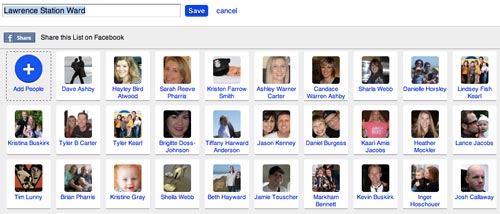
As with its mobile application, the Web site scans your Facebook friends, and detects shared histories, connections and other similarities to automatically group sets of individuals. Katango does not automatically name the lists for you, and doesn't automatically post them to Facebook on your behalf either. That is up to you. But the system helps break down Facebook's well-known approach to public sharing, making it dramatically simpler to create targeted lists for more private sharing.

Katango on the Web detects my Facebook lists, suggests more

Of course, with Google+ gaining a great deal of attention in the last month, particularly for the user-generated circles that allow for selective sharing, comparisons between Google+ and Katango are practically required. But so far, Google circles are manually created by the user from scratch, and Katango is still a third party impacting Facebook, not exactly the native offering from the company.

One Smart List of Friends Generated by Katango

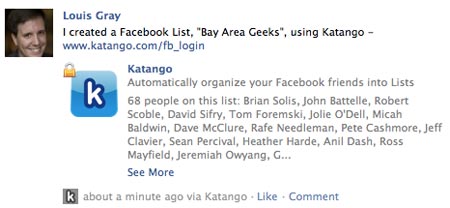
The biggest news out of the Web-based version launched this morning? Katango lists are now exportable directly to Facebook, so you can take these lists out of the app and start using them from within Facebook itself. But be aware by default, if your friends are included in a list, Katango will send them a note to say they have been. To disable this, go to "settings" on the Web and uncheck this notification capability.

Katango Tells My Facebook Friends I Made a New List

Katango helps eliminate the hassle of creating dedicated Facebook lists and makes selective sharing on the site a lot easier. As noted in my previous post, their guesses about shared connections are actually very good as well. Not perfect, of course, but 95% of what you need. If you're a Facebook addict and want to share with some people some of the time, but not all the people all the time, you definitely want to check out Katango on the Web. They're at http://www.katango.com.