Showing posts with label TweetDeck (43 posts). Show all posts

May 14, 2015

Preaching to Our Choirs and Setting Up Blinders for All Else

Preaching to Our Choirs and Setting Up Blinders for All Else

Just about four years ago, Eli Pariser raised some very real flags about the "filter bubble", concerned that many of us on the Web were limiting our viewpoints by following those people and companies with whom we were most aligned. Our personal positions on politics, sports, and yes, even technology, have us in a constant state of affirmation seeking, and the desire to be part of a group of like-minded people, to reinforce our position and strengthen our decided upon beliefs, that we just might be right. And should somebody in our streams disagree with us, or launch into an off topic rant, we can easily unfollow them, and "clean up" the channel.

At the time, thanks to tools like my6sense, where I was an advisor, and later VP of marketing, I said the filter bubble was "not bad" as options were always there to see new voices. While my6sense may not have been a massive consumer success, it was amazingly smart tool that solved the problem for me. But in the ensuing time, it's become even more clear that people, through constant following and unfollowing on our many social networks, are growingly subscribed to homogenous streams, and the content creators, be they bloggers, Tweeters, photographers or anything else, are limiting the subjects they discuss, to continue feeding the faithful.

As someone who gained a following talking about tech, new tools and communities, I've staked my position on the Web as an early adopter, a cloud proponent, a measurement advocate, and engaged social media participant. I have a pretty good idea of what topics will resonate with my audiences on the various streams, and what won't. I know that my discussing items outside of my bubble are seen as noise to those who have chosen to follow me, and they vote with their engagement, or lack of it.

More than nine years ago, shockingly, I saw this coming, when I talked about a Web divided, where people who espoused a certain view would flock toward an extreme community and not be interested in the opposite view. But it goes beyond picking a side in a discussion. What's happened is that people set up blinders to avoid discussion of anything else - including the content creators themselves.

There's a lesser-used feature in TweetDeck, which enables you to view a Twitter stream through the eyes of another user, surfacing public tweets from accounts they follow. During the Baltimore riots, while a huge portion of Twitter's audience was living through the accounts through the news media, or sharing their experiences about race and police, the Silicon Valley tech bubble largely stayed silent, as if there were two different worlds that didn't connect. I could log in to TweetDeck and pick any prominent voice in tech and see that, in their streams, there was no talk of Baltimore. Or race. Or Ferguson. While people marched in the streets, and dodged rocks or tear gas, the digerati continued to talk about who was raising money, the quality of pitch decks, or complaints about housing prices in San Francisco.

My tweets about Baltimore arresting police offers or links to why the situation exploded in the first place went unnoticed - while the streams continued to debate the future of wearables or the latest entrant into Unicorn status as a billion dollar startup. It was more than an echo chamber. It was a wind tunnel. And my daily journey into Feedly seemed to be no different than any other time. The same articles were written by the same people, about the same things. The same headlines begging you to click were thrown out there, only to be reshared and retweeted in a rush for page views.

Oh. I see you're tweeting about something that's not tech.

Maybe we've grown fatigued of outrage. Maybe there have been enough dramas and disasters and disappointments that we just don't react publicly. But I think there's more to it. We have been taught, thanks to our constant focus on engagement and numbers, that we have to speak to a niche. VCs talk to VCs. Engineers talk to Engineers. Startups talk about being a startup. We're becoming afraid of expressing a position that may cause a debate. We're refusing to talk about things that are uncomfortable, and we're closing our eyes to people who don't always care about the things we do. And I think that's dangerous. It sets us up to further carve out our cliques and become closed minded.

I mildly apologize for the irregular posts here of late. But part of the reason, beyond being busy, or focused on other things, is I don't want to be more of the same. The world is a vibrant tapestry, not monochrome, and I don't want to be the thirty-second person to talk about the same things everyone else is. We should embrace a world focused on curiosity, not compliance.

March 11, 2013

Video: Getting the Attention of Influencers and Bloggers

Video: Getting the Attention of Influencers and Bloggers


Having been somebody on both sides of the startup and blogger equation, I know how hard it is for new companies, products and ideas to get visbility and break through the noise, grabbing the attention and sustained interest of early adopters, influencers and users. Today on +GDL (Google Developers Live, the program I run at +Google), I sat down with colleague +Don Dodge to share some of my own experiences and talk about this very thing.

In the discussion, about 20 minutes, I talk about working with +Edwin Khodabakchian of +feedly, +Iain Dodsworth of TweetDeck and more, as some examples of sharp people who engaged with me in the many thousands of posts that have found home on +louisgray.com. This event is one in a series we're calling Root Access, targeting startups and developers on Google Developers Live. Find many more events, publishing every workday at https://developers.google.com/live.

June 17, 2011

Regator Introduces Streaming Breaking News App

Regator Introduces Streaming Breaking News App

Regator has had its eyes on the social media and blogging trends space for the last three years, following the introduction of their blog search engine in 2008, expansion to mobile the following year, and expanding to display global trends just last year. A week ago, the company introduced a new application, reminiscent of TweetDeck and LazyScope, which they are targeting at newsrooms and bloggers who don't want to miss stories in their field as they break. The company believes that its ability to closely follow social media channels gives them the ability to deliver alerts to top stories long before they arrive on traditional sites, helping writers get their stories out ahead of competition.

Meanwhile, if you're not shackled by the AOL Way or at a post mill like some of the major blogs, as a consumer, the new app can simply be a fun way to stay on top of the top news on topics you care about, cascading down your stream in a multi-column Adobe AIR app, with Growl alerts bringing new additions to your attention immediately.

Regator's Breaking News Service on My Desktop

With TweetDeck nearly three years old, the environment of a chronologically-ordered multi-column AIR app is very familiar to most. Regator mines its content repository, surfacing alerts from many different fields, including Entertainment, Sports, Politics, Fashion, Travel, Food, Tech and more, and more specifically, trending topics for all of the above, including subcategories like Social Media, Gadgets and Hardware for Tech, or Astronomy, Chemistry and Physics for Academia. You can also add columns for search terms of your choosing, and with the pro application, a Notes tab, intended for journalists sculpting stories discovered in the program.

To get the best handle on the app, I'd recommend starting with top trends in a major area of your interest. For example, my "Trends: Technology" column shows news of the day, from Research In Motion and LulzSec to more consistent updates from the world of iPhone, Android, Yahoo!, and yes, Angry Birds. Clicking any of these specific topics opens it up in a new column, so if you've got a beat that is interested in three or four major topics, you can just leave this app open and let the stories flow.

Top Stories on Samsung Galaxy Tab and Apple in Regator

In years past, I got excited about products like Lazyfeed, which did more than just follow individual blogs you had subscribed to or friends you followed, but topics you selected, and its partner, LazyScope, which combined quasi-RSS subscriptions to the Twitter experience. Regator has delivered an app that uses social as its content repository, but presents it in a way that is much more like a news wire than a social service. So you won't see which social media personality made a story popular, or any traditional social actions, like retweeting or favoriting. Just raw content with links to the source. It's a great way to get caught up on the news you like without having to suffer through all the topics you don't.

A limited Web version of the service can be seen at http://breakingnews.regator.com/recent/, showing breaking news in the topics you select or more global content.You can also get the app on the site by going to https://breakingnews.regator.com/manage/ and clicking "Download Desktop App".

February 12, 2011

The Story of TweetDeck's Rise from Obscurity to a Rumored Sale for ~$30 Million In Less than 1,000 Days

The Story of TweetDeck's Rise from Obscurity to a Rumored Sale for ~$30 Million In Less than 1,000 Days

The launch and resulting success of TweetDeck starting in the summer of 2008 surprised everyone, including the application's founder, Iain Dodsworth, who is reported tonight to be selling the product to Ubermedia for as much as $30 million - culminating a two and a half year journey from complete obscurity to a position where his product is recognized as one of the most innovative social and communication dashboards on the Web - the standard tool used from casual users to businesses and newsrooms alike. Time from the product reaching the public consciousness on July 4, 2008 and getting close to a sale on February 11, 2011 is 952 days - nearly 1,000 days of dedicated development, with practically one-fifth of the world's tweets flowing through his application, from the desktop to mobile devices to the Chrome Web browser.

Iain, in an interview with me back in 2009 referred to the first day, launch day, as "one of shock and extreme excitement," the result of his finding Twitter "a bit overwhelming" after following about 50 people. Unsatisfied with the current offerings, he set about making his own client.

As long-time blog readers know (and may remember), our paths crossed when Iain neared release of the first version, and the first product, something new the world had never seen, was covered here. I remember Iain's real fear that the first beta version would not be good enough, combined with a hope that initial press would make it visible. On July 3, 2008, he sent me an e-mail, saying:
"I am furiously coding away getting the next version out there (a real improvement on the current version). Since you are the highest profile person who has seen TweetDeck it would be great to capitalize on your visibility (if that's ok with you) so please DO blog on it with the URL possibly making the point that its very early beta and a new version is due very soon..." adding "Really appreciate any push you can give it."
The next day after trying to summarize this new product in a way that clearly described its potential, I put up a post covering it as a new AIR app with integrated search and groups. From there, the word spread like wildfire. By mid-day on July 4th, TweetDeck had managed the 6th highest Trending Topic on Summize (prior to Twitter's acquisition), behind Obama. I e-mailed Iain, and he responded quickly, "Oh cool! I've taken a screen grab :-)".

My Short e-mail to Iain with a Screenshot on 7/4/08

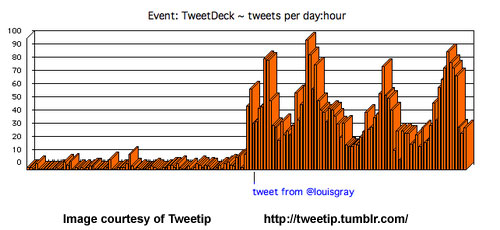
Seemingly innocent times. There's no question he probably didn't foresee what was to eventually happen, even after continued excitement around the app made it clear he'd hit a nerve just under two weeks later, when the spike in activity was highlighted by a since-defunct Tumblr site called Tweetip. Only a few weeks later, Iain wrote me to say he wanted to "make TweetDeck something quite spectacular," suggesting while looking for Angel investment, he was considering a "Pro" version of the app to sell for "a nominal amount." I am sure my answers weren't too helpful, but he forged forward.

TweetDeck's Jump As Noted by Tweetip on 7/14/08

Then came the hard work of adding more features, scaling to meet demand and finding a way to work within what at the time was a flaky service, Twitter, which struggled with API issues, downtime and frequent inconsistencies. Iain forged forward, responsible for about 4-6% of all tweets within 5 months and gaining funding in January of 2009 and becoming the desktop standard against Twitter's Web client.


I speak with Iain in December of 2009 at LeWeb


By February of 2009, TweetDeck went global, adding translations, tweets by e-mail and integrated StockTwits. As Iain's product was still relatively small, he was kind enough to offer an exclusive video demo featured in this post where he showed the new features to the blog's readers. I still remember sitting in an airport coming back from a trade show, sending him a note, and getting this video back, where he answered my questions personally in less than an hour. Even to a real-time geek like me, that was very cool. Later, TweetDeck expanded beyond Twitter, with support for Facebook and MySpace later in 2009, promising the addition of Twitter lists integration, and later expanding the vision to become the client for all streams from any source, which led to a B round of $3 million.

By this time, TweetDeck was clearly a big deal. Despite serious competition from Seesmic and others, and a parallel acquisition of Tweetie by Twitter, TweetDeck had become a serious company with big aspirations - beyond the scrappy individual who could lob e-mails to me overnight and work with my little eponymous blog to get coverage. This I welcome, of course. For all the fun of owning a story, I'd rather see the little guys graduate to be household names, and TweetDeck seemingly pulled it off. It's probable that an exit to UberMedia isn't something that kids dream about, but an 8 to 10x return on investment for VCs is a win, and Iain went from being a single guy staring excitedly at his laptop on a big first day to someone who has his finger on the pulse of the real-time Web, the move to a world of pages to a world of streams, and no doubt can afford some luxuries today that he couldn't yesterday.

For those entrepreneurs looking to get rich quick, you had better believe this is hard work. Iain once e-mailed me to say he was doing 16 hour days, 7 days a week, coding. And nearly three years is a long time to do that. It's not a 20-year career pushing papers in an anonymous cubicle, but it's attention to detail, differentiation and quality that made TweetDeck the best at what they do. I haven't asked Iain for a hint to the future, and didn't approach UberMedia for their plans either, but let's put TweetDeck next to SocialMedian and others who got their start here, and whose founders are now quite financially well off. Very exciting. Can't wait to see who is next.

November 22, 2010

my6sense Adds Posting, Smart Widgets to Android App

my6sense Adds Posting, Smart Widgets to Android App

Following a humble start as a consumption-focused RSS reader on iTunes, my6sense has grown to become a versatile intersection of news and social, consumption and sharing. The app, available for both iOS and Android, pulls in streams from Facebook, Twitter and Google Buzz, and lets you share out to each of these networks. Today, the company, where I am VP of Marketing, issued the latest update for the fast-growing Android platform - bringing native posting to the aforementioned networks within the app, and a helpful widget that brings your top news to you on your Android device.
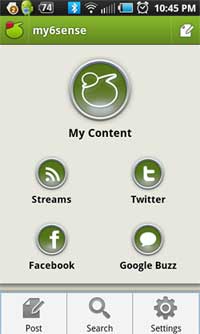
As you can imagine, creating an application that impacts social streams like Facebook, Twitter and Google Buzz presents its own challenges, as users start to expect the most advanced capabilities of native clients, such as TweetDeck and Seesmic. No sooner did we support these networks than did calls come for native replies, retweets, direct messages, likes and comments for each network. After knocking those off, the similar refrain continued as people wanted to update their status on the go directly from our app, instead of reading an update in our app and opening a second one to jump into the streams themselves.

So we listened.

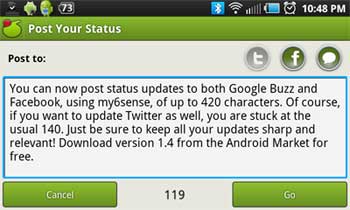
You can now Post to Your Networks in my6sense for Android.

Version 1.4 of the application, available free on the Android Market, has a "Post" button in the top right of all streams. And it's not limited to just one stream at a time, either. If you have connected your Facebook, Twitter and Buzz, you can post to any or each of the networks, much like the Seesmic-owned Ping.fm does. Of course, if you post to Twitter, the standard 140 character limit applies, and Facebook updates are similarly limited to 420 characters. That said, if you have a keyboard on your phone and you want to bang out War and Peace, point it at Google Buzz, and you can go as long as you like.

Posting to Facebook and Buzz Using my6sense

One of the benefits of building out a sharp app for the Android platform is customization of a widget for the app - unavailable on iOS. Familiar with widgets from other platforms, which tend to show the most recent update, chronologically, we wanted to leverage the strength of our service, bringing personalized top news to you - and more than one update. The widget, a stylish black, scrolls through your top messages and you can click the up or down arrows to find them yourself, without opening the app. Find the article you like and click through to read.

The my6sense Widget With Top Stories

my6sense's core focus is, and will be, on making sure the best content gets to you as an individual, and that you don't miss important updates. We're working on making this digital intuition available in more places, and with more partners. But we want to make this a versatile Swiss Army knife that lets you jump into the streams with both feet.

Brad of TheNextWeb, a great user and clear fan of the service, wrote about the updates, saying "my6sense for Android gets updates to take over as your social client of choice". Choice is a good thing. I will choose the smart apps that make me the most efficient. He also posted a great demo video you might like. If you are on Android and haven't already picked up the app, find it at http://bit.ly/m6sandroid.

Disclosure: I am VP of Marketing at my6sense.

August 11, 2010

TweetDeck Looms to Battle Seesmic, Twitter on Android

TweetDeck Looms to Battle Seesmic, Twitter on Android


In the two years since TweetDeck first launched on the desktop, it has set the standard for multi-functional multi-account Twitter-centric applications, bringing the concept of columns, grouping and integrated search to what had previously been a bland market of simple apps. With the product's success, we saw the metamorphosis of Seesmic from a video comments company to one that has gone head to head with TweetDeck on practically every screen, even as the two saw focused effort from Loren Brichter on Tweetie pass them by and become the official Twitter application from the microblogging mothership for both the Mac desktop and the iPhone.


Now, the two are competing for visibility on yet another screen - that of the fast-growing Android platform, and unlike previous battles, which usually saw TweetDeck innovating first, it was Seesmic who got there first - in a big way, going live on Android and BlackBerry back in November of 2009. Tomorrow, TweetDeck will officially launch the first iteration of its Android product on the Android Marketplace, and those who prefer it will once again have that choice.


The Accounts Pages for TweetDeck and Seesmic for Android


As Twitter quite visibly has filled holes in its lineup with the addition of Tweetie, both TweetDeck and Seesmic have positioned themselves as the more robust alternatives, providing support for not just Twitter streams, but also Facebook, Google Buzz, LinkedIn and Foursquare, depending on the platform. Seesmic's Android app, so far, in the absence of an offering from TweetDeck, has been my choice, thanks to its integrated multi-account and multi-service support - something Twitter's native app simply won't do.


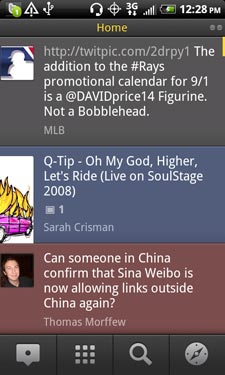
TweetDeck Updates Put Multiple Sources In One Stream


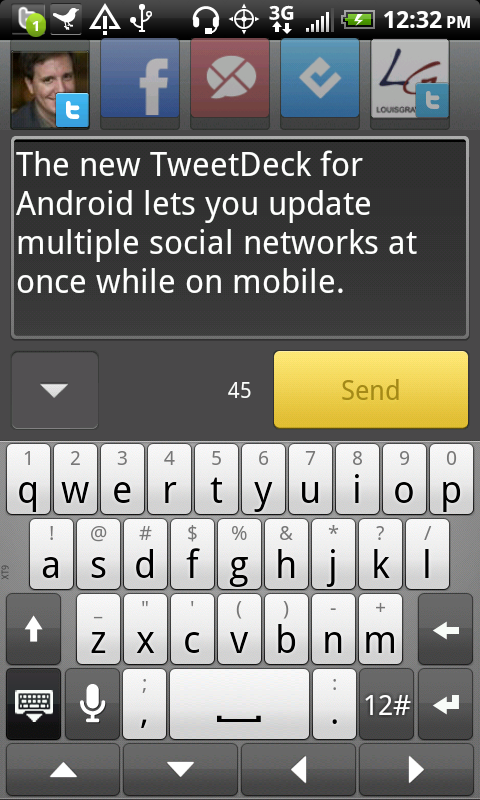
Now, for Android, both applications will allow you to view streams from multiple sources, and update multiple accounts simultaneously. But where TweetDeck and Seesmic differ is that Seesmic's activity is very hierarchical. You view one of your accounts at a time, and go back to the top level to see other accounts, while TweetDeck is looking to "mix" the streams with updates from all different sources in a single column.


Updating from TweetDeck Android and Browsing a Profile


Updates display in TweetDeck in different colors depending on their source. Gray updates are from Twitter, Red are from Google Buzz, Blue are from Facebook, and Aqua updates are from Foursquare. Now, you can see all these in one place. Also true to TweetDeck's background is the option for you to swipe right or left and see more specific "columns", including a new one called "Me", which captures mentions for you across multiple networks, including Facebook comments and likes, as well as Buzz updates on your content.

A New "Me" Column in TweetDeck for Android

For somebody who needs that mixing of updates across networks on a single mobile screen, TweetDeck will be the best option. But the early version, which I have been using all day, definitely feels brand new, while Seesmic's offering is more stable and feels easier to use - no doubt the product of having been publicly available on Android for more than 8 months. TweetDeck's Android launch has been much-awaited, and its integration of a column for "Me" is interesting. The product also offers deeper integration with Foursquare, tapping into venue details for check-ins.

For TweetDeck addicts, the introduction does not come too soon, even if Seesmic, today, is a stronger offering. This should be a fun space to keep an eye on over the next several months.

May 20, 2010

TweetDeck Aims to Be Client for All Streams In All Places

TweetDeck Aims to Be Client for All Streams In All Places

I touched briefly on TweetDeck's promised integration of the Google Buzz API yesterday evening, but did not gain the opportunity to try Iain Dodsworth's latest client until today. Luckily for me, I also ran into Iain at Google I/O this afternoon, and in stopping to congratulate him on his firm's raising $3 million in funding for a B round to fuel continued expansion, we talked about TweetDeck's future and got a sneak peek at some unreleased versions looking to hit computer and mobile screens soon.

The latest TweetDeck, available from their site, not only incorporates Buzz updates, but also Foursquare - much like its online cousin, Seesmic, had announced earlier this week. The additions mean that, should you choose to do so, you can view updates from Twitter, Facebook, LinkedIn, Buzz, Foursquare, and MySpace all from within TweetDeck's signature columned interface. TweetDeck was also featured running in full HTML 5 in the Chrome Web browser during Wednesday's keynote, and I saw it running again, on Iain's demo Mac today. In addition, Iain showed a sleek Android client of TweetDeck that's bound to hit very soon.

Adding Buzz and Foursquare to My TweetDeck

One of my main suggestions/complaints about Buzz in its 100 day life is that it is so closely tied to GMail. Even if I use GMail as a secondary account, I have always done so via IMAP, and read my GMail updates in Apple Mail. As a result, getting to Buzz requires a separate login to GMail.com, and then clicking the Buzz tab. It has always felt the same as using a product in emulation or virtualization mode, and native is always better. But getting the Buzz stream in TweetDeck is surprisingly clean - and is a solid alternative that doesn't force me to go through GMail.com first. From there, I can post directly to Buzz (but not with rich media yet), I can see others' streams, and add likes or comments right from within TweetDeck.

Hiding Foursquare from Other Columns! Yes!

I am also extremely partial to the option to add Foursquare as a separate column in TweetDeck while simultaneously hiding Foursquare updates in the "All Friends" column. Great move.

While many Twitter developers were shaking in their boots over the company's acquisition of Tweetie and development of Twitter for Android, Iain said he had no such fears. TweetDeck is focused on the high end of the market, he said, one that does not fear complexity, but is instead looking for a rich and heavily featured social media experience.

Buzz Activity Front And Center In TweetDeck

With TweetDeck's multi-column interface becoming instantly recognizable, more and more services are no doubt jockeying for position. As we were at Google I/O, we only partially joked about a Google-centric TweetDeck (GoogleDeck?) that would pull in Buzz, Google Wave, and Latitude, in lieu of Foursquare.

Iain reported that TweetDeck has swelled to 15 employees in the nearly two years since the product debuted in mid 2008, adding that even if TweetDeck were revenue-free, the $3 million raised today would last the team about two years, all expenses included. But TweetDeck has already found revenue streams, part of why the VCs are interested in getting a deeper position. Getting on more screens in more places with more content will no doubt make the product the feature-rich alternative to standard Twitter, and seeing Buzz in the client is already pushing more activity back to that network - making the move a win for both parties.

May 19, 2010

Google Buzz API Debuts, Fueling Potential Network Growth

Google Buzz API Debuts, Fueling Potential Network Growth

Google Buzz celebrated its 100th day of public existence at Google I/O Wednesday with the introduction of its much-awaited API, and the immediate adoption of that API from some interesting showcase partners, including Seesmic, TweetDeck and SocialWok. In the last three months of Buzz's availability, I've discussed how Google had aimed to avoid offering proprietary standards for developers to point their applications to, choosing instead to work with open tools including OAuth, AtomPub, Activity Streams, Pubsubhubbub, RSS and WebFinger. On Google I/O's first day, the company showed the first fruits of that labor, giving the fledgling network the opportunity to tap into the same developer community that other services, including Twitter, Facebook and LinkedIn, have enjoyed.

Chris Chabot (@chabotc), a developer advocate for Google, explained the role of Buzz at Google Wednesday, saying that "The Web is better when it is social," chronicling the rise of social activity to the point where having a social profile online is as common as having a mobile phone. "The Web is becoming a social place. It is moving from a static place to one about people sharing experiences, playing, working and talking together," he said.

Initial Partners Using the Google Buzz API

But as Google's social team has chronicled several times, including Chris Messina's talk on Activity Streams at SXSW this Spring, many of the different destinations on the social Web speak different languages. Rather than inventing a new language, Google wanted to utilize existing standards to avoid such headaches, and make Buzz part of the Web's infrastructure, "not a special destination."

In April, after one particularly nutty report was issued on Buzz's aggregation statistics, we proved the majority of Buzz's active content originates on that network. The new Buzz API makes it easier for third party clients, such as Seesmic and TweetDeck to push comments, likes, rich media and other updates to the network, but also to consume content from Buzz in users' favorite application. This seemingly minor move - one already seen by Facebook and LinkedIn, puts Buzz on par with those historically larger networks, and ahead of scrappy startups like FriendFeed, which never gained such prominence.

Google Buzz Displayed In Seesmic (Next to Foursquare)

Marco Kaiser (@marco) of Seesmic, who demonstrated his company's application pulling and pushing data from Buzz, said Seesmic wants "to support as many services as possible to as many products as possible", and as of today, all of their products, including the Web version, Desktop and Android clients, let you add Buzz as an account and see Buzz content alongside Twitter and other updates. This caps a busy week for Seesmic, following their Monday addition of Foursquare and other updates.

While Twitter has had an off and on relationship with its own development community, the ease of developers creating applications and Web services has led to much of the service's growth. Buzz, assuming expanded adoption of their API by other partners, could receive the same kind of boost that so far has been lacking in the service - seemingly siloed despite so many promises to connect with the outside world.


In addition to the announcements by Seesmic and other partners, Google introduced a testbed for developers to try out the API, which you can find at http://www.buzz-demos.com/. The test site lets you display your stream, add, edit and delete content, follow and unfollow others. It surely won't be all that long until many of the automation tools that have existed in Twitter's ecosystem make their way to Buzz.

As someone who long begged for services like FriendFeed to be supported by major clients like TweetDeck and Seesmic, but didn't see it happen, the rapid adoption and seeming ease of the Buzz API is a huge endorsement for the future of the network. It could have something to do with Google's name being attached, or the ease of the standards, but the potential is there nonetheless.

Google's official post on the new Buzz API is here: Introducing the Google Buzz API. You can find me on Buzz here: http://www.google.com/profiles/louisgray.

April 11, 2010

You Asked Twitter to Grow Up. They Have. And You're Mad?

You Asked Twitter to Grow Up. They Have. And You're Mad?

The Friday night surprise of Twitter having acquired Tweetie from Atebits, and adding its creator, Loren Brichter, to the company's swelling mobile team, on the back of Twitter's also announcing their first mobile client for BlackBerry, not only was big news on its own, but it has set off waves in the world of Twitter application developers and users, some of whom are seeing the move as something akin to a betrayal or an anti-competitive move, which puts the owners of the platform in conflict with those expanding it. While I am sympathetic to some of their positions, having seen competitive clients find the world in which they live a lot more difficult, the step is a brilliant one, which is an important stepping stone in terms of moving Twitter forward as a business. For years, as users and coders, we begged for Twitter to graduate from the lean startup mode, with questionable quality and uptime, to one focused on delivering an exceptional product. Now, they are executing, and the next 12 months will undoubtedly be defining in terms of how the company potentially transitions from an cash-burning endeavor to a revenue-generating technology giant.

First and foremost, the most telling bit from Twitter's post on the acquisition of Tweetie came in the first paragraph, when the company explained that people searching Apple's iTunes App store for a Twitter client would not find an official application, but instead a host of them, which was confusing and offputting. While we early adopters have enjoyed the array of Twitter clients, from TweetDeck and Seesmic to Tweetie, Brizzly and many others, it is easy to see how the mainstream audience could be lost before even starting. After all, Facebook and LinkedIn have official applications for the iPhone, from the company themselves, and Twitter didn't - a major hole in their offering. This admission by Twitter to said hole, and solving it on two platforms in one day, is a big move, and one that further cements their brand leadership, instead of sharing that brand with another client or another service.

The acquisition of Tweetie instead of other applications is sharp for more reasons than one. Note that TweetDeck and Seesmic and Brizzly, as well as many other applications serving Twitter, have been drawn to support multiple services in addition to Twitter, most often Facebook. Twitter buying Tweetie, which had remained Twitter-centric, avoids the headaches of peeling away Facebook or Identica or other services' updates, and keeping the application dedicated. Also, despite my personal relationships with many different Twitter client developers, I have always found myself coming back to Tweetie, both on the iPhone and on the Mac. In October, after thinking aloud about Twitter (Web), Tweetie, TweetDeck, Seesmic and Brizzly, I came to the conclusion that Tweetie was closest to the ever-elusive perfect Twitter client. Not only did it offer a top-quality feature set, but it did so with an unmatched interface and innovative integration with practically all leading-edge options, like location, photo integration and lists. So Twitter is not just buying a solution, but they are buying the best one. That Atebits was practically a sole proprietorship, not burdened with millions of dollars of VC funding, as Seesmic and TweetDeck are, made the purchase an even easier move.

If you wrap all that into one statement, Twitter arguably purchased the best client for the best price with the best dedicated feature set, keeping their service at the center of the universe, not competing for attention from other social streams. In one fell swoop, Twitter went from being a zero on the iPhone and Mac client space to the leader, and we can expect iPad comes soon.

But enough about that. People are still throwing up their hands about Twitter's move, saying it makes developers less likely to work on their platform. That platform owners sometimes innovate in ways that go head to head with their own ecosystem is not new. (See: Charles Hudson: Three Reminders About Platform Businesses) Microsoft has made a living from it. Apple does it all the time. And now Twitter is maturing and doing the same. This isn't because they are evil, or hate developers at all. What they need to do is extend their product and extend their brand and start to do a better job of owning the user experience. To date, the Web site has not seen as much growth as the client ecosystem, meaning much of Twitter's onboarding and initial user experience has been owned by third party apps who are not as loyal to the platform, all too happy to offer options to gain data from Facebook and Linkedin, for example.

Much of the discussion in the last week has centered around Twitter developers plugging holes in the company's product. No doubt for the most part that has been true. For example, SocialToo, Jesse Stay's company, where I am an advisor, in early March, enabled phishing protection in all direct messages for all users. (I wrote about it) That was announced on Monday, March 8th, after significant development. But the very next day, on Tuesday, March 9th, Twitter announced that they too were stepping up their anti-phishing attacks in direct messages. The assumption could be that Twitter was cutting Jesse off at the knees, but in reality, they were working to protect their own customers and doing the right thing. Jesse wrote a little about that tonight in a post titled "Twitter, Two Years Later and Nothing Has Changed", and he knows, as I do, that it will take more than plugging holes in Twitter's product to develop a successful business.

While Twitter's move removed a competitive lead from SocialToo in this specific case, it was no cause for alarm or fury, any more than it should be for dedicated Twitter clients who will be building alternatives to Twitter's own products now. If they are looking to attract users, they will need to continue finding ways to offer differentiated user experiences, and innovating where Twitter may be behind. Keep in mind that it was Twitter's users who came up with hashtags, replies and retweets, and clients like TweetDeck who debuted columns and multi-account support. Buying Tweetie doesn't mean that Twitter overnight is going to be innovating at that level.

In December, following a presentation by Ryan Sarver, Twitter's director of platform, at LeWeb, I said that "Twitter's Maturation Continues As They Embrace Developers". While this week's news may not feel like an embrace, it is absolutely sign of maturation. The company is now stopping those holes, and securing the infrastructure. We also have already seen hints of a new revamped Web interface that should take the user experience up another level again. The company continues to hire new people practically every week, almost all of them notable - and bringing with them solid resumes from Valley giants.

This rich pedigree of people and a growing user base that is showing record site activity every month, along with the company's planned @Anywhere platform, pending advertising model, and expansion through business development and word of mouth around the world is setting Twitter up for market leadership approachable by only a small handful of Silicon Valley titans. It's what we all have been asking for them to do as we begged for site stability, greater user discovery, improved tools and reduced latency. There will be some bumps along the way, as the developer community sees churn, and some products eventually are made obsolete. But Twitter can't reduce its own potential in the name of being the friendly nice guy. They need to think about their own business and driving the greatest possible experience for the greatest number of people, in a profitable way. This weekend's moves, and updates we can expect from Chirp this week will push them further along the path.

DISCLOSURE: I am an unpaid advisor to SocialToo. I hold a small equity stake in the company.

January 4, 2010

Ping! Seesmic Expands Update Reach With Ping.fm Buy

Ping! Seesmic Expands Update Reach With Ping.fm Buy

With so many social networks gaining traction, the potential for communities to be split and conversations diversified is a known issue. Aiming to solve the problem and ensure users could update once and populate anywhere, Sean McCullough, along with co-founder Adam Duffy, created Ping.fm, which lets you update 50 social networks at once.

Today, Seesmic, the well-known microblogging client, which to date has focused on Twitter and Facebook, acquired the service, extending the product's reach. In combination with Seesmic's recent inroads to a native Windows client and an Android application, alongside their Web interface and AIR application, the service looks to become ubiquitous, updating any site from anywhere.

In today's announcement, Seesmic CEO Loic LeMeur said that the company's vision recognizes that friends "are not all in one social network, but we want to help you stay in touch with them anytime and from any device." Ping.fm has a reported half a million active users, who post approximately 200,000 updates daily. These updates will contribute to Seesmic's stated goal of one million updates a day in 2010.

At LeWeb, in the Twitter Apps panel I moderated (video here), Sean McCullough of Ping.fm and Marco Kaiser of Seesmic both participated.

Seesmic's array of applications, including BlackBerry, will all soon have what Loic termed "advanced Ping.fm integration very shortly", adding that users could update not just with Seesmic's apps, but also through Ping.fm's e-mail, SMS and chat gateways.

To date, Seesmic has been seen as direct competition to the other major column-based Twitter client, TweetDeck. But while TweetDeck has taken a slower approach to new interfaces, holding on to its AIR installs and iPhone application, Seesmic looks like it is branching ahead, serving more screens and now, more networks.

December 10, 2009

Video: LeWeb Twitter Apps Panel via UStream

Video: LeWeb Twitter Apps Panel via UStream


This morning, I moderated a panel on Twitter Applications, at LeWeb, featuring:
The panel lasted for approximately one hour, and is embedded above, courtesy of UStream.

Disclosure: my6sense is a new Paladin Advisors Group client. I am Managing Director of New Media for Paladin.

Talking With TweetDeck and Tweetmeme at LeWeb

Talking With TweetDeck and Tweetmeme at LeWeb


At LeWeb 2009 here in Paris, France, I participated in a panel on Twitter applications and the Twitter platform, featuring TweetDeck, Seesmic, TwitterFeed, OneForty.com, my6sense, Ping.fm and Microsoft. Following the panel, I sat down with Iain Dodsworth of TweetDeck and Nick Halstead of Tweetmeme, getting the opportunity to talk with each of them about the origins of their product, how they are working with Twitter, and what's next. In these free-form podcasts, we also talked about competition, business models, and their approach to innovation.


Talking With Tweetmeme's Nick Halstead


Talking with TweetDeck's Iain Dodsworth


Both podcasts were recorded using CinchCast on the iPhone from BlogTalk Radio.