Showing posts with label Relevance (5 posts). Show all posts

August 12, 2011

Strawberryj.am: Popular Links from Your Twitter Friends

Strawberryj.am: Popular Links from Your Twitter Friends


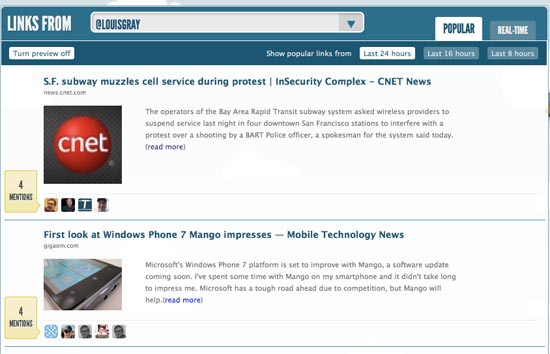
Everyone knows you can't see every update on every social network all of the time. Many services have emerged to help find you the most interesting shared content from products like Twitter, based on your own interests, those of the community or the world at large. An interesting one is called Strawberry Jam, a project backed by Hettema & Bergsten, which scans links from those you follow on Twitter and finds the content most frequently shared from your own social circle. Going further, Strawberry Jam also compiles saved searches for your explicit interests, hashtags, and even lists. If done well, you can essentially slice and dice the Twitter stream to make sure your friends are providing you the best from the real time Web.

Strawberry Jam, At Work On Finding the Best from My Twitter Stream

Strawberry Jam, found at the quirky URL of http://strawberryj.am/, makes it easier to step out of the Twitter timeline for a few hours, and still not miss anything. Your friends, assuming they do a good job of curating links, will share stuff and bump it to the top. This is the default view of Strawberry Jam, which shows top content from your stream over the last 8, 16 or 24 hours.

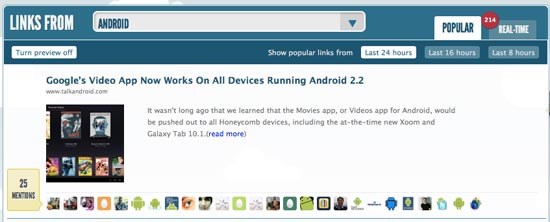
If your friends don't care about the same things you do, Strawberry Jam has figured that might be the case. You can search on specific keywords, like Apple, Android, Twitter or whatever you like and similarly find the most shared items on those topics. This even extends to hashtags and interestingly for the few who leverage them, Twitter lists. Just plug in the name of the list and its owner, and that too can be mined for popular links.

Searching for Solid Android Links on Strawberry Jam

Meanwhile, Strawberry Jam doesn't think you should be constantly spending a bunch of time on their site just to get good content. If you like, you can configure the site to send you email summaries each day, at a time you choose, with up to 5 links per category. So if you want to run Strawberry Jam overnight and get the top stories from your friends on just about any subject, it will be in your in box when you wake up.

Like my6sense, Strawberry Jam believes in showing you top links without the noise on Twitter. Obviously their approach puts more emphasis on collaborative filtering from your social graph to infer interest, but the value is similar.

Strawberry Jam is available by invite. You can get in by checking with Holden Page, the service's community manager, and all around good guy. Besides… today's his birthday.

Disclosures: I am VP of Marketing at my6sense, an assumed alternative to Strawberry Jam. Additionally, Holden Page once was an intern at Paladin Advisors Group, and worked for me in 2009.

July 19, 2011

Google+ & Other Social Networks Need Algorithmic Filters

Google+ & Other Social Networks Need Algorithmic Filters

Google+'s entry into the social networking market presents a new slate of opportunity for tech geeks who have been unsatisfied with leading offerings from Facebook and Twitter. The network's initial launch has been intriguing for two major pieces, namely the need to recreate one's social graph from scratch, including manual sorting, and secondly, as noted before, not starting with aggregation of third party content. The clean slate approach presents optimistic participants with a hope to "do things right" this time, and not fall into the limitations of networks past. Given Google's science-driven history, smart folks have also cautioned the company against leveraging algorithmic filters that might surface some content in the place of others.

The most visible argument was that from Tom Anderson, MySpace cofounder, who said, "Can a company so enamored with the power of algorithms and machine learning, let the user take control?", adding "... I'm worried that Google is going to make a misstep and ruin the service," through leveraging algorithms to cut signal from noise. While I have enjoyed Tom's resurgence to visibility and insights into early use of the network, I think the conclusion he reaches needs some work. Where there is signal, there is noise, and what's been missing in all networks to date is the right approach to surface quality content, which no doubt feeds into Tom's comments.

The vast majority of social networking content is consumed in reverse chronological format, with the most recent content being at the top. This is true for Twitter and all of Twitter's clients, it is true for Facebook's "Most Recent" feed, it's true for LinkedIn's news feed, and is mostly true with others like FriendFeed and Google+, which for the most part, sort content by the most recent activity - meaning older posts can be "bumped up" with additional comments. FriendFeed fought this intelligently over time, letting older posts eventually float downstream, while Google Buzz fought a similar challenge as the most visible posters' active threads initially took too much screen real estate.

In contrast to the chronological view, one can find intelligently filtered streams on Facebook, with the service's news feed, and in Twitter's search results, which try to show you "Top" content, and not just "All" content, dependent on the user sharing updates. But Facebook's approach, from my own understanding, relies heavily on your previous interaction with a person, augmented by that post's activity, which can bubble it to the top - independent of context. This means that if, for example, I share two posts, one on Apple's blowout quarterly earnings, and the second showing a cute picture of Braden at the supermarket, the posts may carry equal weight, assuming we are BFF. You can see this all the time in your own news feed on Facebook, as seemingly "random" posts from your friends surface to the top, while friends outside your top two dozen interactions almost disappear.

An algorithm that surfaces personalized content that does not take into account the many multiple factors that indicate interest, from the person sharing the content, to the content source, keywords, headline, author, time of day, time since publishing, the individual(s) commenting on that message, the keywords in the headline in combination with the author and/or the source, etc. simply isn't enough. The truth is that each of us does this automatically, and what the world needs is social networking that thinks like we do. For example, if you like financial news from the Wall Street Journal more than you like it from GigaOM, then similar stories from both should be weighted this way. But if you prefer articles on stock from Om Malik more than you do from Mathew Ingram, that too should be determined. The human brain is a very complex object indeed, but just because something is hard doesn't make it something you don't want to try.

Which brings us back to Google+. Initial content in any network excitedly rallies around itself. Soon following, one finds a backlash against meta posts, a call for the mainstream to enter the site, a fear for what happens when they do, a backlash against top users and so on. But once the fun of that is done, people behave like people and want to see interesting stuff. One person's noise is another person's signal, and unfortunately, very few people can be constantly logged in to a service. This means that when they log back in to a service, they shouldn't be forced to see just the most recent things that have happened, but instead, the best things that have happened - the content that is most important to them as an individual, the pieces of content that they absolutely did not want to miss. Because if something is especially important and relevant to you as an individual, that it came out two hours ago does not render it useless.

The advent of Google's much-discussed Circles delivers bidirectional manual filtering of people. It's bidirectional in that you are consuming from a unique list which you created, and you are sharing to a unique list of people which you created. If you create a list of "My Poker Buddies" and another for "College friends" and another for "Tech News People", the truth is that your poker buddies are going to talk about things other than poker, your college friends are going to talk about new stuff, and your tech news friends are going to talk about whatever they want... all day long. So the circles are porous. Simply naming one "Baseball" won't force people to talk about baseball, and until search is fully implemented beyond Sparks, there is no great way to find that on the site.

Another common fear about filters (which we discussed when responding the filter bubble) was that preferences are reinforcing, and that you see only what you want to see, at the exclusion of all else, that this leads to a dangerous space where you don't get access to alternate opinions. Again, I argue that we are very early in the game of finding high quality algorithm-driven personal filters for news, for social networks, or anything else we use that could benefit from personalized ranking. The solution to a smart algorithm that learns your preferences implicitly, rather than polling you explicitly for what you say you like will mean that you don't have to sift through the dozens or hundreds of posts that you deem off-topic, but instead that you get the best delivered right to you.

Unfortunately, while many companies have talked about this possible panacea, most all of them are cheating through collaborative filtering, and assuming that your social graph is smart enough to determine what is the best content for you. It's simply not true. Your interests are not my interests, and just because I like a specific topic on one day doesn't make it the most important thing the next. What is needed is a strong body of record that is tied to you as an individual, applied to your stream in real-time, helping you avoid the mess and find the best.

Google has traditionally been very cautious, going against conventional wisdom by not leveraging behavioral targeting as much as they could, by going out of their way to not overuse your Web history, your email activity, or in any other way, abusing the relationship you have with them and your content. With Google+, on both mobile and desktop, they have a new opportunity to do this correctly, continually learning more about your interests and activity to serve you the most relevant updates while avoiding much of the cruft that has plagued other networks, specifically Facebook. Having worked closely with my6sense for the better part of two years, I've seen directly how smart algorithms based on implicit feedback can make useful high quality streams out of what would more commonly be considered noise - and I've seen many people on Google+ and Twitter call for the same such filtering engine to be applied.

As Google+ gains visibility with the service opening up to more users, and less geeky users, it is inevitable that the stream content will be diversified and become more "noisy". Initial users will no longer be accepting of the content, excited just to use something new, but they will want the network to provide increased quality and connections than the status quo. While it's expected Google will eventually do a tie-in with casual gaming on a dedicated games site, the general hope from the community is that game-related info with not pollenate Google+. It's well-known that game info is a common polluter of Facebook streams, even if you've done your darndest to block all the services that hit your feed.

Tom's approach is laudable. He sees a new network with great promise, and is scared that Google will fumble it away. But I believe his conclusion is not perfect, for if done correctly, intelligent algorithms can make the network the most personal and most relevant one on the market. What Google+ needs to deliver is not just that it exists, but that it is differentiated and better. Why not use the smarts and information the company has to achieve just that?

Disclosure (as always): I am the VP of Marketing at my6sense, which provides personalization of news and social streams (but not yet Google+).

May 19, 2011

Linktamer: Coming Soon to Find Your Best News Links

Linktamer: Coming Soon to Find Your Best News Links

While we're on the topic of personalization and filters... there's a new project called Linktamer currently under construction that looks like it could be a Web-based tool to find the most interesting stories from your feeds based on your interests, relying heavily on your direct feedback to stories, and the tags describing them. While there's been no mention thus far of the service's plans for a public debut, a Twitter account (@linktamer) exists, possibly waiting for the day it's officially unveiled.

Like many other services, including my6sense and others described in last night's post, Linktamer breaks the latest news into two separate streams - that of the most recent content, and that ordered by your own assumed preferences, garnered based on inputs to the system. Every item contains the option to give future similar stories more value, or less, and with more development, it looks like there is future opportunity to sort stories by specific topic and drill down to find the best by subject, although that's not yet enabled.

Recent Items Pouring into Linktamer Without Assigned Scores (Not Logged In)

Much like the prototypical RSS reader, Linktamer streams in items, each providing a publish date, a headline, and a source. Linktamer extracts a lead graphic for those stories that have one, extracts about a dozen tags that describe the article, and delivers a score called "Signal", an analysis of how interesting that story is to the logged in user. Stories with no relevance have a rating of 00, with most relevance increasing presumably to 100.

Top Stories On Linktamer With Signal Scores
(Options to Provide Feedback Illustrated On Right)

To provide feedback for items in the system, there are four actions for each post on Linktamer. One can like an item by clicking the heart symbol, click the X to say you are "not interested" in the post (or others of its type, click the checkmark to indicate it has been read, or the arrow to share it - most likely to external social networks (though this is not yet implemented).

Items Sorted by Time Get Scores, If Logged In As a User

What Linktamer provides now is a raw hint at what could be another interesting alternative to personalized RSS streams - one that doesn't look to rely heavily (if at all) on collaborative filtering or simple popularity as many other services do, and starts with the Web while many others have kept their focus on mobile devices. The project appears to be thee brainchild of Alan Grow, who may emerge to claim it as time to launch approaches. Looking forward to seeing this one develop.

Disclosures: As noted often, I am vice president of marketing at my6sense, focused on personalization of news and social streams, much like Linktamer's future mission could be.

May 18, 2011

Why The Filter Bubble Is No Bubble and It's Not Bad Either

Why The Filter Bubble Is No Bubble and It's Not Bad Either

Multiple Factors Go Into A Solid Personalization Service
(from my6sense's internal slide decks)

Eli Pariser, former Executive Director of MoveOn.org, is a smart guy who knows the Web very well. His most recent work takes on the movement toward services that adopt algorithm-driven personalization to provide you individualized content - which he calls "The Filter Bubble", matching a book he recently wrote by the same name. His summary, as eloquently stated during a TED talk in March, is that we as Web consumers are going to miss being exposed to information that challenges our views, that we will self-select our sources and content we wish to consume, and the services will comply. The result? A dangerous world, he argues, that is bad for democracy, and no doubt bad for knowledge as well.

Spending considerable amount of time thinking about the impact of machine-driven personalization as VP of Marketing at my6sense, as well as being an early adopter of many other tools that adopt various factors of personalization, from The Cadmus to Zite, Flipboard, Hunch, Cascaad and others, it is important to think about the impact of our efforts to bring personal relevance to the fast-moving Web and if we are indeed pushing people instead to a house of mirrors where most things look the same and the comfortable world agrees with our world view.

First, the argument that people prefer to associate with like-minded individuals and listen, read and watch news and commentary that agrees with their worldview is pretty well accepted. In politics, conservatives may prefer Fox News for their media, while liberals prefer CNN and MSNBC. This is exacerbated dramatically further on the Web with niche discussions becoming even easier to find. Way back in February 2006, when this blog was pretty new, I talked about how people don't usually want to mingle with people of opposing views, but instead that views become polarized as communities flock to the edge, where they are comfortable.

Quoting my 28 year-old self:
"To measure credibility on the Web, visitors are looking for people who already agree with their opinions. They're not so much looking to be changed or to gain information from other viewpoints, but to instead become more hardened in their positions."
(See: Blogging Bifurcation - A Web Divided from February 23, 2006)
No matter the media, be it online or offline, we self-select what we consume based on a vast number of criteria.

We first self-select the source of our content - for example (in a world of dead tree papers) the New York Times, instead of the Washington Post or USA Today. Then, we choose how we are going to consume the content, be it to skim the front page first, or to dive into the business section. Perhaps we always read Sports first and then go back to the front page, and finally settle on the Features section. What we don't do is read every single story from beginning to end starting at the top left and moving to the back. Similarly, on television, we have our favorite shows, and again, we have preferences. We don't tun the TV on to channel one and hit the "up" button on our remote control until we find something we like. Instead, we choose our watching behavior based on our interests, and in a world of DVRs, we watch our favorite shows and limit our options to even be exposed to commercials highlighting other fare on the same network.

Personalization Puts You At the Center of Content

What new tools like my6sense and others are doing is recognizing that this capability of accurately divining the order of your preferences is largely missing in a new world of real-time streams. No man, not even the cyborg tech bloggers among us, can read every single tweet, Facebook update, Techmeme headline or news story that crests The Drudge Report. What my6sense and others like it are trying to do is eliminate the noise which you will never be interested in, while at the same time, surfacing the content which is deemed important to you based on your interests. No two people consume content in the same way, so presenting the content in the same way to each person (as has been done for centuries) doesn't make too much sense any more. It makes more sense, both for the user and for the content producer, to bring the best and most relevant content to the right people who want to see it and engage with it.

The concerns raised by Pariser are absolutely valid if the services being personalized don't offer any way for content that has not previously shown interest to come into your sphere. If the only signals that you've given to a service are that you like Apple computers and NBA playoff scores, and that's all you'll get, you'll have a poor understanding of the 2012 presidential election race and probably might not have noticed the fluctuations in the price of gas.

In my6sense, there are two critical ways that make sure you don't stay in your bubble forever:

1) There is always the option to view your streams sorted "by Time". Always.

Every single application that we have provided, from our iPhone and Android applications, to the NOOKColor application with Barnes and Noble, and even the Twitter extension on Chrome, offers a "relevance" tab based on your interests right next to the traditional chronologically-ordered view. There's no winner take all algorithm that erases the time view, because we know you should always have the option to see what your connections and feeds are saying "right now".

What's being discussed in the "Time" column could be anything. It could directly fall into your interests, or it could be something completely random, and that never will go away.

2) Collaborative filtering, while not the dominant signal, is still a signal.

If I have trained my application to know that I have a strong liking for technology news and consume this most of the day, it's unlikely that I will have previously given information that signals any interest in Osama Bin Laden's death or the earthquake in Japan. That said, if an event occurs that gets the attention of many of my social connections who begin to discuss it or share items on that topic, the system should interpret that as a strong social signal and surface this content in the application, so that alongside my regular Android ecosystem updates, I retain the option for breaking news.

In November, I wrote that "The Third Wave of the Web Will Be Uniquely Personal", as services adapt to my preferences and history to bring me a unique experience. We see this happening with Gmail's Priority Inbox, Google News personalization, the Facebook news feed and many other tweaks to our Web consumption experience. This doesn't mean that we are going to opt ourselves into a bubble by which we are never exposed to opposing viewpoints. Instead, it dramatically hones our signal to find us the best of what we want to see and leaves the door open for the real world to impact us.

As a member of the management team on a service that offers aggregation and multiple sources of a content, we often talk about how it's not a great user experience to deliver many articles in a row from a single source, or many articles in a row talking about the same event, even if it happens to be the event that is most critical for you to know. It is also not a great user experience if you feel that you are isolated, in a place where no other ideas enter and no other viewpoints get a chance to cross your screen.

The trend of personalization is a great thing - not bad at all. Every day you are self-selecting your news based on who you follow on Twitter and Facebook. Every day you are self-selecting your news based on the RSS feeds you read and the social networks you visit. This is something you are already doing. What apps like my6sense and others help to do is get you the best of what you want and free up the time you'd usually spend looking for that great stuff to go off and do something else - maybe start your own product... or even read other viewpoints where arguments are welcome.

For more on Eli's thoughts, see his interview with Time.com here: 5 Questions with Eli Pariser, Author of 'The Filter Bubble'. He is on Twitter at @elipariser, where he has personalized his news feed with 460 hand-picked people to follow.

Disclosures: I am vice president of marketing at my6sense, who delivers personalization of streams. my6sense can be assumed to be competing with multiple services in this piece, including Cadmus, Flipboard, Zite, etc.

May 4, 2011

Twitter Launches @twittersuggests for Follow Recs

Twitter Launches @twittersuggests for Follow Recs

Twitter really wants you following more people. The company launched a full-on assault to users' mentions tonight with the unannounced introduction of a new account called @twittersuggests, which recommends people to follow by way of a dedicated tweet, just for you. This extends the service's preexisting features that have brought recommended connections, including "who to follow" and joint following and followed by lists when you browse new accounts.

As Twitter describes it, "@twittersuggests is an experimental feature that helps you find interesting new accounts to follow by tweeting Who To Follow suggestions, personalized just for you! This feature was created by Twitter, and it looks like a normal Twitter account – it will Tweet recommendations which you can reply to, retweet or mark as favorites."

One Example Of @TwitterSuggests At Work

It might look a bit like the famed Follow Friday phenomenon, but instead of being broadcast from one individual to their stream in hopes that others will follow your friends, this is targeted at a single user with names that may top the recommended list.

Twitter Suggests Has Posted Almost 100,000 Times Today

Given the vast amount of Twitter users on the network today, numbered in the millions, there's no way that @twittersuggests is guaranteed to give your account some love right away. As they mention, there's no way for you to opt into the experiment, but you can block @twittersuggests if the mention spam bugs you. They write the recommendations are being sent to "a small percentage of users, as an experiment."

Pankaj Describing the New Feature

The service was first described by Twitter's tech lead, Pankaj Gupta, who said, "It's a dead simple experiment with success uncertain, but I'm proud of it." Pankaj's bio says he is focused on user relevance, personalized recommendations and ranking. It's a hot topic these days.

Interestingly, the service name listed for the @twittersuggests account is called "Real Time Who To Follow". Clicking that link takes you to the description of the @twittersuggests help page. That's it. The incredible part? Twitter Suggests has already posted almost 100,000 tweets and new ones are going out every few seconds. Membership drive indeed. It's like the reply spam firehose has been unleashed. Watch and see if you get recommended to anyone. You're likely to hear people talking about this account quite a bit.