Showing posts with label Links (93 posts). Show all posts

January 10, 2018

Linking Less and Talking More: Disappearing Web Mentions

Linking Less and Talking More: Disappearing Web Mentions


The World Wide Web was designed to primarily do three things - inform, discover and connect. A globally connected series of documents could instantly bring you to the thoughts and experiences of someone across the world. In the earliest designs of the Web, it was through hyperlinks that you would find those new voices. Links brought you new sources of data, and those downstream documents led you even further to new people and ideas.

As the Web evolved, and incorporated photos, videos, streaming, and all manner of media, discovery expanded to include search. Without an explicit link, you could still find pointers to new content in the results of your query. Destination sites, acting as content hubs, would surface new content, usually within their network, of recommendations you might like. Ads, essentially links with pretty pictures, would offer another exit.

WebCrawler: One of the Web's first search engines
When blogging was the main medium of first person information sharing, prior to the rise and later domination of real time social streams, the way we discovered new voices was through links to others. I'd mention those I agreed with and highlight, with more links, those I didn't. One popular feature in practically everyone's sidebar was a blogroll, to show those with closest ties or just who we liked to read. And there were custom search engines, like Technorati, which when combined with tools like Google Alerts, could let you know when somebody mentioned you on the Web.

Technorati: The original blog and link search engine
But over time, a number of things happened to chop away at this fluffy cloud of friendly discovery.

1. Many Blogs Gravitated Toward Internal Linking, Not External Linking
The big sites realized that keeping visitors on their own site was more profitable and aided their metrics more than sending them away did. And while there is obvious irony in my posting to my own discussions on this from the past, we actually had lengthy discussions about these internal linking practices in 2007 (Part two and part three) 
Arguments a decade ago in favor of internal linking were that site visitors were familiar with companies and topics discussed, and could see previous coverage by their publication to learn more if they weren't. And any link off site started feeding the ad revenues of a potential competitor.
2. Dedicated Blog Search Sites Didn't Graduate to Quality Businesses
Technorati was a specialized blog search engine that skipped the general Web and went directly to blogs for its content. Its leaderboard of bloggers was closely watched, as were trending topics on the site that led to see what the blogosphere was discussing. But it was seemingly always in financial trouble, and has pivoted beyond recognition to whatever it is now.  
A 2010 interview I had with the company's leadership team claimed a pivot to quality, but their CEO was gone a year later, and so are pretty much all the discovery tools that initially aided me to find some of the best voices of the Web 2.0 era. And yes, Google Blog Search quietly disappeared not too long afterward.
3. Blog Discussions Pivoted to Real Time Streams and Sharing
As I noted in 2009 (yet another internal link, am I right?), linking between communities was declining in favor of retweets on Twitter or sharing into the stream. The microburst of a little site traffic would provide that one time dopamine hit, but not leave a trail for later web spiders to find.
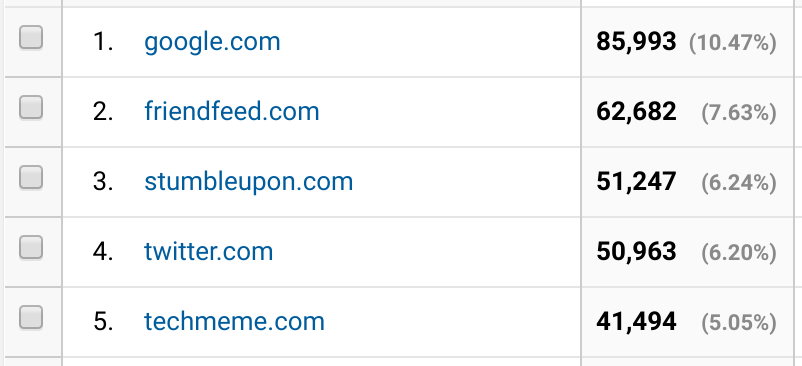
My top referring sites, via Google Analytics, from previous years

As the social streams of Twitter and Facebook took over, and bloggers (me too) got distracted, the share became the canonical mention. Your mentions on Twitter, or your notification of shares on Facebook, were faster delivered and easily quantifiable. And individual profile owners are quite unlike the publishers looking to deep dive into their analytics to discern where traffic came from.

Today, Brent Simmons laments the result of all the mentions going to the streams and leaving the Web. With links decreasing, and blog search being a relic, he yearns for a way to find again how his business is mentioned on the web or when he is being linked to. Joe Gregorio, like me, wistfully remembers analysis of referral logs to find how people found you... all through links.

Simmons' proposal is a limited one, keeping it to the MacOS/iOS community. A small project like that shouldn't be too challenging, but it speaks to a bigger problem, where the connections we once demanded are an afterthought behind the latest viral tweet and trending Facebook share. Streams are ephemeral, but the Web was built to last. It'd be great to see new voices building, informing and connecting again.

Disclosures: I work at Google and am on the Google Analytics product. So I think about publisher tools and visitor stats more than most.

September 19, 2013

Our Fragile Web of Dead Domains and Lapsing Links

Our Fragile Web of Dead Domains and Lapsing Links

For all our talk about how much information is produced every year, and how every little piece of our lives is being shared and instantly discoverable, it is surprising how difficult it can be to find information on the Web, in its original state from just five years ago, let alone ten or fifteen.

While we were once regaled with stories of how the Internet could withstand nuclear war, thanks to a complicated structure of redundancy and geographical backups, simple human mistakes, conflated with the occasional act of malice, have reduced our expectation that data, once posted, will be forever stable.

I believe strongly in the concept of the cloud, and have moved practically all my data to it, relying on a cloud-centric laptop each day and saving my files in the cloud. But not everyone is as careful about selecting providers and maintaining platforms and domains as I have been, and it's not too uncommon for entire sites and bookmarks to vanish from the Web, with only Archive.org and other clever cachers left to tell the tale.

Before this sounds like a sordid tale or anti-Web screed from someone embedded in the Web, let me give you a specific example. Imagine, if you would, a unique URL pointing back to the original dotcom boom - a simple one like .com.com. No, I didn't type it twice. The domain com.com has long been owned by CNET, part of CBS Interactive. While CNET has undergone a number of owners over the decades since its launch, it's also seen extreme variance in how they marketed their main site and URLs. For those of us who just wanted the news, it was News.com. Later News.com would redirect to News.Cnet.com, as it does today.

Archive.org Shows News.com.com in a Previous Known Good State

But at one point, News.com redirected to News.com.com, and for whatever reason, that's the bookmark I've had follow me from browser to browser for years. Suddenly, a couple months ago, this bookmark stopped working, instead showing me a directory of links, which looked like a squatter had seized the URL and taken it over. Archive.org shows the same. News.com.com worked and then in July... it stopped redirecting. So that's annoying. While it's simple enough for me to update my bookmark, and no doubt I'm in the small minority of users who kept that URL, to have a potentially high profile URL like .com.com do absolutely nothing ... seems foolish.

But Now The Old News.com.com URL is Pure Rubbish

Enough about .com.com. What's just as frustrating at times is the short shelf life for links and images from years past. My own blog has been around a little over seven years, and in the 3,000 or so posts I've made since start, each one has had many links. As companies come and go, their websites and the links to their subpages go away. News media sites, which one would hope would present a timeless archive, a long tail of information to the truth seekers out there, are often the worst offenders, as articles of a certain date fall behind a paywall, or site platforms change, forever hijacking link structure and rendering previous links inept.

One of the biggest regrets I have, as far as the web is concerned is one that +Ryan Tate (now with +WIRED) and I share. In the Web's more prehistoric times, back in the late 1990s, he and I both worked at the Daily Californian student newspaper at +UC Berkeley. Both of us wrote hundreds of news stories, covering everything from student elections to campus crazies and the occasional homicide. But at one point, after I'd left the paper, our site was hacked/corrupted, and all the existing content was lost - shockingly without backup. So more than 99% of that data is gone for good, and one will either have to travel to the Berkeley campus and pick up a hardbound paper to see our work, or it's just gone. While few of my stories are worth reading about 15 years later, they are part of my own personal (and work) history which has little record.

From writing on actual death to link death... while CNET's link lapse with .com.com is a surprise, it could possibly be due to a sale, to be used by an unknown acquirer, or simple neglect. Worse is when one sees links automatically shortened, only for the URL shortener to disappear, or for the hosting service to invalidate other short links. While I've made my case for URLs to look good and be intuitive, we've gotten used to seeing smaller URLs, best exemplified by the t.co from Twitter, helpful on their service, along with goo.gl from Google, bit.ly, and others. But by buying into a short URL service, you require it to be maintained by the original owners and all the tables being intact. So for those of us who long shared with ff.im from FriendFeed, it is by the grace of Facebook that those old things are still around, and practically nobody would be surprised if they went the way of the dodo in the next couple years.

My argument is that the Web should be built for permanence. A link I post today should be a link that works later. A permalink to a dedicated page with content should produce that same content, even if the surrounding frame has been upgraded, in the future. And short links and domains should behave in a trustworthy, user friendly manner. It would be a minor tragedy if the start page you use daily suddenly became something else, and a larger one if the domain on which you host your personal stories simply closed shop because the host didn't find it financially feasible to keep going any more. So while the magic of the Web is real, and it sometimes does seem you can practically find anything out there and get it instantly, assuming speedy broadband, the gaps have me thinking we can do better. And yeah +CNET, what's up?

June 9, 2010

Symbaloo Hits US Market With Start Page, Curation Engine

Symbaloo Hits US Market With Start Page, Curation Engine

Before there was social networking as we know it today, and before blogs, there were flat home pages. Among the first things most of us would do with these flat personal home pages would be to compile a list of links - essentially an extension of our browser bookmarks - so that our friends and other Web visitors would find out what we like, or possibly, so we could demonstrate an expertise. Now, as we have moved to a real-time Web built as much on streams as on pages, our sharing has sped up and many people are talking about the discovery and highlighting of key content as curation. New word... same idea.

Good curation tools are hard to find, though I have seen a number of attempts to get the formula right - and much of the fault lies with gaps in today's search engines, who are increasingly favoring most recent content over most exact content. Into the void comes Symbaloo, a company that is taking a new spin on personalized link pages, or start pages, and creating what are called "Web Mixes", with core components being tiles (much like bookmarks), RSS feeds and rich media, which can be used to capture the day's news - but more importantly serve to be a page of record for a topic or a time.

Symbaloo, a Dutch company, which has already enjoyed strong success in some areas of Europe, is today opening up to US customers in an early beta. With roots deep in the Continent, they are unapologetic about taking baby steps to serve us on the mainland, but they are eager to make a dent here as well.

A Default Symbaloo Start Page With Dedicated Tiles and Resources

Symbaloo's main design features 52 tiles, laid out in a 6 x 10 rectangular grid, with the center area reserved to display selected RSS feeds or to search the Web with any of the pre-loaded search engines. Whatever you choose to do with those 52 available tiles is up to you - and you can share any custom Webmix you build with your friends downstream, highlighting the curation you have done.

50 Hand-Selected Top Startups In a Symbaloo Webmix

For example, given my interest in Web services and early adoption, I put together a list of 50 top startups, excluding the "wise beyond their years" examples of Facebook, Twitter and other large private companies, and then ordered these 50 from 1-50 in terms of potential impact and visibility, starting with Foursquare and ending with Fabulis. As you can see, the "50 Top Startups" Webmix displays high quality graphics for each tile and is visually appealing.

http://www.symbaloo.com/mix/50-top-startups

Similarly, I also chose to take a few minutes and display 50 core Web sites you probably visit often, all in one place:

http://www.symbaloo.com/mix/50-core-web-sites

50 Core Web Sites To Get News, Networking and Finance

Creating your own Webmixes is very easy. After logging in, hit the + sign to create a new Webmix, and then click a tile where you want to add a link. If the link you are looking to add already exists, just click to add it to your Webmix. If it doesn't, then you can create it using an image from your computer, or one of the many standard icons provided by Symbaloo.

If you have a field of expertise, and want to share your findings, or your sources of data, with the world, Symbaloo's Webmix approach packs a lot of links into a single graphically pleasing page. I would expect you could rapidly see topical pages built for everything from Sports to Business to History. I could see Webmixes being created not just by technology curators like me, but also by teachers and journalists working stories.

For many, Symbaloo's approach may be compelling enough for them to use as their new browser start page, but for most of us, we have already edited our portals and are pretty set with what we want to see the first time we open up the Web. Instead, I think the opportunity to curate the Web and share with friends what we know is going to be the biggest opportunity. I expect to leverage Symbaloo as a one-stop personal portal, which I can get to from my desktop, iPad or any other mobile device. You can start making your Webmixes at http://www.symbaloo.com.

Disclosure: Symbaloo is a client of Paladin Advisors Group, where I am Managing Editor of New Media.

December 19, 2009

Growing Grumblings on Tech News Don't Address Incentives

Growing Grumblings on Tech News Don't Address Incentives

If you are the subject of the news, people will judge your actions and how you react to being in the spotlight. If you are the distributor of the news, how you message that news, and how accurately you report that news, will also be dissected. On the Web, especially in our sliver of Silicon Valley, where real time is becoming the standard, analysis of said news is itself happening in real time. From many corners, often from the more technically-oriented folks on the Web, I am seeing discussion around the tech news industry's alleged failings, inaccuracies, and usefulness (or lack thereof). While some of the feedback no doubt has merit, it too comes in simplified form, without offering potential solutions, taking into account how the creators and publishers of this tech news blogosphere are incentivized and rewarded.

On Sunday, Mike Arrington of TechCrunch, as he often does, started a discussion around what he termed "fast food content", saying that "hand crafted content is dead", summarizing a piece that lamented sites which steal content without attribution, and more darkly, sites that employ people to rewrite others' content, without adding anything new or doing "real reporting", the kind one learns in journalism class, or is required to do when working for a "dead tree" newspaper or magazine.

Given Mike's focus, running one of the more widely read tech news sites on the Web, his concerns lie around those who borrow much of his and his writers' content and publish it as their own. But I have also given a lot of thought, especially of late, to the vast number of tech news sites and blogs that are out there covering the same stories, and are jostling amongst each other to beat their competition by a few minutes - opting not to win on quality, but instead, on time. In this case, it's often not another tech blog's news that is being borrowed, but official announcements from companies.

One of the easiest things for tech blogs to do is repeat updates from the official blogs of interesting companies, add a few internal links to previous coverage they have done on that topic, add a paragraph or two of analysis, and hit the post button. I've no doubt done it myself over the last few years, even with this self-awareness, but you can see the process unfold practically every day. Watch for phrases like "According to a post on the official Twitter blog..." or "In an update on Google's blog this morning"... as many of the better-known sites all post their own interpretations of the news that came from the top.

This, in my opinion, is the very definition of the "fast food news" Mike is talking about, and time spent both producing it and consuming it could be put to better use - as in these cases, links could serve just as well as full articles.

I am by no means an ombudsman for tech media and the tech news consumer. I am but one person who takes in a lot of content, and produces a little on my own. But I see a few other areas where the tech news engine is falling short for news consumers, news makers and the news authors themselves.

I believe "fast food news" also can refer to the mass hysteria over making sure every site posts the news that a major browser or a major operating system has issued a point release, or when a popular site has an outage, that the incident becomes front page news for every blog. At some point, given the vast multitude of interesting tech stories, individuals and companies out there, one must take a deep breath and realize that being the 10th site to report that Twitter got hacked last night didn't really add a lot of value to readers.

In fact, when Twitter did get hacked Thursday night, Mike (again) had a solid post that added information, and, as he gained more knowledge of the incident, he updated the same post multiple times throughout the night. Because he was the first to the scene, with real data, his post had meat, while many, many others that followed were just echoes of the obvious.

So why is this happening? There are a few reasons:

First, the advertising model that forces many sites to drive page views and social interactions, through Digg, StumbleUpon, and Twitter retweets, is turning many tech news sites into post mills, staffed largely by inexpensive writers and freelancers. Instead of deep analysis posts that require interviews, backgrounds, and research, these sites are instead home to excerpts from YouTube, polls, user surveys, and whatever happens to be trending on Twitter that day. Quality is exchanged for quantity.

Second, many of these sites operate under the guise that they are the only site their readers see. Just because one major tech site covered a story 30 minutes before doesn't mean they should assume their readers already know. That is why if you do subscribe to many technology blogs, as I do, you can expect the vast majority of them to report the same story around the same time - instead of choosing a specific focus that can set them apart from the competition.

Third, thanks to competition and personal interactions, not every site likes the others. Years of infighting and annoyances, thanks to individual posts, personalities, or business priorities means that some sites really dislike each other. They won't link to one another. They will ban the competition from their user conferences, and when they aren't taking potshots, they will act like the other doesn't exist. Thus, if the competition "breaks" a story, the other will post it anyway, or try to find a wrinkle that makes their own version of events "improved" or invalidating the other.

Fourth, the rise of aggregation sites makes piling on to the news something that is rewarded. If all competitive blogs have covered a major story, many others will follow suit, be it to get into "discussion" on Techmeme, to see TrackBacks on the originating posts, or to come up when the popular terms are searched for on Twitter, Google and other engines.

In essence, the incentives, for the most part, do not tilt in favor of writing unique stories or doing the required research necessary to get a full story, to get quotes from a source, or find data points that back up analysis.

That's why you see people like Alex Payne (of Twitter) complain, saying "Rarely does technology journalism produce informed, correct, relevant, and readable content. This is a sorry and damaging state of affairs." in his rant from March (Towards Better Technology Journalism), and why Marco Ament, the lead developer of Tumblr and Instapaper creator, this week, wrote: "Over the last few years, I have unsubscribed from nearly every tech-news feed. I have never regretted the decision afterward, and I haven’t missed anything important. Tech news needs help. Badly. It’s truly terrible."

Keep in mind that it's not unexpected for the more technical among us to dislike the way their works are interpreted. Engineering distrusting marketing is practically a requirement and a religion. But we know they are somewhat right. As much as we can complain about the public relations industry as a whole, many flaks often find that their offers for reporters to speak with the CEO or an official representative of the company go without interest, either due to time issues or a lacking skill set. It's always a lot easier just to ask for the press release ahead of time, and an embargo date.

In an ideal world, those who are acting as our news filters would take the extra time necessary to ferret out news before its time, would ask those making the news the questions they didn't want to answer, would understand competitive landscapes, and wouldn't worry about getting a post up in a few minutes to hit a quantity threshold, without it first passing a quality threshold.

Lest we think Alex and Marco are the lone cries for help, you can see other comments this week from The Angry Drunk, and from Google's DeWitt Clinton, who posted to Twitter, "Don't worry. Save some time. Your story doesn't need a shred of truth to it. It will be retweeted just the same." in response not to a tech blog story, but a mainstream media piece that had missed the mark. (He later, in contrast, praised Marshall Kirkpatrick of ReadWriteWeb for solid reporting)

Content producers need to make choices in terms of what it is they cover, and where their field of expertise lies. If not breaking the news, or having access to the technology elite, there are many other ways to make your voice heard, through analysis and personal use cases, as well as the option to find new stories. Content consumers too have the choice as to where they get their news. I would hope that those people who are being spoon fed repeats of others' original reporting, or are waiting, jaws agape, for recaps of company blog posts, recognize what it is they are really missing.

Given the low cost structure needed to create content, it doesn't look like there is going to be a painful consolidation any time soon. In the meantime, the system is set up to reward those who publish quickly and pile on - for extra effort doesn't bring home the page views. There are going to be pockets of the Web that harbor original ideas, a focus on quality and data, and there are going to be other places where copying, scraping, and shortcuts are going to rule the day. I know what I hope to be. The question is, can we do our part, as publishers and consumers, to somehow reward those that do things right?

July 15, 2009

Google Reader Improves Link Blog Discovery, Security, Adds Likes

Google Reader Improves Link Blog Discovery, Security, Adds Likes

Google Reader, for more than two years, has played a central role both in terms of how I discover information and how I distribute information. It is through Google Reader that I get updated from hundreds of blogs and news sources, and through a shared link blog that I can parse out what I believe to be the best content, sharing it to friends I am connected to on the service, and off to third party social sites including Socialmedian, ReadBurner, FriendFeed and RSSmeme. But so far it's been difficult to find somebody's shares, obscured by a hard-to-figure-out URL. Today, Google Reader has made steps to enable faster discovery of people and topics, all within Reader.

The news, which hit this afternoon, is that you can now search within Google Reader for people who have public shared items and subscribe to their shares with a single click. The new search feature, powered by Google Profiles, lets you browse by name, location or topic.


Searching for the name "Clinton" to find new link blogs

But, if you don't want to have your shared items broadcast to the world at large, you can still keep your shares private, or even share items to a specific group of contacts. These contact groups are the same you manage in your GMail, so changes on either service will be synchronized.


Selectively Share Between Groups

As link blogs have risen in importance, alongside your other social activity, from your blog to microblogging, etc., Google Reader has made it even more simple to highlight your link blog on your Google Profile, with a simple check box. So if you hadn't already added your items to your Profile manually, this will take care of it.


Adding shared items to the Google Profile with a checkbox

Similar to Facebook's recent move with vanity URLs, you can now also have your shared link blog feature your own Google user name, which can be enabled in your profile. So now, instead of a number like "05763917848110205585" which I have always had, mine can just say "louisgray".


You can now "Like" Shared Items In Link Blogs

And don't think Google Reader isn't watching what is happening on other networks. The team has added on to the ability for friends to make comments on your shared items, enabling a "Like" feature, found not just on Facebook, but on FriendFeed and Socialmedian as well. So now, if you see a friend's shared item, and you like it, just click like, or hit the "L" key. So if you're a keyboard maven, you hit J to go forward, K to go back, and L to like. More work for your right ring finger. Interestingly, all "likes" are public, while comments on shared items are still only shared with friends. So if you like something, others reading the shared link blog can find out you are a fan as well.

I have long been a fan of shared link blogs, and have even encouraged companies to get into the act to show they are listening to the news and opinions in the industry. My Google Reader shared link blog is a major reason of why I've never left Google Reader for an alternative, and making the feeds discoverable should be a helpful boost to visibility. You can find my shared link blog here.

March 5, 2009

Technorati's Revenge? The Site Is Beating Google for Blog Reactions

Technorati's Revenge? The Site Is Beating Google for Blog Reactions

To laud Technorati is going against the flow, to say the very least. The once-omnipresent blog search engine has practically been reduced to a state of irrelevancy, thanks to inconsistent uptime, odd product launches and withdrawals, nonsensical redesigns, executive turnover and aggressive competition from others - primarily Google Blog Search. In previous posts on Technorati, I've referred to them as "totally toast" and "fighting off irrelevance". But surprisingly, especially in recent months, the moribund site has consistently beaten Google in terms of finding new and accurate links to my blog or mentions of the site, while Google's results have actually gotten less relevant over time, including false positives from blog rolls and the like. No doubt this had much to do with why Rob Diana, in January, said for the most part, that blog search sucks.

Google is set up to find all of the world's information, and it is doing a fantastic job at that, as we all know, and it is the gold standard for search in practically every regard. But it's maybe too good. The company's over-aggressive spiders are just as likely to trigger false positives in terms of knowing what is a blog and what is not, or what is a blog post or what is simply sidebar information. Last August, I highlighted one issue, when MyBlogLog activity was spawning false positives. On other occasions, I've seen updates from aggregation sites, like Socialmedian, do the same. At this point, my bookmarked blog search from Google to find reactions excludes no fewer than four sites, to try and filter down the accurate results.

And as I'm fighting off false positives with Google, Technorati is quietly finding me mentions that I can't get using Google, which relies on keywords instead of links. Not even the advanced blog search page on Google lets me find links to a site the way most bloggers want to find.

Technorati, for instance, found me links from LivingstonBuzz.com, BlackWeb20.com, and from Regular Geek in the last few days, which were pointing my way, but didn't mention my name or site domain - and I'm finding this to be the rule, rather than the exception. While at one point I'd stopped visiting Technorati, I've now returned to the site on a frequent basis to see responses, and participate in the conversation wherever it may be.

Technorati's benefits over Google Blog Search may no doubt be short lived. Maybe Google Blog Search will solve some of their issues soon, and develop new features, while Technorati has been relatively stagnant. And I'm still waiting for somebody to come up with the "inverse Technorati" idea I floated back in October of 2007. I'm not saying Technorati is perfect, or winning me over as a major force to be reckoned with in innovation, but if I want to know who is linking my way and extending the conversation, they're still doing a good job, and beating Google, which is a significant feat.

January 27, 2009

Trackbacks Are Still Dead. Could Tweetbacks Take Their Place?

Trackbacks Are Still Dead. Could Tweetbacks Take Their Place?

By Phil Glockner of Scribkin (FriendFeed/Twitter)


The Trackback Problem

Today, as I was visiting different blogs reading the news of the day, I made a special note on how many comments each post had and if trackbacks and pingbacks were listed.

Trackbacks and Pingbacks are two of three types of linkback, defined by Wikipedia as "... a method for Web authors to obtain notifications when other authors link to one of their documents."

What I'm coming to realize is that, in terms of showing buzz around a post, trackbacks and pingbacks are dead. Worse, they just show how many spam blogs (splogs) are out there, hanging off of an RSS feed and republishing part or entire posts in order to artificially inflate their Google rank numbers.

(See Also: Did Trackbacks Die, and Who Killed Them? from July 2007)

Take this Inquisitr post, for example. If you scroll down to the bottom, you will see 6 or more trackback links, most of them with the same block of quoted text. After quick inspection, it appears all but one of these links go to blogs that are either partially or completely ripping off the Inquisitr's content.

In essence, instead of showing relative popularity and linking to further discussion, this has become an avenue that is not only exploited by spambots but flaunted right under the noses of the content creators.

One Option: Tweetbacks

As news blogs increasingly extend into social networks, they are looking for a way to register their reach on those social networks. A good example of this is Digg. One of the reasons Digg got so popular so quickly was due to it allowing blogs to display how many times a Digg user had submitted (or Dugg) the article. This provided a fine synergy between the blog and Digg, and in theory both services benefited.

However, even solutions like Digg, Mixx and Sphinn seem to be losing clout, as people turn to using Twitter instead to highlight items of interest.

With that in mind, it seems only natural for blogs to want to show how their posts have legs on Twitter. To that end, several WordPress plugins have been created that attempt to serve this need, such as TweetSuite, TweetBacks, and to a lesser extent, TwitterTools.

From these three, I would say TweetSuite is the most stylish and functional. However, TweetBacks is a solid framework and with a little skill can be integrated much more cleanly into a blog theme.

FriendFeed..Backs? FriendBacks?

FriendFeed may not be as popular or as well-known as Twitter, nor have as much reach, yet, but because of its unique ability to aggregate RSS streams and simultaneously act as a community hub, with the addition of a powerful and flexible open API, there has been a significant amount of development around it as well.

Recently, there was news that Disqus turned on two-way integration with FriendFeed (after also enabling Track- and Pingback support and more recently, Facebook Connect). However, there are already at least two other good solutions, including FriendFeed Comments WordPress plugin and FriendFeed-to-Disqus Sync, a cloud-based synchronization utility that Disqus itself wrote about here.

What's Next?

Buzz and reach are always going to be things that blogs strive for, especially blogs that employ multiple bloggers and are ad-supported. Are tweetbacks and 'friendbacks' going to keep them going indefinitely into the future? Absolutely not. Something new will appear and, if it has an API, people are going to figure out how to tie their blog to it.

Read more by Phil Glockner at Scribkin.com.

January 9, 2009

10 Ways to Maximize Your Google Reader Link Blog

10 Ways to Maximize Your Google Reader Link Blog

I've been sharing articles I've read in Google Reader for the better part of two years. I don't know exactly when I started, but I'm fairly sure I'm nowhere near finished. And while I admittedly started sharing to a link blog without having a clear goal in mind, I'm finding that this massive shared items repository is becoming an incredibly versatile information hub that benefits me, the authors of articles I've shared, and the consumers, be they friends in Google Reader, or in many other locations.

I believe that while Google Reader has grown in visibility, arguably becoming the most popular RSS reader on the Web, the utility of shared link blogs is less known. Here are ten ways you can maximize your Google Reader link blog - most of which I'm doing, and probably didn't anticipate when I first started sharing items into the ether.

1. Act as a trusted information filter.

Regardless of how fast a reader you are, there is no possible way you can read every single news source and blog on the Web. Neither can anybody you know. And regardless of how closely your feed match percentage is on Toluu, there are feeds you read that your friends don't. By sharing the best items of what you read every day from Google Reader, you are hand-selecting the best of the Web and "endorsing" those items to your link blog subscribers.

Do so with some regularity, and you might be surprised as to how people come to rely on your manual intervention and news discovery. I first became cognizant of this in February when "SeekGround" reported "I discovered that I had shared more of louisgray's shared items than anyone else's in the last 30 days". In May, Duff's Device similarly wrote: "I saw another article that I received from Louis Gray'sGoogle Reader Shared Items again. Thanks for keeping on top of the world for me Louis. :-)"

As of tonight, ReadBurner reports I have nearly 8,500 articles shared on my Google Reader link blog. While there are others who have shared more total items, I know that I have shared those items I believe are most interesting to me, and others I believe are following along.

2. Share your items with Google Friends.

Though Google hasn't nailed the "what is a friend" issue, you can add friends through GMail and Google Talk. If they are also Google Reader users, and share items, you can opt in to seeing their Google Reader shares, and they can see yours. If they subscribe to your shared items, your shares are mixed in with all the other feeds on their list. Of course, if you don't want to see their lists, click "Hide" next to their name, or "Show" to bring them back.


3. Embed your Google Reader link blog to your own blog or Web site.

When I first started sharing to my link blog, I had this odd feeling I was sharing posts and nobody knew about it. After all, the link blog URL isn't the most intuitive on the planet. But you can embed a widget on your blog to display a subset of your recently shared items, and visitors to your blog can click out to items you've shared.

4. Add your Google Reader link blog to your Google profile

Your Google profile is a fairly blank slate, for you to add or delete as you please. While it's very common for people to add links to their Twitter page, their blog or their LinkedIn profile, I'd suggest it's just as important to add your link blog to the page. Mine is here.

5. Share items to Facebook, FriendFeed or Socialmedian.

2008 was the year of personal news aggregators, which took updates on your services from around the Web and put them all in one place. While this trends was best exemplified by FriendFeed, Facebook also offers the option to feature your Google Reader shared items, and Socialmedian will pull them in as news, going so far as to check the shares by topic to place them in the right categories.

You can see my Google Reader shares on FriendFeed here. And to avoid duplication of items, if I share items from louisgray.com, I manually delete them from FriendFeed. Takes seconds, and reduces the noise. (My Socialmedian page is here...)

6. Add your share count to ReadBurner, RSSmeme or Feedheads.

Feedheads, the pioneer in tabulating popular Google Reader share counts, was joined by ReadBurner and later RSSmeme, in early 2008. As some people are turning to ReadBurner and RSSmeme as a democratically sorted Digg or Techmeme, sharing items you like will add your vote to the list.

Be sure to add your feed to ReadBurner here.

7. Replace your bookmarks with Google Reader shared items.

At the end of the year, I said that RSS Has Practically Eliminated My Need for Browser Bookmarks. As I thought about it more, it's my Google Reader Link blog that is essentially my rolling bookmark list, highlighting those items which are the best, and which I will want to return to. While Delicious is also a good Web-based bookmarking system, the link blog is a good way to find recent items of interest.

8. Expand the visibility of lesser-known sources.

Sometimes, I get in a routine of reading my RSS feeds and then sharing, without thinking about how the shares are effecting the downstream author. But I've gotten e-mails saying the shares have generated attention beyond what I expected. Last month, one blogger wrote, "When you pop an article on (the linkblog), I'll get 60-70 hits and get pumped to the first page, that is pretty averge for the support you give me." Earlier this week I got a similar e-mail from a second author, who wrote an e-mail titled "Thanks yet again", adding "Your Google Reader share really lit up that discussion."

In a tech blogging world where there are so many different sources of news, and so many people writing about the exact same thing, you can make a difference by choosing lesser-known sources of news, and highlighting the best content, not just the loudest. I've tried to share items from those who have done original reporting or are thinking differently than the echo chamber, and it in turn can deliver greater visibility.

9. Use your linkblog as your "to comment" list.

As part of my online new year's resolution, I said I would be making more time to comment on other blogs through the year. But as you know, my full-time job doesn't work all too well with browsing the Web and making comments throughout the day. Instead, I've found I'll go back to my own Google Reader linkblog, and open the items in a new tab, and go through to add comments one by one, left to right, so I've given the authors feedback and participated.

10. Create your own leaderboard of news sources.

Google Reader tracks statistics on what your most-shared news sources are over the last 30 days, which can report on who you've found most interesting in the last month. Given each person's individual tastes, the results can be very different than more public leaderboards which tend to feature those who are most popular and have a deeper subscription base. While my own link blog does tend to feature popular sites like TechCrunch, Scobleizer and ReadWriteWeb, I can see that I've also shared a high number from lesser-known sites, including TechWag, Regular Geek, The Future Buzz, Andy DeSoto and Chuqui 3.0. And if you're stat-oriented like I am, you can check in and see how this changes over time. (See my blog leaderboard from last July)

So... are you sharing your Google Reader items? I am. You can find mine here. For the betterment of the community, it'd be great to see your shared item links in the comments.


DISCLOSURE: I am an advisor to ReadBurner.

September 25, 2008

Outbrain to Extend Blog Recommendations With Third Party Content

Outbrain to Extend Blog Recommendations With Third Party Content

Outbrain is best known for its easy to install blog widget that allows readers to rate posts on a one to five star scale, from "Bad" to "Excellent". I've been running it myself the last few months, and have seen some consistent, if not overwhelming, activity on the widgets each day. Outbrain is looking to extend their service by adding stories they believe you may like in addition to the current post, both from the site you own and from third party sites who are fellow Outbrain users. The idea, in their mind, is to deliver a wider range of content to readers, no matter the source.


Outbrain recommends other posts you might like and lets you rate posts.

Today, those who install Outbrain's blog widget also see stories "You might like", but they are limited to the blog on which the widget is installed. The new extension will, in effect, act like the "Web rings" of old, by syndicating your content on similar sites and extending the potential audience. Outbrain also is a big fan of Scott Karp's recent article on Publishing 2.0, which showed that sites which have the highest reader loyalty also are heavy linkers outside their own blogs.

This change is expected to roll out in the next few weeks, Outbrain told publishers late Tuesday night.

While the most visible aspects of Outbrain are the stars on users' blogs, there is actually a good set of statistics being tracked on the back end today, including a record of all blog post ratings, including the score, the post and the rater's country, the ability to sort all posts by total number of ratings, average rating and total popularity score (tabulated by the number of votes and average rating), and how many page views you have gained from the Outbrain network at large.


The most recent ratings on Outbrain.


The most popular posts, by rating, on Outbrain.

Given I'm not a high-traffic destination site, I doubt I'm exactly lighting up the Outbrain leaderboard. Most of my posts get a couple votes, and the most popular posts have received from 12 to 15 votes apiece. This could be due to people's unfamiliarity with Outbrain, reluctance to use the widget, or my low visibility.


My most active post on Outbrain got 15 votes.

Tonight, I logged in to my Outbrain account, and turned on story recommendations, both from my own site, and from third party sites. Over time, we'll see if Outbrain can deliver customized, quality, suggested links, and if this will increase the reader experience. Keep me posted on your thoughts.

September 13, 2008

Statistics Are Your Friend, Even When They're Bad

Statistics Are Your Friend, Even When They're Bad

By Robert Seidman of TVbytheNumbers (Twitter / FriendFeed)

It should be no surprise that being part of a site called TVbytheNumbers that I’m obsessed with statistics and this obsession extends to all the web site analytics and statistics that are available to us.

While I hear and read things often about how Feedburner’s stats stink and Google Analytics stats stink and none of them ever sync up well, that really hasn’t been my personal experience. Using either Feedburner or Google Analytics as an intraday tool is certainly problematic, and I have had a day or two here and there where Feedburner did lose data for an hour of five that it never recovered, but mostly both are just slow and do recover. Google Analytics typically tracks visits and visitors correctly intraday within reasonable timeframes, but lags behind in counting total pages for hours. Usually, by 8am Pacific time (but not often before then) all the page views for yesterday show up. And once they do, on a page view basis, Google Analytics, Feedburner and Quantcast all seem like they wind up syncing up within 2%-3%.

Given everything involved, I find the 2% difference very reasonable and it doesn’t bother us any. We wind up triangulating between Feedburner, Google Analytics and Quantcast and it’s less of a hassle than managing our Web logs.

Because of the problem cited above with Google Analytics being slow to capture all the page views, it does make intraday monitoring fairly worthless, aside from tracking visits and visitors. All the other stats – time on page, bounce rate, pages per visit, etc. – are all wrong until all the page views are captured. But there’s little we’re doing that requires great analytics on an intraday basis. There are certainly times when it would come in handy, but even as it is, it works well enough intraday where we can at least figure out if we add something or move something around whether the desired result was achieved.

As a tool used after the fact, I find Google Analytics to be an extremely valuable tool, though I often don’t like what I see!

One thing we’ve thrown in the towel on is that referral traffic is almost always bad, no matter the source. There are some rare exceptions where linking produces good traffic (high time on site, number of pages per visit, etc), but that’s indeed rare. In fact, in almost every instance where a specific post is linked, the traffic is bad, with bounce rates often in excess of 80%. That’s whether Louis is linking to it, whether someone throws a link on Twitter, or even if Matt Drudge links to one of our stories. StumbleUpon and Digg show similar results.

Such traffic is great for jacking up visits and visitors, but bad for bounce rates, pages per visit and time on site. We’ve pretty much thrown our hands up in the air on that score and attributed it to web surfing behavior via links. As an aside, the stable link we have from Drudge to “TV Ratings” produces much better results, but if he links to specific story on our site and gives it any prominence on his site, the traffic has a very high bounce rate.

That seems largely out of our control, however there was still one stat that really bothered me. That was that if someone landed on our site via our home page, the bounce rates were still pretty high, approaching 50%. Better if someone came directly instead of via a referral, but still bothersome either way. Here's the landing page results for our site for August 1-31:


Recently, with that and a couple of other factors in mind – mainly wanting the ability to showcase more content on the home page – we redesigned the site. The bounce rate for traffic landing on our home page was around 47% for August. In the last week, post- redesign, that is now around 25%. The bounce rate for referral traffic to specific posts is still lousy, but again, we don’t feel like we can do much about that. Here are the landing page stats from September 6-12.


All of this has me wishing I’d gotten around to redesigning the site sooner. Who knows how much repeat traffic we may have lost as a result of design? I also feel silly because once upon a time I actually had responsibility for the web design/UI group at Charles Schwab. I recently had lunch with the VP who ran that group in my org and when I told her about the results she shook her head and laughed at me. My mentality had been this: our blog is a blog, pretty much like every other blog and designed pretty much like every other blog so spending a lot of energy on design tweaking didn’t seem like a worthwhile priority.

I definitely should’ve known better. I’m still not very happy about the bounce rates on referral traffic, but am quite happy about the reduction in bounce rates for people landing on our home page and would ascribe that improvement completely to redesigning.

By the way, for anyone interested, we went with the Live Wire theme from Woo Themes that we modified a little. So far I’d consider it the best $70 we ever spent. It’s not a perfect world, so the theme isn’t perfect, but setting the navigation structure (which we’ll certainly still need to tweak) and other modifications didn’t take much time. For $70 and time spent, cutting the bounce rate to our home page just about in half seems like time and money well spent.

Read more by Robert Seidman at TVByTheNumbers.com.

July 8, 2008

The Importance Of Blog Linking Seems to Be Declining

The Importance Of Blog Linking Seems to Be Declining

I am a strong believer in the power of linking between blogs, and I still go out of my way to link, especially to peers, to smaller blogs, and to developers of services I write about. At one time, I thought being linked to by the most prominent bloggers could have a significant impact on my traffic. And for a short time, it did. But now, I've seen traffic from other blogs to be driving an ever-declining percentage of visits to my site, swamped by social media tools, aggregation sites, and of course, Google search.

Yesterday, out of curiosity, I downloaded all my visitor logs going back to January of 2006, when I started regularly posting on the blog. While there's no question traffic overall is significantly higher now than it was one year ago or two years ago, the impact that even the biggest of blogs can deliver is lessened. I believe that this is due to a few things:
  1. People are relying on aggregators to find them new sources of information, including Techmeme, Hacker News, Reddit, Mixx, FriendFeed and others.
  2. People, especially those who read this site, are relying more on RSS readers, and many have subscribed to so many feeds that they are reading through stories in an effort to clear out their unread items, not clicking the embedded links.
  3. People who actually read blogs on the site (outside of RSS) are clicking through to respond to the author with comments, rather than viewing links.
This year, thanks to covering some of the hottest topics in the tech blogosphere, I've been lucky enough to have been linked to from some of the most-prominent blogs in the market, including TechCrunch, ReadWriteWeb, Mashable, Scobleizer, MicroPersuasion, Jeremiah Owyang, Mathew Ingram, The Inquisitr, Profy and others. I've also been actively engaged with those flying lower on the radar, including I'm Not Actually a Geek, SheGeeks, Regular Geek (see a theme?) and others.

But looking at my aggregate statistics from the last six months, not even the "big name" linkers drove a lot of traffic, relative to just about every other source. And in some cases, the top blogs that drove traffic were themselves relative unknowns who I've featured in my monthly obscure blog recommendations, themselves often being the beneficiaries of being on Digg or Techmeme.

Top Blog Referrals in First half of 2008:
  1. I'm Not Actually a Geek: When Your Blog Is LouisGrayCrunched
  2. Scobleizer: Loving my FriendFeed
  3. Regular Geek: Required Reading in Social Media
  4. ValleyWag: Most bloggers don't deserve any ad revenue, the seven-word version
  5. TechCrunch: More Bloggers Raising Money. Here Come The Politics. And Here Comes My Rant.
  6. Micro Persuasion: Become an Expert with the Power of Deliberate Practice
  7. Mathew Ingram: Duncan Riley: Lessons in diplomacy
  8. WebWare: A Proposal for Twitter: Shut It Down
  9. ReadWriteweb: Content Is Becoming a Commodity
  10. Mark Evans: Who's Louis Gray?
Definitely a lot of bigger names here, mixed in with some others. But the most interesting thing is that the highest among these "only" delivered just shy of 500 visitors over the first six months of the year, and the lowest passed less than 100. That doesn't even come close to a single day's worth of Google traffic, or a single day of having a post on Techmeme or Hacker News, let alone Digg.

Instead of blogs driving traffic, we have some more mainstream names, as shown in the below graphic from Google Analytics, highlighting sources for the last 30 days:


In fact, it isn't until the #10 position overall over the last 30 days that you get a total number of visitors that is less than the #1 blog referral over the last 180 days. And in most cases, I've not seen any kind of meaningful traffic from mentions on Mashable or ReadWriteWeb. Back in January, I was a little less than happy that Mashable wasn't giving linkage a lot of prominence, but even now that they are, the impact is extremely small. I got 77 referrals from Mashable on their story around Twitter brand management, and 53 more from a story on my being an early adopter, very insignificant in the large scheme of things.

Now, I'm not saying that this data proves linking is dead. I know links power Google juice, and they enhance Technorati rankings, and if done well, people can find new sources of data, but the ability for even a so-called A-List blogger to deliver a windfall of visits is much less than I had ever expected. It is now more important to be part of the social media sites that drive strong traffic - the Twitters and Techmemes and FriendFeeds and Stumbleupons and Reddits, if traffic is your goal. Those sites, combined with RSS activity in Google Reader and other programs are what will drive traffic. So don't wait around begging for Scoble or Mashable to write you up. It might not have the effect you thought.

July 5, 2008

TinyURL Adds Custom Alias Feature To Shortened URL Service

TinyURL Adds Custom Alias Feature To Shortened URL Service

The URL shortening service TinyURL was first useful for sending longer URLs to friends over e-mail to avoid line breaks that would often disable links in many e-mail programs.

With the advent and massive growth of SMS and microblogging services, like Twitter, TinyURL and other services like it have become omnipresent, an integral part of sharing blog posts, news, and other items.

In fact, Steve Gillmor of TechCrunch recently wrote, "Who controls TinyURL... controls the high ground in the battle for the Internet platform."

But until Friday, the URL was always a string of gibberish, a simple link to tinyurl.com followed by an indecipherable string of letters and numbers. You typically had to trust the person or service sending the TinyURL, or preview it to be sure you weren't being sent to a Rick Astley music video or a malware site.


Now, TinyURL added a new wrinkle, the ability to make a custom alias for any shortened URL you make, making it just as easy for people to read as Web browsers. Now, instead of always showing links to my blog posts that read as http://tinyurl.com/55aml3 or http://tinyurl.com/6px3kc, I could in theory, make them read like: http://tinyurl.com/lg70508 or http://tinyurl.com/tweetdeck.


This might seem like a small update, and it is, but it could make the service more mainstream, especially in the enterprise where slower adopters are more comfortable sharing items that are branded, or in a consistent format. It could also be another step in helping TinyURL compete with smaller URL shortening sites, including Snurl. With the exception of automated TinyURLs generated from TwitterFeed, I'll be trying to make my own custom aliases to links I share via Twitter, E-mail, or FriendFeed.