Showing posts with label Google TV (3 posts). Show all posts

June 23, 2011

YouTube, Android Offer Alternative to iTunes Film Rentals

YouTube, Android Offer Alternative to iTunes Film Rentals

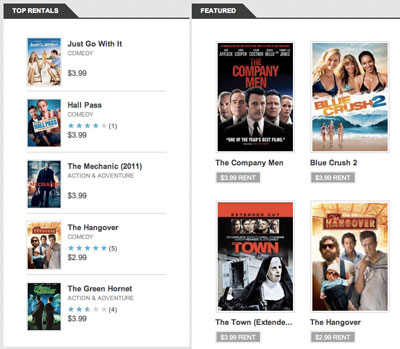
One of the new product announcements at Google IO in May was the introduction of movie rentals from the Android Market. Following the path beaten by Apple with its iTunes and Apple TV pairing, popular movie rentals can be picked up for the typical price of $2.99 or $3.99 each, are watchable in the next month and playable for 24 hours after you start. It's familiar, but new for Google, who added the option to their marketplace a month ago, making one less reason one has to be shackled to iTunes. The video rental service is powered by YouTube, who has clearly shown they know how to push Web video content to hundreds of millions of homes worldwide, and is ready to try longer-length content.

As mentioned frequently here, I've been a longtime iTunes user, and have slowly migrated away from the platform, thanks to increased use of Spotify and Google Music on one side, NOOK on the other, and now, movies, by way of Android Market, on top of Netflix Instant. The focus is not so much an anti-Apple vendetta, but just finding new ways to consume rich media on my changing array of devices. The more Android and Chrome I have in my house, the less iTunes is an option - until Apple changes its mind.

Some Top Titles On Android Market (Powered by YouTube)

The promise of the Android Market offering is to play these movies right in your Web browser, on any of your Google account-enabled devices. There's no need to download the movie (as iTunes does), but you instead start streaming after an extremely minimal amount of buffering, at either 320p or 480p. Purchases are sent to the account you have registered with Google Checkout, and the item shows in your Android Market purchase history. All straight forward.

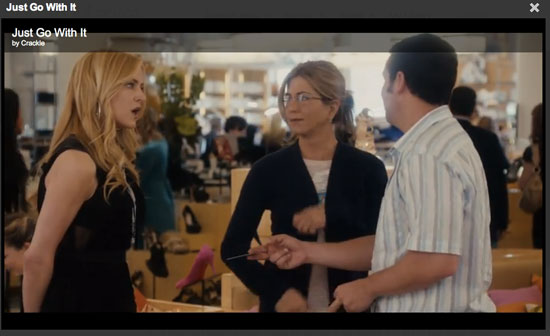
Streaming "Just Go With It" On Chrome Via Android Market

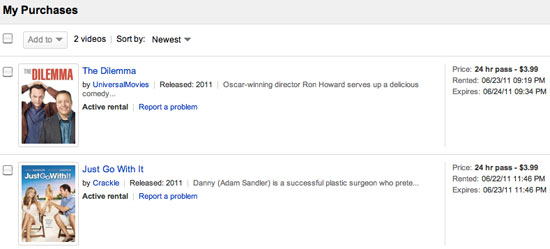
In the last two days, I pulled down Adam Sandler's romantic comedy "Just Go With It" and Vince Vaughn's "The Dilemma". Both $3.99, I can play these videos on the Web (and even Google TV's Chrome App) and expand to full screen. In our on demand world, the experience is on par with Apple TV or Netflix Instant, and your service preference depends on the device you're using or the title you want. Using the Android Market interface is actually just a front end for YouTube's full-length feature movie rentals (see all of them here), including films like The Hangover, Harry Potter and The Deathly Hallows, The King's Speech, Knocked Up and many others. It's yet another example of Google trying to push to the browser what traditionally has been handled with desktop client software.

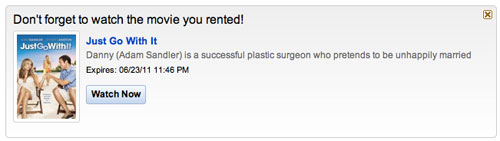
YouTube Reminds Me to Watch The Movie I Rented

My Rented Films Visible on YouTube

I tested the video rentals on my Mac, in both Chrome and Safari and on the CR-48, as well as on Google TV. Essentially, if the app can play YouTube videos and you can sign in with you're Google credentials, you're good to go.

My Receipt Delivered Via Email, Like Any Other Google Checkout Purchase

At Google I/O, it was promised that ChromeOS (and these rentals specifically) would bring more offline access for those outside of broadband streaming. I assume those will come soon, to solve for the poor souls stuck on airplanes who still want access, and might still be going to Apple to shell out three or four bucks at a time.

April 17, 2011

Apple TV, Google TV, TiVo: Crowded Theater, All Good

Apple TV, Google TV, TiVo: Crowded Theater, All Good


There is no one perfect home entertainment gadget. No single gadget manages to record all your favorite shows on demand, has access to the deepest online library for new and older titles, syncs perfectly with services like Netflix and finds all the Web's video at once. Devices ranging from set top boxes like Apple TV, TiVo, Google TV, Roku, and Boxxee, and game centers including the Nintendo Wii, XBox 360 and Sony Playstation, and single-purpose devices like the Slingbox have been working hard to make our entertainment consumption world ideal, but each has its strengths and holes. In our home, we've tried to fill all the holes, and this requires multiple devices, each one finding a perfect niche that can't be replaced by an alternative.

We moved beyond the traditional VCR/DVD world in 2003 with the arrival of our first TiVo DVR -a series one. Since then, we added two newer boxes, the TiVo HD device and the TiVo XL, the bigger brother of the HD, with a terabyte of storage. While the Premiere line of TiVos emerged last year, it wasn't compelling enough an upgrade to make the move, but we're very happy with the pair we have.

In 2007, with Apple's release of the first generation Apple TV, we snapped up a 40 gigabyte model, which is in use today. Last year, I also picked up the newest model Apple TV, which is stream centric. Meanwhile, last month, after some delay, I added Google TV to the mix with a Logitech Revue. Having seen it panned by much of the tech press, and the multiple demos I'd received falling short, it took some hands-on testing at a local Best Buy to push me to bring it home.

So with all these boxes and companion remotes, how do I choose what to use? Like I mentioned last May with mobile phones, you have to look to the core of each device to find their specialty.

Each Product Has Its Own Core Focus

For the Apple TV, the product's strength is its tie to the iTunes store, specifically, the vast video library which contains more new releases for rent or purchase than alternatives. Google and TiVo have close links to the Amazon video store, but the experience has never matched that of iTunes. When we want to rent a movie for an evening, or purchase a video for my kids to watch (like Toy Story or Cars), it's on the Apple TV.

For TiVo, the product's strength has always been around its ability to time shift videos and record my favorites. A companion benefit is its show guide and search, to find future shows and set them to record. The TiVos upstairs and downstairs run our scheduled programming, and having tried crappy DVRs from Comcast, Dish and others, there's simply no parallel to what TiVo offers.

For Google TV, the device is Web centric, much like Android, of course, and most things Google touches. There's something fun about browsing the Twitter app on the full screen, browsing Web sites, and enjoying YouTube on a screen much larger than a laptop. Tired of my kids running into videos on YouTube with the iPad that weren't exactly my favorite, browsing YouTube myself with them in the room puts me back in control and reduces their digital ADD.

Another much-overlooked feature of Google TV is the ability to browse what's on, automatically sorted by genre. Like most of you with kids, being stuck with baskets of laundry is made much easier when watching something entertaining. Yesterday, owning this task, I checked what movies were on, found Knocked Up just started and amused myself through three baskets of whites and colored laundry. It's similarly very good for finding out what sports are playing anywhere on the TV dial.

Is Google TV Any Good? I Say Absolutely.

As the Google TV is the newest gadget for us, and I've covered Apple TV and TiVo many times before, it's worth saying how good the experience has been. Reading scads of reviews that slammed its utility, or the keyboard remote, I was very surprised how easy it was to setup and how immediate its benefits were. I was most concerned that putting the Logitech box between the TiVo and TV would somehow impact the TiVo's ability to schedule recordings. This turned out not to be a problem at all. The keyboard remote was as simple as any other laptop keyboard, and the Home key always puts me to home base, the center of applications, what's on TV, and is the conduit to browsing the Web.

Even more futuristic is the ability to use any Android device as the remote control with the Google TV app. There's some fun to using the Galaxy Tab as the remote control, with part of the app's screen space devoted to playing the role of trackpad. If you haven't done it, surfing the Web from the tablet to the big screen is pretty cool.

Obviously, each experience could improve some. The Apple TV doesn't know anything about live TV and doesn't have Safari running on it like Chrome does for Google. Google TV makes no attempt to record shows, even though it knows they're on. Meanwhile, the TiVo doesn't really know the real Web exists, despite tie-ins on Premiere with Web widgets and third parties like Netflix, Amazon and Blockbuster. But in our home, if we have an entertainment need to fill, we have a box to do the job.

PR around the Google TV has been pretty light since its initial launch, and one could guess that maybe we'll hear more about the product at Google I/O in May, the one year anniversary of its introduction. Maybe new hardware and TVs will be announced, or new content partnerships, after months of hearing that sites (like Hulu) want to keep Google out of their kitchen. TiVo is due for a big upgrade that maybe makes me update the older boxes. And Apple TV only really gets talked about when you hear rumors that Apple could go the true television route and release an HDTV line. They've certainly got the relationships with suppliers, and the best UI team on the planet. But if you know what you want out of TV, Google TV, Apple TV and TiVo all have a fit and each one brings value. So don't get caught up the tech news grumpiness you find elsewhere. Considering how inexpensive each device is, you just might get all three.


May 20, 2010

While Apple Slept On Their Hobby, Google Executed

While Apple Slept On Their Hobby, Google Executed


After noting Apple practically being a zero in terms of mentions in yesterday's keynote at Google I/O, today saw the gloves come off as Google came out swinging against its competitor - and it had to be noted, even from this longtime Mac customer - that many of the punches landed, again and again. Most damning? Google actually took TV seriously - instead of teasing customers with a streamlined device, like the Apple TV, which looked great, and functioned well, but was often dismissed as not being a central focus. The result, despite the occasional bumps in the morning's demo, is the latest and most credible offering yet that could unify the worlds of Web and television in one place - on the biggest screen in the house. (See the official Google TV site)

Back in 2007, I had high hopes for the Apple TV. I openly questioned those naysayers on the device, celebrated its small feature updates, such as adding YouTube support, and postulated how it could compete and defeat other businesses, such as Netflix. But it seemed Apple had other ideas for the device - pretty much ignoring it, even as the company saw tremendous focus in other places - first with the iPhone, and now with the iPad.

Yes, the Apple TV still works. Yes, it can still show photos and YouTube and my music and pull down films from iTunes. But it's a siloed dinosaur.

Google made its antiquity especially clear today, as instead of using Apple's divide and conquer mentality, with Apple TV being completely separate from your TV, the company promises to bring the Web to the TV, complete with a search box that finds content, no matter where the source. The reason this has a much better chance to succeed than Apple TV ever could? Commitment. Commitment from the company's leadership, from partners, and to the word they keep smacking us with - openness.


Rishi Chandra, product manager for Google TV, says the company's new offering is about "taking the best of what TV has to offer today and what the Web has to offer today and give a seamless experience", which should result in the ability to find playable content - no matter where it is and bring it to the big screen.

Built following a history of unsuccessful challengers, such as Web TV, Google's massive potential comes from several points - including the immediate leverage of the Android platform, including the application marketplace and command from any Android mobile device, the full-fledged Google Chrome browser, the obvious support of YouTube, and alliances with Adobe for Flash and teaming with leading industry partners like Sony, Logitech, Best Buy and Intel to make the entire ecosystem do its thing.

As an Apple user, and as a TiVo customer, I have grown used to those two companies playing a significant role in my TV entertainment experience. Those two companies are exceptional when it comes to getting user experience right and making things feel smooth. Google hasn't managed to replicate that feeling of seamless integration yet, but their ability to display bookmarks on TV, to download apps from a PC and have them hit the TV, and manage the TV from multiple devices at once all look like they are getting so many features into this thing that there is really no way somebody like Apple can compete, even if they were to buckle down and try for real this time.

Google and its partners promised that the first television sets, set top boxes and input devices will all start hitting shelves by Fall of this year - in time for the holiday shopping season. It will remain to be seen how customers take to a new platform with devices coming from different sources, but it looks like it is Google that is "Thinking Different" about the TV and trying to open it up as a platform for its many developers to leverage - all while Cupertino pretends its Apple TV doesn't exist. As an Apple TV owner, I am disappointed in the lack of attention paid to this product, and think often my loyalty may have been taken for granted. But Google is executing so well in so many areas, it is obvious we have an alternative, one that, if the UI is excellent, could change the game.

Best Buy CEO Bryan Dunn, speaking with Google CEO Eric Schmidt, referred to the new Google TV platform as "not just a new aisle but a new category". Rishi Chandra echoed his comments saying, "Our goal is to have the same impact on the TV experience as the smart phone did with the mobile experience."

The TV looks like it finally may get smart. I just want to know why Cupertino played dumb for so long.