Showing posts with label Stocks (26 posts). Show all posts

February 9, 2016

Running a Social Fantasy Stock Portfolio With Google Finance

Running a Social Fantasy Stock Portfolio With Google Finance


It’s no secret the stock market has been more than a little bit rough this year. After years of growth and optimistic enthusiasm about Internet giants, promising biotech pioneers who aimed to change the world, and starry eyed hope for unprofitable unicorns, 2016 has seen record setting declines through January, with the average company losing double digit percentages in value, and less fortunate market caps slashed by more than half in less time than Noah and his family were said to have spent on an ark.

But amid the daily headlines screaming with bold red letters, the overnight alerts about instability in China, and debate over whether the low price of oil will halt the rise of the electric car, a few friends of mine and I have been running a parallel stock game of sorts which makes the daily punishments of whiplash just a little more acceptable, and maybe even fun.


When the leader is down 13%, you know it’s been a rough year already.

The starting rules sounded simple: Start with a virtual $100,000 (any number works, but $100k sounds big) Pick ten stocks or commodities Invest $10k in each one, either short or long. Hold those picks for a full year. No trading. After a full year, the person with the greatest balance wins.


We all started with 100k, but we’d all beg to get there now.

The rules, especially the counterproductive block on any mid-year trading or selling, seem simple. And the twelve month horizon may have you believe it’s a set it and forget it game — just plug in the tickers and come back to see how you did. But the reality is far different. Six different people with different backgrounds, who claim to know what they’re doing and have more than an average level of experience in the market, each delivered widely differing picks, and now we’re keeping an eye on sixty different securities, watching how they move in the face of some pretty strong headwinds.

One portfolio bet 10 for 10 on small cap biotech stocks, crossing fingers for a binary spike on approvals from the FDA, but has had absolutely no luck, down more than 40 percent on the year already — needing a near double to get back to par. Others of us picked large cap tech leaders like Google, Facebook, Netflix, Apple and Amazon, and have also seen declines around 20%. Solar picks like SolarCity, SunEdison and SunRun? Down 33%. One contrarian portfolio is hoping for turnarounds from Yahoo!, HP, Chipotle and Yelp! and faring no better. Pretty much the only things that have kept above water in 2016 are retail picks like Macy’s and Walmart, old media like Time Warner, and a few opportunistic shorts.

(Disclosures: I work at Google and also own SunRun stock in real life. No other biases are assumed or intended.)

The Contrarian Account is Down Too

That none of us predicted a market correction makes us seem more than a little daft, but even though we’ve managed to take $600,000 and turn it into just over $450,000 in about a month’s time, the daily ups and downs and charts created by the automated spreadsheet have turned what should be a tragedy into a thrilling contest that plays out five days a week.

How Google Finance and Google Sheets Run This Game

Stock portfolios are typically a secure and individual endeavor. They’re not made for other people viewing, and they’re not social. But when my dad wagered I couldn’t invest his money better than the 3.5% annual return he expected from a money market account in 2014, I had to find a way to prove I could. And I happened upon Google Finance’s integration with Google Sheets — plugging in my own ten picks that summer, and eventually delivering 10% or so gains on the year. That experience had me getting deeper into Google Finance calls, dabbling with App Script, and setting up the game we have today.

Step 0: Make your picks.

For this game, I set an arbitrary date of January 1st, 2016, and had all participants enter their selections before market trading on the New Year, so that when the market opened, we were good to go.


Start with 10 tickers and then let Google Finance do all the work in Sheets.

Step 1: Get the prices for your picks.

Google Sheets supports calls to Google Finance that request the stock ticker, and then a number of variables, like “Price”, “High”, “EPS”, “low52” for the yearly lows, etc. (see https://support.google.com/docs/answer/3093281) For example: =GOOGLEFINANCE(“AAPL”, “price”) would return the price for Apple stock. Paste that into the cell and change the ticker for your stock.

Step 2: Determine how many shares each player has per ticker.

We determined $10,000 per ticker, and divided the shares by the opening price on January first. A simple spreadsheet call did the math for us.

Step 3: Show the daily change in each ticker and portfolio.

The call of =GOOGLEFINANCE(“GRPN”, “changepct”)/100 would show how much Groupon stock has gone up or down by percent each day. That percentage change, against the total value of your shares at the end of the previous day, would deliver the Daily Impact from that ticker. Add up all ten, and you have the daily change by portfolio.

Step 4: Create background sheets to run a scoreboard.

Now that all the tickers are constantly getting data from Google Finance, and showing the ups and downs each day and over the long term, you can set up three distinct hidden sheets. These sound complicated, but you only have to do it once.

4.1 ) The Master Data sheet. This sheet tracks every ticker in every portfolio and captures their current value. This is done by making calls to each person’s portfolio and the respective cells, like share count, price and gains.


You only have to put these formulas in once, and they’re not really that complicated.

4.2) The All Time script sheet and Daily Script sheets. These are more fancy, as they take data from the Master Data sheet, and auto sort by the most valuable stock pick, displayed it in descending order. This is done using Google Apps Script, with one of these commands: =SORT(‘Master Data’!A2:L41, 8, FALSE) to get all time data =SORT(‘Master Data’!A2:L41, 9, FALSE) to get daily change data That looks crazy, but what you’re doing is making a call to the Master Data sheet, saying you’re looking at all 40 rows from 2 to 41, and all columns from A to L, then ranking by the 8th column, which is the overall gains column, or the 9th, which is today’s change. These sheets make the game more fun.

4.3) The Leaderboard sheet. This small sheet tracks the current values of each players’ portfolios, and how much they’ve gained — both since the beginning of the game, and today.

Step 5: Get As Creative as You Want

Once you have every player’s portfolio being tracked in near real-time through the day, you can do practically anything you like with the data.


The day’s action on a red day shows 10 stocks up and 50 down.

We set up a front page which highlights the current leaderboard, from top to bottom, and shows which stocks have done the best all time or each day. And for those who love to watch the CNBC ticker, we set up another page called “Today”, which captures the day’s action, including our total gains or losses on the day, and an eyeball look at how many tickers are up or down on the session.


Fun charts bring color and tell the story as the market runs.

We also set up a page dedicated for charts, to capture how we’re doing each month on the game — which requires some manual work on the last day of each month, but is trivial, and compares each player to another, showing how much we each need to improve to move up the ladder to the next slot.

And on each portfolio page, we got creative with the Finance API and made calls to 52 week highs, lows and how far each ticker is doing from the annual peak.

What Could Go Wrong?

With Google Finance doing all the calls in the background, and the tickers never changing, the game doesn’t need a lot of maintenance from the project owner — aside from the monthly data captures, and any new features you come up with. But the stock market is a tricky place, and you have to watch for complications.

What if a company gets bought or goes private?

Our answer has been that if a company gets purchased, we would ‘pay out’ the holder as if they owned real stock. An all cash transaction would pay out at the value of the deal, while a stock transaction would get equivalent stock of the acquirer. If a company goes private, the stock value is frozen at the last day it was traded.

What if a stock splits?

That’s a fairly easy one, actually, if you see it. For example, if Amazon is at $500 a share, and you have 20 shares, and it splits 5:1, you’d give the current holder 100 shares at $100 a share, and adjust the acquisition price to a fifth of the original.

What if a ticker changes?

That’s annoying, but we already encountered that with Broadcom getting acquired by Avago Technologies. The calls to $BRCM no longer worked. I tracked down the acquisition details, swapped out the calls to $BRCM in exchange for $AVGO and made sure the dollars matched.

What about dividends?

Look. This is a game, so no dividends for you. Sorry.

What about index funds and options?

Index funds are great if you’re trying to be safe, but games are about risk. And options are too tricky to set up, so no. Sorry.

I did the hard work of getting started. Here’s your template.

Practically all the Google Finance calls from Google Sheets can be found on this help center page: https://support.google.com/docs/answer/3093281. I leaned on Reddit a bit to find out how to pull in data on Bitcoin, and asked my colleague Steven Bazyl some App Script questions when I was getting started. But now I have a template that runs itself. If you want to paper trade by yourself or with some friends, you can absolutely take our template, and put in your own picks. And just maybe the market will turn around and we can talk about gains instead of losses!

Here you go: https://goo.gl/YdTalj Have fun and good luck!

September 6, 2011

Being Genuine Is the Best Disclosure Of Them All

Being Genuine Is the Best Disclosure Of Them All

Even with the purest of intentions, people have bias, which can rise from an infinite number of sources, be they financial, personal, emotional, career-oriented, or any other. The topic of bias and disclosure flares up often in the increasingly complicated world of blogging and journalism, and as many of us both participate and cover the world in which we work, new rules are being adapted, usually with some push back by those for whom the existing set of rules worked well. In 2009, the Federal Trade Commission (FTC) tried to step in and provide guidelines for bloggers with conflicts, asking those who received compensation for their efforts to disclose it. But even if you assume they intend to eliminate bias, they're not even close to answering for all potential bias cases. Not even my gimmicky and fun set of disclosure icons, put together at the end of 2009, can correctly anticipate every situation.

With this weekend's flareup over TechCrunch founder (and AOL employee) Mike Arrington's CrunchFund making headlines again, more lines are being drawn in the sand about what is appropriate for a man of Mike's position to do. His employees have explained they operate independently of his activities. His employer says the rules are different for his organization. His critics have called him names and penned him as having crossed the line. But this topic isn't a new one. It's just got an intriguing name behind it, someone that many of us watch, who draws attention good and bad, depending on your view, thanks to his being visible and arguably, on top, in his field.

More than three years ago (In August 2008), I wrote that "If you look hard enough, conflicts of interest are everywhere." The first topic I brought up back then was if bloggers should cover companies they invest in, and at the time, I said "Investors in a company usually know it very well, especially if it's an early-stage situation, where they will know it better than the general public. It's no secret they'll likely be more positive on the company, but if they're fair and disclose the relationship, you may learn a great deal." In this post, I also said "disclosure is needed" if bloggers joined boards, took day-job positions with a company, or participated in starting or buying a company. It's always good, at least for me, to have the body of work to point to when issues like this come up, as they do regularly. At the end of 2008, again discussing bias, I said, regarding my own preferences, "Even though I like these products, these people, and their ideas, the idea is to continue to be trusted. What liking a product doesn't do is force me to make up things that they don't do, or gloss over clear issues."


It's not my place, as a mere tech blogger and Silicon Valley marketeer, to assess the appropriateness of Mike's new fund. I am not involved, had zero knowledge of it in advance, and don't believe I am impacted by its existence. The story is interesting, and that's it. But the tumult over the discussion is really all about detecting bias and trying to divine one's intent out of their writing - to see if their words can be less trusted due to their outside interests. And that's the crux. Being genuine, transparent and truthful, despite any perceived bias, will always win. Being honest and direct and overdisclosing to the point of amusement, is always better than having to disclose after the fact.


Maybe I should disclose to you that despite never having worked for Mike (we're still talking about Mike Arrington), and having minimal contact over the years, I have never had a bad experience with him. Every experience has been good, be it in person face to face, be it in conversations on the phone, by email, or even Twitter DMs and Facebook messages. The last time I saw Mike was at a swanky Los Altos gathering where we talked briefly. He shook my hand (not something he likes to do) and said it was good to see me. We even talked a bit about Seattle and how he's writing less at TechCrunch. Mike previously invited me to TechCrunch headquarters in Palo Alto (when they were located there) and even gave me the scoop (by a few days) that he had hired MG Siegler away from VentureBeat. You might even try really hard and say that I am biased in favor of TechCrunch because I've previously worked for a company that was covered by the site (when I was working at my6sense), that TechCrunch covered my joining Google, and maybe it's in my best interests to be nice to Mike and the TechCrunch family if I ever want products I am associated with in the future to be viewed nicely. But this points out how hard it is to really determine what's in the author's head. You can't tell me why it is that I wrote something when I did, and you can't know what prompted me to do it.

Enough about Mike. He's a great firestarter for topics though, right?

At the end of last week, there was a quick story on Mashable that listed a few tips on how you could score your next job using social media. It's a pretty typical story for the site - a list style post that has a small number of things you can do to improve your life using the Internet. In the post, the author referenced my joining Google by saying, "take a tip from Louis Gray, whose demonstrated love and dedication for Google+ got him hired as a product evangelist."


With all due respect to the author, whom I don't know, his fast summary was balderdash. I didn't ever say in my post that my love and dedication for Google+ was the reason I was offered a job with Google and he didn't ask. It should be noted I underwent the same hiring process as any other candidate looking to join Google. The same 10+ interviews you have read about, and the interview process started months ago - before Google+ existed. The way I found out Google+ launched was by way of a tweet from Matt Cutts. I didn't get any early look at the product, and didn't get tipped as to when it was launching. The process for my being hired into the social team at the company was well under way before Google+ launched, and I would like to think that reasons I was hired were more tied to my body of work and job history than any excitement about the project itself. (I also haven't cleared this post with Google PR or anyone at Google, and don't plan on making that a habit)

That leads to another level of bias to discuss. After Google approached me late this Spring about possibly joining the company, I was cautious in terms of what I would say about their products or planning. I was cautious not in the perspective of making sure not to say anything that would talk them out of hiring, but in fact, the reverse. I made sure to be just as fair as I always have been, calling out issues that made sense, and praising where it made sense, so that if I were hired or not hired, readers of the blogs would not see any change in my approach. For example, in the months after our discussions began, I said it would take several days to move my music library to Google music and continued to praise Spotify. I even said in mid-July, after more than a half dozen interviews, that I thought Google+ should leverage smart algorithms to personalize the content. I also railed against people pointing their own domains to Google+ instead of their own content, saying "I am hesitant to endorse forwarding your identity to a third party domain you do not control."

But where could I have disclosed "I am currently in the interviewing process at Google"? I couldn't, of course.

Similarly, in the past, I could not disclose if a company I was working with was seeking a venture capital round, an acquisition, a partnership or any number of things where the guarantee of non-disclosure, by agreement, trumped the request for disclosure here. What's more important than seeing if you need every single potential source of bias listed out on the page, as I often do, is if the author has established a record of being truthful, genuine and open to their biases. My posts here and elsewhere are biased, and the number of potential biases that impacts my choices of what I use and what I write about is legion.

Maybe Mark Zuckerberg was really on to something when one of the hallmark statuses available to Facebookers was that of "It's complicated." Life is complicated. It becomes more complicated based on who you know, what you do, who you interact with, what value they provide you, what they say to you and all who impact you and so on. I am confident that even though I am working hard to impact a great project at a visible company, my body of work stands for itself and I stand for something. Bias is complicated and the best way to classify bias is if you can find a direct link to an action that delivers another action which would not have happened without the first. You can try all day to divine the intent of the source, but you can't read their mind. Them being genuine first and always clears it all up.

July 30, 2011

How My Stock Got Reverse Split 22,000 to One

How My Stock Got Reverse Split 22,000 to One

A lot of stories are written about companies that do extremely well, or people who have struck it big. Those are fun. But even in the Silicon Valley, there are stories that didn't go quite so smoothly.

Back in 2001, I joined an innovative new company that was going to go head to head with large established firms like EMC, NetApp, Dell and IBM. We had new ideas and a great feature set with big potential customers lined up. I was given 15,000 stock options for my role as a Marketing Manager, which optimistic colleagues used to point to the crazy P&E ratios of the time to expect that if we met plans, could be worth not just millions, but tens of millions, someday.

But for a variety of reasons, both due to our own issues, and global economics, initial growth was way behind expectations. Our losses were high, and we found ourselves needing to go out for another financing round at a much lower valuation by 2003. We raised plenty more money, but those initial shares I had were reverse split 550 to 1. This meant my initial 15,000 shares were now a shade over 27 shares.

By 2005, we went back to the well again, and got more funding. Those 27 shares were reverse split a second time, this time at a ratio of 40 to 1. That left me with less than a single share from my first allocation (15,000/22,000), so even though I'd vested all four years' worth, the finance team rounded my fractional share down to zero.

In my 12+ years in the valley, I've been hired, promoted and laid off. I've raised big rounds of funding and seen them go up in smoke. I've filed for IPO and withdrawn it, and seen companies talk acquisition, but then decline. That's part of why I still fight for startups when I do, and why I try to add a little more depth when I write about companies big and small. I've got the gray hairs and scars from having lived this... and I'm no armchair quarterback.

/via My Google+ Profile.

July 11, 2011

RetailRoadshow: Watch CEOs Pitch Before They Go Public

RetailRoadshow: Watch CEOs Pitch Before They Go Public

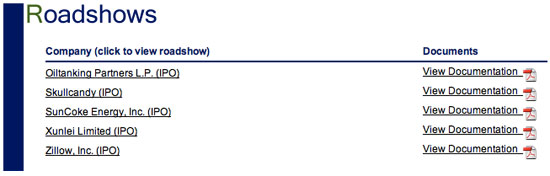
In the last decade-plus, the SEC and other agencies have pushed to bring more transparency to potential investors, who traditionally have had much less access to companies and information than Wall Street insiders. From protective rules such as the Sarbanes-Oxley act, to the public posting of SEC documents online, investors can get a much broader picture than they could not so long ago. But if you're not a Wall Street Insider, it's unlikely you've sat down face to face with the company CEO and CFO and heard them tell you just why they are the best place to put your money. For the last five years or so, I've had RetailRoadshow in my RSS feeds, and get the opportunity to see them pitch, unfiltered.

With interesting Tech or Web companies like Zillow, LivingSocial, Groupon, and others trying their hand at public markets and others like LinkedIn and Tesla Motors having done so in the last year-plus, now's as good a time as any to keep RetailRoadshow bookmarked.

Current Presentations Available on RetailRoadsho

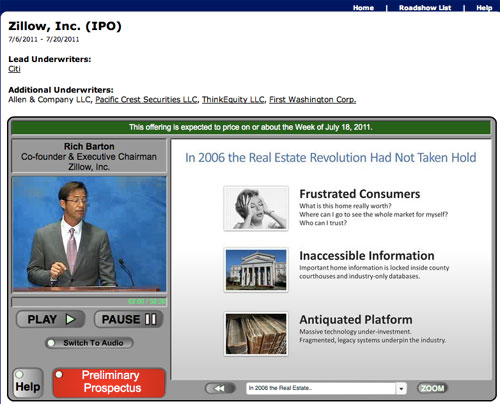
For such a vital service, RetailRoadshow is surprisingly quiet. Their Twitter account hasn't posted since April 2010, only having done so 29 times. If they've got a Facebook page, I don't know about it. But their RSS feed works and their bare bones site works. What the site lacks in visibility it makes up for in unfiltered information. You get the same data as the insiders, as the company's chief executives speak to you - uninterrupted by questions, with the company's prepared deck scrolling alongside. You even hear the mouse clicks as the exec hits the next slide.

Zillow's Co-founder and Executive Chairman Pitching His IPO

Watching presentations such as that from Zillow, LinkedIn, 3Par, FriendFinder and others in the past makes the process of bringing a company public look a lot simpler than it is, of course. Many of the execs don't have top-notch speaking skills, and often, their slides look like they need some retouching by a design guru. The hardest part of the process, typically, is getting the company to the point where they could file anyway, even if you think some of the companies looking to go public really aren't ready, or got their amazingly fast.

As someone who watches the markets like this, I really have just two browser cheats to keep on top of the process - the first being filings at the SEC that contain "S-1" in the title, and the second being RetailRoadshow. But if you do find a company whose pitch you want to see, go fast, because they don't stay live for long.

June 27, 2011

Not All Roads to the Public Markets Are Smooth Ones

Not All Roads to the Public Markets Are Smooth Ones

In Silicon Valley, we fall in love with and memorialize success stories. Leaders of successful companies can be seen as pop culture heroes, and their decisions during times of challenge or opportunity can be told and retold as legend. The first years of companies like Apple, Microsoft, Sun, and Oracle in one era, Netscape and Yahoo! in another, Google and LinkedIn in a third, and in today's evolving present history, including Facebook, Foursquare, Groupon and more, are possibly going to be reviewed and dissected in the same way we look back on innovations from the turn of the 20th century with the assembly line, and the Industrial Revolution in centuries past.

The opportunity to grow fast, get big and get rich drives many people to flock here and try their own hand at catapulting an idea into a passion that could see millions or tens of millions of users. But, if nine of ten startups fail, for every big name I just mentioned, there are carcasses of many others that never make it. And for every rocketship IPO that has people clamoring for updates, there are others that take a longer path. (See all of the S-1 filings on the SEC)

Friday saw the second filing of an S-1 by BlueArc, my employer from early 2001 to Spring of 2009. The company is looking to raise $100 million by entering the public markets on the heels of rising revenue and reduced losses. I know the story well as I helped author the first version of this same document when we filed to go public in 2007 and was there when we withdrew the filing in 2008.

(You can safely assume I own shares, though not a significant number, and it's in my best interest if they do eventually go public. Given the company's sensitive position, I'm reticent to mention particulars, so this article is painted with a broad brush, and is as neutral as possible. Rather than ignore the news, I'm offering the filing as an example of a company that has not seen overnight success.)

The company was founded in the late 1990s, and raised more than $200 million, the most recent round completed last fall. In my time there, we signed some amazing customers, got some powerful OEM and reseller deals, and sold to new territories. We learned where our products were a great fit, and where we had challenges. We hired lots of great people, and saw others struggle. CEOs were changed a few times. We had layoffs a few times. The company and its customers made the front page of trade magazines and the business sections of the New York Times and Wall Street Journal. Other times, rumors flew about the company's viability. At one point, the noise got so bad, a leading industry analyst wrote an entire column about how he'd heard so many rumors on the company, fed by tough competitors, that he recommended anybody hearing such rumors to just ignore them.

The result of a company that has a few years under its belt, with many funding rounds, some happy investors and some unhappy, some happy employees, and some unhappy former employees, is a body of work that tells a story. For financial junkies and tech watchers, or just the curious, poring over the details of BlueArc's S-1 is interesting. There are no funny numbers like those from Groupon, who quite visibly took money off the table for its founders and key employees. There is no meteoric financial windfall like those seen at Google and assumed at Facebook. Just a growing, challenging, business in a tough market that has seen competitors purchased by industry heavyweights for billions of dollars and others, failing, just go out of business or sold for scrap.

While most of the tech press is enamored with consumer Internet plays and mobile apps, the enterprise market has its own unfair share of intrigue - often harder to grok, but just as aggressive. The South Bay especially, the world of Milpitas and San Jose, is dotted with networking firms, semiconductor firms, storage and switching companies in the shadows of NetApp and Cisco. Having lived that world for most of the last decade, coming from the position of a challenger with unique technology, I'm hoping that the colleagues of mine still at the company find a positive exit for the decade-plus some have put into the effort, or lesser tenures for the more recent arrivals. But for those of us who seem to have attention deficit disorder when it comes to watching companies start and flourish, or to our own job-hopping resumes, this is an interesting case study of one company that didn't take the easy route.

Disclosures: I was employed in the Marketing department at BlueArc from 2001 to 2009 and own a small amount of the company's common stock.

November 25, 2010

Less Informed Analysts Don't Serve the Public Good

Less Informed Analysts Don't Serve the Public Good

In the wake of the first dot com boom and subsequent crash, regulation swept through the financial industry, pushing a wedge between those who rated stocks and those who backed them, buckling down on insider information and weeding out a visible few who had not exactly acted with their clients' best interests in mind. With public trust in corporations further declining in the following few years with high-profile scams led by Enron, Worldcom and others, the federal government has played an increased role in watching what businesses can say at which times, both publicly and privately. What is released from companies now comes with lengthy SEC disclosures, authors routinely disclose their stock positions, and Sarbanes-Oxley compliance puts fear into the hearts of public and would-be public companies, to follow the rules - or else.

With this background came news earlier in the week that the SEC was looking into Apple stock analysts who had relied on connections with suppliers and manufacturers in the channel to help predict the company's sales projections. This broader definition of insider trading, if it becomes commonplace, nullifies some advantage and insight the analysts had, and reduces their value to customers.

While most of the SECs' moves in the last decade can be easily tracked to protecting investors from scams, conflicts of interest and pyramid schemes, I have to wonder what this type of move signals. Is the eventual goal to eliminate any real research and intelligence used in the community to level the playing field and make the professional analyst game one that more heavily relies on a gut feel and chart reading? Neither is an exact science.

Assuming the new guide to insider trading is to be adopted, the suggestion essentially means that financial analysts should not be briefed by company employees during the quarter, should not survey those selling the products, their partners or maybe even the customers themselves. The rarified times an analyst can talk with the execs would be limited to the short conference call Q&A periods that occur after each briefing. This would make the already imperfect industry one further removed from real data. Anybody can count numbers after they have been released, but few have proven true abilities to accurately guess a company's direction - and provide real data to customers who don't exactly do this for a living.

What I worry about is not that Apple investors (or others like them) are suddenly going to be in the dark because 1 or 2 guys get slapped on the wrist for chatting up resellers. What this leads to is a company running unchecked with no communication to the outside world, except for every 90 days when they emerge from their corporate offices and tell you how they actually did.

What we need as investors and market watchers is not less access to real data, but more access to information, which we can then use to make good decisions, or bad, based on what we know. There are already enough people out there guessing and writing and throwing stuff on the wall to see what sticks. This just will make it worse.

March 27, 2009

Rackspace Stock Undergoes the Scoble Effect Following Robert's Hire

Rackspace Stock Undergoes the Scoble Effect Following Robert's Hire

In the two weeks following Robert Scoble's official announcement that he was to be joining Rackspace, Inc. and embarking on a new project called Building 43, the company's stock has jumped by more than 30 percent, rising at a pace three times that of the NASDAQ, as the broader market tries to recover from a horrific year. And while yes, the argument should be made the two are not connected, the rise in the company's stock has added approximately $300 million to Rackspace's market cap. If Robert were responsible for even 1% of the jump, he would already have delivered $3 million of net value to the company.


Rackspace's 2-week Rise Has Been Impressive

While Scoble hasn't been blogging as much as he used to, in his most-impactful years, simply getting linked to would deliver what smaller bloggers called "The Scoble Effect", as new visitors to the site could dramatically outnumber their regulars. And it's fun to think just maybe he can do the same for the Web hosting firm.

At the close of trading on Friday, March 13th, the last day before Scoble's news was unveiled, Rackspace stock closed at $5.98 a share. At the end of trading today, the shares closed at $7.81 apiece, a move up of 30.6% in two weeks. In fact, according to Google Finance, Rackspace stock has been up on 8 of the 10 trading days following his announcement.


Meanwhile, Microsoft Has Been Slowly Sinking

In contrast, Microsoft, the last public company where Scoble worked, having left their offices in June of 2006, has seen their stock decline more than 15 percent since he left. Of course, so has just about everyone else...

March 21, 2009

Did eTrade Blow It By Making Their Mobile App A BlackBerry Exclusive?

Did eTrade Blow It By Making Their Mobile App A BlackBerry Exclusive?

As Apple's iTunes application store continues to grow, it is becoming an increasing rarity to find needs unmet by the company or its wide array of third party developers. But one clear vacancy is in the real-time stock information and trading department. I've been waiting for eTrade, my broker of choice, to develop an application for the iPhone for quite some time, but the company hasn't publicly made any strides to meet my needs. In fact, after rolling out a specialized application for the BlackBerry platform in June of 2008, we've had nine months of silence, and I'm left to believe the company is sticking with Research In Motion as their partner for the long haul.

The stereotypical image one has of today's Wall Street movers and shakers has evolved beyond the neatly pressed suits and ties, and sharp shoes, to include a hyper-obsessed BlackBerry addict, who can't look up in fear of missing an e-mail. But beyond the trading floor, consumers far from New York and other bustling metropolises are making updates to their portfolios - even in times of recession. And what eTrade has done by partnering up exclusively with BlackBerry on the mobile side is shut out the very real growing population who have selected other platforms, be they the iPhone, Google's Android, or even the Palm Pre.


eTrade Highlights Its Exclusive BlackBerry Deal

Today, using eTrade on the iPhone is barely passable. One simply has to log in through the standard Safari browser and use the non-optimized interface. It's good enough to get a near real-time update for portfolio holdings and balances, but too limiting to do much else. I'm certainly not using the Web site on the iPhone for researching stocks, reading news, making trades or seeing real-time updates.

I'm not saying the iPhone will kill the BlackBerry and render eTrade's move an abject failure, but even with BlackBerry's latest models, they don't seem to have the inside track on growth and innovation. They seem to have lost the swagger that made them a market leader for the last five or so years, while Apple and Google (to a lesser extent) have taken their place.

The iPhone is growing up to the point it's not just a game platform or a music device. I use the Mint.com application to see my up to date financial numbers, aggregated from many accounts. And Apple helpfully offers a basic stock price app. But they're no substitute for real trading.

An eTrade application for the iPhone should include:
  • Real-time stock quotes
  • Porfolio updates including gains and losses or trends
  • Stock trading
  • Company news and information
  • Market overviews
For a company like eTrade, which is so broad in terms of its reach to consumers, to limit itself to a single mobile platform, especially one that seems to be on its way to being eclipsed by more nimble competitors, seems wrong. As an eTrade customer, I know I would use this application, and regardless the cost for it to be developed, eTrade would make up the amount in very little time, from the hordes of iPhone users who could start making trades on the go, from anywhere.

eTrade, your own stock is barely over a buck. I know you have other issues on your mind. But every day that goes by where I don't have an eTrade application on my iPhone means less revenue for you. Call BlackBerry up and tell them you want to see other people.

February 20, 2009

Which Companies Will Blink First and Lead Us Out of The Depths?

Which Companies Will Blink First and Lead Us Out of The Depths?


Graphic via Dreamstime.com

One of the scariest things about the type of economic slowdown we are in today is that it breeds yet more slowdown. If you see the headlines, you can read that as companies anticipate lower revenues and diminished profits, or expanded losses, they are turning to layoffs, and in parallel, reducing their own spending, from program and infrastructure costs, to employee costs. Just this week, for example, HP announced 5 percent pay cuts for its massive salaried employee base, across the board, and the Mercury News reports more than 100 public companies in all industries have reported executive pay cuts since the recession began.

While this helps the company in the immediate term, the ripple effects downstream are quantifiable - which, in my opinion, could make the problems worse.

Assuming lower revenues is one thing. Lowering spending costs impacts all the company's vendors, in reducing their own revenues, spreading the pain around. And of course, reducing the number of paid employees, and reducing the pay to those employees who are left, impacts them such that they are less willing to spend.

It's a high-stakes game of chicken, for if companies expect the market to turn around, and want dollars to flow again, they have to contribute to the economy themselves, and all actions we have recently seen in the press point to companies simply trying to survive what for many is the deepest downturn in memory. But there cannot be survival if every company reduces its spend so that every company downstream, and its employees, fails as well.

During the 2001 to 2003 recession, there were a few bright spots of hope and prosperity here in the Valley, from Google, who rocketed to market-share nirvana in the face of strong competition, to Apple, who rebuilt themselves from a PC company to one built around electronic gadgets and digital sales, following the introduction of the iPod in 2001, and later, the iTunes Music Store, in 2003.

Also during the 2001 to 2003 downturn, government leaders told consumers that the patriotic thing to do would be to open up their wallets and shop - to help keep the economy humming - even as spirits were broken. Of course, the resulting debts and the issues that surround people spending above their means were main contributors to the stark realities we see today, from credit crunches to home foreclosures. But this time, consumers have (hopefully) wisened up, and they are likely more reluctant to spend their way out of this deep recession, especially if they are one of the unfortunate millions who are drawing unemployment benefits or see their bi-weekly paystub reduced.

On this blog, many of the companies and services we talk about have very little to do with capital creation and distribution. Some of the products are fun widgets or sites that enable people to connect in new ways, not so much finding new places to spend money or even have revenue themselves. We recognize that - and hold to the line that for the most part, this blog caters toward early adopters, and it is not necessarily our role to gauge every company's business acumen and prospects - best left to others. But surrounding those people are real businesses with real, tangible products and a real-life balance sheet - and many entrepreneurs and fellow bloggers work for these companies that have been impacted - including some of my peers who write on this site.

Silicon Valley is not immune to this financial crisis. Companies big and small have reduced forecasts and results. Companies big and small have reduced headcount, and many more have reduced their operating expenses, without drawing headlines. Down the food chain, many start-ups have found the VC well to be dry, and will either be shutting down or changing their prospects. But as 90 percent of start-ups fail, this shakeout could violently separate the good ideas from the bad - faster than they had ever desired.

So as practically every business has reacted to the downturn and closed the spigot on spending, which ones will be the first to reverse the trend and say, 'Enough!', instead, taking advantage of competitive weaknesses to seize market share, and approach a more-wary consumer base? We can't sit on our hands and expect Google and Apple to be the names that rise to the top again.

February 11, 2009

Sirius Radio Now Looks Like an Outer Space WebVan

Sirius Radio Now Looks Like an Outer Space WebVan


WebVan's debut in the 1990s as a way to order groceries online and have them shipped to your home or business sounded like a fantastic way to leverage the power of the Web. But as we all know now, the costs of deploying expensive, expansive warehouses in many metropolitan areas, not to mention the costs of delivery and promotion, were way beyond what was sustainable. Hundreds of millions of dollars in venture capital, not to mention stock holders after the firm went public, went up in smoke, as the company spiraled into bankruptcy.

The idea may have been ahead of its time or just poorly implemented, but it stands as a tragic example of where hope came ahead of logic. And now we're seeing it again - with all the news around Sirius XM Radio's potentially filing for bankruptcy, after the struggling satellite radio company found that slowed growth in the face of lower native car installations, competition from iPod/iTunes/iPhone, and the inability to pay massive accumulated debt, have combined to make the current plan unsustainable.

And again we have what looked like a very cool idea, costing billions of dollars to deploy, on the brink of failure. And again, we see shareholders who believed in the idea, ahead of the reality, getting wiped out. In what's already been a horrific last year for the stock market, Sirius' freefall has been notable - especially considering it's not involved in banking or real estate.

A few months ago, in a podcast with Wayne Sutton and Kipp Bodnar, I said we "knew" Sirius would pull through because it had a compelling offering, and that threats to its business were overblown. Boy, was I wrong. I may have been looking forward to getting Sirius Radio with my next car, whenever that happened, but it doesn't look like that's going to happen any sooner than my dialing up WebVan for some eggs and milk.

December 31, 2008

I Didn't Hold an End of Year Stock Sale in 2008

I Didn't Hold an End of Year Stock Sale in 2008

In January, amid some scorn, I admitted one of my yearly traditions has been to zero out my stock holdings in eTrade at the end of the calendar year, primarily to simplify that April's tax returns. Not having to span investment holdings over multiple years makes tabulating my profits or loss the following year that much easier, and also gives me a chance come January to start over with stocks I believe are primed for a big year. (See: My Empty Stock Drawer)

But as has been mentioned here several times, and in every media you prefer to consume, 2008 has been very, very different, and I just couldn't stomach the idea of selling some of the stocks I own at their near-historic lows this time around. While I certainly could use the write-off, instead of clearing the deck as 2008 comes to a close, I am standing pat. Part of me says it's because I'm sure these stocks will eventually rebound, and another part admits it is pure numbness and potentially the equivalent of being in shock. Maybe instead it's post-traumatic stress syndrome.

Of course, holding on to stocks this low doesn't guarantee they won't go even lower. If you had asked me 30, 60 or 90 days ago about some stocks, I'd have remarked they couldn't possibly dip further. But nobody is an expert when it comes to what we are seeing in the financial markets today, and I don't claim to be one at all. I am even lowering my own expectations.

2008 broke a tradition of the financial markets practically making sense, and we're breaking our own tradition as well. We're either going to have a nice bounce in 2009, or we're going down with the ship.

December 17, 2008

Fidelity Puts Lipstick On My Investment Pigs

Fidelity Puts Lipstick On My Investment Pigs

Given the stock market's nonsense, it's a rare person who is happy with their 401k's performance, and I'm no exception. While my return has increased a good 10 percent or so from hitting bottom about a month ago, every dollar put into my Fidelity fund through the year has essentially been turned into sixty cents. With Americans feeling the pinch and looking to preserve cash and stay conservative, Fidelity e-mailed today to say they're changing the name of some of the funds I've been part of. The main change? Removing the word "Aggressive".

As the screenshot below shows, Fidelity is changing the "Fidelity Aggressive International Fund" to "Fidelity International Capital Appreciation Fund" and the "Fidelity Aggressive Growth Fund" to "Fidelity Growth Strategies Fund".


The reason, they write in an e-mail is to "create more consistency across the equity fund product line" although no changes are expected in the funds' objectives, strategy or management, an odd note, considering the Aggressive Growth Fund is down 43.85% this year, and the Aggressive International Fund is down a similar amount.

So... should I feel my money is safer, now that the word "Aggressive" has been replaced with "Capital Appreciation" and "Strategies"? I'm just hoping this isn't the first step, leading from "Aggressive" to "Capital Appreciation" to "Maintaining" to "Losing Slightly" to "Bankruptcy Quickening".

Thanks Fidelity! Good to know my money, or what's left of it, is safe and secure.