Silicon Valley Technology Commentary & Archives · Est. 2006 3,045 Posts · 2006–2026

February 14, 2011

February 14, 2011 · 2 MIN READ · BY LOUIS GRAY

Cooliris Launches Group Photo Sharing, Raises $9.6M

Cooliris Launches Group Photo Sharing, Raises $9.6M

The convergence of two major trends in the world of social - intimate hand-selected social networks and mobile photo sharing have converged on Cooliris, the Palo Alto-based company best known for its 3D Wall application, and the geniuses behind my personal favorite Gallery application for Android. In the crosshairs of this intersection, the company today is announcing LiveShare 1.2, a new group sharing photo stream service, and in parallel, the addition of nearly $10 million in series C funding from existing investors, including Silicon Valley legend Kleiner Perkins Caufield & Byers.

In the same frothy environment that has pushed peers like Instagram, Path and PicPlz to significant levels of visibility and in some cases valuation, Cooliris has delivered an application that lets users create photo streams on the fly, share them with any number of friends, including the option to make them fully public, and enable others to take action on your photos.

   
Starting With LiveShare, Creating a Stream and Adding Friends


While there are dozens of photo sites and applications out there, I've long felt a big gap has not been met in unifying the ability to support groups and events for shared experiences. If one has a hashtag at an event where everybody, including strangers, can participate, then why not also deliver a shared photo stream for all who took place in an event? Cooliris' new LiveShare capabiltiies make this a reality as you can view public streams, search for stream titles, or ingeniously scan your local area for streams nearby.


This Social Media Panel Photo Stream Has Multiple Contributors


Even if you are starting cold on LiveShare, the application asks you to select whether you want to see pubic streams from Music, Sports, Film, Festival or Nightlife. Select all of them to get the entire gamut of updates from friends and strangers in your area. Find a stream nearby, and you can give the location a tap to reveal photos in that stream, complete with relative time of the pictures to show recency.


Checking Cooliris Streams Nearby and Setting Filters


Unsurprisingly, LiveShare brings with it a like feature, as do most top social apps these days. Spot photos in your friends' streams or public streams that catch your eye? Simply hit the Thumbs Up button and provide positive feedback. Alternatively, you can share the item or flag it for being inappropriate - standard moderation tools for apps of this type.


Checking Out Public Streams and Liking Cool Photos


The most powerful delivery from the application isn't the fun stuff, like the fancy geolocation features and sharp photo quality, but instead that core value of multiple people posting to the same stream. Instead of having to wade through many different friends' streams to find all the photos of an event, all the friends can share to the same event, and retain record of authorship, so you don't have to worry you're giving away your art.

The $9.6 million in series C funding follows $15.5 million in series B funding from April of 2009 and $3 million in series A funding back in July of 2007, according to CrunchBase. In aggregate, the company has raised just over $28 million.

February 13, 2011

February 13, 2011 · 4 MIN READ · BY LOUIS GRAY

XYDO Preparing Personalized News Hub With Quora Flavor

XYDO Preparing Personalized News Hub With Quora Flavor

Continuing the mantra that the third wave of the Web is one of personalized news, streams and social experiences, XYDO is on the verge of launching what they call a personalized news network that claims to show you only the news you find interesting from all the friends and people you follow across the social Web. XYDO claims to learn what you like, and feels a lot like an intelligent mix between Digg and Quora, tapping into your social graph to discover the most frequently shared articles, spotting trending topics, and presenting the opportunity to follow subjects, sites and users.

Founded by Eric Roach (@veroach) and Cameron Brain (@cameronbrain), the app pulls links shared from your Twitter, automatically assigns the links categories (much like Socialmedian once did), and tabulates shares from your network to assign a point value which brings items to the top. But more than a simple share counter, XYDO starts you off with asking for you to select the topics you want to follow and avoiding those you don't. Want to follow Apple but not Android, or want to stay on top of Entertainment News, but care less about World News? XYDO will make that process pretty easy.

Personalized News Promised from XYDO

What you select as your favorite subjects, in addition to the people you follow, becomes what XYDO calls "Your Activity Stream". This differs from the top level XYDO network, which highlights activity across the entire site. Both streams are cut by three sections, including "Trending", "Newest", and the "Top in 24 hours", all self-explanatory and familiar to Digg and Twitter users.

Setting Up XYDO With News I Want to Follow

Where XYDO gets more interesting than simply yet another top news site is in the details around each ingested item. You can vote specific shares up or down (like on Digg and the since-retired Ballhype sites), you can see what topics each item is slugged with, see who shared an item, and you can even Discuss items within XYDO itself. Each item becomes a potential conversation platform, pulling in the full RSS feed and adding the option to have a siloed comment exchange - a practice which set the blog world ablaze back in 2008, but is practically accepted as standard practice by now.

Top Trending Tech News on XYDO

The site starts to feel like Quora in a few ways in that after a few clicks, you could find yourself deeper and deeper into XYDO that you may never get out. Clicking on one story (such as GigaOM's coverage of Uber getting VC money) leads to more stories on Gadgets, Silicon Valley, Technology and Business. Related articles span the right column on the page, as do the ubiquitous share buttons that allow for sending the item to Facebook, Twitter and other users' in boxes. Of course, from the Gadgets and Personal Technology Page, you can follow this item in XYDO, catch the RSS, and in extreme Quora-like fashion, every single topic features an equivalent Twitter account for tending updates, just like Quora did for top questions and answers. But instead of the q_ prefix, XYDO prefers x_, such as @x_gadgets and @x_techcrunch.

Top Items from Gadgets on XYDO In the Last Day

For each topic, one finds top recommenders of content and contributing sources. Feel strongly enough and you can add new sources to topics you follow as well. Xydo also offers a multi-faceted search engine that crawls subjects, connections and articles for keywords.

Leaving a Comment on One XYDO Article

A Single Share on XYDO With the Original Share and Total Points

Assuming XYDO can accurately and consistently deliver topical content on news I care about, filtered and ranked by my social graph, they've got a strong offering on their hands. Early use, even now that the site is in private beta, shows a high level of signal versus noise, especially after selecting more keywords and connections, while avoiding others. But the service isn't perfectly social. While Quora is social at its core, based on personal answers to topics, news runs the day at XYDO and people are on the periphery. I may find we share interests and you've voted up topics I like. We may even exchange comments on a shared article in the site, but bumping into you seems tangential to the service more than its core offering.

XYDO may be in private beta now, but they swear they are letting in new people every week. Existing users, such as myself, can also invite you. So if you want an invite, let me know in the comments, and I will dish out as many as I can find. You can find me here: http://www.xydo.com/users/978.

Disclosure: Theoretically, my6sense, where I am VP of Marketing, is in the personalized news game, which I should note. Our approach to determining personalization and product deliverables vary greatly from XYDO, however.
February 13, 2011 · 4 MIN READ · BY LOUIS GRAY

Kinoma to Bring Sleek App UI to Smartphones and Beyond

Kinoma to Bring Sleek App UI to Smartphones and Beyond

Near the end of 2010, Marvell Electronics, the San Jose-based silicon manufacturing firm, quietly made an acquisition of a software company called Kinoma, making mobile media browsers and other software for smartphones on Windows Mobile and Palm. This odd couple of sorts has pulled away the curtain today at the Mobile World Congress in Barcelona, Spain, promising to bring a new, elegant software platform for practically any digital device, designed for the new world of touch interfaces, bringing simplicity out of the domain of geeks, but all the way down to embedded devices. The idea? That Marvell ships a ton of silicon - billions of dollars a year worth, leveraging ARM processors that promise high performance and thrifty power consumption... but that don't have a strong UI to match. Kinoma now has a practically infinite playground, to take one of the slickest touch-based interfaces I've ever seen, pointing it first at smartphone and tablets, and later, taking it downmarket to practically every screen you've seen that begs for an overhaul.

The pedigree of the Kinoma team is a lofty one, filled with names you probably don't recognize, but whose products you use often. Peter Hoddie, who cofounded Kinoma in 2002, and is now VP of the Kinoma Platform at Marvell, spent nearly a decade at Apple working on the Quicktime platform. Brian Friedkin and Michael Kellner, also cofounders, similarly hailed from Apple, working with QuickTime and the development authoring platform Carbon.

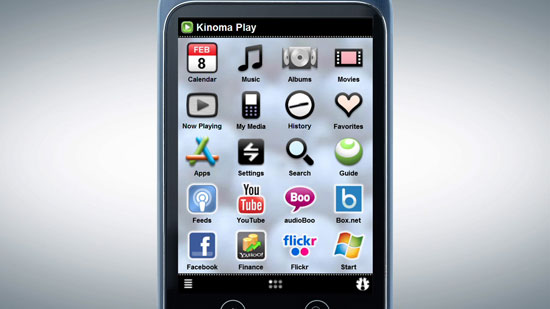
Kinoma Play - the First Kinoma App

The trio's time at Apple delivered two primary focuses evident in today's unveiled product - a focus on multimedia, and a top quality user experience. That they spent years coding for underpowered computers also prepares them well for a world of feature phones and embedded devices in line for a UX fix. Last week, I sat down with Peter for a demo of the new Kinoma interface, and to talk about his vision for a world of proliferating devices. His story was one of applications that could speak to one another, actions that took a single click instead of multiple commands, and delivering resources to developers who want to leverage a consistent user experience.

The initial offering, called Kinoma Play, is essentially a new smartphone launcher that starts with 40 native applications, from social media to location and search. Kinoma's underlying foundation will be open sourced, and Marvell can then focus on optimizing the software layer for the company's chipsets.

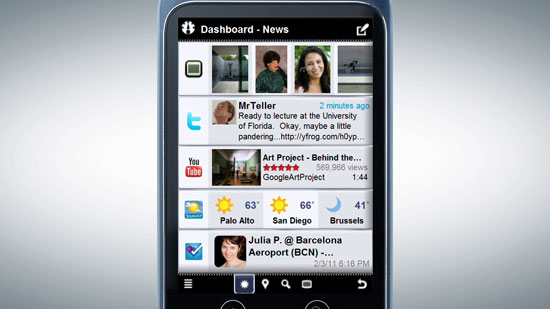
The Kinoma Dashboard in Action

"What we can do as part of Marvell is bring sophistication from the smartphone market down to embedded devices," Hoddie told me. "Think of it as an evolution. There were computers which became phones, and we adapted. Some of these lower end devices are stretching it another direction. Bringing a great user experience to these devices is a big deal."

Unlike many software manufacturers, whose hardware demands continue to increase with seeming incremental solutions, Kinoma's expectation is to run with small amount of code for even the simplest of devices - and the the product's SDK is intended to make new platforms accessible to a broader audience than has typically been available from offerings such as Android and iOS, which require languages like Java and Objective C.

The Kinoma interface is incredibly sleek, centered around a new experience called a Dashboard, which brings features and events from an application to a single place, described as being both "infinite" and "self-organizing". There is even an application called History which shows all activity across all applications in a single place.

"The whole experience becomes the baseline for people to build on top of," said Hoddie. "Apple brings design to the party, but makes it challenging for people to achieve to their level. Google brings an open platform, but not the thoughtfulness to user experience. We are the right solution at the right point in time that the market needs right now. Smartphones and tablets aren't the only game in town."

One of the more intriguing aspects of Kinoma is the capability for applications to interact and link to one another, rather than their trying to do all tasks or being solely limited. While they can speak to one another, Kinoma acts as the glue to bring a consistency in the operating system and applications. One can see the Kinoma launcher sitting atop Android phones and Windows 7 phones or other smartphones in the future, even as the smart UI travels downstream to devices most of us might not use every day.

So why Marvell? Kinoma's no babe in the woods, with 8 years of history, and they recognized they needed a big partner to provide the business muscle, developer resources and OEM relationships to gain serious traction.

"As a small company, we could be innovative and controlled our own destiny, but it wasn't enough to be small and clever," Hoddie said. "We were going to need more resources. In parallel, Marvell was seeing how important software was to what they were doing. Being close to the hardware is important, but also getting closer to the ecosystem, which will be a huge deal for Marvell and lift the entire industry."

Kinoma goes live at the Mobile World Congress in Barcelona today, and it won't be long until you can try out their unique interface on smartphones near you.

February 12, 2011

February 12, 2011 · 5 MIN READ · BY LOUIS GRAY

The Story of TweetDeck's Rise from Obscurity to a Rumored Sale for ~$30 Million In Less than 1,000 Days

The Story of TweetDeck's Rise from Obscurity to a Rumored Sale for ~$30 Million In Less than 1,000 Days

The launch and resulting success of TweetDeck starting in the summer of 2008 surprised everyone, including the application's founder, Iain Dodsworth, who is reported tonight to be selling the product to Ubermedia for as much as $30 million - culminating a two and a half year journey from complete obscurity to a position where his product is recognized as one of the most innovative social and communication dashboards on the Web - the standard tool used from casual users to businesses and newsrooms alike. Time from the product reaching the public consciousness on July 4, 2008 and getting close to a sale on February 11, 2011 is 952 days - nearly 1,000 days of dedicated development, with practically one-fifth of the world's tweets flowing through his application, from the desktop to mobile devices to the Chrome Web browser.

Iain, in an interview with me back in 2009 referred to the first day, launch day, as "one of shock and extreme excitement," the result of his finding Twitter "a bit overwhelming" after following about 50 people. Unsatisfied with the current offerings, he set about making his own client.

As long-time blog readers know (and may remember), our paths crossed when Iain neared release of the first version, and the first product, something new the world had never seen, was covered here. I remember Iain's real fear that the first beta version would not be good enough, combined with a hope that initial press would make it visible. On July 3, 2008, he sent me an e-mail, saying:
"I am furiously coding away getting the next version out there (a real improvement on the current version). Since you are the highest profile person who has seen TweetDeck it would be great to capitalize on your visibility (if that's ok with you) so please DO blog on it with the URL possibly making the point that its very early beta and a new version is due very soon..." adding "Really appreciate any push you can give it."
The next day after trying to summarize this new product in a way that clearly described its potential, I put up a post covering it as a new AIR app with integrated search and groups. From there, the word spread like wildfire. By mid-day on July 4th, TweetDeck had managed the 6th highest Trending Topic on Summize (prior to Twitter's acquisition), behind Obama. I e-mailed Iain, and he responded quickly, "Oh cool! I've taken a screen grab :-)".

My Short e-mail to Iain with a Screenshot on 7/4/08

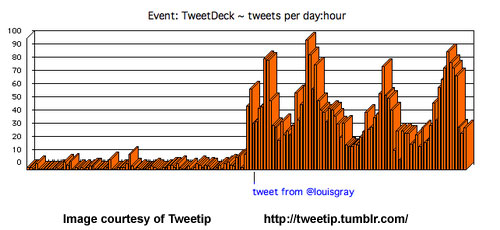
Seemingly innocent times. There's no question he probably didn't foresee what was to eventually happen, even after continued excitement around the app made it clear he'd hit a nerve just under two weeks later, when the spike in activity was highlighted by a since-defunct Tumblr site called Tweetip. Only a few weeks later, Iain wrote me to say he wanted to "make TweetDeck something quite spectacular," suggesting while looking for Angel investment, he was considering a "Pro" version of the app to sell for "a nominal amount." I am sure my answers weren't too helpful, but he forged forward.

TweetDeck's Jump As Noted by Tweetip on 7/14/08

Then came the hard work of adding more features, scaling to meet demand and finding a way to work within what at the time was a flaky service, Twitter, which struggled with API issues, downtime and frequent inconsistencies. Iain forged forward, responsible for about 4-6% of all tweets within 5 months and gaining funding in January of 2009 and becoming the desktop standard against Twitter's Web client.


I speak with Iain in December of 2009 at LeWeb


By February of 2009, TweetDeck went global, adding translations, tweets by e-mail and integrated StockTwits. As Iain's product was still relatively small, he was kind enough to offer an exclusive video demo featured in this post where he showed the new features to the blog's readers. I still remember sitting in an airport coming back from a trade show, sending him a note, and getting this video back, where he answered my questions personally in less than an hour. Even to a real-time geek like me, that was very cool. Later, TweetDeck expanded beyond Twitter, with support for Facebook and MySpace later in 2009, promising the addition of Twitter lists integration, and later expanding the vision to become the client for all streams from any source, which led to a B round of $3 million.

By this time, TweetDeck was clearly a big deal. Despite serious competition from Seesmic and others, and a parallel acquisition of Tweetie by Twitter, TweetDeck had become a serious company with big aspirations - beyond the scrappy individual who could lob e-mails to me overnight and work with my little eponymous blog to get coverage. This I welcome, of course. For all the fun of owning a story, I'd rather see the little guys graduate to be household names, and TweetDeck seemingly pulled it off. It's probable that an exit to UberMedia isn't something that kids dream about, but an 8 to 10x return on investment for VCs is a win, and Iain went from being a single guy staring excitedly at his laptop on a big first day to someone who has his finger on the pulse of the real-time Web, the move to a world of pages to a world of streams, and no doubt can afford some luxuries today that he couldn't yesterday.

For those entrepreneurs looking to get rich quick, you had better believe this is hard work. Iain once e-mailed me to say he was doing 16 hour days, 7 days a week, coding. And nearly three years is a long time to do that. It's not a 20-year career pushing papers in an anonymous cubicle, but it's attention to detail, differentiation and quality that made TweetDeck the best at what they do. I haven't asked Iain for a hint to the future, and didn't approach UberMedia for their plans either, but let's put TweetDeck next to SocialMedian and others who got their start here, and whose founders are now quite financially well off. Very exciting. Can't wait to see who is next.