Silicon Valley Technology Commentary & Archives · Est. 2006 3,045 Posts · 2006–2026

February 20, 2011

February 20, 2011 · 3 MIN READ · BY LOUIS GRAY

NPR Features News Acceleration, Our Ability to Consume It

NPR Features News Acceleration, Our Ability to Consume It

Yesterday NPR Reporter Linton Weeks posted a interesting observational piece on the accelerating pace of news, from its discovery to a reaction - spurred forward not just by the 24 hour broadcast networks, but the parallel growth of social media, which sometimes plays the role of news starter, news observer or news distributor. (See: Media Black Hole: So Much News That We'll Implode?) His example of a congressman who resigned due to scandal before the public had even been aware of the scandal was an interesting one, not necessarily indicative of the trend, but smart politicking. That said, he correctly notes the trend of all these publishing places to be first, fastest and continuously on - often at the expense of quality and the viewers' ability to understand what has transpired.

Included in the piece were some comments from me, where I echoed some of my thoughts over the years on this blog and elsewhere, that people are choosing to select a few preferred sources over others to filter the news on their behalf, and often, they are checking out of the need to be fully informed and understand the facts behind the spin. It's a lot easier to turn off CNN and go play FarmVille, or to have Glenn Beck tell you the evils of Obama's legislation than to read it yourself, after all.

(See Also: from 2006 Blogging Bifurcation - A Web Divided)

This discussion plays well into the often-discussed debate of information overload or filter failure. As I share often when talking with partners of my6sense, quality of conversations on blogs and comments have decreased in exchange for lightweight tokens of appreciation - including retweets and likes. People move fast because they can, first of all, and second, because they fear they don't have the time to do more - that something else interesting is behind the next link, tweet or email.

Linton also asked me a different question, which wasn't carried in the piece. He asked:
"Will there come a time when we will want processors to do something slower – or at least appear to do something slower?"
To this, I said no. The solution is to not slow down the pace of media or our ability to consume it. The solution is instead, as I've often said,
"To help surface the best stuff for you as an individual, personalized based on your interests - so you see the best from all your streams and can skip the rest. A slow computer is the opposite of what we need. We need fast interpretation of streams and ranking."
Personalization based on one's interests doesn't mean buying into an echo chamber effect, but skimming off the noise that's unrelated. Smart systems will still find you trending news that you must see, even if you haven't given explicit signals of interest. But the way to survive in the world of faster distribution and decision making is to avoid getting caught in time-wasting triviality.

The news is faster. The ability to exist in an accelerated world, in my view, is as important or critical for the world of the future human as typing skills. If the data deluge is slowing you down, you need better tools or a new agenda.

Disclosure: I am VP of Marketing at my6sense, which makes tools to personalize the new world of streams.

February 20, 2011 · 2 MIN READ · BY LOUIS GRAY

Redfin Captures Real Estate Cold Snap With Local Stats

Redfin Captures Real Estate Cold Snap With Local Stats

I've long praised the value of Redfin for tracking the ups and downs of the real estate market. I named the site my number one Web service of 2010, after telling you how it did so well for us that we practically single-sourced our home search last Spring and Summer on the site. Even after our home purchase, I've kept frequent watch on Redfin, and they're showing home sales dropping and prices falling in a cold winter market.
But they take the trend beyond that of a gut feeling, now offering users the option to dive deep into local trends, by zip code, to see trends, recent sales, and even give tips on whether you should wait a few months for the price to drop.

Redfin Shows Weak Winter Market for Local Sales

Watching my own home, just in the last month, the price has dropped by about $30k (according to Zillow). For the 30-year mortgage owner, this shouldn't be a big deal, but it's indicative of what's happened in our particular part of the Bay Area. Redfin said January was chilly for both sellers and buyers, as activity was on pause before the usual seasonal ramp-up for spring and a busy summer. But they insightfully noted price drops on the West Coast with other parts of the country being "mixed." It's no wonder my nightly emails from Redfin on sales haven't filled me with good thoughts of late.

Browsing Redfin By Zip Code Provides Significant Detail

As a new feature to their standard map search, Redfin now offers statistics by zip code, anywhere they operate. For example, if you try Mountain View (94303) or Belmont (94002), you can scan market activity for the area, including:
  • New Homes for Sale
  • Upcoming Open Houses
  • Price Reduced
  • Recently Sold
  • Most Expensive
  • Least Expensive
  • Most Popular
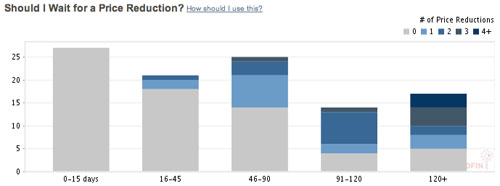
Just below this array of information, one finds graphs of market trends, including price per square foot, sale to list percentage (indicating whether a neighborhood is hot or cold), the number for sale and the number sold, by zip code. Unsurprisingly, given the chilling winter market, data in my area shows sales below list across the board, combined with a lower number of sales than any other point in the year.

Redfin Shows Data on Price Reductions Over Time

As more communities become supported by Redfin and the company starts to follow and aggregate more statistics, there becomes real potential for the site to act as a data-rich barometer for a critical part of the economy. For every Web wonk professing a "bubble" and an imminent crash, it's clear that the financial world has a lot more work to do. Redfin's seeing the way it really is, down to your zip code. Try yours.

February 18, 2011

February 18, 2011 · 3 MIN READ · BY LOUIS GRAY

The Curious Myth of the Tablet Operating System

The Curious Myth of the Tablet Operating System

iOS Unifies for Tablets and Phones, While Android Splits and Regroups

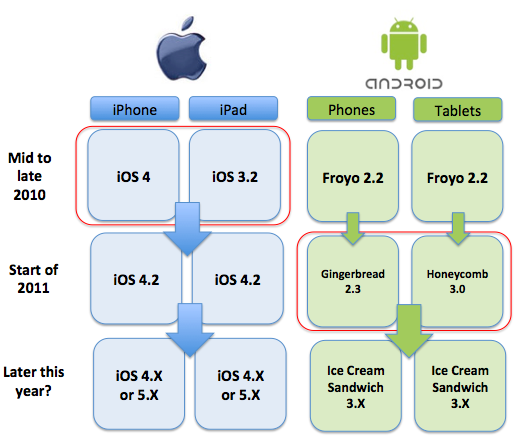
Now that Honeycomb (Android 3.0) has been unveiled, native on the Motorola XOOM, and recently announced new Samsung Galaxy Tab 10.1, Android users are at a proverbial fork in the road - with Froyo and Gingerbread (2.2 and 2.3 respectively) being the shipping mobile OS for handsets and Honeycomb the approved OS for tablets. It's a fork in the development plan that looks like it's temporary, with rumors already out there that the next version of Android, said to be called Ice Cream Sandwich, will unify the two versions, once again giving users a single OS build to choose from. Confused yet? Well, you wouldn't need to be if Google hadn't unfortunately called its 2.2 offering, Froyo, unready and not optimized for the tablet market. In doing so, it set expectations for users and developers of a split in the OS, and gave undue ammunition to rival Apple, who frolicked in the gap when reporting sky-high iPad sales.

Despite Google's warnings that Froyo was not designed with tablets in mind, Samsung sold millions of 7-inch Galaxy Tabs to consumers, while Barnes and Noble set sales records for its NOOKColor, similarly built on the 2.x OS line, and other manufacturers tried their hand at the growing Android tablet market. As a user, I've been very pleased with both the Galaxy Tab and NOOKColor, which feel as natural as a large Android phone, and have significant parallels to the way the iPad felt after years with iPod Touch and iPhone.

From the demos and reports of Honeycomb's new UI, the upgrade looks very impressive. But if major steps were taken with Android to make it a superior tablet experience, then why the plan to unify the tablet and phone experience again - a la iOS?


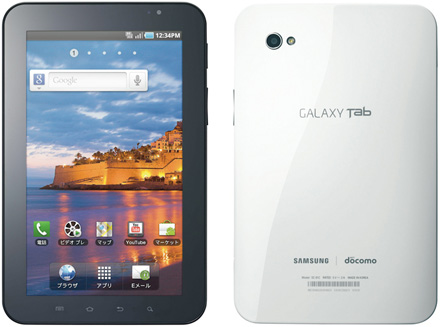
The Original Galaxy Tab, Running Froyo 2.2


Curiouser still, at least to me, was how Apple was so successful in framing Google's comment on Froyo and tablets at the same time when iOS itself was not necessarily optimized for tablets. At the same time when Froyo 2.2 was the only answer for both phones and tablets, iOS 4.2 was the only answer for both iPhones and iPads. Yet, one strategy was seen as right and the other wrong. Meanwhile, previous to this, iPhones and iPod Touch gained access to iOS 4 while iPad was still on iOS 3.2 - so yes, there was a time when Apple had a phone OS and a tablet OS, which was seen as okay, a temporary issue, and now that they have a universal OS, where the phone looks like the tablet, this too is accepted. Win, win!

As a Galaxy Tab user, running 2.2 on a 7-inch tablet, it's clear there are a few steps Google could have taken to make it more ready for tablets. Amusingly, there are even error messages that refer to it as a phone when you need to charge its battery, as Froyo assumes a phone. But it's a great device, and in my opinion, comparable to the pair of iPads we have in our home, just in a more portable device.

Which leads us to the next discussion... where do phones leave off and tablets begin? Our 32 Gig iPod Touch looks like a tablet. Go a little higher to the Samsung Epic 4G and HTC EVO and we're at a 4-inch screen. The Galaxy is 7 inch, the iPad 9.7 inches... and so on. If it's a flat screen device with a touch interface, is it not a tablet? And should one OS rule both? Seems to me that Android and iOS both do fine at any size, and 2.2 is a great option, even if 3.0 is even better.

Google may have a head of steam behind it now, one that will accelerate when Honeycomb-based tablets are more easily available at lower prices, but I think they could have saved themselves some serious PR headaches if they'd just played the Apple card of what was shipping was good enough.
February 18, 2011 · 3 MIN READ · BY LOUIS GRAY

Like With PCs, Mobile Market Share Stats Fire Blanks

Like With PCs, Mobile Market Share Stats Fire Blanks


What is Android's market share against iPhone? In August of 2010, Nielsen claimed shipments of Android beat iOS for the first time, representing 27 percent of the market against 23 for Apple. By the end of January 2011, a second firm reported news that Android was number one overall, topping Symbian, while practically doubling that of iPhone (32 percent to 16 percent). On the same day, a third firm, NPD, said Android outsells all other competitors combined, with a US market share of 53 percent.

Which one is right and who cares? How many firms get to announce that Android is number one overall or that it has whatever percentage lead over iPhone for installed users or for the most recent quarter before they all agree? I think I've seen this story before (repeated 100 times).

Do consumers select a product based on market share statistics alone? I hope not. Of course, in contrast to the calculator rattling at all these firms, in addition to IDC, Gartner and the box counters of old who are taking turns counting newer and smaller boxes, you've got the Apple faithful who are going to do a great job arguing that Apple isn't in the market share race after all, that more people pay more dollars per iPhone than other platforms, and that developers make more money on their platform. Take a look at the latest report from Mac faithful site AppleInsider for their take, saying today that Apple's rivals battle for iOS scraps.

Can we all, instead of repeating every little survey that ekes one side up a percentage point here, or down another there, simply agree that the iOS is a great operating system, that Android is increasingly high quality with similar features and some solid innovation, and that the total population of Android users is increasing at a faster rate, thanks to broader priceband support and business relationships with handsets and carriers? I don't know which firm is right on which number, and frankly don't care. Like I've said many times over the last year, one's choice in mobile is a personal choice based on preference now. Nokia has fallen in love with the Microsoft Borg, and that leaves iOS and Android to have the dual battle many have been begging for, with the numbers playing out as we expect them to.

Developers who are launching iOS only are a rarity these days. Instagram, Path and Flipboard are all notable for having great interfaces but also because they are the exception and not the rule. I'm glad we've moved on somewhat from counting apps on each marketplace, but I think it's also time to move on from counting total units. Just recognize that smart developers are going to develop for both places, and consumers who make a move - to one platform or another - are going to find the apps they know and prefer available.

Even if Android grows to take 80 percent market share, which maybe it will, Apple knows how to live in its world of a smart minority. So let's cut out the garbage market share reports that flail in accuracy or in detailing anything we don't already know and instead, watch the results of two very different approaches to business models and customer focus take place in front of our eyes. It's the most interesting battle since the IE vs Netscape wars of the mid-90s, but this time, nobody's going to get crushed.