Silicon Valley Technology Commentary & Archives · Est. 2006 3,045 Posts · 2006–2026

April 13, 2011

April 13, 2011 · 2 MIN READ · BY LOUIS GRAY

All Mac Users Get Unlimited Access to New York Times Free

All Mac Users Get Unlimited Access to New York Times Free

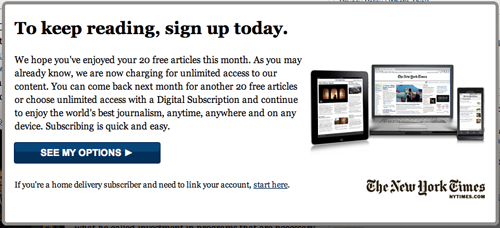
While most my news consumption comes through RSS (Google Reader), Twitter or on my phone (using my6sense of course), the New York Times home page is one site I still visit directly, and with some regularity. With their recent move to limit free access to the site to 20 articles a month, I haven't given it much thought - until yesterday, I saw I started to get little warnings that I had 2 articles remaining of my free 20, then 1, and then they were all gone. But as others have pointed out, there are so many holes in the Times' paywall, it seems to be an impotent approach, a limping attempt to squeeze much-needed revenue into the flagging old media giant. One of the biggest holes in the paywall is that of Safari - the Apple Web browser that ships on every Mac, and is available for Windows as well.

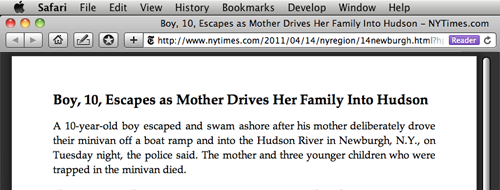
Without having to resort to any browser shenanigans, all Mac users have to do to read any of the New York Times' articles after the 20 articles are consumed is hit the "Reader" button in the location bar. While the New York Times begs you to pay up to read the full story, Apple extracts the text and repaginates it for you in a clean way - the entire article, whether you've paid or not.

The NY Times Warns I'm Almost Out of Articles

What Happens Once You've Read 20 Items

The battle between publishers and news applications has been a push-pull tug of war between innovation and traditional media ownership. One has seen clashes with Flipboard and Pulse as two of the most recent examples, with Pulse even getting sued by the New York Times right after their mobile reader app launched on iPad last year. But technology always seems to win. For every half-baked scheme to force readers to pay for content they expect is free, technology finds a way around it, whether intentional or otherwise.

Clicking "Reader" In Safari Brings Every NY Times Story in Full

Considering Apple's extensive market weight, and Cupertino's highlighting of the New York Times in Steve Jobs keynotes, commercials and other features, I don't see the Times screaming at Jobs to get this particular circumnavigation fixed. It's just another thing it looks like the Times people didn't think about when they tried to force their most loyal (and even occasional) readers like me to pony up.

If you're a Mac user who has switched to Firefox or Chrome, this is one place where Safari has a leg up, so if you hit your limit on the NYT, just open up a second browser.

April 10, 2011

April 10, 2011 · 5 MIN READ · BY LOUIS GRAY

The Android and iOS War Is Not Mac vs Windows Part 2

The Android and iOS War Is Not Mac vs Windows Part 2


Over the last several months, I have seen scads of articles trying to equate the battle between Apple's iOS on one side and Google's Android on the other as a rerun of the famous Microsoft Windows versus Apple Macintosh battles that played out over the 1980s and early 1990s. In practically every case, Android is seen as Windows. After all, both operating systems have achieved market leadership (in most ways you could count leadership) through extensive partner relationships. In both cases, Apple fanatics look down on the alternative as being less polished. In both cases, the opposing non-Apple camp has the chance to revel in geekery, showing what's possible when you get to the system foundation, while looking down upon the more closed, possibly less flexible Apple option. But I would argue there's a different way to look at this conflict, and it comes down to apps - which flips the discussion on its head.

Microsoft Word 6 for Mac. The Pain Still Is Felt Everywhere.

As a longtime Mac OS user (and sufferer), I slogged my way through Apple's dark times in the mid to late 1990s, taunted by developers who would avoid Mac OS as a platform. Others, if they did choose to release for Mac OS, might do so well after comparable versions were issued for Windows. Often, the Mac version was a klutzy port of the Windows original, running slowly and awkwardly on Apple machines. While we had our own native apps that only ran on Mac, press and advertisers alike knew that Windows had the numbers - more users, more options and dramatically more software. Most of us Mac addicts were left to order out of catalogs instead of retail stores, quietly fixing our need like those with misunderstood fetishes, while Windows users gleefully got first-day shipments of PC titles with the latest games, office software, and multimedia. We begged for scraps, but our day eventually came.

In time, our once pitiful position, a mere blip in software sales next to the incumbent behemoth, changed. Under Steve Jobs' leadership the new Apple and Mac began to stand for something else - not just in quality, but in numbers. The popular titles that once were shipping Windows only started to ship for both Mac and Windows simultaneously. Large companies that once abandoned the Mac came back, or set up separate business units thad did a fantastic job creating quality software. The gap once felt in software has practically disappeared, and I can't remember the last time I felt longingly for a piece of software that ran exclusively on Windows, or found a hardware device that had forgotten to find a way to work well with Mac out of the box. I have an HP Laptop running Windows 7 (and IE) at home, but I've only had to use it to get into proprietary online meeting rooms that demand Windows. Otherwise, the notebook stays closed.

Does this mean that the Mac ever caught up in terms of the vast number of software titles? No. But no Mac user today feels the same way that we Mac users did eight or twelve years ago, because everything we can do on a PC, we can do on a Mac, and there are many different things possible on this platform that can't be done on Windows.

Top App Developers Are Coding for Android and iOS

This brings me back to Android. Apple's iOS has more applications than Android. It has a smart, well-organized, high quality store design that presents new and high quality apps to users for iPhone, iPod and iPad. The Android Market is close, but not perfect. iOS has a good number of applications that are iOS-only, which do not exist for Android, namely favorites like Instagram, Path, Flipboard and more - many more.

But, as I've predicted over the last nine or so months, since changing my mobile OS preferences, this is changing, just like the Mac issues of the past. The gap in software is closing in terms of the number of applications. The polish of Android is improving relative to that of iOS, as Google improves with each iterative release. The amount of software available is increasing to fill needs that were previously unserved. Soon Android users, if we have not gotten there already, will feel like the Mac users of today, where every need is served, and there is no lingering desire for anything on the other side of the mobile software divide.

You can see the dominoes begin to fall as iOS-only applications, like Path, publicly promise Android versions soon, while promising to wait and deliver an amazing experience. You see applications like Ninua start as Android only, and games developers deploy for Android while ignoring iOS. (See: Bionic Panda Games) I believe only the most ardent of iOS fanatics will stay single sourced in the long run, just like BBEdit has never strayed from its Mac-only approach (and boy do we love them for it).

For when it comes to the mobile applications piece of this skirmish, Apple is not Apple of the 1990s. It is playing a role more similar to that of Microsoft, who had more titles, more developers, and a seeming guise of invincibility. This is not a replay of that battle, but a new one where the challenger is now the dominant one, and behaving much like a dominant player would. What I like more about this specific discussion is that this time, in my opinion, both sides are great. I would take a market battle between Apple and Google any day over the frustrations and issues that took place with a dominant Windows of yesteryear. I still love my Mac and the iPad has transformed mobile computing. But let's not be so naive about the world of Android software. Developers, users and the entire Android ecosystem are going to be benefitting from continued progress and growth - in quality and quantity.


April 7, 2011

April 7, 2011 · 3 MIN READ · BY LOUIS GRAY

Ninua Launches Social News Reader on Android

Ninua Launches Social News Reader on Android

As I've discussed many times, finding the right news from your news streams and social streams is an increasingly difficult challenge - and for most people, traditional RSS readers have proven too difficult for mass adoption, despite my own feverish feed religion. Into the void steps a new reader, launching first on Android, to try and connect readers and writers through social news exploration, tapping into three main news reading pillars to try and deliver a high quality, polished news reader, competing with people like Pulse and Flipboard, but unique in its own right. The new product is called Ninua News Reader, and it's from the team behind NetworkedBlogs, the most popular tool for posting your blog entries to Facebook.

Ninua's approach to the world of news, as demoed at the 500 Startups Demo Day in Mountain View on Wednesday, is centered around three major news reading pillars, including:
  1. Headlines and Mainstream News
  2. Blogs
  3. What Friends Read
Founder and CEO Waleed Abdulla said the company was "trying to do news in the right way", by helping users follow friends who share your interests and learn new sources through their own reading lists. Unlike other news readers, including Flipboard, Ninua does not pull in social stream content from Facebook or Twitter, but it does use that increasingly-important social graph to help provide guidance for your eventual reading list. Abdulla said, "The Facebook stream is social, but it's not news. See what your friends are reading, and if you like it, you can follow them. The app is tailored to you based on the sources you follow and the friends you follow."


Selecting Topics and Sources in Ninua for Android


If it sounds simple, that's because it pretty much is. Upon installing and launching the app on Android, you're asked to select three topics of interests from a pre-selected handful. Dependent on your choices (for example: Technology, Startups and Sports), you are then presented with a list of matching blogs and news sources to follow - all of them prechecked to be added to your reading list. Deselect those you don't want, and then you're asked to connect to Facebook to match the social side of things.


Following Friends and Their Recommendations


Once you've found your friends using the app and what they follow, the app taps its NetworkedBlogs roots and finds other sites your friends may not just be reading, but writing. There's a good chance you'll want to add those to your reading list as well. Now you've got a healthy list of sources based on your interests, and a list of sources based on your friends' interests.


My News Front Page and One Story In Ninua


With this array of sources in tow, complete the setup and you can read the news from those sources you've selected, or you can add new sources. There's no mention of the word RSS, the word Feed, or anything remotely as scary as big words like Pubsubhubbub or acronyms like OPML. The resulting articles are laid out with social signals to show other upvotes, and you can share the articles you like best to other services.

Ninua is a new wrinkle on the social-centric reader, mashed up with your own interests. Unsurprisingly, the app debuts with a strong user experience, and it's calm enough to not make you feel like you're missing something on the next page or next refresh. It's a solid approach to simplifying the news reading process, especially on mobile. You can find it on Android Market here: https://market.android.com/details?id=com.ninua.android

Disclosure: I am vice president of marketing at my6sense, which offers a personalized social and news reader for Android, iOS and the Web. It can be assumed that Flipboard, Pulse and Ninua can be seen alternatively as competitors or potential partners.

April 5, 2011

April 5, 2011 · 3 MIN READ · BY LOUIS GRAY

Did You Know All Your Emails Were In One Basket?

Did You Know All Your Emails Were In One Basket?


Prior to this weekend, most of your thoughts around the word Epsilon were probably about Greek fraternities or toga parties, but headlines in the tech and security world over the last few days have us instead associating Epsilon with a company most of probably never heard of before - a massive email marketing company used by many top brands. A major security breach seems to have escorted customer email lists from respected companies many of us interact with every day, and with the names piling up, I have to wonder if we had any idea that this centralization of our relationships with companies was happening, or if we are all the unlucky benefactors of outsourcing gone wrong.

The fun started late Saturday when I first got an email from TiVo saying my email address and first name had been exposed due to unauthorized access to their email service provider.

Of course, if you know me, that's no big deal. Everybody and every spider in the world knows my main email addresses are [email protected] and [email protected]. Tough finding that out and combining it with my mysterious first name. You know I don't have too many issues around sharing my cell phone number either - this being a key focal point of a CNN.com article on the "death of privacy" back in December.

The String of Notification Emails

Modern anti-spam measures from both Apple and Google prevent most garbage from missing my in box. For more insidious emails, that fraudulently pretend to be something they are not, which is made possible from this breach, I am wary enough not to do anything foolish.

But, as many others soon found, the first notification of a breach was followed by a second, a third, a fourth, maybe more. The next two days saw more apologetic emails following the breach, from Best Buy, Hilton Hotels and Chase Bank, to name a few. The issue reminds me a bit of the Gawker hack in December that forced people to change their passwords everywhere, myself included. So now what's exposed is not just my email address and first name, but that many companies passed the buck by putting their customer lists in the hands of a single third party who wasn't prepared for such a responsibility.

(Of course, this single third party shrugged it off as impacting a 2 percent subset of their clients)

In the 8+ years I managed our company newsletter and mailing list, from 2001 to 2009, we used a variety of partners, including Responsys and GotMarketing. Later, we put our data into Salesforce.com, and never once suffered such a breach. But in the last few years, companies have gained the ability to self-manage one's database and marketing tools, and do so independent of other companies. There's no great reason that a single third party's mistake should open up the vault to such a bonanza of brands. What this specific failure does is expose that the type of multiple verification systems and complexity expected from us as consumers isn't followed quite as well at the very companies whom we trust to watch over our personal data.

I don't have any problem with putting my email address out there. I don't mind sharing my data with TiVo and Best Buy. I shrug at Hilton and have to trust Chase, or we're toast. But I have to think we're lucky this time that the type of data accessed was so relatively harmless. People are worried that this will lead to phishing attacks and later successful breaches that get more impactful information, but for now, it seems we'll be more annoyed than ever. But think about whether you knew that all of these companies were putting your data in one basket to be raided by one intelligent hacker...

Does knowing that all these brands stuck your data in one place make you feel less safe or more safe? I think we've got to have an alternative, and self-hosting with self-managed security is looking a lot smarter these days.