Silicon Valley Technology Commentary & Archives · Est. 2006 3,045 Posts · 2006–2026

June 2, 2011

June 2, 2011 · 2 MIN READ · BY LOUIS GRAY

Record Labels Yank Videos from Youtify Over Syndication

Record Labels Yank Videos from Youtify Over Syndication

Saturday night, I introduced the service Youtify, a neat service which helps find top music videos and playlists from YouTube, and organizes them in a browser app that looks much like iTunes. Though I published late on a weekend, the story was quickly distributed, especially on Twitter, with nearly 150 shares of the story. But the fast rise to visibility has hit a wall for the service, thanks to problems that started late Tuesday night, when almost all the top videos from YouTube simply stopped playing.

It turns out the rights owners for the music videos themselves, primarily record labels, put a stop to their content being played on the site, with Youtify specifically being blocked.

Per Thulin, one of the cofounders of the project, along with Karl Tannergard, initially thought he had somehow run afoul of YouTube's API rules, as users found the video player was rendered almost completely useless. But after reaching YouTube, they confirmed it was the record labels, and not they, who had stopped access.
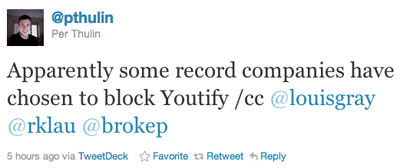
Youtify Ground to a Halt Thanks to Record Labels' Intervention

That the record labels aren't immediately excited about yet another cool and innovative way to showcase their artists' content is no surprise. They've been late to the game and backward in practically every opportunity over the last 20 years. As Thulin wrote me in an email, the action caught them by surprise, especially as nobody made any attempt to contact Youtify directly.

Youtify's Playlists Show Holes Thanks to Rights Management

"Our new plan is to embrace and reward the artists and labels still allowing us to play their videos," he wrote. "We will let those artists and labels put ads in our application for free, and also let our community help spread these videos, generate good ratings, viewcounts, shout-outs on Twitter, etc. We hope that our growing community will generate enough noise for them to reconsider!"
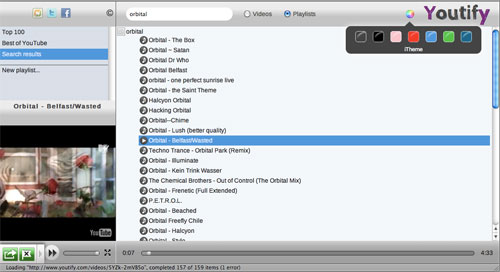
Other Songs Not Impacted Play As They Always Have

Unless the record labels change their mind, the most likely culprit being VEVO, who owns a large portion of the videos that aren't working, Youtify, for the time being, is somewhat hobbled. A small fraction of the Top 100 songs play, while amateur content from "Best of YouTube" still runs as will many searched for playlists that don't intersect by the resistant labels.

The concept for Youtify is great. Even the user interface got a revamp in the last few days following the initial post. But the content is what it's all about, and if they are starved for content, users will probably not be made loyal. The question is will the labels let this one go, or will they remain obtuse?
June 2, 2011 · 4 MIN READ · BY LOUIS GRAY

Apple's Missed Identity Play: "Sign In With Apple"

Apple's Missed Identity Play: "Sign In With Apple"

One of the greatest tug of wars amidst leading Web companies today is that for ownership of your identity, through your personal profile, or pushing you to "Sign in with" their credentials. You may sign in with Twitter, Facebook, Google or OpenID, and enable those services to certify it's you. One of the most successful tech companies out there who never comes up in this conversation is Apple, and it's incredible to think how easily they could have converted its army of Mac loyalists (myself included) to "Sign in With Mac", carrying the Apple flag forward as a badge of honor. More than a decade after getting my .Mac e-mail account (and later signing up my wife to do the same), I am splitting my email activity fifty-fifty with GMail and haven't gained much reason on Apple's side to double down on Cupertino.

When Steve Jobs unveiled iTools at MacWorld San Francisco in 2000, one of the primary offerings of the then-free product was an e-mail address ending in Mac.com. Fresh off success with the 1998 launch of iMac, and still a year away from the debut of the iPod, the company still had its most loyal followers "Thinking Different", and sending people messages with my Mac.com account was cool. It told everybody who would get a note from me that I had chosen Apple. Even when I would have to spell out my e-mail address on the phone, I'd always tell people... "M.A.C. As in Macintosh" in case it wasn't obvious.


Steve Jobs Introducing iTools (MWSF 2000)


But for a variety of reasons, the Mac.com address wasn't especially capitalized on. The service, initially free of charge, controversially converted to an annual paid service by 2002, alongside tools such as iDisk and .Mac home pages, and later rebranded as MobileMe in mid-2008, pushing people even further away from the allegiance with Apple but instead to theoretically more personal Me.com address.

When Apple initially made the move away from free Mac.com addresses for all, the message was that the free mail service was being abused, which no doubt cost them money and headaches - on top of costs for iDisk storage. But of course it also decimated the potential audience of users, most of whom already had free email accounts from somewhere else, be it Hotmail, Yahoo, Netscape or their ISP. Using a Mac.com account almost seems like an artifact unless you're a clear Apple loyalist.

In parallel, while Apple put MobileMe/iTools/Mac.com/whatever on the backburner, the company experienced incredible success with the iTunes ecosystem. Every iTunes customer has an Apple ID (or signs in with AOL), and has trusted Apple with their credit card details, as iTunes expanded from its initial offering of music to music videos, TV shows, movies, books, and of course, mobile applications for iPhone, iPod Touch and iPad. So Apple's effectively sitting on one of the most actively spending user databases in the world, but one that isn't leveraged elsewhere on the Web. There's no "Sign in With Apple" on major sites like the New York Times or CNN. There's no "Sign in With Apple" on Amazon.com or eBay.
iTunes Knows My Apple ID, but the Rest of the Web Doesn't

The fight for identity relevance between the major players of the Web, including Facebook, Google, Twitter, LinkedIn and others is critical, especially as signing in with one's identity brings additional privileges. Signing in with Facebook brings you your social graph and their history as you find what articles are popular. Signing in with Google is starting to bear fruit with their +1 initiative, but it's early days. Signing in with Twitter gives you the option to follow people on downstream sites if they have Twitter @Anywhere installed. But Apple's not playing in a place where they absolutely could have an impact.

Much has been made of Apple's perceived struggles when it comes to Web services. Those of us who have been watching Apple seemingly forever recall the false start of iReviews, where people could review Web sites on the Internet, the aborted launch of iCards for greeting cards through iTools, the lukewarm approach to .Mac Home pages, and the constant renaming of the email service. This is by no means discounting their fantastic success in hardware and some software, but they could be my identity. I, and many others like me, at one time and even today, want to tell the world we are Mac people, and we could sign in with Apple. But we aren't.

With iCloud to be presented at WWDC this next week, we're moving even further away from the naming of .Mac and what it meant to be a Mac person, especially if this product suite gets its fourth name in a decade or so. No doubt they'll keep shipping some great stuff, but even we Mac people are going to sign in with somebody else all around the Web.

May 31, 2011

May 31, 2011 · 2 MIN READ · BY LOUIS GRAY

The San Francisco Chronicle Launches An iPad App

The San Francisco Chronicle Launches An iPad App

While some magazine and newspaper publishers are seeing spotty results with digital editions of their content specifically tailored for the iPad, the millions of Apple tablet owners remain an attractive target for print media brands looking to make additional cash, stemming the bleeding from years of declining subscribers and advertising dollars.

The latest entrant is the Bay Area's own San Francisco Chronicle, who introduced its iPad app today, free to subscribers, but premium for all others, bringing the full content of the day's paper (and editions from the week prior) into your hands without the complementary ink and subsequent visit to the recycle bin.


The Chronicle Front Page on iPad, and Browsing Previous Editions


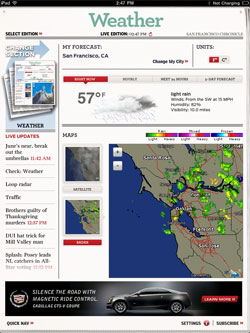
The Chronicle's iPad app delivers edition integrity for the day's paper, containing all stories from all editions, but also features a "Live Edition", marrying the existing content with real-time traffic, weather and news updates. This essentially provides the best of both worlds, letting you meander the paper as you would traditionally, while also getting the benefit of being Web connected.


The Chronicle's Sporting Green Section and a News Story


The application looks and behaves like a standard newspaper, with lead stories, backstories on subsequent pages (a swipe away, of course), and more details from each story continuing on the jump (newspaper parlance for continuing on a later page). But visual perks to the app leverage the fact it's a digital edition, including a sectional carousel that you can navigate left to right (or the reverse) to browse from Business to Sports, Obits and the front page, for example.


Browsing Sections on the Carousel and Seeing Live Traffic


For existing paper subscribers, the new app is free. For those who don't get the paper, after a free 30 day period, access is priced at $5.99 a month or $59.99 a year. This compares to $99 a year for full access to the paper's online edition, or $9.75 a week to get the paper home delivered, Monday through Sunday.


Checking the Current Weather Radar and Sharing a Story to Twitter


With the exception of the controversial The Daily and national news media apps, like those from the New York Times and Wall Street Journal, the most lauded media apps have been almost entirely social, with Flipboard being the most widely known, followed by Zite and others. The San Francisco Chronicle's app is not designed to bring in social content, but sharing outward to Twitter and Facebook is integrated easily. Once your credentials are included, you can share out using the Chronicle's custom URL shortener. Meanwhile, if you are going to be offline, you can download up to ten stories for local reading.

The app itself is free for download, outside of the aforementioned charges. Each page of the app contains a standard horizontal Web banner ad, which no doubt brings in a few dollars to the paper as well. If you're in the race to kill of physical media like I am, moving the Chronicle to your tablet certainly helps in this quest. There's not yet an Android option and the company hasn't announced plans to develop one yet.
May 31, 2011 · 2 MIN READ · BY LOUIS GRAY

Minno Rebrands as BuySimple, Raises $700k Seed Round

Minno Rebrands as BuySimple, Raises $700k Seed Round

Two weeks ago, I highlighted Minno's integration with SoundCloud for micropayments. The new service, founded by a pair of ex-Googlers, is hoping to tap into the growing market for in-app payments and premium social games and solve the complexity presented by today's solutions.

This morning, the company is announcing a not so micro boost to their chances with the closure of a $700,000 seed round, including contribution from Farhad Mohit, the founder of Shopzilla, Jack Abraham, founder of Milo, and GRP partners. In parallel, the company is also changing its name to BuySimple and setting up shop at http://www.buysimple.com.

The name change is more than cosmetic, helping the company evade a cybersquatter who thought Minno.com was worth exchanging high five figures for, which would certainly have put a dent into the seed round. It also captures the hope that Noah Ready-Campbell and Calvin Young have in making the long-discussed but rarely done well action of micropayments a simple one.

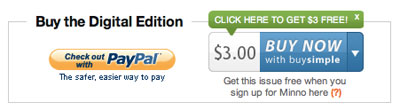
BuySimple Integrated on Hacker Monthly

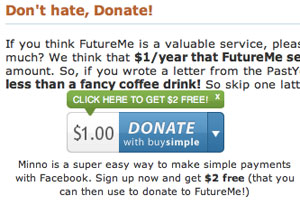
Why will BuySimple be easy where other offerings have failed? In part, users don't need to create new accounts to use the service. They can tap into their existing Facebook accounts today, and imminent support for OpenID providers is promised. Merchants like SoundCloud and others are seeing the opportunity and already signing up. Early partners also include Hacker Monthly and FutureMe, who have posted buttons on their sites to enable users to donate using BuySimple or purchase digital editions of their magazine, right alongside the ubiquitous PayPal buttons.

BuySimple on FutureMe

Unlike PayPal, who is tightly integrated with parent company eBay for auctions and all other sorts of online purchasing, BuySimple is focused on micropayments and making the process easy. During a beta period, the company promises that qualifying partners can tap into the product free. New users get two dollars credit on initial use.

BuySimple is not affiliated with BankSimple, the new banking startup founded by former Twitter engineer Alex Payne.