Silicon Valley Technology Commentary & Archives · Est. 2006 3,045 Posts · 2006–2026

June 29, 2011

June 29, 2011 · 2 MIN READ · BY LOUIS GRAY

Aggregation Is Invisible In Google+. Thank Goodness.

Aggregation Is Invisible In Google+. Thank Goodness.


The true value of a social network is the product of the people participating and the content being shared. There's no doubt some sort of mathematical program smarter geeks can compile to show just how that works, but it's true. You will participate on one service or another because of what is said and who is saying it. If the content doesn't match your interests, or the people aren't those you care about, there's little pull for you to be there. One corollary to this which evolved over the last three-plus years is that social networks gain power through being the originator of the content. While I once was a major proponent of aggregation products that pulled from many corners of the Web, the value downstream is vastly diluted, and adds to noise. This was a major problem for late adopters of FriendFeed, was immediately a problem for Google Buzz on day one, and is an ongoing problem for Facebook users, who often struggle to find ways to delete specific services' access to their feed and wall.

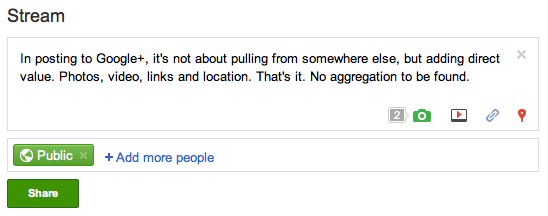
Google+, at least on day one, has absolutely no way to push content into the site from a third party network. This means you don't see a stream of people's Twitter updates, you don't see their blog posts automatically added, you don't see their Foursquare checkins, their Instagram photos, TurnTable spins or any of the other various update virii that flood most streams. Instead, the site is an open whiteboard for status updates, link sharing and photos, all requiring manual input. The inference, and correct assumption, is that those updates on Google+, were written by the person with specific intent for a specific audience. You don't get that feeling that they posted elsewhere and aren't participating locally - a common complaint on other services, like FriendFeed and Buzz.

At the end of 2009, my two-year fascination with aggregation-centric parlays coming to a close, I said aggregation was better in theory, arguing cross-posting should be reduced. This didn't stop Google Buzz from launching with aggregation at its core a few months later. Unfortunately, the ease at which you could pull in content from third party networks like Twitter meant many people, including Google employees, added these feeds and didn't return. It made for a subpar experience, and initial requests for updates included the ability to mute these services as a whole or from specific users.

I would bet that in time as the Google+ API is completed and released, we could soon see the opportunity for mobile and desktop clients (like Seesmic for example) to write to Google+ as a new service. I am betting Seesmic's Ping.fm is already thinking of how they can make Google+ yet another supported service. But I would push for caution in this. I've seen how the deluge of activity from sites like Twitter (and Facebook if they opened up) can drown the downstream aggregator and help it lose its identity.

Some first users of Google+ today commented about the similarities of it to FriendFeed, with nested comments, lists and real time at the core. But honestly, it's the opposite. FriendFeed launched as a major aggregator, supporting dozens of sites. Google+ starts with just one. It's refreshing.

June 28, 2011

June 28, 2011 · 4 MIN READ · BY LOUIS GRAY

Google+ Breaks Out of the Social Box, Ready to Score Users

Google+ Breaks Out of the Social Box, Ready to Score Users

More than a year after the launch of Google Buzz, rumors have been tossed about on most tech news sites about just what Google has been up to in the world of social to ebb the flow of activity that has migrated to Facebook and to a lesser extent, Twitter, over the last few years. With users spending significant time participating in social activity on the Web, it's made Google sometimes seem like the last era's winner, with it being thought the future of discovery is through friends. So long as another company owned the social graph, Google has been pushed to an unfamiliar role, as challenger. With today's launch of Google Plus (nee Google+), you can see they haven't taken the role of backup lightly - delivering a fun and engaging place that brings many of the benefits of existing social sites, but learns from their mistakes. In time, the package of Google+ could be a serious alternative for people's attention.

As a longtime Google ecosystem power user with Google Reader and Buzz, both of which I continue to use even as they've fallen in others' eyes, gaining access to Google+ today was practically second nature. Within minutes, I had started to reassemble a brand new social graph into explicit "Circles", their equivalent of lists, and could share status updates, links, and photos. The vast majority of content in Google+ feeds into a centralized stream of all friends' updates, with additional product features including built-in chat, powered by Google Talk, "Sparks", much like saved searches to surface interesting articles, "Hangouts" for instant video chats with other users, and at least on mobile, "Huddle" for group chat and instant photo uploading.

Circles, Hangouts and Sparks - All Part of Google+.

Clearly, this is no small undertaking - one Google has thought through in the year since Buzz's launch and initial privacy hiccups, and one where they have given an unprecedented (for them) amount of effort in making sure the user experience was top notch. While we've grown accustomed to helping Google test out their first iterations of beta software, Google+ is well designed out of the box, and has seen positive kudos from all corners of the Web, so far as I can tell. There are bugs, of course, but nothing dramatic.

Separating Friends By Circles In Google+

Most of us power users on various social networks, from Facebook and Twitter to lesser successes, like FriendFeed, have been reticent to adopt lists for sharing out of our corpus of friends. FriendFeed and Twitter's lists have primarily been read-only, letting you organize what you consume, and Facebook's selective filters for sharing are underutilized and challenging. The Circles in Google+ are easy, backed by starting from scratch on the social graph for the most part, and being easy enough to drag and drop to new circles, complete with old-school rotary phone like animation. I managed to set up connections with more than 400 different people on Google+ today without getting carpal tunnel syndrome. I can choose to share each post of mine with the world, or a subset of folks in each Circle.

Google + In Action With a Share from Ben Parr

The integration with Picasa and especially automatic uploading has increased the visibility and vitality of the photo service, which has similarly played second fiddle to sites like Flickr for the masses and hip apps like Instagram and Path for the geeks. Albums on Picasa are available for featuring in Google+, and photo sharing is quite simple. You can also tag any Google+ user on any photo, one of the major reasons Facebook Photos became so wildly popular - along with notifications that you'd been tagged.

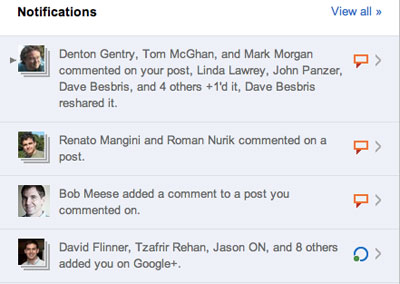
Many Different Types of Notifications, All Clear In Google+

Speaking of notifications, they're nothing if not thorough. Thankfully, unlike other networks, you get follow notifications in bulk. After a certain amount of time (not exactly clear), you can get emails saying how many new people are now following your account. On the fun of day one, I got a handful with dozens apiece, rather than hundreds of separate emails. In the site itself, you can see a small number in a square highlighting the number of notifications that beg for your attention, including new connections, comments on your posts, whether someone has tagged you in Google+, or if comments have happened on a thread where you've commented. Of course, if you don't want an email or phone push notification each time that happens, you can just disable those in your settings, and reduce the amount of bacn in your life.

Congrats! You're Followed On Google+ By Lots of People!

The biggest and most exciting piece of newness with Google+ over Buzz for me, though the services are vastly different, is that Google broke out of the Gmail box on this one. While I understood the desire to automatically create one's friend graph in Gmail and embed it in a popular app, the mere act of having to head to Gmail every time I used Buzz was a real detractor for me. Google+ is its own dedicated URL and it looks great in every browser and mobile device I've tried before, even the Galaxy Tab 10 on Honeycomb.

Sparks Bring News on Topics You Choose to Google+

Right now the service is invite only, and I don't have any invites to spare - trust me, I'd pass them around like candy, because I think this is a service you just might want to enjoy. Google has invited some skepticism for false starts in the past, but from what I've seen today, especially the excitement and wholescale adoption of the launch from prominent Googlers, this time they are absolutely serious and we'll be seeing some noise from this team. Their URL is plus.google.com and you can find me here: https://profiles.google.com/louisgray/posts.
June 27, 2011

June 27, 2011 · 4 MIN READ · BY LOUIS GRAY

Not All Roads to the Public Markets Are Smooth Ones

Not All Roads to the Public Markets Are Smooth Ones

In Silicon Valley, we fall in love with and memorialize success stories. Leaders of successful companies can be seen as pop culture heroes, and their decisions during times of challenge or opportunity can be told and retold as legend. The first years of companies like Apple, Microsoft, Sun, and Oracle in one era, Netscape and Yahoo! in another, Google and LinkedIn in a third, and in today's evolving present history, including Facebook, Foursquare, Groupon and more, are possibly going to be reviewed and dissected in the same way we look back on innovations from the turn of the 20th century with the assembly line, and the Industrial Revolution in centuries past.

The opportunity to grow fast, get big and get rich drives many people to flock here and try their own hand at catapulting an idea into a passion that could see millions or tens of millions of users. But, if nine of ten startups fail, for every big name I just mentioned, there are carcasses of many others that never make it. And for every rocketship IPO that has people clamoring for updates, there are others that take a longer path. (See all of the S-1 filings on the SEC)

Friday saw the second filing of an S-1 by BlueArc, my employer from early 2001 to Spring of 2009. The company is looking to raise $100 million by entering the public markets on the heels of rising revenue and reduced losses. I know the story well as I helped author the first version of this same document when we filed to go public in 2007 and was there when we withdrew the filing in 2008.

(You can safely assume I own shares, though not a significant number, and it's in my best interest if they do eventually go public. Given the company's sensitive position, I'm reticent to mention particulars, so this article is painted with a broad brush, and is as neutral as possible. Rather than ignore the news, I'm offering the filing as an example of a company that has not seen overnight success.)

The company was founded in the late 1990s, and raised more than $200 million, the most recent round completed last fall. In my time there, we signed some amazing customers, got some powerful OEM and reseller deals, and sold to new territories. We learned where our products were a great fit, and where we had challenges. We hired lots of great people, and saw others struggle. CEOs were changed a few times. We had layoffs a few times. The company and its customers made the front page of trade magazines and the business sections of the New York Times and Wall Street Journal. Other times, rumors flew about the company's viability. At one point, the noise got so bad, a leading industry analyst wrote an entire column about how he'd heard so many rumors on the company, fed by tough competitors, that he recommended anybody hearing such rumors to just ignore them.

The result of a company that has a few years under its belt, with many funding rounds, some happy investors and some unhappy, some happy employees, and some unhappy former employees, is a body of work that tells a story. For financial junkies and tech watchers, or just the curious, poring over the details of BlueArc's S-1 is interesting. There are no funny numbers like those from Groupon, who quite visibly took money off the table for its founders and key employees. There is no meteoric financial windfall like those seen at Google and assumed at Facebook. Just a growing, challenging, business in a tough market that has seen competitors purchased by industry heavyweights for billions of dollars and others, failing, just go out of business or sold for scrap.

While most of the tech press is enamored with consumer Internet plays and mobile apps, the enterprise market has its own unfair share of intrigue - often harder to grok, but just as aggressive. The South Bay especially, the world of Milpitas and San Jose, is dotted with networking firms, semiconductor firms, storage and switching companies in the shadows of NetApp and Cisco. Having lived that world for most of the last decade, coming from the position of a challenger with unique technology, I'm hoping that the colleagues of mine still at the company find a positive exit for the decade-plus some have put into the effort, or lesser tenures for the more recent arrivals. But for those of us who seem to have attention deficit disorder when it comes to watching companies start and flourish, or to our own job-hopping resumes, this is an interesting case study of one company that didn't take the easy route.

Disclosures: I was employed in the Marketing department at BlueArc from 2001 to 2009 and own a small amount of the company's common stock.

June 25, 2011

June 25, 2011 · 2 MIN READ · BY LOUIS GRAY

Zillow Rewrites Home Price History, Invalidates Old Data

Zillow Rewrites Home Price History, Invalidates Old Data

Many people look to Zillow for third party estimates of property values, whether homes are on the market or not. One can turn to Zillow to gain property information on homes, including home features, property tax data, and previous sales. The more data-hungry or curious may even watch their own homes or target properties to see fluctuations, due to a number of factors, and get a good idea of whether homes' prices are rising or declining.

Two weeks ago, the company recalibrated its systems, and has pretty much thrown all previous years' data out the window, replacing it with new histories. So if you were using the site to get a good picture of your neighborhood, they're hoping you'll ignore what you already know and start fresh.

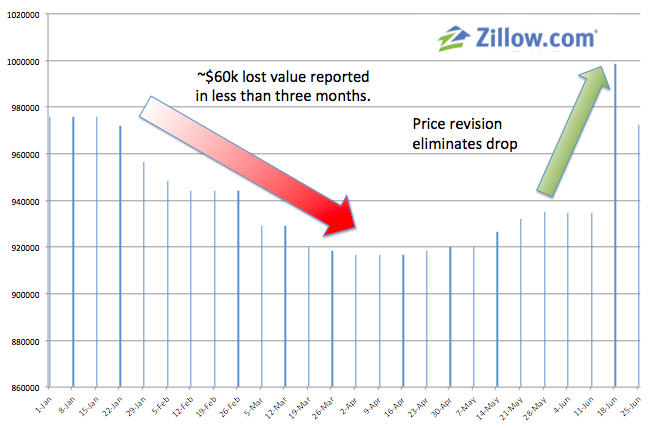
Coming up on the one year mark in our home which we purchased last summer, I've kept an eye on the surrounding market, both on Zillow and Redfin, to not only watch our own home's data, but seeing new sales come and go. In an economy which is by no means perfect, the weekly data coming from Zillow from its frequent "Zestimates", and tagged on my weekly Mint.com emails was pretty bad all Spring. My email archive shows eight separate consecutive downward revisions of our own home value, shaving off sixty thousand dollars in equity. While I have no intention of moving again any time soon, it was hardly reassuring.

Zillow Told Us Our Home Price Was Crashing, Then Changed Its Data

Zillow's New Data Is Smoother, Doesn't Show Crash

I even complained about the continued drops and negative feedback I saw through Zillow on one of my less-trafficked Twitter accounts, citing the $67k drop of almost 10 percent in just under three months.

Clearly the Reported Price Drops Were Weighing On Me

But on June 13th, Zillow wiped the slate clean and the year's data doesn't show such a steep decline after all, showing a comparatively straight line with a near-static value and a minimum of variance. Instead of a sharp downfall I had assumed was true this Spring, the gap between highest Zestimate and lowest is only about $20k, less than a third of the bloodbath I was seeing.

Pricing one's home for sale or financing is a delicate one, a dance of recent area sales, market trends, and all manner of comparables. But Zillow's move has me questioning not just our own home's value, and the year's graph, but all estimates I bump into, and of course, their own projections for values in years' past.

In an FAQ on Zillow's site related to "Zestimate Improvements", they mention that you "Possibly" could see changes in history, thanks to algorithm edits going back to 2006, arguing for improved "current accuracy" and "historical accuracy" - adding "We are now working on re-doing all the history."

An Excerpt from Zillow's FAQ

It's likely they know what they are doing, and with more data, they were losing confidence in both their current and historical values. But it sure didn't seem like the company was unsure about its competence before the move, and I'm not sure they're confident about their current data any more.