Silicon Valley Technology Commentary & Archives · Est. 2006 3,045 Posts · 2006–2026

October 13, 2010

October 13, 2010 · 3 MIN READ · BY LOUIS GRAY

Google's Marissa Mayer Promotion Signals Future of Search

Google's Marissa Mayer Promotion Signals Future of Search

With news breaking yesterday that Google vice president of search products, Marissa Mayer, was taking a new role at the company, focused on location and local services, debate has festered far and wide about what the move means for the company's direction, for her specifically, and, laughably, in some isolated cases, if it was in response to perceived failures in her current role relative to competitive moves from Microsoft's Bing. Without being a fly on the wall or being in the offices where these sorts of things are decided, all one needs to know is that Google hasn't earned its leading reputation by sitting still. Mayer, well respected by practically all who see her in action, is one of the company's leading talents, and is being pushed to what's next, not the battles that have already been decided.

Search is a mature market, and Google, for the better part of a decade, has been doing it better than anybody else. The company has leveraged its leading search position to also become a phenomenal business leader, driving billions of dollars of advertising through its pipes every month.

While others, like Search Engine Land, do a great job of watching the month to month market share jockeying between Google, Bing, Yahoo! and assorted others, displaying Google's share of the pie at around two-thirds of the total, the numbers don't look to be dramatically changing any time soon, even with new innovations each brand is rolling out.

About a month ago, I wrote a post titled "The Future of Search: Personal, Persistent and Implicit". While much of what Google does today with search is focused on one-time explicit searches, the market is moving toward persistent implicit searches, which can tap into your own preferences as an individual, including your purchasing behaviors, your reading preferences, your location, hobbies or business.

It is this determination of who you are and what you like that is driving Facebook's focus on their "Like feature", and this morning's announcement with Bing for social search. It is why Foursquare is such a hot commodity, able to turn down a reported $100 million offer from Yahoo! in deference to going it alone. And this is what Marissa is reportedly going to be doing.

Many armchair quarterbacks are looking at Google and seeing an older, more mature, company that struggles to acquire or retain talent in contrast to market upstarts like Facebook, Foursquare and Twitter. Key to that challenge of keeping the best talent? Keeping them focused on interesting products and quests - the type of quest like what Marissa sees before her, grappling with the different properties within Google that touch location and local and making something impressive, preparing the company for a future where the world of search will look incredibly different indeed.

For savvy press release readers, one does not see any negativity in Marissa's news, and to bring up words of demotion or competitive pressures are ridiculous. At the same time, she joined the company's operating committee, which is essentially as high as you can go without being on the board of directors. Meanwhile, Marissa has enough money to walk away if she ever wanted, and just about any company under the sun would be delighted to have her. So think again when you see nonsense about this being a push down the stairs in Mountain View. This is a strategic move, one that shows they aren't going to be sitting on their laurels at a time when others are making headlines.

We are beginning the third wave of the Internet. Google won the first wave - of information and retrieval. I will be writing a lot more on this soon. Promise. But keep your eyes on Marissa. I don't expect any Dodgeball level mistakes to come this time.

October 9, 2010

October 9, 2010 · 3 MIN READ · BY LOUIS GRAY

Yobongo App Encourages You to Chat With Local Strangers

Yobongo App Encourages You to Chat With Local Strangers

Before the advent of personalized home pages, blogs, and social networks connected to our real identities, many of us participated in anonymous chat rooms, where we tried to connect with strangers with similar interests. These chat rooms were filled with intrigue of finding new conversations and insight from people we might never meet in real life. Some were about hobbies or careers, and many more were built with the goal of hooking up, but others were about location. Today, with our smartphones having the option to determine our location, and with virtually all of them having pervasive access to the Internet, there lies an opportunity to recreate the chat room experience on the mobile, with strangers, tied together by our GPS coordinates. An old friend to louisgray.com readers, Caleb Elston, has announced he is leaving a comfortable job at Justin.tv and striking it out on his own to spread the word about this new experience - and it's called Yobongo.

Caleb first crossed our radar more than two and a half years ago with the launch of his shared OPML site, Toluu. At the end of 2008, Elston started a gift recommendation site, called Kallow, and earlier this year, he launched a Techmeme-like site for top news, called Kickpost. But unlike those three projects, Yobongo is going to get his full attention - as he believes it "is going to be a big thing."


Starting a Yobongo Account, Alerting Local Friends


I spoke at length with Caleb Thursday night, before his announcement, to learn why Yobongo has got him changing his life path, and found not just what inspired its start, but also, details about how the product has been in open testing in Canada for several months.

The idea came about when Caleb was in a crowded movie theater. In advance of a showing, people were "fooling around" on their cell phones. As he recalls, people called out funny lines on the previews and microconversations started happening. As he thought about it, he realized there lay an opportunity to connect everyone in the theater, leveraging smartphones' location capabilities and introducing real-time chat for those connected. But existing solutions were almost exclusively explicit or sexually-based, and there remained an opportunity for a non-adult option, to connect complete strangers for whom location was the single link.


An Active Yobonbo Chat Room


"We thought there might be a possibility you could communicate with people you didn't yet know but shared a location, while using your real identity," Caleb said. "It has to be instant, with no rooms to join, all one one screen."

The algorithm behind the product starts with a basic premise of the target number of people who are active in a single room. The current target of 20 people feels full to users, and there are several dozen active Yobongo sessions, with 2-3 of them in Toronto. Why hasn't Yobongo yet come to the US? Caleb says the company doesn't yet want to launch in full in the country until the mechanics of being truly hyperlocal are solved.

"The big thing is that we believe chatrooms will live on in mobile phones, just as they lived in the late '90's," Caleb said. "The problem then was the bad actors were so motivated, and they had the technical ability to circumvent banning mechanisms, making regular people uncomfortable. But in the earliest days, it showed promise of connecting people."

With Yobongo, identity is tied to a unique phone. If a bad actor is banned, you would essentially have to buy a new phone. Also, in the last 20 years, the culture and technology of the Internet has evolved to make revealing one's true identity more comfortable and accepted.

"Authentic communication can happen between people you do not know," Caleb argued. "For the personal device you have with you all the time, connecting to people is an exciting mechanism. There are more mobile connected devices next year than PC devices."

The application is initially targeting iPhone users, but with time, one should suspect the app to hit more screens and more systems. As Caleb told me, it's "iPhone only right now - but that's not the end game".

October 7, 2010

October 7, 2010 · 4 MIN READ · BY LOUIS GRAY

New Twitter Search Backend: Faster, Not Much Deeper

New Twitter Search Backend: Faster, Not Much Deeper

There are many things Twitter does very well, and some where the company and its service could stand to improve. As the company's popularity has grown, and its employee base has swelled, one of the biggest holes in its lineup has been around its search engine. More than a year ago, after becoming increasingly frustrated with its shortcomings, I gave up and said it was very, very broken. Maybe that wasn't nice. But it was true.

With news today that Twitter has quietly introduced a new back-end for their search engine, it is worth revisiting to see if what they have delivered solved the listed issues, or if, instead, it is just a new back-end, built to perform the basics on a larger scale.

Issue Number One: Search Results Limited to a Few Days

At the time, I used an example to show how Erin Kotecki Vest (@queenofspain) was shown as having mentioned the word "Obama" five times in four days, when she had, of course, mentioned him much more often. At this point, Erin isn't talking about Obama quite as often, so a new, similar search is needed for testing.

I tested the word "Giants" from Mychal Urban, a Bay Area sports writer (@MUrbanCSN). The results went back six full days, covering 7 tweets. Similarly, searching for the word "TechCrunch" from Mike Arrington (@arrington) delivered 7 days worth of results, and 33 total tweets.

It appears the "deeper" database goes about a week, up from low points of 2-3 days.

Issue Number Two: Older Tweets Were Missing

Twitter Search has always offered the option to search the database for a subset of dates. At the time, I used the above example with Erin, but searching from January 1st to May 21st of 2009. A search of this type failed, saying "the page you were looking for doesn't exist".

With the new database, these older tweets are still not available. For example, searching for "techcrunch" from "arrington" between June 1st and August 1st of this year says "no results".

So this is not yet fixed.

Issue Number Three: References of People Were Not Tracked

At the time, I tested to see if Twitter could find my references of an individual, like Mashable's @adamostrow. At the time, it reported "no results. Tonight, I tried the same search, but with Robert Scoble (@scobleizer). If you look at the results, Twitter says there are no results. But I actually sent a reply to Scoble as recently as October 3rd.

On the flip side, I could get Twitter to return results for mentions of @erickschonfeld, displaying three results in the last two days. For whatever reason, this particular query goes at least two days, but less than five.

This appears to suffer from the short database (by time), but is not a separate issue.

Issue Number Four: Oprah Doesn't Exist In Twitter Search

For whatever reason, Twitter Search didn't display results from Oprah (@oprah) two years ago. Tonight, I searched again, and found no results.

As Oprah's last tweet was September 22nd, it may not have been recent enough to see in the database, and doesn't mean it's Oprah specific. A similar search on my name goes back 7 days.

I assume, in this case, that maybe if Oprah had tweeted in the last week, she would be there. Other high profile, high subscriber accounts, like @aplusk, go back a week.


The post from Twitter Engineering focuses on how to keep the current capabilities available under increasing load. As Twitter's focus is on real-time, they note, so should their search engine be. This means, essentially, that older tweets are much less relevant than new tweets - so much so that they drop out of the index after a week's time, both on the old version and the new.

The sign that "older tweets are temporarily unavailable" is seen anytime you hit the end of the road on Twitter search. I had hoped the new database, which sounds technically impressive, would have moved the needle further into the past, but it hasn't yet. The team says "The first difference you might notice is the bigger index, which is now twice as long -- without making searches any slower." If this is the case, then they are, without saying it specifically, acknowledging that Twitter Search had deprecated to only two or three days worth of data, and now it is at seven days, for most searches.

I give Twitter a lot of credit where it is due for the company's maturation and increased feature set, as well as reduced downtime, but it looks like the full functionality once promised by its search engine is not near fruition. Older tweets might be available on Google Realtime search.

October 6, 2010

October 6, 2010 · 3 MIN READ · BY LOUIS GRAY

Congratulations Foursquare on Well-Deserved Downtime

Congratulations Foursquare on Well-Deserved Downtime

Over the last two days, the popular location based service and king of check-ins, Foursquare, has been suffering from intermittent outages related to database overload and storage troubles. And this is wonderful news. Not because I wish them ill will, but it seems this is a necessary strain practically all successful companies go through at some point as they achieve rapid user growth. How users react to what are hopefully temporary bumps, and how the service reacts after the fact can help determine if the company will continue to be embraced, like a Twitter, or dumped, like a Technorati.
Foursquare's rise from its SXSW 2009 debut to near pervasiveness among the digerati, becoming synonymous with the location check-in movement, despite big players like Facebook and Google participating, and more direct competition like Gowalla and Mytown, is a testament to the service's viral nature, including game mechanics, close ties to friending and following, and a casual attitude that eliminated the dark feeling of insecurity many people once had about announcing their locations, and replacing it with something one not just accepts, but expects.

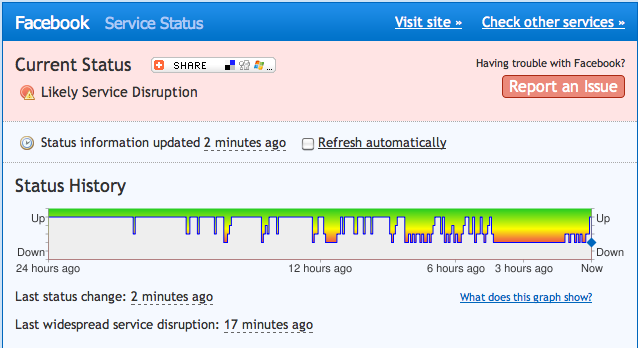
Downtime Hits All Folks, Even Facebook (from Tonight)

Foursquare seems to be in the position to choose their own destiny - to forge ahead as an independent company, flush with cash from a summer VC round, or to court willing suitors at a later date, hopefully at a higher valuation than deals they famously turned down in a public negotiation for control. While two days of shakiness are no doubt unwelcome by the company or its addicted userbase, it seems a rite of passage that the biggest Web services go through in a circuitous route to the top.

Twitter is by far the most famous for continued bouts with downtime, closely tied to scalability issues, and its fail whale mascot is the icon of downtime that all other interruption pages wish to be when they grow up. The company's status blog at http://status.twitter.com/ has actually seen 15 different posts since September 1st, contrasted with only 10 posts from the company's official blog. (http://blog.twitter.com/)

But the blue bird and white whale on a teal background are not the first to document downtime doom. Amazon Web Services promotes a service health dashboard, while Salesforce.com displays a system status at Trust.Salesforce.com. Google provides a status dashboard for Google Apps, with dedicated pages for Blogger status and Feedburner status and others. Even pokey old Web 1.0 dinosaur Hotmail has a status dashboard.

Common to all these services? Previous downtime issues that hit the community hard. Truth is, until there is a major downtime incident, most companies do not offer insight into their status. They may feel like they are teflon, and they can't be taken down, or they simply didn't think about what could happen if something went wrong. It takes a public shakeup that calls the service's stability and viability into question to push for improved system integrity and redundancy, and despite best efforts, some never quite solve the problem.

Back in 2007 and 2008, Technorati was as much known for its Technorat Monster escaping as anything else. This cutesy downtime message foretold the demise of the service, which had to strip out much of its functionality simply to stay up, and was pretty much abandoned by all but a core of users who watched the company evolve its business model and reduce their technical demands. And so far as I know, Technorati never launched a status page. They didn't do what the many other successful companies (above) did when push came to crash. Foursquare, it looks like, is working hard to push this recent event and will come out of this stronger because they are following the proven path - of ownership, late hours, and public transparency.

Tonight may suck for the company's employees, who are taking a public flogging that cans of Red Bull and pizza won't fix. But they should wear the fatigue as a badge of pride. In time, they could look back at this week's events with warm and fuzzy feelings, remembering the outage, which resulted from "too many checkins", as a clear tell they were graduating from Web curiosity to Web titan.