Silicon Valley Technology Commentary & Archives · Est. 2006 3,045 Posts · 2006–2026

January 15, 2011

January 15, 2011 · 3 MIN READ · BY LOUIS GRAY

Wanted: The World's Software Library, by Subscription

Wanted: The World's Software Library, by Subscription

Retail software prices are often eyebrow-raisingly high, and for the most part, inflexible. Every couple years, it's not uncommon for our family to shell out $150 to $500 for the latest Microsoft Office Suite. The full Adobe Creative Suite will set you back almost $2,000, and upgrades are $600. The home edition of Mathematica is about $300. Apple Final Cut Studio will cost you $1,000 and Logic Studio another $500. These prices are no doubt in line with professionals who require the software to live, but for more casual users, who might interact with the software infrequently, paying full retail price seems exorbitant. This sets up a market imbalance, similar to that of the world of music pre-Napster, where the consumer at times can seem justified for obtaining the software freely using another method.

I've previously stated that the vast majority of consumers are solid law-abiding citizens who are happy to pay for quality, assuming price is in line with the assumed value of the goods. When inequality enters the system, be it for full music albums, individual movie theater tickets, software, or even pay per view TV events, technology often comes into play to circumvent the traditional restraints.

Adobe CS Sticker Shock

The disruption of the music industry by Napster's steal what you can model, followed by iTunes' efforts to reign things back again at an affordable price point, has recently evolved further with the subscription-based all you can eat method, one not pioneered by Spotify, but popularized by it, despite years of Rhapsody and Napster (part two), and newer competitors like Rdio offering similar structures. Software, running in parallel, can similarly be downloaded for free on peer to peer networks, and can even be downloaded directly with options like the Mac App Store and Google's Chrome Web Store, but missing is the solution for the casual buyer who just wants to rent the software, occasionally accessing it, without needing to shell out for the boxed retail option, dedicating gigabytes of hard drive space for the privilege, being sure to keep one's serial numbers stored under lock and key.

A new business model, following the Music as a Subscription service, emerges with Software as a Subscription, more commonly referred to as SAAS (Software as a Service). SAAS applications can be enterprise-focused like Salesforce.com, or consumer focused, like Google Docs and Gmail, most of whom see all the activity taking place on the Web via a Web service. But what about the more traditional software titles from Adobe, Microsoft and others? What about an iTunes-like, Spotify-like service where the consumer could pay about $25 to $50 a month and tap into all the popular software titles in the world, reading and writing remotely, but saving locally?

One assumes the major reason this generic software subscription model has not emerged is because the traditional retail software giants can still get buyers at the hundreds of dollars apiece, and they would be less interested in spreading a customer's $500 to $600 across 12 months with other providers. So long as they are raking in the revenue, disrupting their own business isn't appealing.

For consumers with high-speed Web access and relatively powerful CPUs and GPUs, the infrastructure for creating such a software subscription service is there. Toss a few thousand titles on Amazon or iTunes and you can see that with smart cataloging, the ability to use any title in the world would be at your fingertips. Then too would come the next stage of the rollout - including video games and premium offerings with tiered pricings and tiered privileges.

Despite the music industry and other's concerns, Spotify's success is not in the ability for some folks to gain free access with ads, but in the popular and accelerating option for paid accounts, eager to shell out real cash for access to an immense music library. I may scoff at the idea of upgrading my Adobe Creative Suite again for a few hundred bucks, only using it sporadically, but I'd pay a good amount per month, like I do for cable TV, electricity and other plumbing, to gain access to the world's software library. Web-based SAAS for single instance applications is not enough. It's early days. A company that can get all the copyright holders to work together and find a solution to customers would be extremely compelling.

January 12, 2011

January 12, 2011 · 3 MIN READ · BY LOUIS GRAY

Cubeduel Pushes You To Rank Colleagues Hot or Not Style

Cubeduel Pushes You To Rank Colleagues Hot or Not Style

Even if you love your current job or your last job, there's a pretty good chance you had some favorite colleagues, and others who you probably wouldn't mind if they disappeared. You might even have quietly cheered when they were laid off. But most of the time, there's no way for people to know that. Mining your LinkedIn data only shows what companies you worked for and how long. A few more clicks can make it clear who was at the same companies at the same time, and little else. Cubeduel, for reasons unbeknownst to us so far, prompts you to pick who you would work again, one versus another, in a workplace Hot Or Not-like skirmish. Find yourself popular, and your record just might trump that of everyone else.

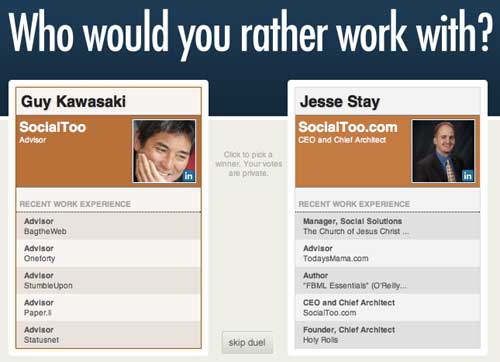
Cubeduel, which taps your LinkedIn database to find your previous colleagues, surfaces two from the same company and puts them up for you to choose - one or another, just like a duel, but one where a coveted seat in the cubicle farm is a reward. If you've lived a pedestrian career, like I have, you may find yourself faced with two differing degrees of mediocrity, or have to choose between two of your best friends, bringing one to the wonderful world of employment, while kicking the other one to the curb with little more than a cardboard sign and black magic marker.

Cubeduel Asks Who Would I Rather Work With? Guy or Jesse?

The site, first mentioned on Twitter by @daveschappell, was started by Tony Wright, the former founder and CEO of YCombinator-backed RescueTime, and Adam Doppelt, cofounder of Urbanspoon. Wright called it a "fun side project" and said it was "growing quite a bit faster" than expected.

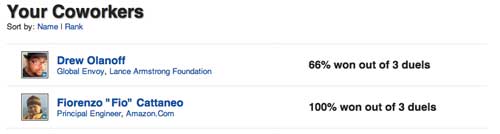
Top Coworkers On Cubeduel So Far...

One Result of A Vote on Cubeduel. Sorry, Ryan...

Anybody familiar with the tried and true model of Hot Or Not can figure out what to do immediately. Two faces come up, and you click who you would rather work with again. The person selected gets 1 vote in their favor, and the other does not. After you have ranked 20 different pairs, you unlock your own rank, assuming people are voting on you, and coworker scores. The game continues after that, begging you to complete 100 matchups, to unlock company specific scores. And who wouldn't want to know how popular one's colleagues ranked against their colleagues, or if you were doing well in the popularity game?

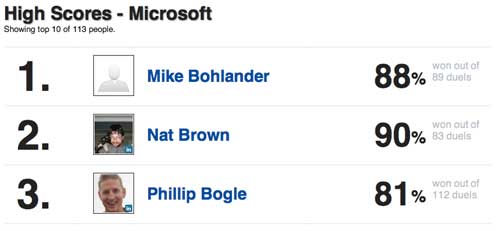
Top Microsoft Employees On Cubeduel

Like Honestly.com, one of the promises of Cubeduel is anonymity. Your colleagues won't know if you picked them or didn't pick them, but leaderboards of the results are public. You can already see how people rank at top companies like Microsoft and Apple, Yahoo! and Google. I'm somewhat pleased to see Phillip Bogle, formerly of Mergelab and Jobster atop the rankings for both Google and Microsoft, given my coverage of him in the past, but I obviously can't swear to his work habits. Maybe his time upon the pile is short lived.

Want to start ranking your former colleagues and push the best folks to the top, and the drones to the bottom? Start a Cubeduel, and go have some fun. It's hiding in public at http://cubeduel.com.
January 12, 2011 · 3 MIN READ · BY LOUIS GRAY

Early Days for Mac App Store, Chrome Web Store

Early Days for Mac App Store, Chrome Web Store

The Chrome Web Store

In 2003, when Apple's iTunes store first went live, there was excitement for a new legal model to purchase our music, but for the most part, as the catalog was extremely thin, my credit card sat idle. While it may have been due to my odd musical preferences, rarely satiated through the radio dial, except for on dedicated shows for Saturday night insomniacs, there just weren't many albums I actually wanted to buy. Practically all my favorite bands were missing. But I believed in the model, and knew that eventually, the contracts would be signed that filled in the gaps. Sure enough, iTunes became a force to be reckoned with and I am almost as assured to find the best stuff in iTunes as I am on Amazon or anywhere else.

We are in a very similar situation now with two of the most recently launched application stores - the Mac App store, focused on desktop software for Mac OS X, and the Chrome Web store for Google's Web browser and parallel OS. Both stores have lofty goals, helping promote their owner's agenda, and both have few recognizable titles. And in both cases, I think consumers are going to largely be sitting on the sidelines as they wait for developers and the business development teams to work their magic.

Top Mac Apps. Think Steve Jobs Likes Solitaire?

With the launch of the Mac App Store, it seemed 90+% of the coverage surrounded two applications - Twitter and Angry Birds. Not coincidentally, those were the two apps I've downloaded so far.

I've peeked at the updated iLife '11 apps, and easily convinced myself the latest feature bumps to iPhoto and iMovie are not worth $30 for me. Similarly, Keynote and Numbers aren't going to set me back $20 each. In fact, despite my understanding that these are replacing retail software titles, after years of staring at the Android Market and iTunes App Store, there's something very much like sticker shock when scrolling through the offerings and seeing prices in the tens of dollars, $30+ and beyond. Aperture is $79, as is Apple Remote Desktop. Kid Pix is $50. and Transmit FTP is more than $30. These are hardly impulse buys.

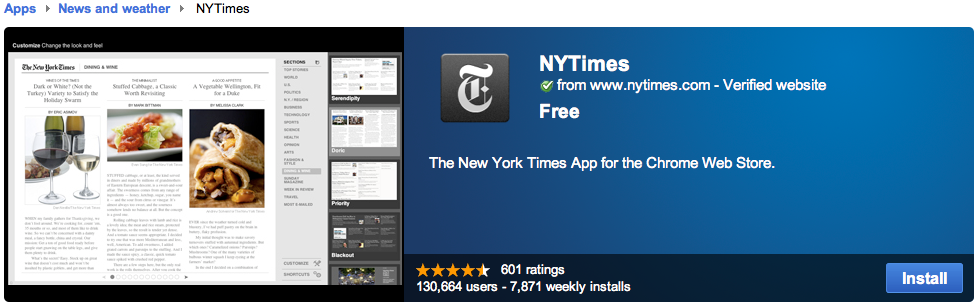
Google's Chrome Web Store isn't scary in terms of dollars. One can do well using the free apps and extensions that target the browser/OS, so long as one isn't expecting top brands to be represented. The Web Store looks a lot like iTunes, but the big guys aren't there. New York Times and TweetDeck are practically exceptions, as it seems developers are taking a slow approach to the store, waiting for users to demand dedicated apps. Sales for top applications number in the low thousands, including staff picks, which have pushed user downloads to about 4,000 a week, in some cases.

The Great Chrome Version of the New York Times

The tempting thing is to say that these two approaches are not the home runs their corporate overlords had expected. But it's smarter to wait and see what happens as the developers follow the users. It's hard to go first, and users who are early adopters of both sites should be patient. If iTunes is any guide, the stores will both fill out and in due time, all the best stuff will be discoverable. Even the Android Market, once barren, doesn't need to highlight its total app count any more. Enough is enough.

I've been waiting for a Mac App Store for years, and found the promise of the Chrome Web store to be among the most exciting opportunities launched in 2010. Both are the right direction for their respective companies - with Apple trying to leverage its iTunes expertise on the robust Mac platform, and Google trying to keep folks in the cloud and in their browser. If it's hard to find great apps on either site, it's worth being patient. They've got to be coming, and users are going to reap the benefits.

January 11, 2011

January 11, 2011 · 2 MIN READ · BY LOUIS GRAY

LunchTree Hits Bay Area for Random Geek Connections

LunchTree Hits Bay Area for Random Geek Connections

Geeks working on startups are notorious for not getting out much. Slaving in front of computer terminals at odd hours, the option of lunch often takes on a familiar routine - the same locations, the same people... even the meals themselves become things of habit. With projects taking precedence over casual connections, it's not unsurprising some startup addicts gain a feeling of isolation. A new gambit called LunchTree, targeting the Bay Area startup community, is hoping to put a dent in this, helping people meet with similar interests over one meal a week, on Tuesdays. That's it - with no confusion of dating services, or anything similar. The idea? Potential for new perspectives through new connections.

The setup for LunchTree is quite simple. Create a profile (here's mine), set up criteria for the type of connection you would like to meet for lunch, and then set a lunch zone. When you have picked a lunch zone, list one or more preferred restaurant, and then, come Tuesday, you have the option to meet a fellow geek for lunch.

Who Do You Want to Go to Lunch With?

If your lunch match options overlap with another person, then early Tuesday morning, your registered phone with LunchTree will get an SMS message at 10:30 on Tuesday asking if you are free to share a mid-day meal. If the answer is affirmative, text back "Join". Then you will be matched with another LunchTree user at a nearby eating place that works for you both.

A Profile on LunchTree

Lunch History on LunchTree


The founder, Jesse Spaulding, first hit our radar way back in early 2008 with his project BlogRize, a platform aimed to help blogs grow their communities. While that site didn't hit the big time, his focus on growing a community never wavered. While the community at LunchTree is quite small now, having just launched, one can easily see the value of casual connections between similar minded folks in the real world over something as simple as lunch. And lest folks get concerned that this is a back-door approach to create yet another dating site, you can specify you only want to meet members of the same gender, and you can't select the reverse. Good luck, lunchtime Lotharios.

If you are in the Bay Area, and you think random meals with similarly-minded folks in your community would add benefit to your life, you should check out LunchTree. You never know if your next connection could end up being a great partner, cofounder, or even a VC.